

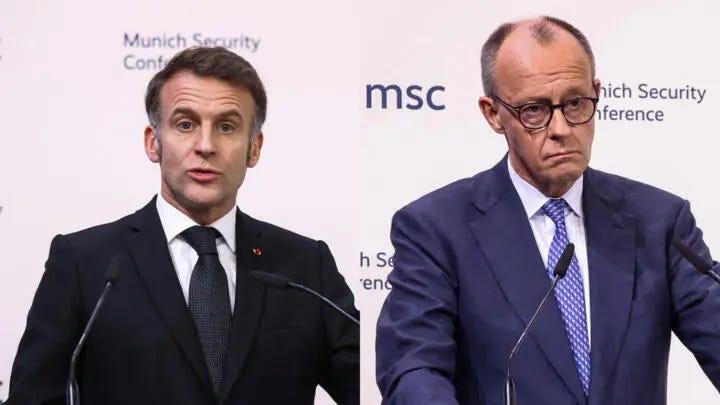
Germany and France have asked the European Commission for a new trade weapon: the power to impose sweeping countermeasures, up to an immediate cut-off from the single market, against any country whose subsidies, dumping or currency practices threaten European industry, and to do so unless a qualified majority of member states votes to stop it. The letter names no country. Nobody in Brussels or Beijing is pretending it is about anyone but China.
For Europeans living in China the letter lands close to home. Many of them are here precisely because German carmakers, French luxury houses and Dutch chip-tool makers decided decades ago that this market was worth the trouble, and the proposal from Friedrich Merz and Emmanuel Macron is, at bottom, a bet that Europe can afford to threaten that relationship. The two leaders sent it to Commission President Ursula von der Leyen on Monday, days before the EU’s trade commissioner was due in Beijing for talks, and it follows three new investigations into Chinese chemicals and a goods deficit with China that reached roughly 360 billion euros last year. What makes it news is Germany. Berlin has long been the brake on Brussels’ China hawks because its companies sell so much here; now the chancellor is standing next to the French president asking for a weapon the French have wanted for years.
The question of what this means for China-EU trade quickly became a popular thread on Zhihu, the question-and-answer site where China’s professional class argues about the world, and the mood there is not alarm. It is something closer to the weary diagnosis of a doctor watching a patient light another cigarette.
The most-read analysis comes from a commenter in the tech industry writing as 飞跃本屯, who treats the proposal as a European copy of America’s Section 301, the 1974 statute that lets the United States executive impose tariffs without waiting for Congress. The mechanism Merz and Macron want, a measure that takes effect unless a supermajority of governments blocks it, is designed to stop a single capital such as Bratislava from holding up action, and 飞跃本屯 concedes it looks sensible on paper. His objection is that it serves politicians and punishes factories. Manufacturing, he argues, runs on long-horizon bets that need stable rules. A company that builds a car plant in Europe on the assumption that half its components will be imported suddenly finds those components tariffed and must choose between raising prices and eating the loss. Companies without the connections to see such moves coming suffer most. For a politician, by contrast, a sudden tariff is cheap theatre: it rewards a union in an election year and looks like effort, where patient industrial policy looks like nothing at all. He points to the United States, which he says used 301 ever more freely after 1988 while its manufacturing kept leaving, though that is his reading of a contested history.
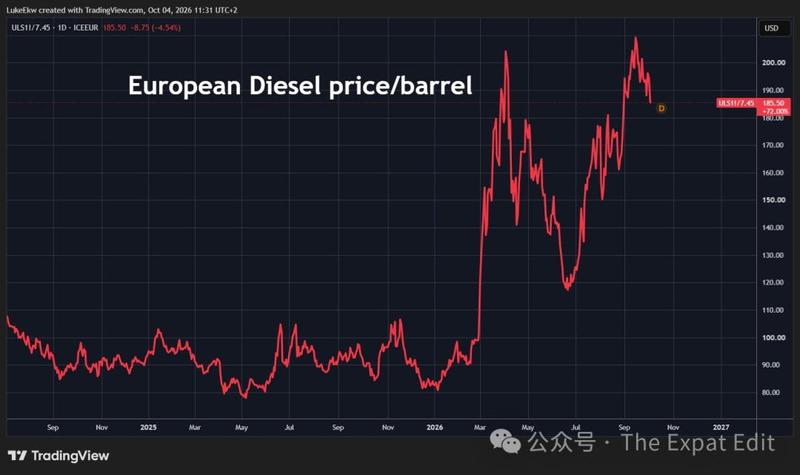
A second strand of the thread is about energy, and it is where the frustration shows. A commenter posting as gkn cnyz, who identifies as a supporter of Ukraine and so is not the usual suspect, opened with a chart of European diesel prices that he says now stand at around 186 dollars a barrel, roughly double where they sat two years ago. He then listed what he sees as Europe’s self-inflicted wounds: the closure of some 30 refineries since 2009, sanctions on Russian crude, support for Ukrainian strikes on Russian refineries that prompted Moscow to halt diesel exports, sanctions on Iran, the fallout from conflict in the Middle East, and a looming American restriction on fuel exports. A trade war with China, he concluded, would simply add to Europe’s own inflation. Several of those claims are his and have not been checked by us, and the chart is a trader’s screenshot rather than an official series, but the argument captures a view that recurs across the thread: that Europe keeps choosing the painful option and then blaming the pain on someone else.
“Why does the EU keep passing policies of economic suicide?”
The more surprising voice on the thread turns the criticism inward. A commenter known as 王者归来 noted that Brussels had warned in early September that China must offer a satisfactory settlement by October or face American-style tariffs, and that the deadline has come and gone with the Europeans still dithering, which he reads as thunder without rain. But he uses the moment to argue that China’s export model has reached the point where it has to change. An iPhone shipped from Shenzhen to Hamburg shows up in the statistics as eight or nine thousand yuan of Chinese surplus, he writes, while perhaps five percent of that value stays in China. Western politicians who demand that China buy back the full sticker price are, in his view, asking China to answer for profits that accrue in Cupertino. His prescription is one Beijing itself has been pushing: build Chinese brands that keep the margins at home. He cites shoes and apparel, where foreign labels decamped to Vietnam the moment Chinese wages rose while domestic brands kept their lines in China, and argues the same logic must now apply to screens, memory and processors. The only durable way to lift consumption, he adds, is to lift incomes. Everything else is a gimmick.
Then there is the camp that does not believe anything will happen at all. One commenter dismissed the letter as two leaders near the end of their terms trying to leave a legacy and to stack bargaining chips before negotiations. German carmakers, he noted, cannot function without Chinese supply chains, and France depends on China in solar and pharmaceuticals; talk of decoupling in that context is a story for voters, not a plan. It is a view that will sound familiar to anyone who has sat in a Shanghai boardroom while a European headquarters issued a stern memo about de-risking and then approved the next China investment.
What the thread largely skips is the mechanics, and the mechanics matter. The letter asks for an instrument that does not yet exist. It would have to be drafted by the Commission, survive the European Parliament and the member states, and be written as country-agnostic law, which means it could in principle be pointed at Washington as readily as at Beijing. European officials have described it mainly as a deterrent, a weapon so large that the threat alone brings trading partners to the table. Whether it ever gets built is a question for next year. The signal, though, was sent this week, and the signal is that Germany has stopped being the country that says no.
For a European running a business in China, the practical reading from both sides of the thread is the same: nothing will change quickly, the two economies remain tangled in ways no letter can undo, and the people most likely to pay for a trade war are the ones who buy diesel and cars rather than the ones who sign communiqués. The Chinese commenters are betting that Europe will blink before it cuts. The letter is Berlin and Paris asking for the option to prove them wrong.
Read the original Zhihu thread: https://www.zhihu.com/question/2090751605838815361
Curated and translated from Zhihu, China's largest Q&A platform.
Newsletter
Subscribe to The Expat Edit
Chinese perspectives on global events, wars, and great power competition. Curated from Zhihu.
Free. No spam. View on Substack →