
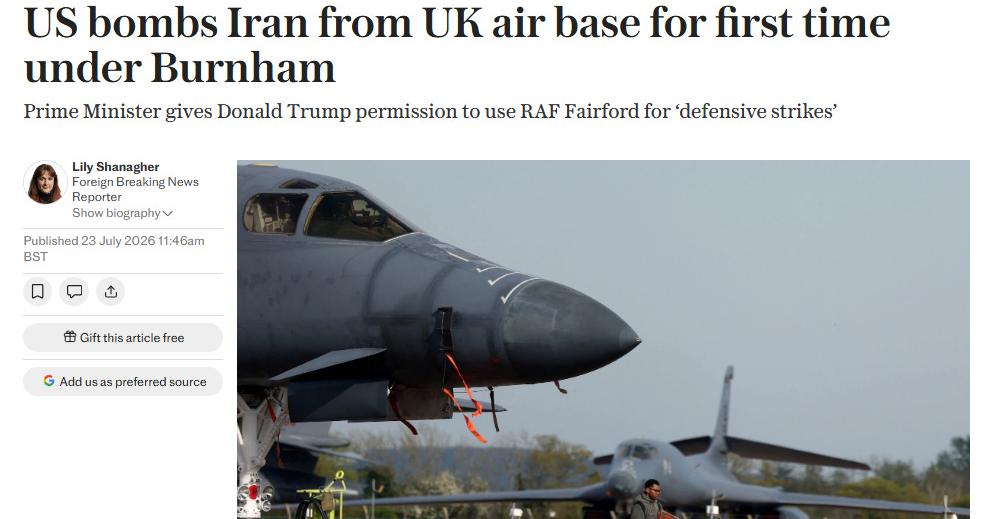
There is a familiar ritual in Western wars. Governments insist they are not truly participants. They are merely helping, supporting, or “standing with.” Language is used to place distance between an action and its consequences, between a runway and the bombs launched from it, between political decisions and the retaliation those decisions invite.
But wars are not governed by euphemism. They are governed by materiel and logistics. And by that standard, Britain has entered the war.
If British territory is being used to support American strikes on Iran, then the distinction between involvement and noninvolvement has collapsed. Tehran is not obliged to adopt London’s preferred vocabulary. It is not required to accept that offensive operations become “defensive” merely because British officials say so. Once bases, aircraft, and infrastructure are made available to one side of a conflict, those assets become part of the conflict. That is not a matter of rhetoric. It is the basic logic of war.
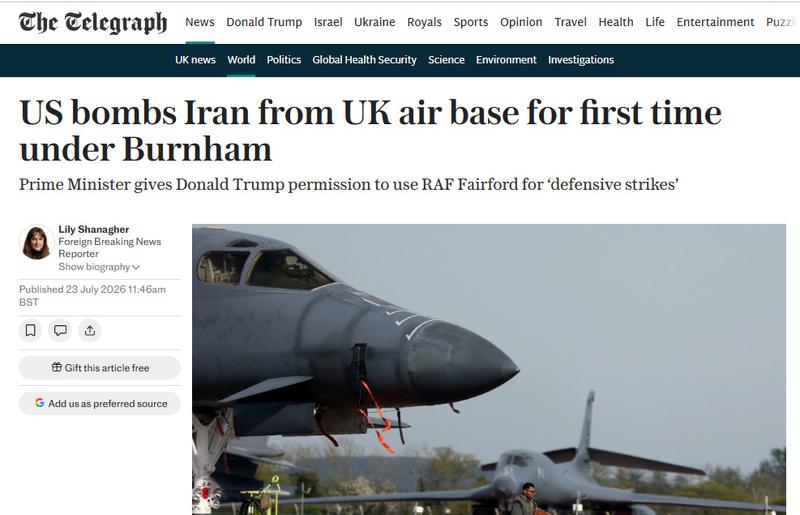
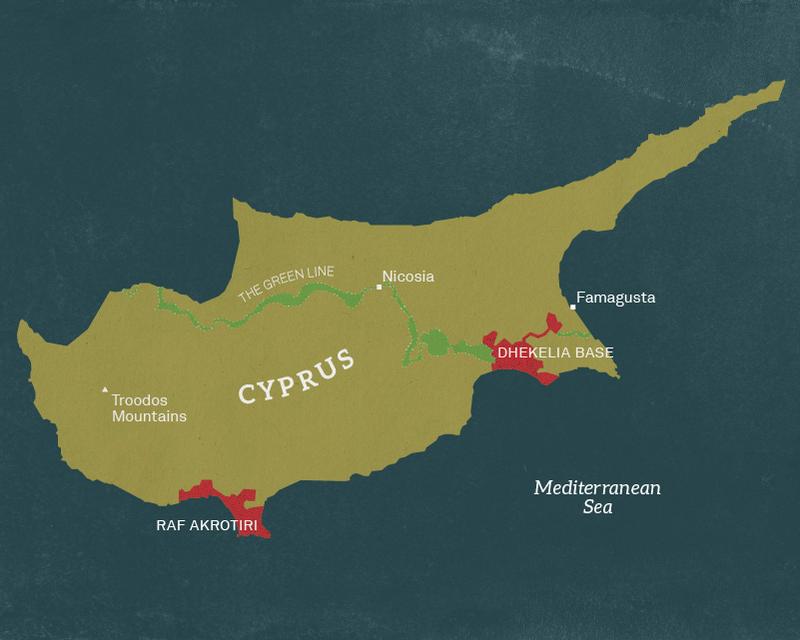
This is why the most consequential question may no longer be what Washington intends to do next, but what Iran might do in response to Britain’s role. And if Iran chooses to retaliate against British assets, Cyprus stands out as the most plausible flashpoint.
The island has long occupied an ambiguous place in the British political mind. It is geographically close enough to the Middle East to be useful and far enough from the British mainland to seem abstract. In peacetime, that arrangement allows policymakers to project force without forcing the British public to dwell too much on the mechanics of intervention. In wartime, it creates a vulnerability that can no longer be ignored.
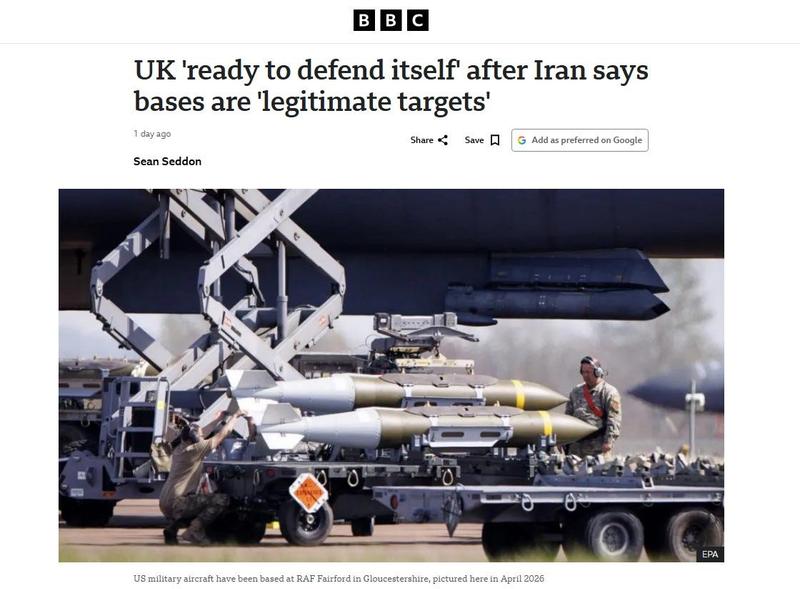
Iran has already made clear how it views states that allow their territory to be used as a staging ground for attacks. The principle is not new. If a country facilitates strikes, that country assumes risk. For the Gulf monarchies, this is no longer a matter of theory. Iran has already hit targets across the region and shown how exposed these states are when their territory is used in support of war. Britain now appears to be entering that same equation, while pretending it has somehow escaped the consequences.
It has not.
There is a tendency in London and Washington to assume that escalation remains a matter of choice for the West alone. The United States can move bombers, reposition tankers, strike targets, and redefine the mission after the fact. Allies can assist while claiming legal or moral insulation. Retaliation, in this view, is treated as either irrational or unlikely. But that assumption is false. Adversaries do not experience Western actions as calibrated signals. They experience them as attacks, and they respond accordingly.
That is especially true in a war where Iran is confronting not a limited tactical challenge, but a broader campaign aimed at coercion, degradation, and possibly regime collapse. Under those conditions, restraint has limits. A state that believes its survival is at stake does not indefinitely tolerate the use of nearby bases to strike it.
Cyprus is within the realm of practical retaliation. Iran does not need the capacity to strike Britain directly to impose a cost on Britain. It only needs to target what Britain uses in the theater of war. In strategic terms, that is enough. It would send the message that there is no free support role in a regional war, no costless hosting arrangement, no legal fiction capable of shielding a combatant from the status of combatant.
The implications would be immediate and severe.
For Britain, a strike on Cyprus would shatter the idea that this war can be managed at arm’s length. It would force the government to explain to the public why British-controlled facilities had become targets. It would also expose the semantic fragility of official statements that seek to classify participation as mere defense. The average citizen may tolerate distant military involvement when it appears bloodless, technical, and controlled. That tolerance weakens quickly when retaliation arrives on territory associated with Britain itself.
For Europe more broadly, such a strike would mark an alarming geographic expansion of the war. Cyprus is not simply a remote outpost. It is a point where Europe, the eastern Mediterranean, and the Middle East blur into one another. An attack there would make plain that the conflict is no longer containable within the usual mental boundaries Western publics draw around foreign war. It would become harder to tell voters that this is happening somewhere else.
And yet it is worth asking what Britain could realistically do in response. That question is not raised often enough. Much commentary still assumes that any Iranian attack on British assets would trigger a straightforward show of force from London. But Britain’s actual military options are more limited than its rhetoric suggests. It can offer basing, intelligence, diplomatic cover, and niche support. It can contribute aircraft and naval assets in selective ways. What it cannot do, at least not at scale or without American direction, is independently alter the course of such a war.
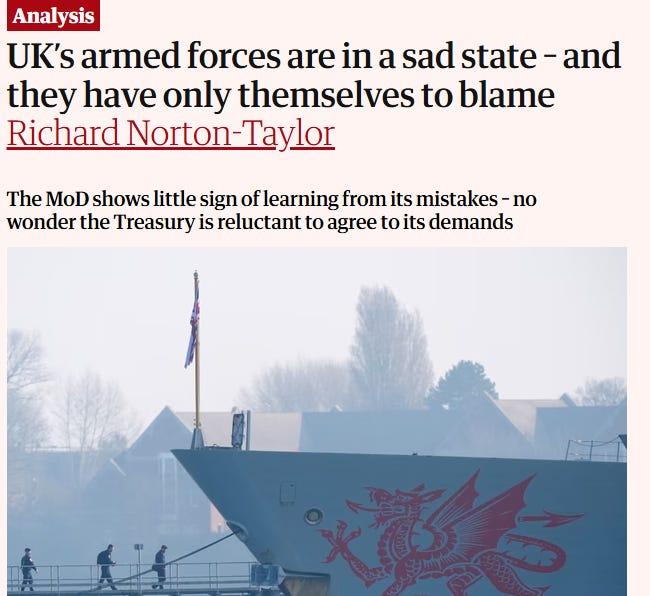
This matters because deterrence depends not just on anger, but on credible capacity. If Tehran concludes that Britain’s operational role is meaningful enough to justify retaliation, but Britain’s ability to escalate independently is limited, then the risk calculus changes. A strike on Cyprus may appear dangerous, but manageable. Particularly if Iranian planners believe that London is already functionally subordinate to Washington’s choices and lacks the autonomy to widen the war on its own terms.
That point carries a deeper political sting. One of the most striking features of the present crisis is how clearly it exposes the narrow autonomy of America’s allies. Britain likes to speak as a sovereign strategic actor. In moments like this, it looks more like an accessory to American power and, by extension, to a wider war agenda that it did not clearly design and cannot clearly control. The result is a peculiar form of dependency: enough involvement to become a target, not enough independence to shape the war decisively.
That is a dangerous middle ground.
It invites the liabilities of war without the authority that should accompany them. It asks the public to bear the risks of escalation while obscuring who actually set the course. It allows the language of alliance to replace the language of accountability.
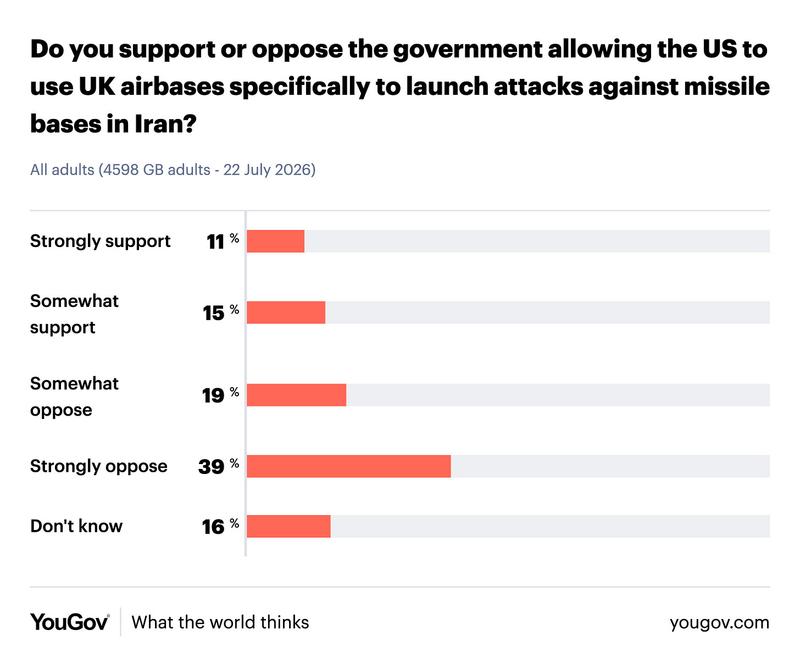
There is also the question of public reaction. Polling across Europe has shown limited appetite for wider war in the Middle East. Britain is not immune to that reality. If Cyprus were struck, the initial reflex in some quarters would undoubtedly be outrage. Parts of the political class and media would present retaliation as proof of Iranian barbarism and as justification for deeper involvement. But another reaction is just as plausible, perhaps more so: a sharp backlash against the decision to entangle Britain in a war the public neither wanted nor approved.
That would not be an irrational response. It would be a democratic one. Citizens are entitled to ask why their country was made a party to a conflict through basing arrangements and military cooperation that were then rhetorically disguised. They are entitled to ask why “defense” now seems to require assuming offensive risk. And they are entitled to ask whether Britain’s leaders have confused alliance management with national interest.
The larger danger is that policymakers may still believe they can preserve ambiguity. They cannot. Iran has already signaled that it regards logistical support for attacks as participation in attacks. If London continues to act as though formal declarations matter more than operational facts, it will be preparing the public poorly for what may come next.
Wars often widen through this kind of self-deception. A government treats a form of support as something less than belligerency. The other side does not. Retaliation follows. Political leaders express shock at consequences that were entirely predictable. Then comes the demand for a firm response, as if escalation were a moral necessity rather than the result of previous choices.
Cyprus is important not because conflict there is inevitable, but because it reveals how close Britain may already be to the line it insists it has not crossed. In practical terms, that line is gone. The only remaining question is whether Tehran decides to act on that reality.
If it does, Britain will discover that the privilege of participating in war rhetorically but not materially does not exist. Once your bases help launch the strikes, your bases can be struck in return.
Listen to CATR on:
Newsletter
Subscribe to Conversations Among the Ruins
Long-form geopolitics and the decline of the unipolar world order. New episodes straight to your inbox.
Free. No spam. View on Substack →
Reader-funded
This is independent, long-form work.
Conversations Among the Ruins is written, not repackaged, and it stays free because readers choose to fund it. If it is worth your time, a paid subscription or a one-off tip keeps it going.
Become a supporter →