

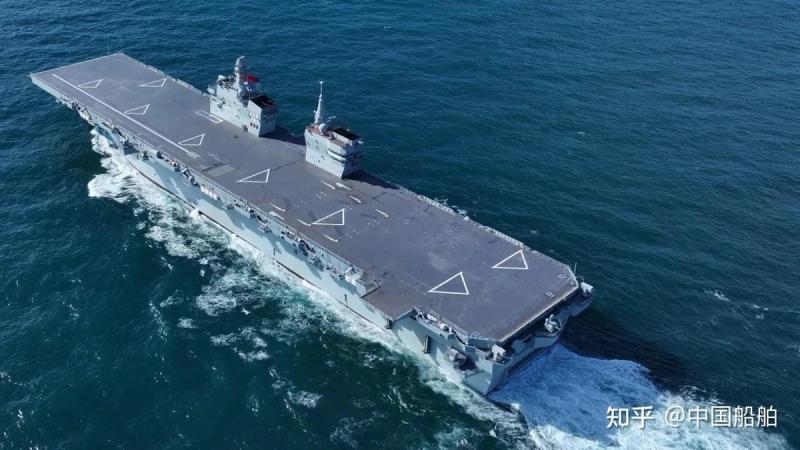
In late October, China’s navy launched and recovered a stealth combat drone, the GJ-21, from the deck of the Sichuan, the first of its Type 076 amphibious assault ships. The ship used an electromagnetic catapult and arresting wires to do it, equipment that until now existed only on full-size aircraft carriers. The announcement was carried by Xinhua on October 30. The ship is still in sea trials and is expected to join the fleet in 2027. Once it does, China will operate the only warship on earth that can land marines on a beach while launching stealth jets to clear the way for them.
Landing an aircraft on a ship is the hardest thing a navy does with an airplane. Doing it with no pilot aboard is harder. Doing it with a tailless flying wing, an aircraft shaped like a boomerang that computers have to coax through every second of flight, is something only one country had managed before this month, and that country gave up on it. The United States landed its X-47B drone on a carrier in 2013, declared victory, and quietly cancelled the program. China’s navy has now done the same thing from a ship that is not even supposed to be an aircraft carrier, and it took two years of sea trials to get there.
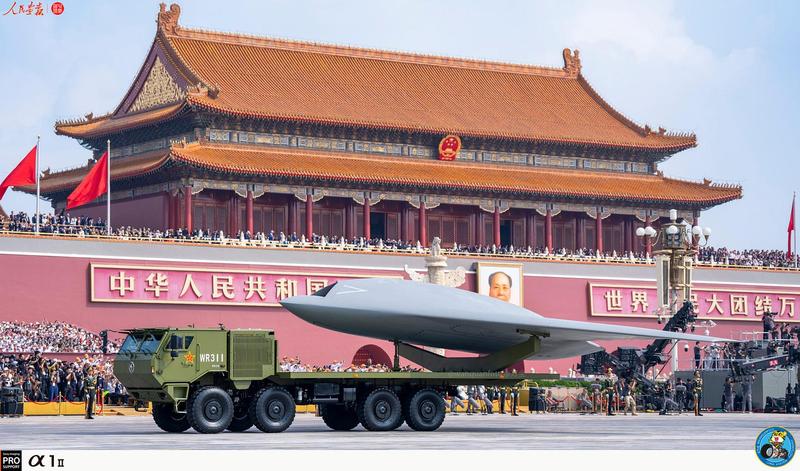
The aircraft is the GJ-21, a navalized version of the GJ-11 flying wing the air force has paraded since 2019, with folding wings and a tail hook added for life at sea. The ship is the Sichuan, hull number 51, which was launched at the end of 2024, began trials in November 2025 and has been working through them since. On paper it is an amphibious assault ship: a vessel for marines, helicopters and landing craft. In practice it is about 263 meters long, displaces more than 40,000 tons fully loaded, and carries an electromagnetic catapult, which no amphibious ship anywhere has ever had. To understand why that combination should worry other navies, it helps to understand what the catapult is for.
Every other amphibious ship in the world has a flat deck and no catapult. That limits them to helicopters and to jump-jets like the American F-35B, which take off short and land vertically. Jump-jets pay for that trick in fuel and weapons: they fly shorter distances carrying less than their catapult-launched cousins, and they need a pilot. A catapult removes the limit. It can hurl a heavy, fuel-laden, fully armed aircraft off a short deck, and because the GJ-21 has no cockpit, every kilogram that would have gone to keeping a human alive goes to fuel, sensors and bombs instead. The Sichuan can do with a stealth drone what the biggest American amphibious ships can only do with a manned fighter, and it can afford to lose the drone.
That is the whole idea, as China’s military enthusiasts explained it on Zhihu, the question-and-answer site where the country’s amateur analysts gather, in a thread that topped the site’s hot list this week. The most-recommended answer, from a commenter writing as 阿槇二号机, pointed out that the GJ-11 has already flown in formation with the J-20 stealth fighter and the J-16D electronic-warfare jet. The naval version, he argued, is therefore a wingman and a node in a network rather than a lone scout: it goes in first, finds the enemy radar, and either strikes it or draws its fire so that crewed aircraft do not have to. A longer answer from a commenter called 点评校尉 used a blunter phrase. The drone’s job, he wrote, is to kick in the door.
Picture how an amphibious landing works under those rules. The hardest part of any landing is the first hour, when the defender’s radars, missile batteries and command posts are all intact and every helicopter full of marines is a target. Today the only way to suppress those defenses from an amphibious ship is to send jump-jets, which are expensive, limited in range and flown by people. The Sichuan’s answer is to launch a flight of stealth drones hours earlier. They are hard to see, they fly far, and they can orbit over the coast looking for targets in a way no pilot could sustain. If one is shot down, the navy has lost an airframe, not an aviator, and a drone that comes back can be refueled and sent again, which makes it cheaper per strike than a cruise missile. Only when the radars are dark do the helicopters launch. A commenter writing as 南瓜君 summarized the doctrine with a phrase borrowed from American naval planning, distributed maritime operations, in which many smaller networked platforms share the work that used to belong to a few giant carriers. He also asked readers to respect the Sichuan’s new unofficial title, the Deputy Carrier.
The advantage over everyone else is not that China has a better drone. It is that China has a ship built around one. The United States Navy’s carrier drone, the MQ-25, is a tanker. Its amphibious ships rely on the F-35B. Britain, Japan, Italy and Spain field jump-jet decks with the same limits. No navy has a vessel that can catapult a stealth strike aircraft and also carry landing craft in its belly, and no navy will have one soon, because the catapult is the hard part: it is an electromagnetic system of the kind only China and the United States have ever put on a ship, and the Sichuan’s is a direct-current design that commenters argued is more reliable than the one on America’s newest carriers. That claim comes from the thread, not from any test data, but the broader point stands. For the next several years the Sichuan will be in a category of one.
“The drone’s job is to kick in the door, soaking up the defenders’ fire so that manned fighters don’t have to.”
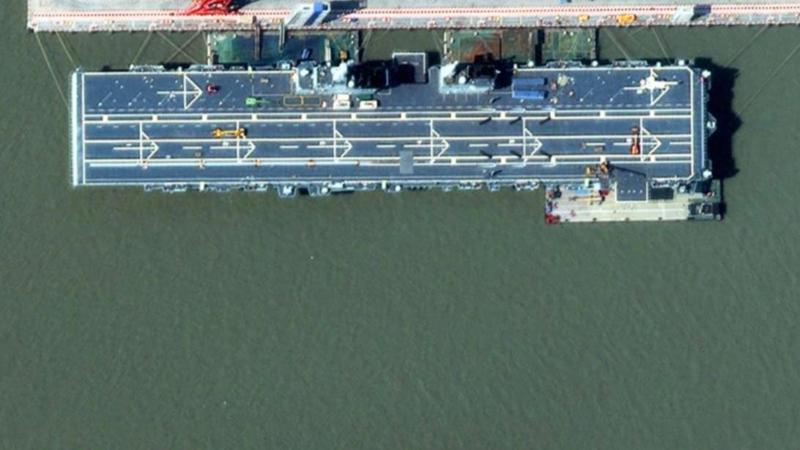
Here it is worth separating what the navy has confirmed from what its fans have filled in. Confirmed: the catapult works at sea, the automatic landing system works at sea, and a folding-wing stealth drone can live aboard. Not confirmed: that the GJ-21 is stealthier than the F-35B, which is an inference from its shape; that it carries long-range PL-15 or PL-16 air-to-air missiles, which comes from a concept animation at an air show; that its strike radius is 1,500 kilometers, which is one commenter’s estimate; and that the ship holds eight of them, which commenters derived by counting the parking spots painted on the deck in a satellite photograph. None of this is implausible. All of it is still a guess, and the navy has yet to release a single frame of video of the landing, a running complaint on the thread.
There are real limits, too. A drone is only as useful as the network behind it, and a stealth aircraft that cannot talk to the satellites, radar planes and ships feeding it targets is a very expensive glider. The Sichuan is one hull, still in trials, with a crew still learning it. And the United States is not standing still on unmanned systems; it simply chose, a decade ago, to put its carrier drone money into tankers rather than strike aircraft, a decision that the Sichuan test will make harder to defend in Washington.
The commenter who asked everyone to respect the Deputy Carrier ended on a quieter note. The Sichuan, he wrote, is designed to fight inside a system, with carriers and submarines and satellites, and it does not need to be everything at once. It needs to put drones in the air and marines on a beach. The test this month showed it can do the first. Everyone with a navy should assume the second will follow.
Curated and translated from Zhihu, China's largest Q&A platform.
Newsletter
Subscribe to The Expat Edit
Chinese perspectives on global events, wars, and great power competition. Curated from Zhihu.
Free. No spam. View on Substack →