

Two weeks ago, on a drop zone near Fort Bragg, a chaplain from the 20th Engineer Brigade consecrated a patch of North Carolina soil. Then the bulldozers went to work. Engineers from the 27th Engineer Battalion dug a trench fifteen feet wide, laid out burial bags stuffed with plastic skeletons and sealed water jugs, and pushed the dirt back in, timing themselves as they went. The Army calls this Operation Dragon Covenant. Its purpose, in the service’s own words, was to test and validate “large-scale battlefield temporary interment.” In plain English, the United States Army is practicing how to dig mass graves for its own soldiers, and it is practicing because it expects to need them.
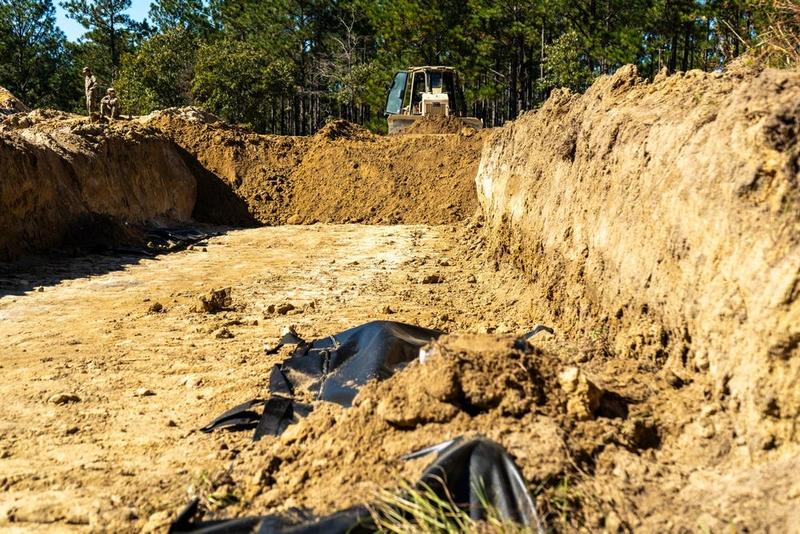
The numbers the Army released are precise in the way that only military planners can be precise about death. A standard interment plot is five parallel trenches holding one hundred bodies. With D6 bulldozers, a crew can now open and close a trench for twenty remains in an hour and fifteen minutes. From that, commanders can plan on a single engineer company burying up to 2,400 bodies every twenty-four hours if it works around the clock. The soldiers also discovered that the old doctrine, written when the last mass graves were dug in Korea, left only seven feet between rows, too narrow for a modern dozer to pass without crushing the trench beside it. That will be fixed in the next edition. A third phase is scheduled for the spring, adding security, medical facilities and a mortuary collection point.
The Army has not done this at scale since the 1950s. For two decades in Iraq and Afghanistan, American air superiority meant that a fallen soldier could be flown home within days, through orderly mortuary channels, to a flag-draped ceremony at Dover. The release explains, with a candor that ought to alarm anyone paying attention, that future conflicts may not offer that luxury. The senior fatality management sergeant put it more bluntly: if we went to war tomorrow, we would be making this up as we went along.
The Pentagon will say the timing is coincidence, that this is routine preparation for large-scale combat operations against a peer adversary, that it has nothing to do with the war the administration is openly preparing to resume against Iran. Perhaps. But the exercise was held in late October, at the moment the White House was weighing a return to kinetic operations, and the lesson the Army took from Iraq and Afghanistan is the lesson that matters. Mass graves become necessary when you cannot fly the dead out. You cannot fly the dead out when you do not own the sky. And the one theater where American forces have recently, humiliatingly, discovered that they do not own the sky is the Persian Gulf.
That is the part of this story the public has been slowest to absorb, because it was deliberately hidden. During the forty days of the first war, the military worked hard to conceal the extent of the damage to its bases in the region. Satellite photographs offered hints. Then came the reporting. The New York Times found that most of the bases had been rendered uninhabitable. Reuters described troops hiding in vans in the desert and in an underground parking garage while base commanders scrambled without a plan. The Wall Street Journal has now published a detailed investigation, with photographs, that confirms the scale of the destruction. American service members, for the first time since the Second World War, have tasted outright defeat on their own installations, and they tasted it from an adversary whose precision, speed and targeting improved over the course of the fighting while American and Israeli capabilities degraded.

Read more
Listen to CATR on:
Newsletter
Subscribe to Conversations Among the Ruins
Long-form geopolitics and the decline of the unipolar world order. New episodes straight to your inbox.
Free. No spam. View on Substack →
Reader-funded
This is independent, long-form work.
Conversations Among the Ruins is written, not repackaged, and it stays free because readers choose to fund it. If it is worth your time, a paid subscription or a one-off tip keeps it going.
Become a supporter →