
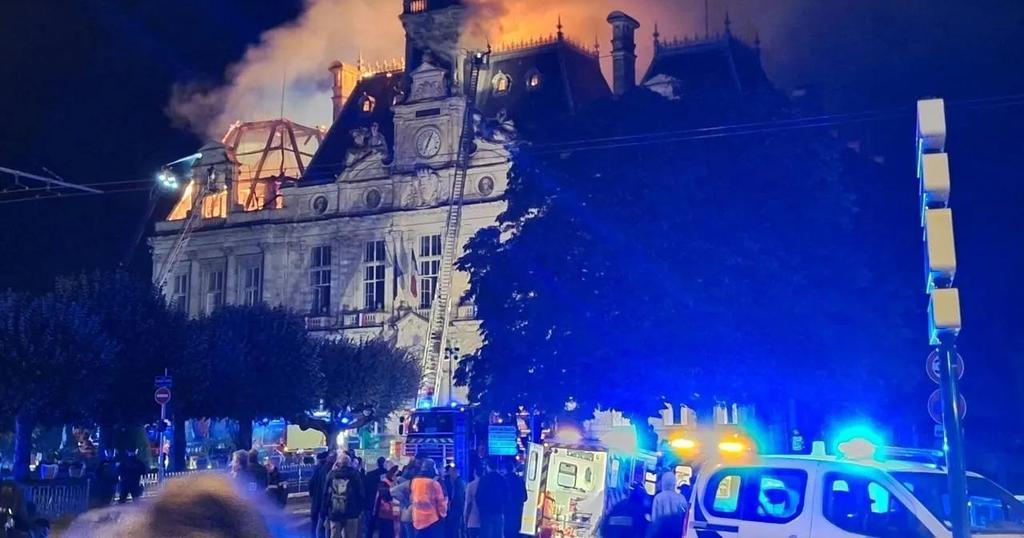
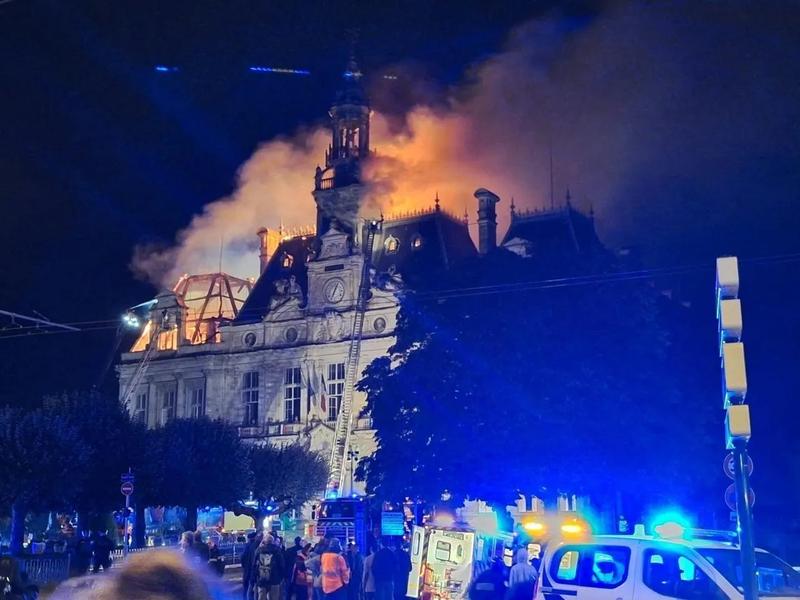
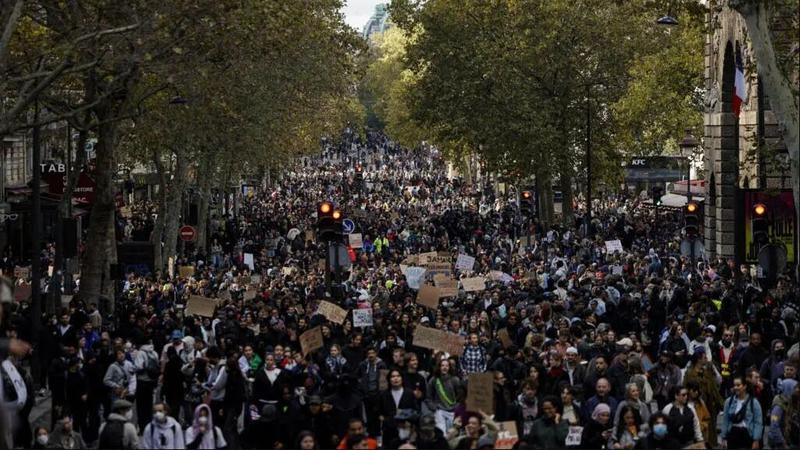
On Saturday, somewhere between half a million and 800,000 people marched across France against the cost of living. By nightfall, Limoges’ historic city hall was in flames, boutiques on the Champs-Élysées had been looted, Lyon’s tourist office had been torched, and some 1,200 people were in custody, with more than 150 police officers hurt. By Sunday morning, the official counts had climbed higher still.
The day had been billed as the return of the gilets jaunes, the yellow-vest roundabout movement of 2018, with its old figureheads calling people onto the streets over fuel, rent and frozen benefits in a tight 2027 budget. Unions and the hard left signed on. The vast majority walked peacefully, down the boulevards of Paris and through the centres of Lyon, Marseille, Toulouse and Lille. Then, as the light went, the black-clad groups French television calls casseurs peeled off. In Limoges, masked men set a municipal police car alight outside the hôtel de ville, broke the windows and started a fire on the ground floor. Firefighters held it for roughly an hour before the roof went; the regional prefect called the loss a catastrophe for heritage. President Emmanuel Macron said France would tolerate no violence. Prime Minister Sébastien Lecornu said nobody would impose an agenda by force.
By the time Paris was sweeping up its glass, the question “why now?” had reached the top of Zhihu, China’s answer-and-argument platform, and drawn hundreds of replies overnight. The diagnoses say as much about how China thinks as about what happened in France.
The most upvoted answer was not political at all. It was a memory. A commenter who had lived and dated in Paris described the arithmetic of an ordinary young Parisian: around 2,000 euros a month after tax, 20 to 30 euros for a meal out, 3 or 4 for a coffee, a metro fare that resets every time you change systems, and a cramped, dim old flat with no air conditioning for most of what’s left. Outside, meanwhile, the world’s wealthy fly in to shop on the avenue Montaigne. Locals in Zara, driving battered Citroëns, watch them do it. Paris, the commenter wrote, has started to feel like India, a city of the very rich and the very poor, and unlike Tokyo or Shanghai, where ordinary people still live decently even though the gap at the top is huge. Pushed open the door of one date’s apartment, and it was like stepping into a rat’s nest. Fled.
The word that recurs through the thread is fenpei, distribution, the Chinese shorthand for who gets what share of the economy, and the lens through which much of the Chinese internet reads every crisis, foreign or domestic. In this telling, France has a boomer generation dancing by the Seine on generous pensions while a younger generation with no prospects loots the Champs-Élysées. Commenters pointed, without much sourcing, to education cuts in the new budget set against money France sends to Brussels and its share of the EU’s loan to Ukraine. Several assumed the presidential election next spring now goes to Marine Le Pen or Jean-Luc Mélenchon, and one asked whether a president polling at 10 percent was running France or a small country in Eastern Europe.
The sharpest rebuttal came from a commenter posting as 哄哄, who argued the distribution crowd had it backwards: France’s problem isn’t how the cake is cut, it’s that the cake is shrinking. Citing the OECD’s wage-tax tables, they noted a single French worker keeps about 53 percent of gross pay and standard VAT runs at 20 percent, so there is no more to squeeze from ordinary people. Squeeze the rich and they leave: 18 of France’s 60 wealthiest, by the commenter’s reading of a Senate disclosure, already pay tax abroad, and roughly 800 millionaires left in 2025. Manufacturing is about 9 percent of GDP, the lowest in the EU; in the first half of last year, they wrote, 44 factories opened and 82 closed. Carving a shrinking cake more artfully, the post concluded, is still just decoration. Two exits remain: grow the cake, or reduce the number of people eating it. America, at least, has a stock market to pump in energy. France has what?
“Even a fool knows the problem is distribution. The question is whether there’s anything left to distribute.”
Other readings competed. A commenter posting as 飞跃本屯 offered a two-crowds theory: an organised left with concrete demands that mostly marches and chants, and a separate population of small-time hooligans from neighbourhoods the state has effectively given up on, for whom, they argued, the welfare system rewards instability over a steady job. One answer explained the night through China’s own dynastic-cycle folk theory, in which every regime’s troubles begin with an empty treasury, and oil prices were simply the spark. Another reached for the plots of Chinese short-video dramas: France as the generous sap who funded everyone’s lifestyle out of its old colonial networks and cultural prestige, until the money stopped and the beneficiaries turned on each other. Immigration and religion were discussed too, in terms blunter than this account can carry, with one long post arguing that French comfort was built on money extracted from francophone Africa and that the bill had come due. Those are netizens’ claims, not reporting.
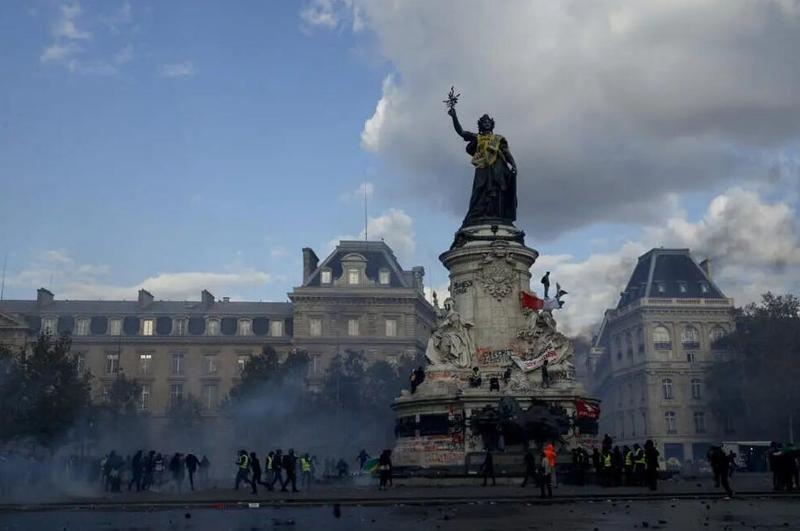
Some of what circulated on Zhihu runs ahead of the record. One widely shared account claimed police had thrown grenades at student protesters earlier in the month and arrested 6,000 of them; we could not verify either figure. What is on the record is grim enough. A teenager lost a hand after picking up a stun grenade, the police watchdog is examining at least two dozen complaints of excessive force, and one protester died north of Paris of cardiac arrest. On Sunday the mayors of Paris, Lyon and Marseille were summoned to meet the prime minister, having complained that the government’s policing plan had left their cities exposed.
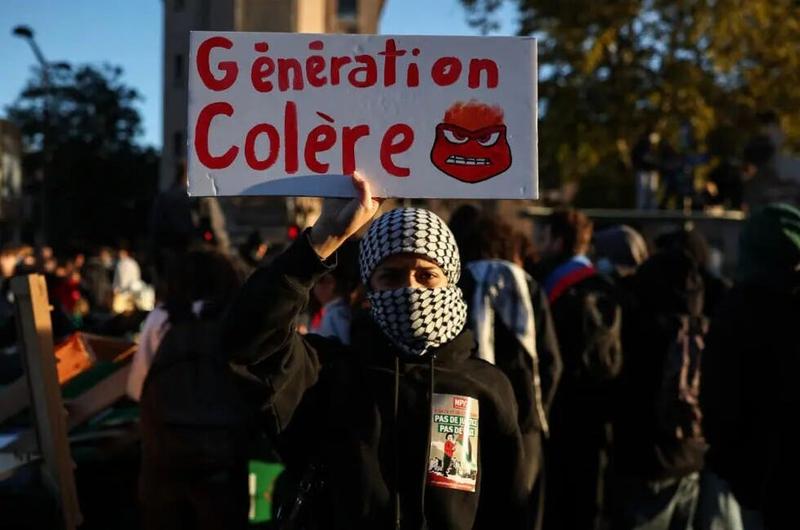
The thread’s consensus, if it has one, is bleak: deindustrialised, overcommitted, politically stuck, no good move left for Macron, whether he sends in the army, sits down to negotiate or waits. But the most quietly revealing answer came from someone who had merely visited. Chinese people like to think of themselves as the world’s great endurers, the commenter wrote, but the French have put up with a median wage of 2,100 euros, an 11-euro Big Mac meal and rent that eats half a paycheque for years before this. If China is in the middle stages of its own distribution problem, they went on, then France is in the late stages, and the French have been remarkably patient about it. The posters at the Place de la République did not read like patience. One said, simply, that everything was fine except everything.
Read the original Zhihu thread: https://www.zhihu.com/question/2095109263622238854
Curated and translated from Zhihu, China's largest Q&A platform.
Newsletter
Subscribe to The Expat Edit
Chinese perspectives on global events, wars, and great power competition. Curated from Zhihu.
Free. No spam. View on Substack →