


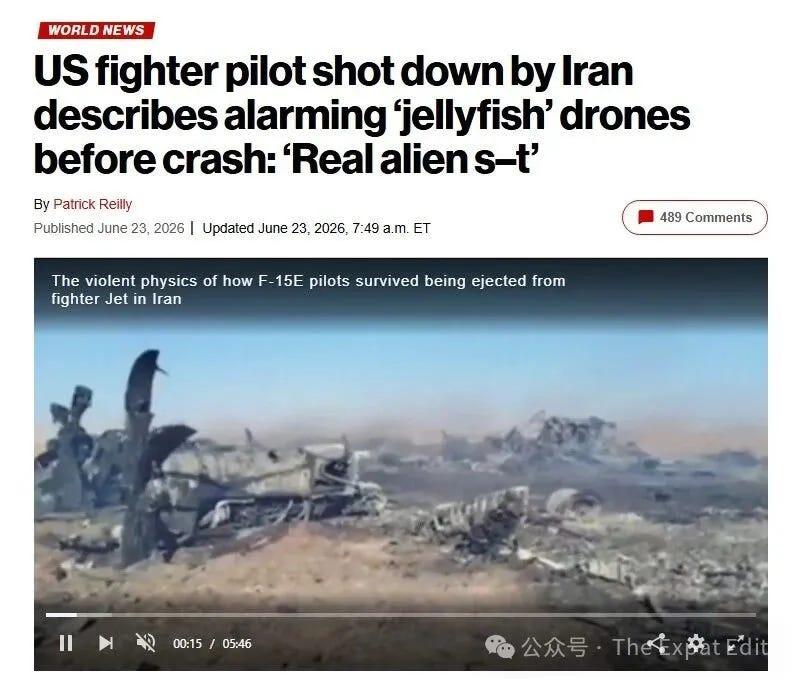
A downed US F-15 pilot reportedly told intelligence officers he saw Iranian drones moving in a strange “jellyfish” formation, with smaller drones hanging beneath larger ones “like legs.” His verdict was blunt: “Real alien s--t.” The quote exploded across Zhihu and WeChat almost instantly. But behind the sci-fi wording is a more grounded question: did Iran really unveil a shocking new drone capability, or are people getting carried away by one dramatic battlefield description?
What the Pilot Actually Claimed
Thanks for reading Silk & Steel! Subscribe for free to receive new posts and support my work.
According to US media reports, the pilot described a swarm of interconnected drones acting like a single airborne organism. That image quickly became the whole story. “Jellyfish drones” is catchy, cinematic, and tailor-made for the internet. But so far, there is still no public video or photo that confirms exactly what he saw in the sky.
That matters. A pilot who has just survived a shootdown is not exactly delivering a lab report. He may have seen a real coordinated drone formation. He may also have exaggerated what was in front of him while under extreme stress. The more careful takeaway is not that Iran has unveiled literal alien hardware, but that American analysts appear to be taking the report seriously enough to investigate.
Why This Story Hit a Nerve
The phrase “alien” did most of the work here. In plain English, the pilot was almost certainly not saying he saw extraterrestrials. He was saying the formation looked bizarre and unlike anything he expected in combat. Chinese netizens understood that immediately, then did what Chinese netizens do best: they turned it into a bigger conversation about modern warfare, American assumptions, and whether Iran has become far more capable than the West likes to admit.
A lot of Zhihu discussion focused on a simple point. Western commentary often treats Iran as a producer of cheap, noisy one-way drones and little else. If Iran can now field even a partially networked, coordinated swarm that mixes decoys, jamming, and strike platforms, then the problem is not that the drones look weird. The problem is that they may be effective.
“The scary part is not whether the formation looked like a jellyfish. It is whether the swarm could think and react like one.”
So How Advanced Is Iran, Really?
Iran’s drone industry did not emerge from comfort. It emerged from sanctions, isolation, and necessity. Locked out of many conventional arms markets, Tehran poured resources into things it could actually build and scale: ballistic missiles, proxy warfare tools, and unmanned systems. Over time, that produced a very large drone ecosystem ranging from surveillance craft to loitering munitions and longer-range strike drones.
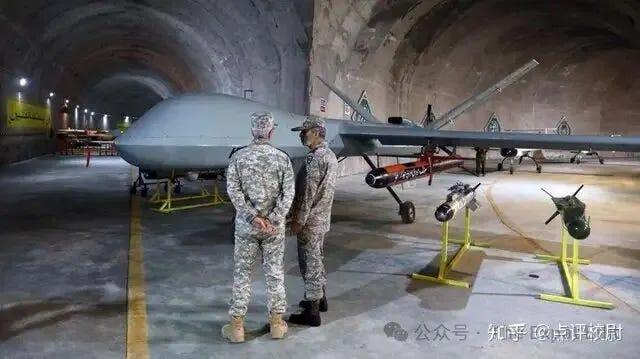
The best-known example is the Shahed family. These are not glamorous machines. They are relatively cheap, slow, and hardly stealthy. But they are good enough, long-range enough, and affordable enough to create ugly cost asymmetries. If your interceptor missile costs vastly more than the drone it is trying to kill, you can “win” tactically while still losing economically.
That is why Iran’s drone level should not be dismissed as primitive. It may not match the most advanced drone powers across every category, but it has become highly competent in the area that matters most in modern conflict: building systems that are cheap, scalable, and difficult to counter at acceptable cost.
The Bigger Point Behind the Hype
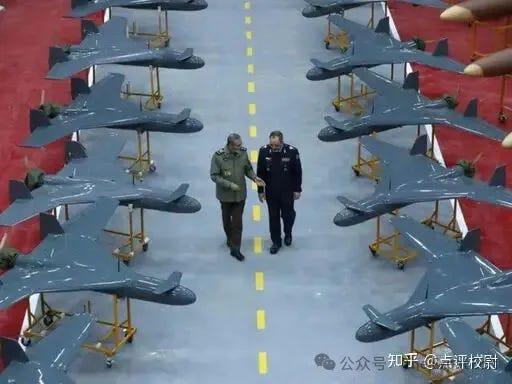
Even if the “jellyfish” account is overstated, the broader direction is clear. Drone warfare is moving away from single platforms and toward cooperation between many platforms. Some confuse this with science fiction. It is actually closer to what people already see in civilian drone light shows, just adapted for reconnaissance, jamming, baiting air defenses, and strike coordination.
In other words, Iran does not need magic technology to unsettle a pilot. It only needs a swarm that is organized, networked enough to share tasks, and cheap enough to use in quantity. That alone is enough to make older assumptions about air superiority look shakier than they used to.

The viral quote made this story famous. But the real issue is much less theatrical. Iran’s drone program appears to be evolving from “cheap nuisance” to “coordinated systems problem.” For any military facing that shift, the unsettling part is not what the drones look like. It is how expensive they are to stop.
Thanks for reading Silk & Steel! Subscribe for free to receive new posts and support my work.
Curated and translated from Zhihu, China's largest Q&A platform.
Newsletter
Subscribe to The Expat Edit
Chinese perspectives on global events, wars, and great power competition. Curated from Zhihu.
Free. No spam. View on Substack →