
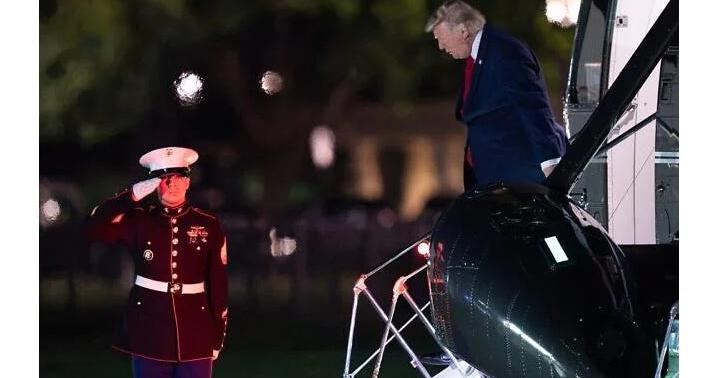
An important debate among geopolitical analysts has centered on whether Iran, sensing weakness in Washington, might overplay its hand. That is the wrong question. The better question is what kind of victory Iran should now seek.
A narrow answer would focus on immediate gains. Tehran could seek some combination of unfrozen assets, a loosening of sanctions pressure, limits on American military activity in the region, and recognition of its leverage over the Strait of Hormuz. Those are tangible objectives. They matter. Any state acting rationally would seek to convert battlefield or strategic advantage into durable concessions.
But there is also a larger possibility, one that is less often stated plainly. Iran’s greatest strategic opportunity may not lie in humiliating the United States. It may lie in driving a political wedge between the United States and Israel.
That split would not take the form of open rupture—at least, not at first. No American administration is likely to declare a dramatic break with Israel. The alliance is too entrenched, too institutionalized, too protected by decades of political consensus. But alliances do not have to collapse in public to weaken in substance. They can erode through blame, strategic divergence, and mounting domestic resentment over costs that no longer seem defensible.
That process is already underway.
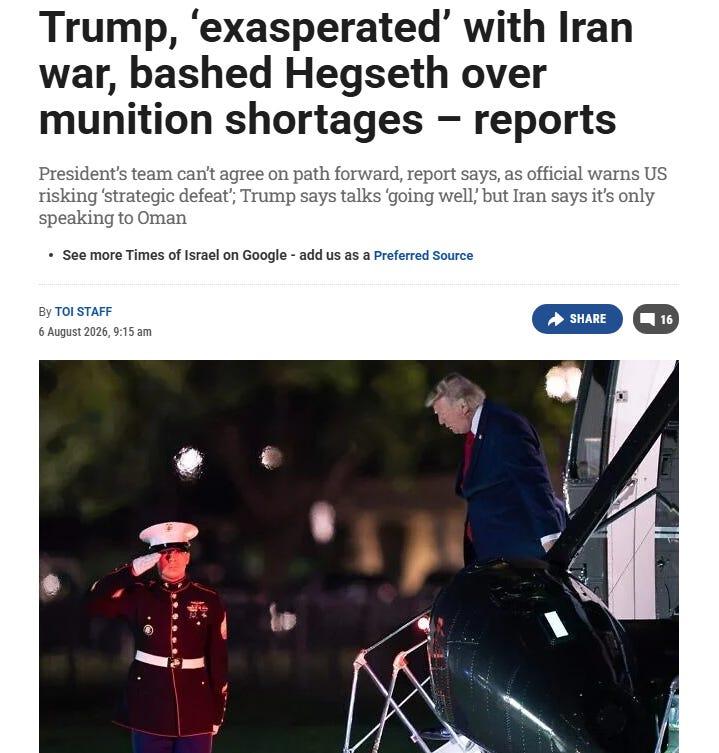
The basic tension is straightforward. Israel and the United States do not always want the same thing, even if political rhetoric insists otherwise. Israel has long sought war with Iran, seeing Tehran as the principal obstacle to full regional freedom of action. For much of Washington, by contrast, the priority is more cautious and more practical. It is about maintaining dollar primacy, limiting economic disruption, and avoiding another open-ended military entanglement.
Until recently, the conflict between Israeli and American interests vis-à-vis Iran has been largely kept behind closed doors. Now, it is bursting out into the open.
The more Israel seeks escalation, the more it forces the United States to absorb the consequences. Those consequences are no longer abstract. They include higher energy costs, depleted munitions stockpiles, greater regional instability, and a rising sense among Americans that they are being dragged into conflicts they did not choose and from which they derive no clear benefit.
This is where Iran’s strategy could become more sophisticated than simple retaliation.
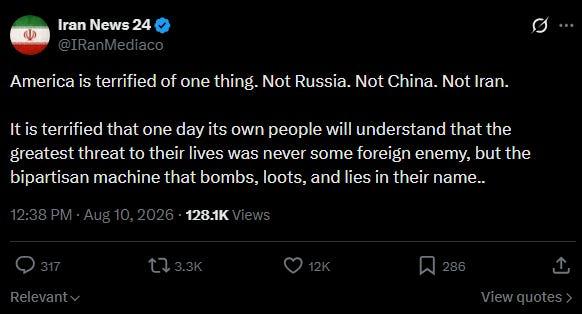
Rather than treating the United States and Israel as a single undifferentiated adversary, Tehran could exploit the growing mismatch between them. It could do so by making any de-escalation with Washington contingent not only on immediate bilateral concessions, but on visible pressure being brought to bear on Israel. That pressure could include demands for restraint in Lebanon, an end to the destruction in Gaza, limits on unilateral Israeli military escalation, and a broader recognition that the unresolved Palestinian question is not peripheral to regional instability but central to it.
To many in Washington, such demands would seem excessive. To many in Tehran, that is precisely the point.
There is a familiar and reasonable argument in foreign policy that victorious states should be cautious, moderate, and realistic. In general, this is wise. But when the defeated state is the United States, this sensible approach no longer applies. In practice, the United States reads moderation as weakness. States that lower their demands in hopes of earning a more reasonable American response discover that conciliation invites more pressure, not less. This has been the bitter experience of both Iran and Russia.
If Iran settles only for tactical relief, it may win a reprieve. It will not have altered the deeper structure of the conflict. That structure is rooted in the political and strategic centrality of Israel to American regional policy. As long as that remains untouched, any temporary arrangement risks becoming just that: temporary.
The argument for a broader strategy is not merely ideological. It is, above all, practical. If Tehran seeks only sanctions relief or the unfreezing of assets, Washington may comply in part while preserving the larger alignment that made confrontation inevitable in the first place. If, however, Iran forces the United States to confront the costs of Israel’s regional agenda, then something more consequential begins to happen. The conflict ceases to be a simple contest between Washington and Tehran. It becomes a political contest inside the American system itself.
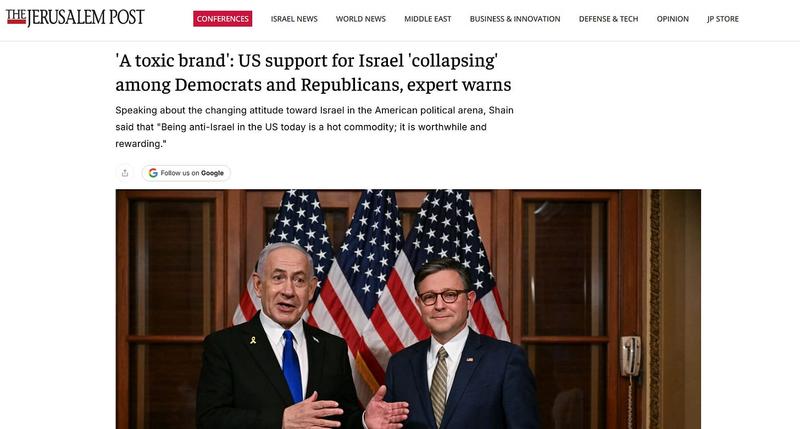
There are already signs of strain. Across the American political spectrum, the old reflexes are weakening. The moral and strategic costs of unconditional support for Israel are more openly discussed than at any point in recent memory. Even within traditionally hawkish circles, there is visible frustration with the way Israeli actions repeatedly complicate American diplomacy and expose American interests to risks that Washington itself would prefer to avoid.
This does not amount to a realignment. Not yet. But it does mark the beginning of one.
The key to that change is not persuasion so much as pressure. Political systems rarely reconsider entrenched assumptions until those assumptions become expensive. In this case, the expense is becoming harder to ignore. By driving a hard bargain on Israel, Iran will shine a bright light on that expense, making it impossible to ignore.
That is why the next phase of this confrontation may be decided less by bombs than by blame.
If the costs continue to rise, someone in Washington will have to answer for them. If Israel refuses to make concessions in Palestine and Lebanon while America bears the consequences, then the logic of the alliance will come under greater scrutiny. The resulting argument may not begin in moral clarity. It may begin in anger, recrimination, and political self-preservation. That is often how strategic shifts begin.
Iran’s advantage is that it does not need to defeat the United States militarily to accelerate this process. It needs only to make clear that there is no stable return to the old order. No cheap victory. No symbolic strike that restores credibility. No arrangement in which Washington indulges Israeli escalation while insulating itself from the consequences.
In that sense, the most effective Iranian strategy may be the one least expected in Washington. It would aim not simply to end a war, but to rearrange the politics that made the war possible.
This would be a long game, one which would carry risks. Israel, if cornered, is unlikely to respond with calm. American leaders, even when frustrated with Israel, remain constrained by domestic politics and institutional habit. The path from strategic strain to political rupture is neither linear nor guaranteed.
Yet the possibility is now visible in a way it was not before.
A generation ago, the idea that pressure on Israel could become a serious feature of American politics would have seemed fanciful. Today it no longer does. The old consensus has not disappeared, but it is no longer unchallenged. Every regional crisis that exposes the divergence between Israeli ambitions and American interests weakens it a little more.
Tehran should understand the significance of that shift. Its most important task is not merely to survive the present confrontation. It is to shape what follows, and the surest way to do that is not to chase a theatrical victory over the United States. Rather, it is to deepen the contradiction between American interests and Israeli ambitions until Washington is forced, however reluctantly, to make the necessary and logical choice to put its own interests first.
Listen to CATR on:
Newsletter
Subscribe to Conversations Among the Ruins
Long-form geopolitics and the decline of the unipolar world order. New episodes straight to your inbox.
Free. No spam. View on Substack →
Reader-funded
This is independent, long-form work.
Conversations Among the Ruins is written, not repackaged, and it stays free because readers choose to fund it. If it is worth your time, a paid subscription or a one-off tip keeps it going.
Become a supporter →