

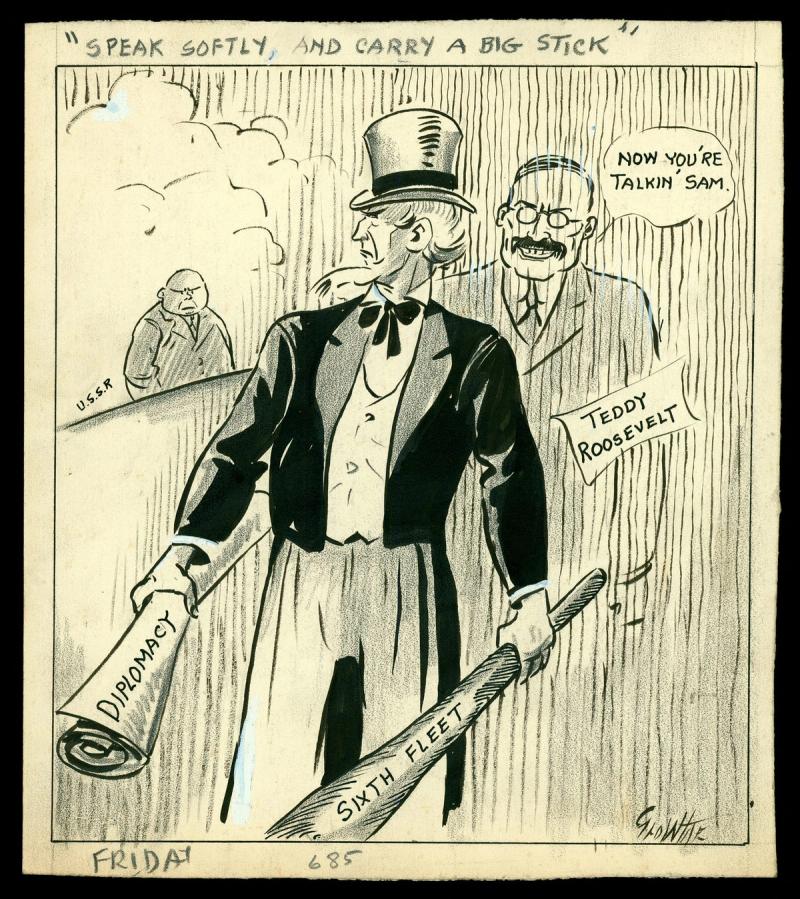
Theodore Roosevelt’s advice to presidents was six words long: speak softly and carry a big stick. The idea was that a country with real power does not need to announce it, and that quiet confidence backed by capacity is what makes adversaries careful. Donald Trump has spent the war on Iran running the formula in reverse. He speaks as loudly as any president in history, and the stick, on inspection, is not there.
Start with the record. In the first forty days of the war, the threats were followed by action. Since then, the pattern has been threat, pause, retreat. Most recently, by multiple accounts, American bombers sat on the runway with ordnance being strapped beneath the wings when the entire operation was called off. Cooler heads got through to the president, which is fortunate, but it is also the third or fourth time cooler heads have had to. A threat that is walked back once is a bluff called. A threat walked back repeatedly is a habit, and every government in the world has now catalogued it.
Then take inventory of what the United States can actually do to Iran. A ground invasion is off the table; there is no force sized for it and no appetite for it. The stockpile of standoff munitions, the cruise missiles and precision weapons that let the Air Force strike from a distance, has been drawn down over months of war and cannot be replenished on any schedule that matters. Regional air defense has been stretched thin. Bases in the Gulf have been struck. The fleet cannot operate close to the Persian Gulf without accepting losses it does not want to explain. This is not a dissident’s reading. It is the consensus of essentially every serious analyst watching the conflict, and it is the reason the president’s threats land as noise rather than as deterrence.

Which brings us to the sentence he delivered at the United Nations, the promise to annihilate Iran and its future generations. Strip the theatrics away and ask a practical question: how? Not with a ground army. Not with a depleted arsenal. Not with a navy that stays out of range. There is exactly one weapon in the American inventory that makes “annihilation” literal, and every delegation in that hall did the arithmetic before he finished the paragraph. Whether the nuclear option is actually forming in the president’s mind, no one outside his circle can know. But logic does not care about his intentions. If the threat is sincere, the bomb is the only means, and if it is not sincere, it is one more bluff on a pile that has stopped impressing anyone.
Read more
Listen to CATR on:
Newsletter
Subscribe to Conversations Among the Ruins
Long-form geopolitics and the decline of the unipolar world order. New episodes straight to your inbox.
Free. No spam. View on Substack →
Reader-funded
This is independent, long-form work.
Conversations Among the Ruins is written, not repackaged, and it stays free because readers choose to fund it. If it is worth your time, a paid subscription or a one-off tip keeps it going.
Become a supporter →