
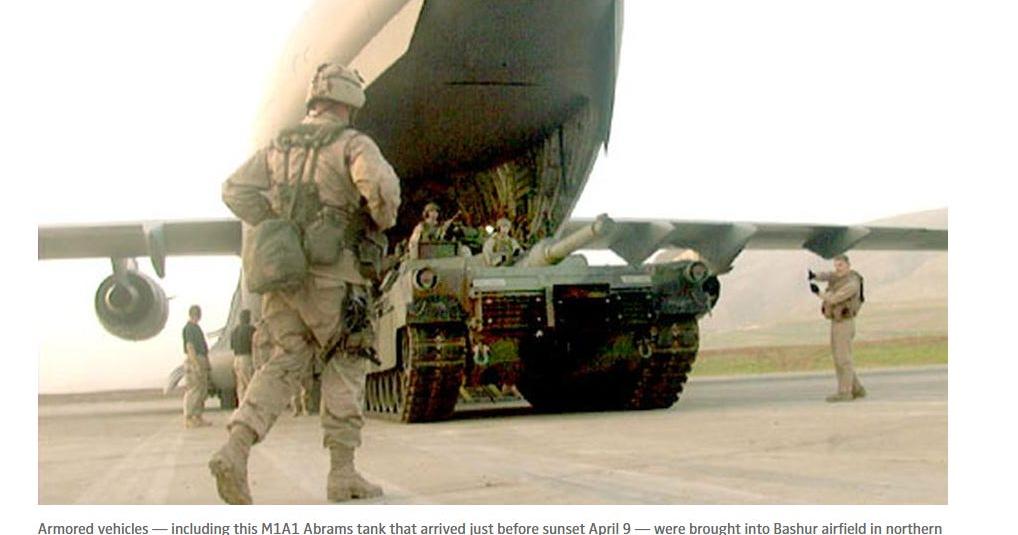
For much of the post-Cold War era, American military dominance rested on a simple operational assumption: if the United States chose to fight, it would own the sky.
That assumption shaped nearly everything. It informed procurement, doctrine, alliance structures, and the wider political culture of American power. A country that could establish air superiority quickly and then exploit it at will possessed a decisive military advantage. Once hostile air defenses were neutralized, American aircraft could roam overhead, strike deeply, provide persistent surveillance, and dismantle enemy infrastructure with a degree of freedom few states could hope to match.
This was not merely a battlefield advantage. It became a habit of mind.
From Iraq to the Balkans to Libya, the United States fought wars in which control of the air was treated not as a hard-won and fragile condition, but as the opening act. Air supremacy was expected, not contested. It was the foundation on which the rest of the campaign would be built.
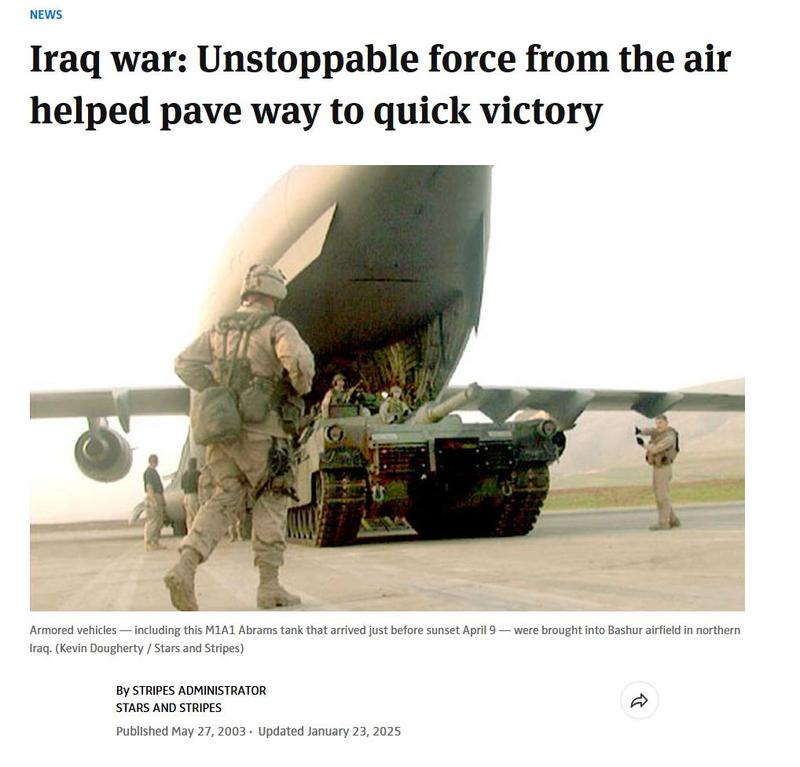
That era has ended.
The clearest evidence did not come first from Iran, but from Ukraine. Early in the war, many analysts assumed Russia’s larger and more advanced air force would dominate Ukrainian skies. It did not. Instead, one of the most important military lessons of the conflict was that even a powerful air force now faces severe constraints when operating against layered air defenses. Russia retained major advantages in aircraft, missiles, and strike capacity, but in general it did not fly freely into Ukrainian airspace. It adapted by relying more heavily on standoff weapons, glide bombs, and ground-to-ground missiles launched from safe distances.
That adaptation was telling. It revealed a central fact of modern war: a formidable air force can be denied the freedom of action that once defined supremacy.
The same lesson is now visible in the confrontation with Iran.
American and Israeli officials have repeatedly spoken in the language of dominance. At various points, they have implied that Iranian airspace has been effectively mastered and that hostile defenses have been reduced to marginal importance. Yet the pattern of operations suggests something more limited and more cautious.
If the United States and Israel truly possessed uncontested command of the skies, their aircraft would fly repeatedly and deeply into Iranian airspace. They would strike targets across the country with manned aircraft operating at relative freedom. They would rely less on expensive standoff munitions launched from safer distances and less on vulnerable attack drones. In a permissive environment, a superior air force does not merely hit targets. It inhabits the airspace.
That is not what is happening.
Strikes have tended to concentrate in western and southern Iran, where geography shortens the exposure window and permits attacks from more favorable angles. Footage released from operations generally comes not from fighter cockpits ranging freely over Iranian territory, but from drones. The reliance on long-range precision weapons is especially revealing. Standoff munitions can inflict substantial damage, but they are not evidence of true aerial mastery. In many cases, they are evidence that airspace remains too dangerous to enter with confidence.
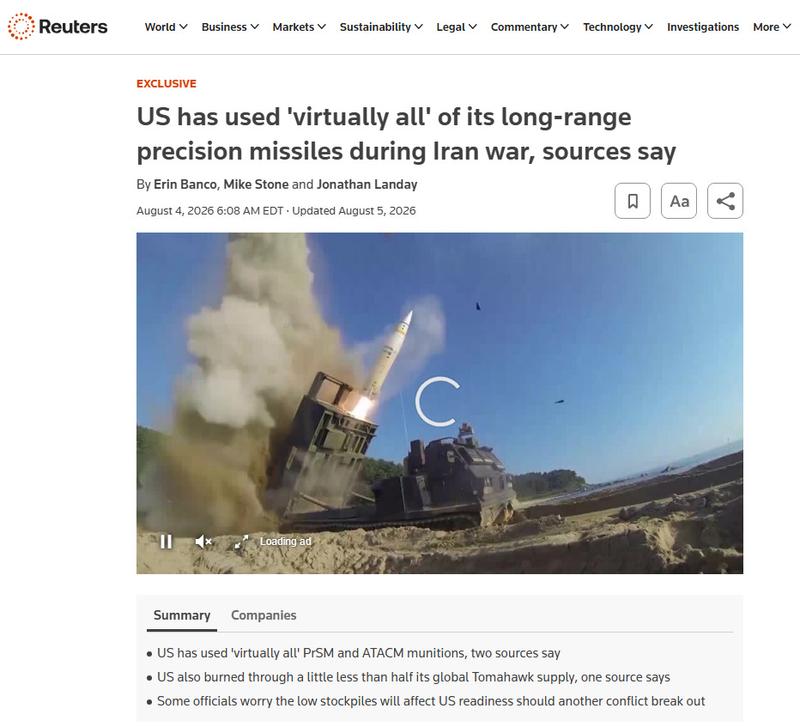
The fact is that the technologies of denial have improved. Modern air defense interceptors are faster and more accurate than the systems that shaped Western assumptions during the 1990s and early 2000s. Even when they cannot seal off the sky, they can raise the cost of manned flight enough to alter behavior. They can force pilots to remain farther out, reduce sortie flexibility, narrow target sets, and transform what would once have been routine penetration into a calculated gamble.
In earlier eras, pilots had more ability to evade. Aircraft could maneuver against incoming threats with a better chance of survival. That margin has narrowed drastically. Once a modern interceptor is launched and tracking properly, the odds of survival quickly drop towards zero. The effect is psychological as well as operational. Commanders become more cautious not because their air forces are weak, but because the consequences of losing advanced aircraft and trained pilots are too high.
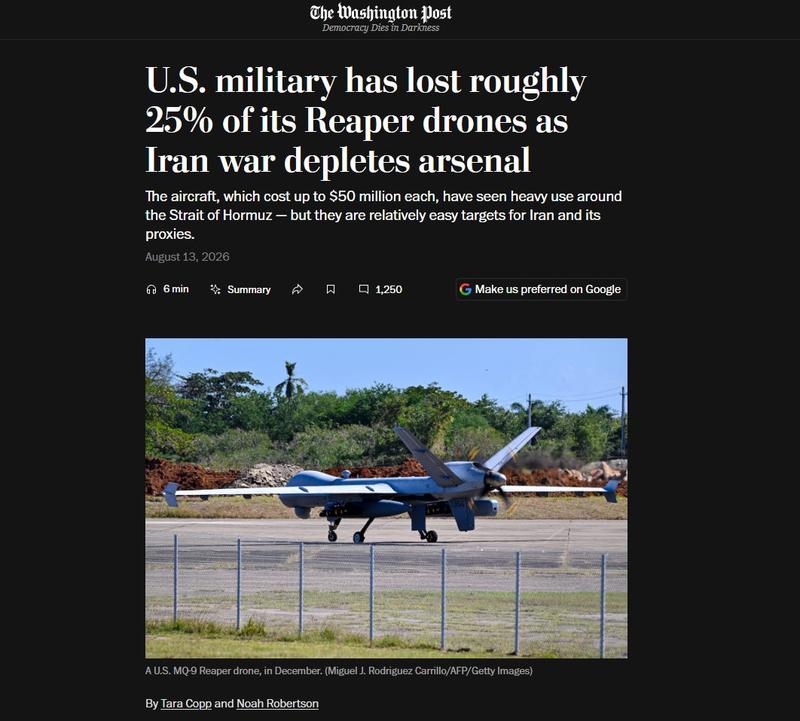
That helps explain another striking feature of the Iran war: the growing dependence on large, expensive drones in contested environments even when those drones are clearly vulnerable.
The MQ-9 Reaper was not designed for sustained survival against capable air defenses. Yet it has been used repeatedly in exactly those conditions, and the results have been sobering. In Yemen, they were shot down with regularity. In the broader confrontation linked to Iran, the losses have mounted again. Each destroyed drone represents not just a high financial cost (over $30 million), but a strategic signal. When a military keeps sending vulnerable unmanned aircraft into hostile skies, despite knowing they are likely to be lost, it may be because those systems are considered more expendable than manned aircraft the military is unwilling to risk.
That is not a picture of invulnerability. It is a picture of adaptation under constraint. Even states that lack a world-class air force can now make the sky dangerous enough to deny their adversaries the freedom they once took for granted, and that denial does not have to be total to be effective. It only has to be sufficient.
For a country like the United States, this creates a particularly difficult challenge because so much of its broader military model depends on freedom of action at distance. The United States does not defend itself primarily by waiting behind its borders. It defends itself by projecting force abroad, reassuring allies, policing key regions, and preserving escalation dominance across several theaters. Air supremacy was central to that model because it made all of those commitments appear manageable. If the air domain becomes more contested, then the cost of maintaining global military primacy rises sharply.
This is not simply a matter of acquiring newer aircraft. The F-35, the B-21, and other advanced systems may preserve important advantages. But no platform can restore the strategic conditions of the 1990s. The problem is not the absence of innovation. It is that countermeasures have spread and matured too. The offense-defense balance has changed.
That requires more than technological adjustment. It requires intellectual adjustment.
For too long, American policymakers have spoken as though air power retained something close to its old freedom. Public language still drifts easily toward claims of complete control, total dominance, and overwhelming superiority. Yet these formulas obscure more than they reveal. A country that relies on standoff missiles because piloted aircraft cannot operate safely overhead is not exercising the same type of power it once did. A force that uses drones as risk absorbers in place of manned penetration is not demonstrating unconstrained command of the sky.
The vocabulary of supremacy survives. The operational reality has changed.
This does not mean the United States is helpless. It means that power has become more reciprocal than Washington prefers to admit. Adversaries no longer need to match America plane for plane to impose meaningful limits. They only need enough defensive competence to make unrestricted air operations prohibitively costly. Once that threshold is crossed, the psychological foundation of American military primacy begins to erode.
The lesson is uncomfortable because it strikes at one of the deepest assumptions in modern U.S. strategy. For a generation, air dominance was the least questioned element of American power. It was the one advantage that seemed beyond serious dispute. Naval reach could be challenged. Occupations could go badly. Proxy wars could become quagmires. But control of the sky remained secure.
No longer. The sky has become a dangerous place.
Listen to CATR on:
Newsletter
Subscribe to Conversations Among the Ruins
Long-form geopolitics and the decline of the unipolar world order. New episodes straight to your inbox.
Free. No spam. View on Substack →
Reader-funded
This is independent, long-form work.
Conversations Among the Ruins is written, not repackaged, and it stays free because readers choose to fund it. If it is worth your time, a paid subscription or a one-off tip keeps it going.
Become a supporter →