
For the better part of a year the world has fixed its gaze on the wrong capitals. Every carrier steaming toward the Persian Gulf, every exchange of missiles between Israel and Iran, every leaked war plan out of the Pentagon has been treated as the hinge on which the Middle East turns. It is not. Washington is not going to back down; the president could not find the exit even if he wanted one. Israel is not going to change its behavior; it never has. The one piece of the American order in the region that can actually move, and move quickly, is Saudi Arabia. And Saudi Arabia is in far more trouble than anyone in Washington is willing to say out loud.

Start with what the kingdom is. Strip away the Vision 2030 brochures and the renderings of glass cities in the desert and you are left with a country that is oil and almost nothing else. That is a strength when the oil flows. It becomes a fatal weakness the moment someone demonstrates that they can stop it. Someone has.
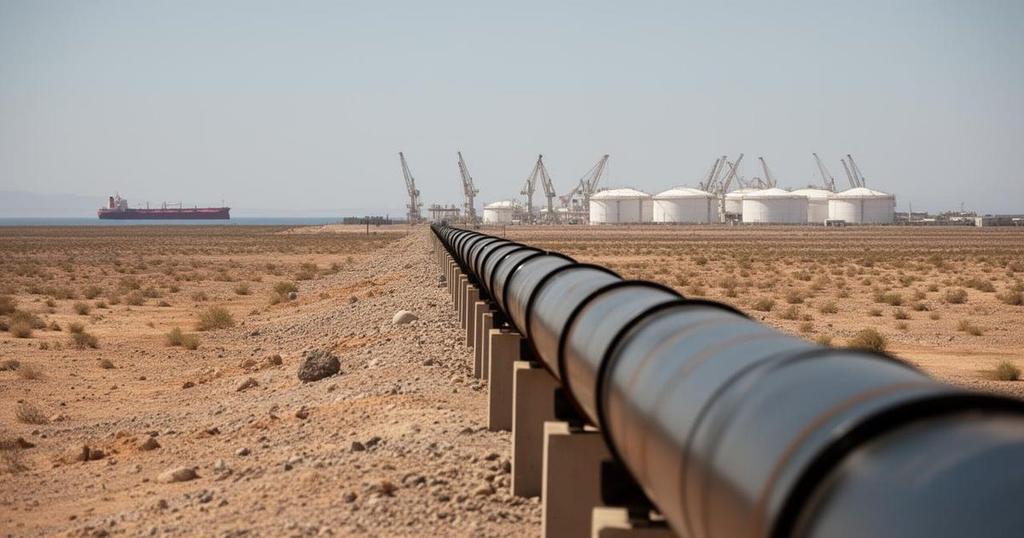
Over the past several weeks the pipeline that carries Saudi crude west to the Red Sea, the kingdom’s lifeline now that the Strait of Hormuz has become a war zone, has been taken apart one pumping station at a time. Two stations were knocked out earlier in the fighting, either by the Houthis or by Iraqi militias; the attribution hardly matters. Saudi engineers did what engineers do. They patched the line around the dead stations and ran it on the remaining pumps, accepting a flow of perhaps 40 percent of capacity. Then this week a third station was hit, and the Houthis claimed it without ambiguity. The flow stopped. The pattern is not random harassment. It is surgical, and it carries a message: we can do this whenever we choose.
The kingdom’s fallback has been Ras Tanura, its great export terminal on the Gulf. Reuters has reported a jump in loadings there of roughly three million barrels a day as Riyadh scrambles to get crude out by sea. That is a fraction of what the country shipped before the war, but it is something. It is also a hostage. Ras Tanura sits directly across the water from Iran, within easy range of short range missiles and drones that Tehran has not needed to touch. Iran has climbed its escalation ladder with notable care, taking one rung, pausing, watching, taking another. The rungs above it are not mysterious. The port at Ras Tanura. The refineries. The liquefied natural gas plants. The desalination plants that make life in the peninsula physically possible. The undersea data cables. All of it sits there waiting, and Iran has shown it does not need its long range arsenal to reach any of it.
Against this backdrop, Riyadh has chosen to reopen its war with the Houthis. The strikes on Sanaa that began the current round were reportedly carried out with American approval, and perhaps with something more than approval. The Saudi backed forces on the ground have since taken back a sliver of territory near the Bab al Mandab, and the announcement has been treated as a turning point. Anyone who has watched the war in Ukraine knows better. Every few months Kiev concentrates its forces at a soft point on the line, takes back a few villages, and declares a counteroffensive. Within weeks the Russians have the ground back and are moving again. The Saudi gain looks like the same thing: real, small, and probably temporary. While the cameras pointed at the coast, the Houthis completed the encirclement of Taiz, one of the most important cities in the country. Over a decade of war they have proven themselves the better fighters: more committed, more inventive, and far more patient than the mercenaries arrayed against them.
Then came the moment that ought to have ended the illusion. When the Houthis struck back and the pain began to register in Saudi cities and Saudi oil fields, Mohammed bin Salman asked Washington for help. According to accounts in the American press, the president initially agreed. Aircraft were armed. Then the operation was called off, because Pentagon officials persuaded him it could not be done. If the earlier reports are true, if Washington nudged the crown prince into this fight and then left him in it, one can only imagine his fury. But the refusal tells us something larger than the state of one relationship. It tells us the American position is weaker than the administration admits. The reports of depleted munitions stockpiles and an overstretched navy are evidently true. The seventy day campaign against the Houthis last year burned through Tomahawks the United States cannot quickly replace. The Pentagon looked at a second front and said the country could not afford it.
Consider what that means for the bargain that has underwritten the region since the 1970s. The deal was never complicated. Saudi Arabia keeps the oil flowing and prices it in dollars. The United States provides security and sells weapons. For fifty years both sides kept their word. The Saudis are still keeping theirs. They are pumping what they can. They have signed on to buy tens of billions of dollars in American arms, including some 24 billion dollars’ worth of F-35 fighters, the very kind of twentieth century prestige hardware this war has shown to be nearly irrelevant against swarms of cheap drones. They are still negotiating a civilian nuclear agreement with Washington. They have held up their end. The United States has not. It promised protection on the strength of a formidable twentieth century military, and it is discovering that its opponents are fighting a twenty-first century war.
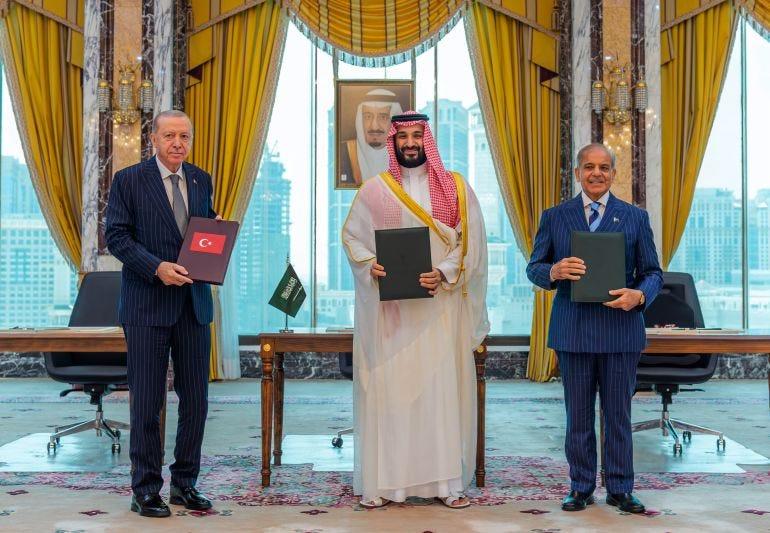
Nor is anyone else coming. The much celebrated defense pact between Riyadh, Islamabad and Ankara lasted roughly until the first Houthi missile arrived, at which point Pakistan announced that the conflict was a pre-existing condition and therefore outside the agreement. Pakistan depends on Saudi money, but it depends on China more, and Beijing has no interest in watching its closest partner march into Yemen. Pakistani public opinion would not stand for it in any case.
So the kingdom faces two roads, and both lead to the same place. Either Saudi Arabia keeps absorbing blows it cannot answer until the oil infrastructure, and with it the monarchy, gives way. Or the crown prince reads the situation, picks up the phone to Tehran and Sanaa, and tells the Americans to leave. In the first case the petrodollar dies with the kingdom. In the second it dies by decree. The petrodollar is not the whole of the dollar’s status as the world’s reserve currency; the dollar is used for too many other things for that. But it has been a pillar of that status, and the structure is already swaying. Treasury yields are pressing toward six percent. The federal debt has passed 40 trillion dollars. The Treasury is resorting to maneuvers to buy its own paper. Central banks around the world are quietly moving their reserves elsewhere. No one knows where the tipping point lies. Knocking out the Saudi pillar is as plausible a candidate as any.
What makes this moment dangerous and, strangely, hopeful is that a monarchy can turn on a dime. Only months ago the Saudis killed an American naval operation in the Gulf because Iran warned them their facilities would burn if it proceeded. That fear has not evaporated; it has been overruled by a gamble. Mohammed bin Salman is not an ideologue. None of the Gulf monarchs are. They are self interested men who want to keep their thrones, and American power is what kept them there. Unlike Washington, which cannot change course because no one is actually steering, a crown prince can wake up one morning and decide that his protector is a fiction. Somewhere in the coming months, there will be a phone call from Tehran or Sanaa offering him one last chance to take that step. The best outcome for his country, and for a world that cannot afford another collapsed state in the Gulf, is that he takes it.
Watch Riyadh. The empire’s weakest load bearing wall is not in Tel Aviv or Tehran. It is a kingdom of sand whose only treasure can be set alight by men in sandals, and whose protector has already told it, quietly, that the cavalry is not coming.
Listen to CATR on:
Newsletter
Subscribe to Conversations Among the Ruins
Long-form geopolitics and the decline of the unipolar world order. New episodes straight to your inbox.
Free. No spam. View on Substack →
Reader-funded
This is independent, long-form work.
Conversations Among the Ruins is written, not repackaged, and it stays free because readers choose to fund it. If it is worth your time, a paid subscription or a one-off tip keeps it going.
Become a supporter →