
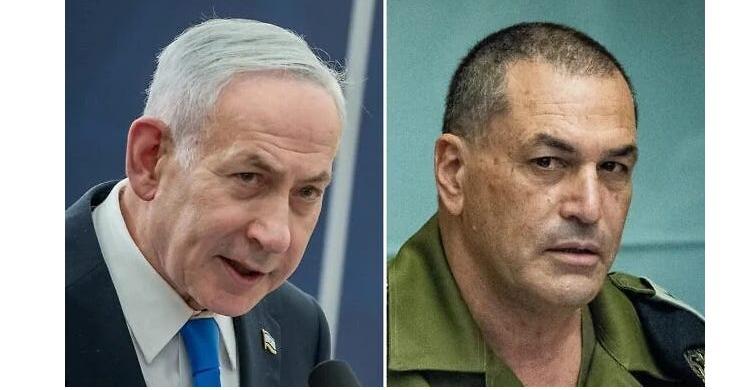
Two days before Israelis go to the polls, Benjamin Netanyahu asked his army to attack Iran. The chief of staff, Eyal Zamir, told him no. He wanted formal authorization, a cabinet process, something more than a prime minister’s phone call in the final hours of a campaign he appears to be losing. Whatever the procedural cover, the answer was a refusal, and it is worth pausing on what that refusal tells us. The Israel Defense Forces are not opposed to striking Iran. They have argued for it, planned for it, and executed it. What they objected to was the timing, and the reason they objected is that everyone could see what the timing was for. An army that lets itself be used as a campaign prop stops being an institution and becomes a faction. Zamir understood that. Netanyahu, with his coalition sagging and Gadi Eisenkot projected to overtake him, no longer cares.
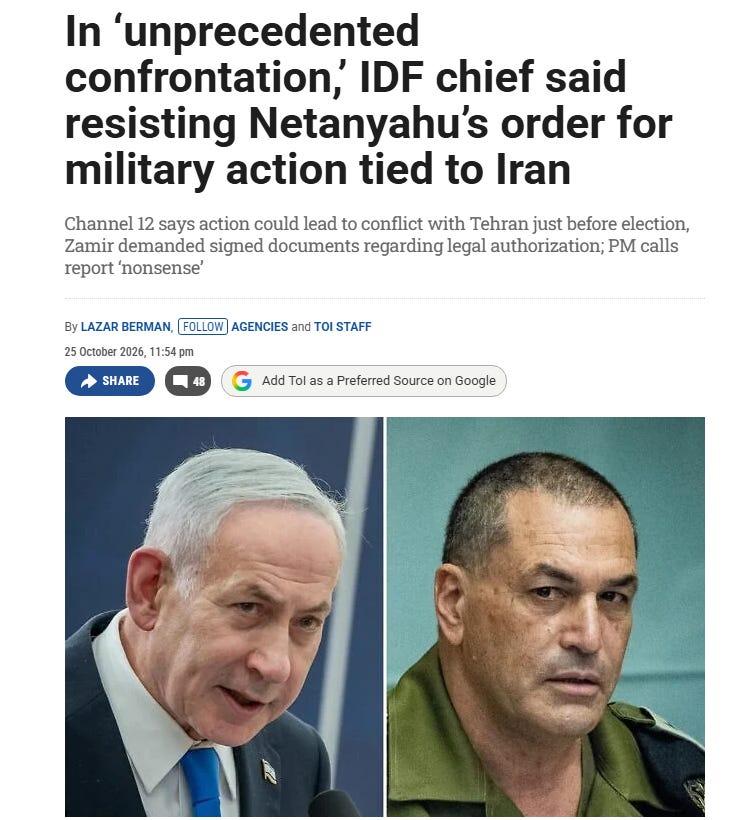
That episode would be alarming enough on its own. It becomes something closer to a warning when you set it beside the calendar in Washington.
Consider the two timelines. If the polls are right, Netanyahu loses this week. But losing an Israeli election does not remove a prime minister. It starts a negotiation. Forming a coalition in Israel routinely takes two to three months, and until a new government is sworn in, the old one governs. Netanyahu will remain prime minister, with full command authority, through November, December, and very possibly into the new year. He will be a lame duck with a corruption trial waiting for him and a war that is the only thing standing between him and a courtroom.
Now look at the United States. The midterm elections are days away, and the signs point to a severe defeat for the president’s party. But the new Congress does not sit until January 3. For roughly two months, Donald Trump will govern with the old Congress, the one that has never once restrained him, while the verdict of the voters hangs in the air and the impeachment inquiries, subpoenas, and cabinet fights of the next Congress are being drafted. Robert Pape, the University of Chicago political scientist who studies the logic of escalation, has called this interval the most dangerous period of the entire war. He is right, and the reason is simple. It is the window in which the costs of going further and the costs of stopping both fall on a president who has nothing left to protect except his own account of himself.
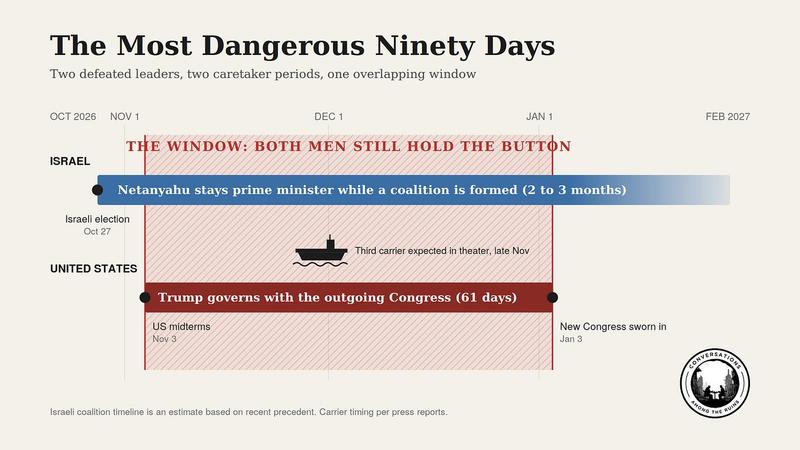
Put the two timelines on top of each other, and they overlap almost perfectly. From early November to early January, both men who started this war will still hold the power to expand it, and both will have been told by their own voters that they are finished. That is not a coincidence to be noted. It is the setup for a decision.
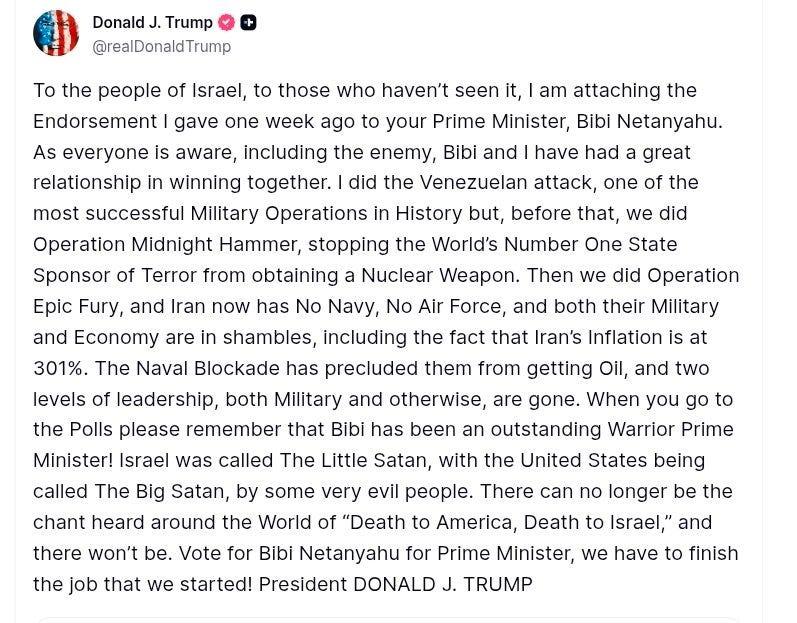
The argument for restraint rests on the assumption that electoral defeat chastens leaders. It does not. It corners them. Netanyahu has already shown what he does when cornered. After October 7, facing mass protests over his judicial overhaul and a public that wanted him gone, he used the war to pull his bitterest opponents into a unity government. A renewed Iranian missile campaign, with Israelis sleeping in shelters again, is the one scenario in which he might pull that trick a second time, and he knows it. A strike on Iran in the caretaker period is not a desperate gamble for him. It is the only play on the board.
Trump’s calculation is uglier because it is less about survival and more about story. He has never made the case for this war. There was no argument offered in February, only a shifting set of assertions, some of them contradicting each other within days. Since then the justification has narrowed to a single claim, that Iran was weeks from a bomb, a claim the administration has never substantiated and that Trump himself undercut when he declared the program obliterated a year ago. He does not make the case because the case is not there, and he knows that if he stops now, the absence of a case becomes the verdict on his presidency. Netanyahu, who has been promising an imminent Iranian bomb for the better part of forty years, is there to tell him the opposite: that this is what great leaders endure, that the people will understand later, that there will be statues. A man who cannot bear to be called a loser will always prefer that story to the truth.
The hardware tells the same story as the politics. A third carrier is reportedly making its way to the region, with arrival expected around the end of November. Leaks describe a short, intense strike package focused on Iran’s energy infrastructure, a few days to a week, a different kind of operation from the opening forty days because the forward bases that made those possible have been wrecked and the standoff munitions drawn down. Whether it is two carriers or three is almost beside the point. The point is that the package is being assembled, and once it sits in theater, every morning the president wakes up at the edge of a cliff with the button beside him. Packages that get built get used.
What would an Iranian response to a strike on its energy sector look like? Tehran has told us. It has published target lists that include Gulf infrastructure and Israel’s own undeclared nuclear site at Dimona. Iran has not yet fully used its cheapest and most permanent weapon in the Strait of Hormuz, the sea mine, because mines cannot be dialed back. A second American campaign would remove the reason for that restraint. This is the likely reason why the Saudi defense minister, Pakistan’s army chief, and Turkey’s intelligence chief are in Tehran this week, not so much to broker peace as to work out what they will do when Washington ignores them.
None of this is inevitable. Zamir’s refusal proves that the machinery can still say no. Eisenkot, if he takes over, is no dove, but he may be willing to wait. The Gulf states may finally decide that their survival is worth more than their dollar holdings. But those are the restraining forces, and every one of them operates on a timeline measured in months. The forces pushing the other way operate on a timeline measured in days, and they are concentrated in the ninety days that begin next week.
The world has spent the past couple of months asking whether the second major strike comes before the elections or after. The answer is after. The real question is what kind of crisis Trump and Netanyahu will have created when the new Congress begins its term next January.
Listen to CATR on:
Newsletter
Subscribe to Conversations Among the Ruins
Long-form geopolitics and the decline of the unipolar world order. New episodes straight to your inbox.
Free. No spam. View on Substack →
Reader-funded
This is independent, long-form work.
Conversations Among the Ruins is written, not repackaged, and it stays free because readers choose to fund it. If it is worth your time, a paid subscription or a one-off tip keeps it going.
Become a supporter →