
For decades, American power rested not only on ships, bases, and warplanes, but on a broader assumption that lay beneath them all. The United States, it was believed, possessed such overwhelming military capacity that no serious rival could hope to match it. The number of overseas bases, the size of the defense budget, the reach of the Navy, and the technical sophistication of the Air Force all reinforced the same conclusion. America could sustain war, deter enemies, protect allies, and, if necessary, dominate several theaters at once.
That assumption is now being tested by reality. And reality is not being kind.
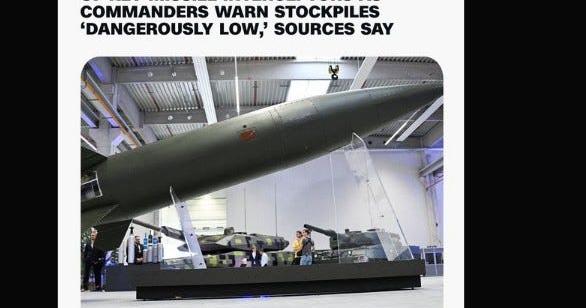
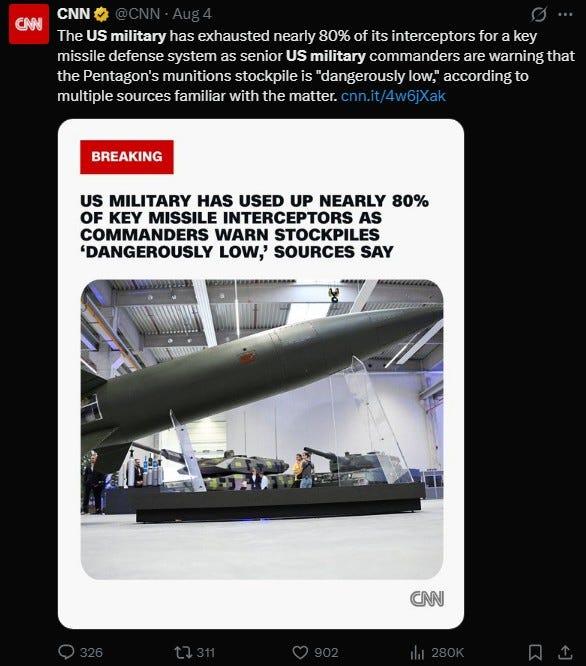
The clearest sign is not a dramatic battlefield defeat. It is something quieter and, in its own way, more devastating. It is the growing stream of reports that the United States is short on the munitions required for a prolonged modern conflict. Interceptors, long-range precision weapons, and key missile stocks have been depleted at rates the public was never meant to contemplate. The language of military supremacy remains intact. The material basis for it does not.
This is what makes the recent panic over leaks so revealing. Officials do not react this angrily to falsehoods that can be easily disproved. They react this way when uncomfortable truths are escaping containment. The issue is not merely that the United States has used large quantities of expensive munitions in support of allies and regional operations. It is that replenishment has proven far slower and more difficult than one would expect of a superpower.
This is not simply a matter of accounting. It goes to the heart of how power works.
Military power is not measured by rhetoric alone, nor by the nominal size of a defense budget. It is measured by what can actually be produced, delivered, sustained, and defended under wartime conditions. A country may spend more than any rival in history and still discover, at the moment of crisis, that much of what it bought was insufficient and ill-suited to the wars it now faces.
That appears to be the current position of the United States.
For years, Washington operated under conditions so permissive that its weaknesses were easy to hide. The post-Cold War era encouraged habits of strategic overconfidence. The wars that followed, especially those associated with the War on Terror, rewarded a military geared toward campaigns against weak and technologically inferior adversaries. Enormous sums were poured into platforms optimized for environments where American air dominance could be assumed, where supply lines were secure, and where the enemy could not strike back in serious ways.
That is not the present environment.
The wars now shaping the international system are not colonial expeditions or punitive raids. They are industrial contests. They demand missiles in volume, air defense in depth, resilient supply chains, and the capacity to replace losses quickly. They reward states that can manufacture at scale and adapt under pressure. They punish states that confuse high expenditure with usable strength.
The United States still speaks as if it retains escalation dominance everywhere. Yet in practice, it is failing to maintain the inventories needed to support existing commitments. This has become increasingly visible in Ukraine, where pleas for additional interceptors run up against a basic constraint. The problem is not reluctance in Washington. It is shortage.
Governments can change their minds, but they cannot instantly refill arsenals.
The same problem hovers over the Middle East. A country that cannot easily replenish key weapons stocks and that cannot reliably defend its own regional installations from retaliation is not in the same strategic position it occupied a generation ago. This does not mean the United States is defenseless, far from it. It remains the most heavily armed country in the world. But there is a profound difference between being heavily armed and being prepared for sustained high-intensity war against capable adversaries.
The illusion of abundance has concealed that difference for a long time.
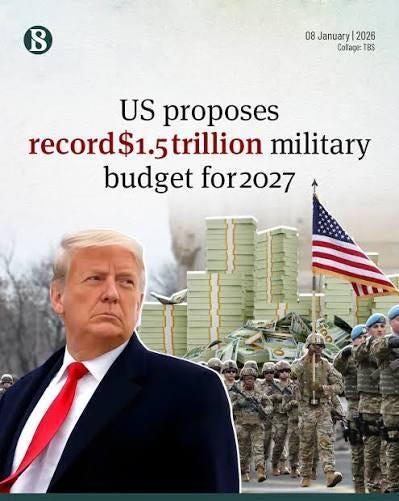
What has made the revelation so jarring is the scale of the mismatch between spending and output. America spends sums on defense that would seem, on paper, to guarantee overwhelming readiness. Yet even now, when the need for production has become impossible to ignore, output increases have been incremental and slow. The problem is not solved by appropriating more money. Money can fund contracts, but cannot instantly create engineers, skilled labor, secure supply chains, or industrial ecosystems that have been hollowed out over decades.
This is one of the least understood facts about military decline. Industrial capacity is not a tap that can be turned on at will. It is an ecosystem of skills, machinery, subcontractors, materials, logistics, and organizational competence. Once degraded, it takes years to rebuild. In some sectors, the essential expertise has become scarce. Factories cannot be improvised through a press release.
In that sense, the weakness now on display is deeper than a temporary shortage. It reflects a broader national transformation. The United States has spent decades shifting away from productive capacity and toward finance, services, and consumption. It has retained immense wealth, but wealth is not the same as manufacturing power. A society can become extraordinarily rich while losing the habit and infrastructure of making things at scale. A nation can preserve the image of military supremacy long after the industrial foundations of that supremacy have eroded.
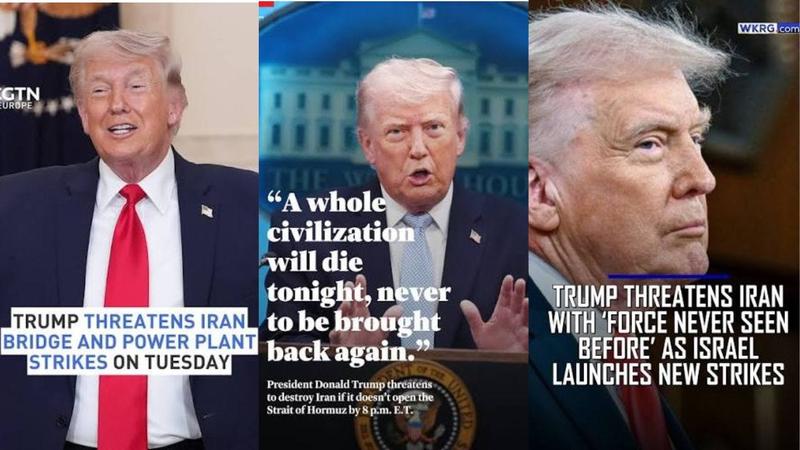
What is especially dangerous is the strategic psychology that lingers after the material basis has faded. Political leaders continue to speak in maximalist terms. Threats are made casually. Enemies are told they can be obliterated. Entire regions are treated as if they remain subject to the old logic of unquestioned American coercion. Yet if the stockpiles are strained, the factories are slow, and the logistics are fragile, then this style of rhetoric becomes more than irresponsible. It becomes a bluff that may be called.
A state that discovers its conventional power is less overwhelming than it imagined faces a temptation. It can either adjust its ambitions to its means, or it can reach for more dangerous instruments to preserve credibility. This is where logistical decline becomes a matter of strategic risk. If conventional deterrence is weakened, the pressure to rely more heavily on nuclear threats or other forms of extreme escalation can grow.
That does not mean such escalation is inevitable. But it does mean the world is entering a more volatile phase, one in which the old confidence of American statecraft is no longer backed by the same margin of material superiority.
Some of this may prove healthy in the long run. The mythology of limitless force has done immense damage. It encouraged interventions that should never have occurred and commitments that were never sustainable. It persuaded allies that American backing was inexhaustible. It persuaded Washington that military primacy could substitute for strategic restraint. A clearer understanding of limits could, in principle, produce a more sober foreign policy.
But there is no guarantee of sobriety. Declining powers do not always retreat gracefully. They often become more erratic as the gap widens between what they believe they are and what they are actually capable of doing.
That is why the recent admissions matter so much. They are not simply disclosures about inventories. They are glimpses of a structural truth. The United States may still possess extraordinary strength, but it no longer possesses the effortless, unquestioned military dominance that shaped the post-Cold War world. The arsenal is thinner than advertised. The industrial base is much less responsive than assumed. The threats are louder than the underlying capacity justifies.
The mythology has not yet collapsed. In politics, in media, and in elite foreign policy circles, the language of supremacy remains deeply entrenched. But the facts are becoming harder to suppress. Vanishing stockpiles, delayed replenishment, vulnerable bases, and overextended commitments all point in the same direction.
The illusion is evaporating.
And once a great power loses the ability to sustain the image of limitless force, the world begins to reorganize itself accordingly.
Listen to CATR on:
Newsletter
Subscribe to Conversations Among the Ruins
Long-form geopolitics and the decline of the unipolar world order. New episodes straight to your inbox.
Free. No spam. View on Substack →
Reader-funded
This is independent, long-form work.
Conversations Among the Ruins is written, not repackaged, and it stays free because readers choose to fund it. If it is worth your time, a paid subscription or a one-off tip keeps it going.
Become a supporter →