

Everyone agrees the empire is in trouble. That is the problem. Say the United States is overstretched and the response is a knowing nod: yes, of course, China, the debt, the wars, we all know. The nod is the most dangerous gesture in American politics, because it has replaced alarm. The decline has been absorbed as a mood, a thing one is wise and weary about, rather than as an event that is happening on a schedule and will end in a specific way.
The public is not in denial. It is worse than that. It has made its peace.
And it is not asleep, either. A majority of Americans now say they are more sympathetic to the Palestinians than to the Israelis, a reversal that was unthinkable a few years ago, and Democratic candidates are winning primaries on the issue. The average voter is not following the war with Iran hour by hour, but he sees the number on the sign at the gas station, reads that this week’s inflation report was driven by energy costs, and makes the connection. Politicians who cheered the war a few months ago are putting daylight between themselves and it, and the midterms are shaping up as a wipeout for the party in power.
So the public is paying attention. The problem is what it concludes.
The prevailing conclusion is that this is a cycle. We went through Vietnam. We went through the inflation of the 1970s. We went through the financial crisis and the pandemic. Each time the country was still standing afterward, and so the lesson absorbed is that it always will be. Prices will come down, a new Congress will be seated, a new president will be elected, and the adults will shore things up. The system is solid; we just need to get through this administration.
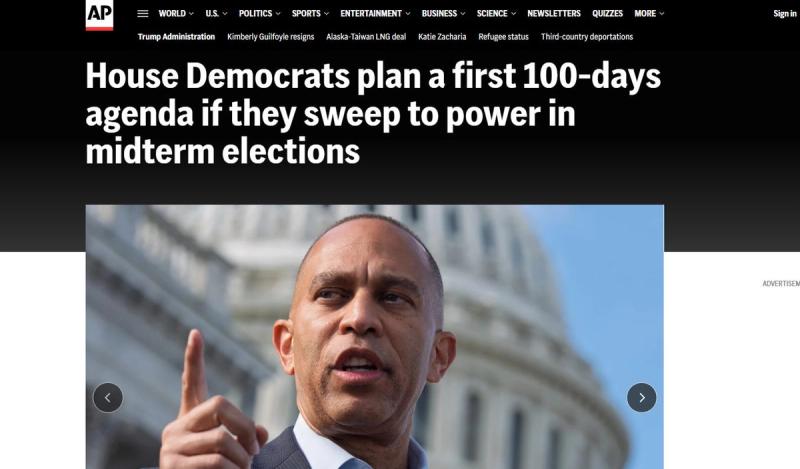
You can read this view every morning in the best newspapers in the country. The reporting is often good. The framing is almost always the same. Things are fundamentally fine, the institutions will remain solid, the problem is one man. When the subject turns to Israel, the framing shifts only slightly: there are problems, but they belong to Ben-Gvir and Smotrich and perhaps Netanyahu, and once they are gone, the relationship will heal. This is not analysis. It is reassurance, and it is doing real damage.
Because the rest of the world has stopped believing it, and says so out loud.
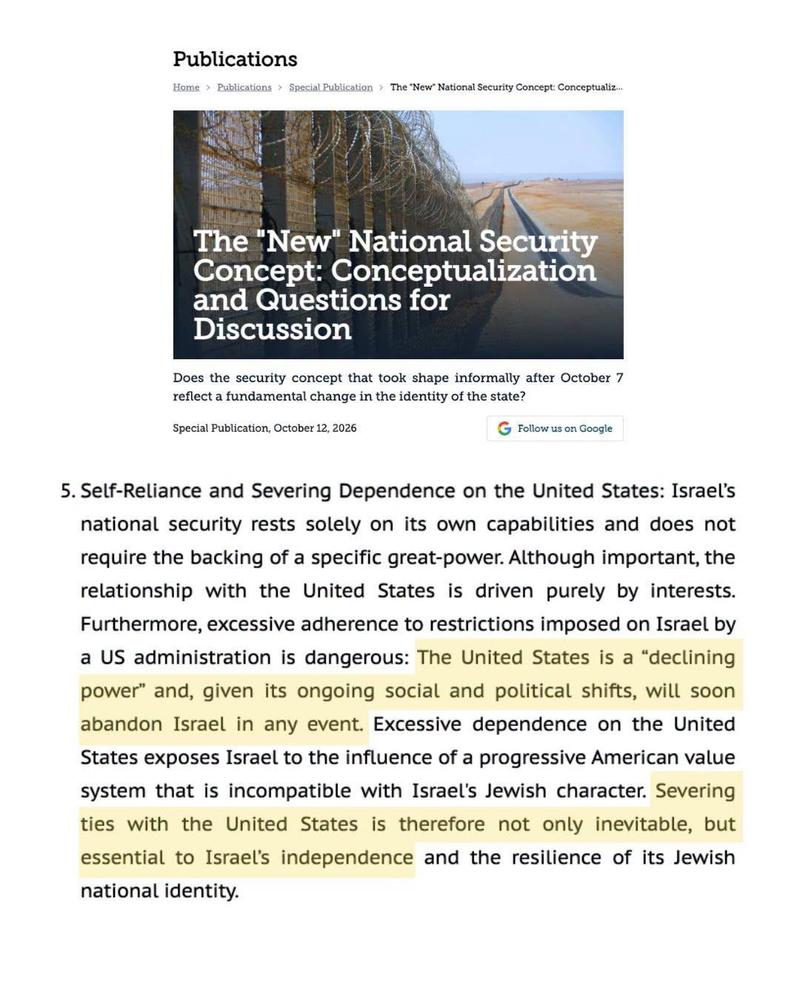
A report published this week by one of Israel’s leading think tanks, in a country with every reason to want the United States strong, states it plainly. The United States is a “declining power” that, given its social and political shifts, “will soon abandon Israel in any event.” The authors’ conclusion is not to shore up the relationship but to prepare for its end: severing ties with Washington is “not only inevitable, but essential to Israel’s independence.” That is a more honest reckoning than anything the American establishment has produced about itself.
The smugness has a source, and the source is understandable. Two oceans and two friendly neighbors have always done for the United States what other nations have to do with armies and diplomacy, and the public has rarely had to notice a war until it arrived in the kitchen as a draft notice or a price tag. Add to that many decades of prosperity and peace at home, interrupted by very little, September 11 being the notable exception. The country launched a war that destroyed Iraq, destabilized its neighbors, and sent millions of people into exile, and the consequences at home were four thousand or so American dead and an enormous bill that nobody ever had to pay, because the United States owns a printing press and the world was willing to accept what came out of it. When you can run a catastrophic foreign policy for a generation and feel almost nothing, you stop believing in consequences.
Walk through any American town this month, and the striking thing is how normal it all looks. The stores are open. The restaurants are full. The only visible sign that anything has changed is the number on the sign at the fuel station. That normality is not evidence that the alarm is overblown. It is evidence of the insulation, and insulation is the thing that fails last and fails all at once.
Because the printing press is the thing that is now failing. Bond yields are climbing. The dollar is going less far than it did. The bases in the Gulf that underwrote American dominance in the region are, in the words of the Secretary of the Navy, “blown to hell”. These are not predictions from the dissident margins; they are facts the government now concedes. And the people who warned about them before the war, the people treated as cranks, turned out to have a better record than the people with column inches.

Here is what makes the present moment different from Vietnam or 1979 or 2008. In each of those cases, the structure held because the foundations were intact. The dollar was still the world’s reserve currency, and nothing was ready to replace it. American military power could still be presumed, and American allies had nowhere else to go. Those foundations are what is being tested now, and not by some abstract rival but by the direct consequences of American choices: sanctioning a third of the world, seizing other nations’ assets, launching a war against Iran, whose predicted outcomes have mostly come true. A country that cannot protect Saudi Arabia cannot expect Saudi Arabia to keep protecting its currency.
A blue wave in November will not change any of this. Whoever controls Congress will inherit the same yields, the same energy prices, the same emptied stockpiles, and the same wars. The belief that the next election will restore the old equilibrium is the final and most comforting form of the smugness, and it will be the last to go.
So no, the people who say the era is ending are not members of a cult. They are the ones who are not smug. The facts are there for anyone willing to read them without the reassurance that history has always provided. The reckoning will most likely arrive as an energy crisis and an economic crisis together, since the two rarely travel alone, and most Americans will be blindsided by it, not because the warnings were absent but because they came from the wrong kind of people.
The smugness will end, and probably sooner than later. The only question is how much it costs the country to learn the lesson the hard way.
Listen to CATR on:
Newsletter
Subscribe to Conversations Among the Ruins
Long-form geopolitics and the decline of the unipolar world order. New episodes straight to your inbox.
Free. No spam. View on Substack →
Reader-funded
This is independent, long-form work.
Conversations Among the Ruins is written, not repackaged, and it stays free because readers choose to fund it. If it is worth your time, a paid subscription or a one-off tip keeps it going.
Become a supporter →