
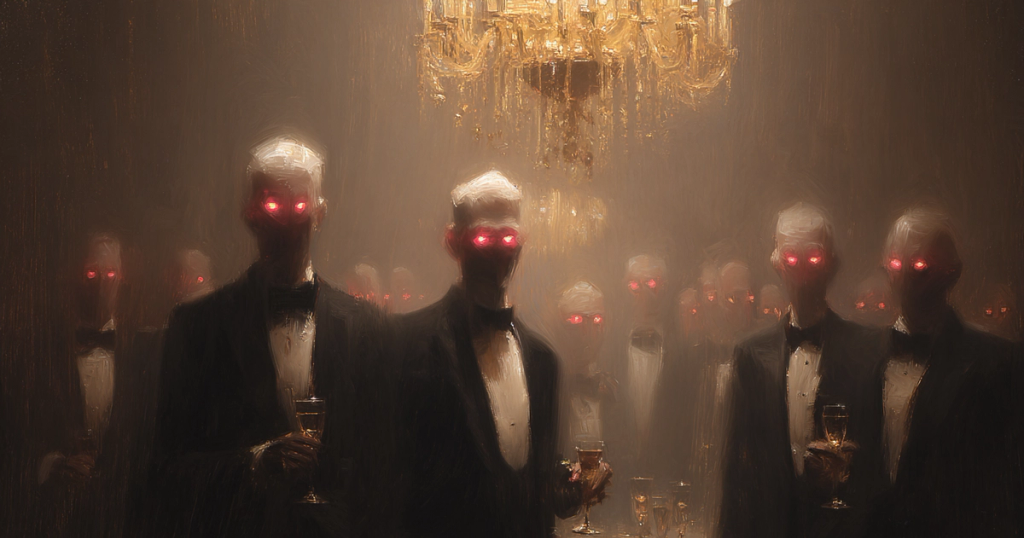
For decades, the United States viewed its geopolitical adversaries through the lens of political, economic, or military competition. The Cold War was a clash of ideologies; the trade wars were battles for market dominance. Yet, a profound shift is occurring in how the non-Western world perceives the collective West. We are no longer viewed merely as a strategic rival to be outmaneuvered. Increasingly, the West is perceived by its adversaries—and quietly by many of its own citizens—as an entity afflicted by a deep spiritual sickness.
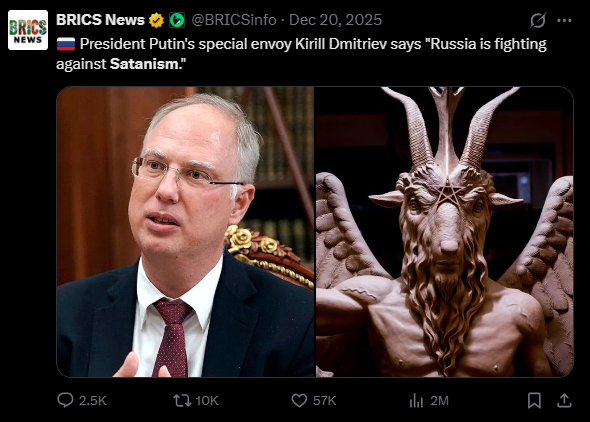
In capitals from Moscow to Tehran, the rhetoric has evolved. While leaders like Vladimir Putin often maintain a careful, cool diplomatic exterior to avoid escalating tensions into a global conflagration, others within the Russian and Iranian spheres are less inhibited. They describe the West not just as greedy or imperialistic, but as fundamentally depraved, or even "satanic."
To the secular Western mind, such language is easily dismissed as hyperbolic propaganda. However, to dismiss it is to miss a critical disintegration of Western soft power. This is not merely about foreign perceptions. It mirrors an internal crisis of legitimacy. The rot is visible at the top. When high-profile scandals expose the depravity of the elite class—symbolized most potently by the Jeffrey Epstein saga—it confirms a suspicion that the civilization has lost its soul.

This moral decay poses a fatal problem for the maintenance of empire. Historically, nations mobilize for war through a clear moral binary: we are good, and they are evil. Propaganda dehumanizes the enemy to make the prospect of killing palatable. But the current Western leadership class faces an insurmountable hurdle. They cannot convincingly claim the mantle of righteousness.
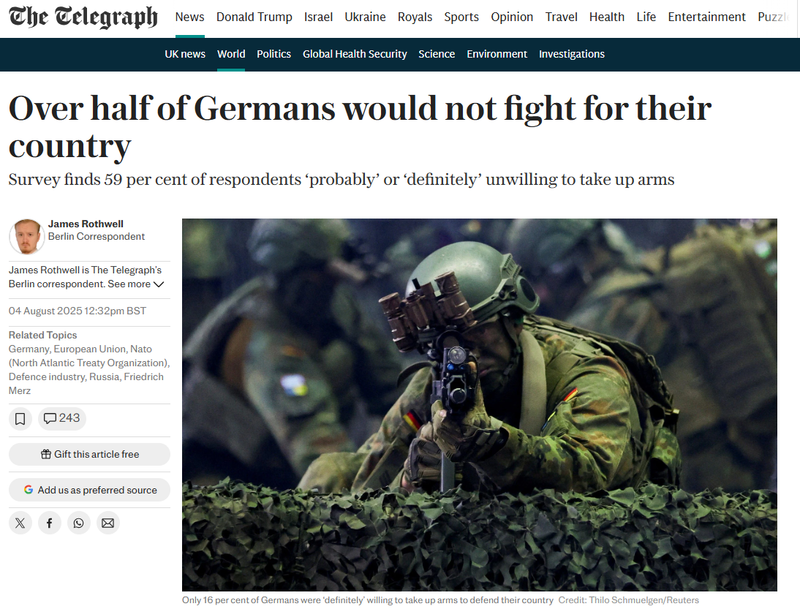
There is a primal drive, particularly among young men, to align with the forces of good and to conquer evil. But when the ruling class is viewed as the source of corruption, that martial spirit evaporates. We see this in the plummeting recruitment numbers across Western militaries and the polling data from Europe, where vast majorities in countries like Germany indicate they would not fight to defend their nation.
The citizenry may applaud a televised special operation or a quick, low-risk decapitation strike against a minor power. These "TV wars" offer a fleeting dopamine hit of national strength. But should the West find itself in a protracted conflict with a near-peer adversary, the "TV war" ends and reality begins. A civilization that believes its leaders are demented will not endure the trenches for them.
This leaves the world in a precarious position. We face a dying hegemon that retains the capacity for apocalyptic violence. While the United States cannot convince its own people to fight a long war, it possesses nuclear arsenals and conventional forces capable of bullying smaller nations into submission. The danger lies in the gray area—regional powers like Iran that are strong enough to inflict damage but weak enough to tempt Western leaders into thinking a quick victory is possible.
The insistence on maintaining a unipolar world, or a "Pax Americana," has proven to be a failure. Far from ensuring global stability, the desperate attempt to impose a single ideological vision upon the planet has driven conflict. It is an unrealistic denial of the world as it actually is.
The alternative is not chaos, but a return to realism: a multipolar world.
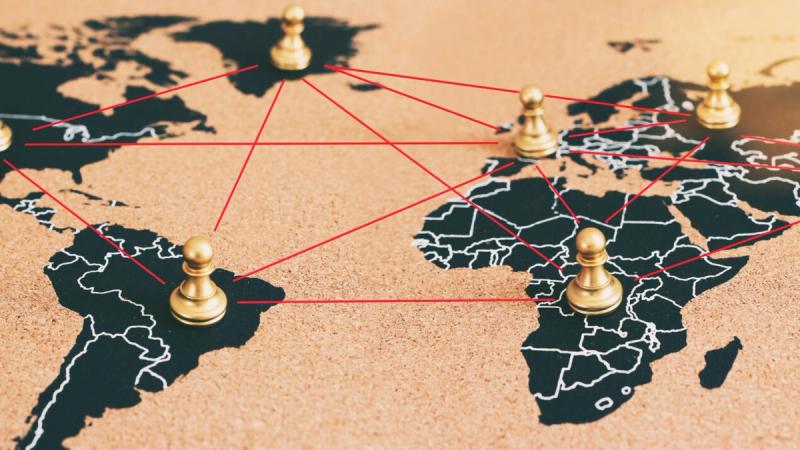
The transition to multipolarity is already underway. It is not a distant theory but an unfolding reality. Accepting this shift requires abandoning the "End of History" narrative which insists every nation must eventually bend the knee to Western liberalism. Instead, we must accept a world of distinct civilizations. In this future, China, Russia, Iran, and others pursue their own visions and realize their own destinies within their borders.
This will not be a golden age. We live in a fallen world where conflict is endemic to the human condition. However, a multipolar order allows for the management of conflict rather than the ceaseless provocation of it. It represents a waking up from the nightmare of liberal hegemony.
Paradoxically, the death of the American Empire could be the salvation of the American nation. Stripped of the burdens of global policing and the hubris of trying to rule the world, the United States could turn its gaze inward. We possess a dominant position on the North American continent, flanked by vast oceans, with neighbors who pose no existential threat.
By shedding the costly and dangerous pretension that we must dictate the affairs of nations halfway across the globe, we could redirect our immense resources and talent toward domestic prosperity. We could heal the internal rot rather than exporting it. The end of the unipolar moment is inevitable; whether we accept it with grace or burn the world down trying to prevent it remains the only open question.
Listen to CATR on:
Newsletter
Subscribe to Conversations Among the Ruins
Long-form geopolitics and the decline of the unipolar world order. New episodes straight to your inbox.
Free. No spam. View on Substack →
Reader-funded
This is independent, long-form work.
Conversations Among the Ruins is written, not repackaged, and it stays free because readers choose to fund it. If it is worth your time, a paid subscription or a one-off tip keeps it going.
Become a supporter →