
There is a peculiar kind of isolation that comes with paying close attention to foreign policy in America. It can make a person feel unhinged. One begins with a question that sounds almost absurd in polite company: Are things really this dangerous, or have I simply spent too much time staring into the abyss?
This is not paranoia. It is the disorienting effect of noticing how often public life is arranged to keep the most consequential questions at the edge of vision. Americans are encouraged to think of foreign policy as a distant theater, a procession of headlines from places they have never been and may never see. They are taught to regard wars as tragic but somehow abstract, strategic but not personal, expensive but not intimately connected to the cost of groceries, the stability of their communities, or the quality of their representation.
Yet there are moments when the distance collapses.
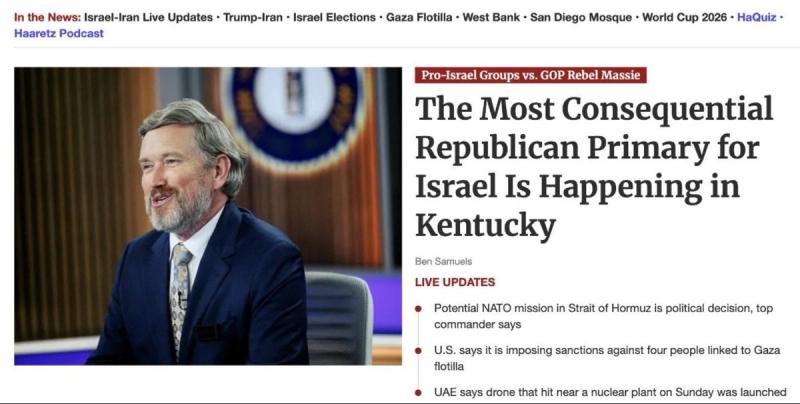
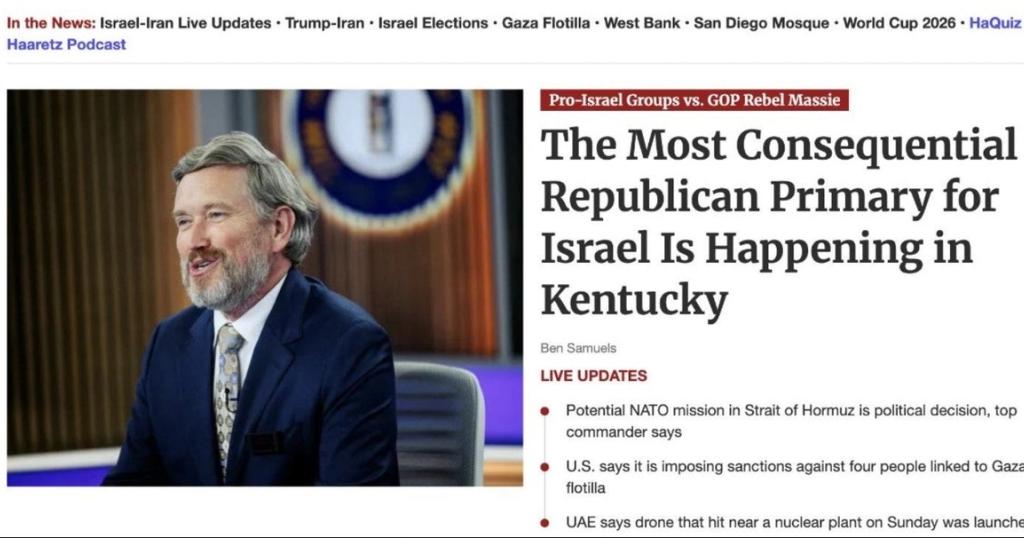
A congressional primary in rural Kentucky becomes a showcase for the reach of pro-Israel power in American politics. Tens of millions of dollars pour into a district where many families are struggling simply to stay afloat. The message is unmistakable: decisions made in Washington about war, aid, and allegiance are not merely national matters. They are being shaped, openly and aggressively, by a foreign interest far removed from the daily life of the people expected to live with the consequences.
For years, this influence operated through indirection. The language was antiseptic. The assumptions were inherited. The slogans were familiar. America was told it was defending democracy, preserving stability, fighting terror, containing extremism. The justifications shifted, but the direction of travel rarely did. More intervention. More obligations. More deference to an alliance with Israel that ordinary voters neither requested nor meaningfully consented to.
What has changed is not simply the policy. It is the clarity.
An increasing number of Americans now see that the U.S.-Israel relationship is not merely a matter of diplomacy or military cooperation. It is a domestic political fact. It reaches into primaries, campaign finance, media framing, and the boundaries of acceptable dissent. It punishes deviation. It rewards obedience. And when challenged, it often grows less subtle, not more.
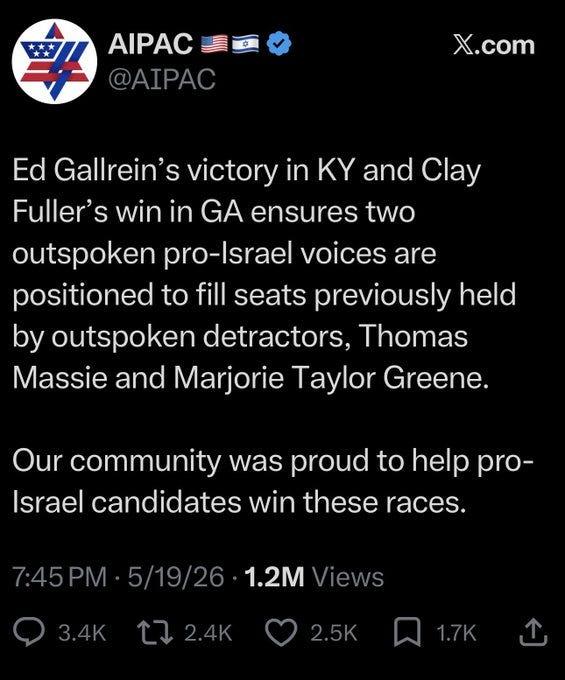
That bluntness may prove to be its weakness. By making its influence so visible, Israel and its American allies may be accelerating the backlash against them. But if they, too, can see the direction of public opinion, that only raises the danger that they will press hardest now, while they still can.
Two clocks appear to be ticking at once.
The first is domestic. Public opinion is changing, but institutions lag. That lag is one of the defining features of political life. A population can move sharply in one direction while parties, donor networks, lobby groups, and media organizations continue to operate as if nothing essential has changed. For a while, money can suppress reality. It can distort primaries, marginalize dissenters, and manufacture the appearance of consensus. But it cannot do so forever.
The collapse of a political arrangement usually begins with a loss of legitimacy long before it loses power. People stop believing in the language that sustains it. They hear the old formulations and feel only irritation. They watch elected officials recite their lines and recognize the performance. They begin to understand that the stated reasons are not the real reasons.
That is where much of the country now seems to be.
The second clock is geopolitical. Israeli leadership, and the constellation of forces aligned with it in Washington, seems to understand that its window may be narrowing. Public opinion in the United States, especially among younger Americans, has shifted dramatically. The old emotional, ideological, and rhetorical defenses are weaker than they once were. The moral authority that shielded Israeli conduct for decades has eroded under the weight of relentless visibility. Images travel too fast. Cruelty, once softened by euphemism or hidden behind institutional loyalty, now arrives unfiltered.
This helps explain the growing urgency. If political support is softening, then the pressure to secure strategic objectives immediately becomes more intense. In that context, escalation with Iran can come to look, from their perspective, not merely desirable but necessary. Perhaps this is the last plausible chance to force the United States to wage a war that future administrations, or future electorates, might no longer tolerate. If that assessment is guiding decisions, then the danger is obvious. A leadership class that believes it is running out of time is more likely to behave recklessly.
This shift is visible across ideological lines, though it manifests differently. Among Democrats, open skepticism toward Israel has become increasingly common, particularly among younger voters. Among Republicans, the change is more uneven but no less significant. The old neoconservative assumptions no longer command automatic loyalty. Voters who once accepted foreign intervention as a sign of seriousness now see it as a sign of capture, vanity, or decay.
What remains powerful is not public conviction but political machinery. Lobbying networks still know how to discipline candidates. Donors still know how to make examples of dissenters. Party structures still know how to reward compliance. But there is a difference between control and confidence. A political order that must spend enormous sums to crush a single dissenter in a rural district is not demonstrating serenity. It is advertising fear.
And fear can be clarifying.
There is something deeply corrosive about the spectacle of a foreign-aligned lobbying apparatus treating an American election as its own internal affair. Most citizens do not need a graduate seminar in geopolitics to understand the obscenity of that arrangement. They can feel it. They know what it means when their communities are neglected, their wages are strained, their debt rises, and yet immense energy is devoted to enforcing loyalty to priorities that are not their own.
This recognition is one reason the issue now carries more explosive political potential than it once did. If economic conditions worsen, if energy prices continue to rise, if another war expands, and Americans are told yet again to accept sacrifice in the name of interests they did not choose, the backlash will not remain theoretical. The public is far more likely now to connect the dots. What was once murky has become legible.
That does not guarantee wisdom. Public anger can be channeled toward renewal, but it can also become destructive. Much depends on whether serious, principled leaders emerge who can speak plainly without descending into hatred or hysteria. The country will need figures capable of naming corruption without reproducing it in another form. It will need people who can oppose capture without embracing vengeance, and who can distinguish national interest from nationalist theater.
That kind of politics is rare, but not impossible.
For now, the most important fact is that resignation is premature. The people who benefit from the current arrangement are powerful, but they are not omnipotent. They can delay change. They can intimidate. They can distort. They can punish. What they cannot do indefinitely is preserve a political arrangement that more and more citizens no longer accept as legitimate.
This is why hope, properly understood, is not naïveté. It is not confidence that everything will work out. It is the refusal to mistake the present distribution of power for a permanent moral verdict. Systems that look immovable often depend on habits of deference that can disappear faster than anyone expects.
The real question is whether political change can arrive before strategic catastrophe does. That is the race now. On one side are those who sense their influence slipping and may be willing to risk war to lock in their objectives while they still can. On the other is a public slowly awakening to the cost of arrangements that have for too long escaped scrutiny.
No one can say with certainty how that race will end. History does not grant previews. But the mood that is spreading across the country, uneasy, angry, newly alert, is not the mood of a population that can be managed forever. It is the mood that precedes a reckoning.
And perhaps the first sign of sanity, in an age like this one, is simply the willingness to admit that the reckoning is overdue.
Listen to CATR on:
Newsletter
Subscribe to Conversations Among the Ruins
Long-form geopolitics and the decline of the unipolar world order. New episodes straight to your inbox.
Free. No spam. View on Substack →
Reader-funded
This is independent, long-form work.
Conversations Among the Ruins is written, not repackaged, and it stays free because readers choose to fund it. If it is worth your time, a paid subscription or a one-off tip keeps it going.
Become a supporter →