
There are days when the stories stay in their own lanes, and there are days when they do not. Yesterday belonged to the second kind. Chas Freeman described an American air campaign against Iran that destroys the same targets twice and accomplishes nothing. Alexander Mercouris walked through a war in Ukraine that is failing in four directions at once. Michael Hudson and Richard Wolff traced an economic order that is being reorganized without Washington's consent, and in one striking case at its expense. None of these men coordinated their arguments. They did not need to. The pattern is now too consistent to require assembly: on the military front in the Persian Gulf, on the battlefield in Ukraine, and across the financial architecture of the global economy, the American position is deteriorating simultaneously.
A War Without an Exit
Start with Iran, because it is the newest front and, in Freeman's telling, the most gratuitous. The veteran diplomat's assessment of the renewed American strikes was not that they are failing on the margins but that they are conceptually empty. Enough time has passed since the earlier rounds, he noted, that equipment destroyed then has likely been replaced, only to be destroyed again. "So this is a losing game," he said. "It does nothing."¹ Iran, in his reading, has no intention of capitulating, and Washington has no theory of how the campaign ends.
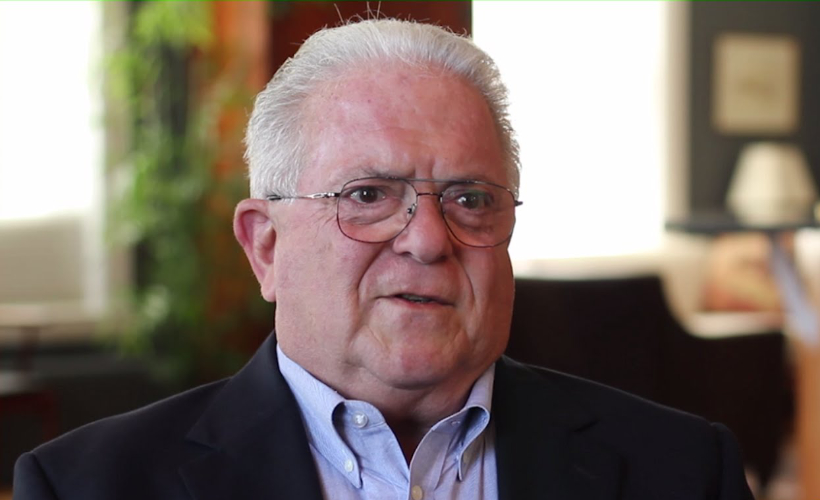
“So this is a pointless war that Trump has gotten the United States into from which he has no apparent exit.”
Larry Johnson supplied the material dimension of the same argument. The Navy fleet sustaining the campaign, he said, is running on a logistics system that was hollowed out years ago. "They used to have four fast resupply ships and someone said, Ah, we don't need all those. We'll just cut them back to two. Well, you cut them back to two now. You don't have enough to service this fleet that's out there."² The deeper problem is the arsenal itself. "The reality is that the United States is out of critical missiles, or it's running very very low," Johnson said, "and the task of replacing those missiles is beyond difficult since China controls rare earth minerals that are essential ingredients in manufacturing those missiles."² A precision-strike campaign whose precision munitions cannot be replaced at the rate they are expended is a campaign on a clock.
Against this backdrop, Vice President JD Vance's public claims of American military success drew open ridicule from Johnson. "He's doing the equivalent of stripping naked and running around declaring himself as some sort of deity," he said. "It's just a ridiculous comment."²
The Closing Stages
In Ukraine, the day's developments were not one setback but a cluster of them, and Mercouris catalogued each. A Russian drone strike overnight reached the center of Kiev, hitting a target near the main railway station, an attack he judged "particularly concerning" for the Ukrainians because of what it says about the reach of Russian strikes into the capital's core.³ In Kharkov region, by his account, roughly 2,000 Ukrainian troops remain surrounded after the capture of a string of villages, and he found the persistence of the encirclement more telling than the captures themselves.³ Kiev's answer, a reprisal raid on Moscow involving by some counts more than 400 drones, failed outright. "It seems that no drone, none of these drones was able to penetrate the increasingly dense ring of Russian air defenses created around Moscow," Mercouris said.³ And in a Kiev suburb, an open gunfight broke out between Ukraine's SBU security service and its military intelligence agency. "In a sense, this gunfight tells us again that the war is being lost in Ukraine," he concluded.³ Wounded states turn their weapons inward.
Lawrence Wilkerson reached the same destination by a shorter route. "I think what we're looking at is the beginning of the closing stages," the retired colonel said, "and the closing stages are going to be pretty much in favor of Russia as any fool even could understand."⁴ As for Ukraine's president, Wilkerson was blunt about where the failure will be assigned: "I don't know how that's going to resolve for Zelensky, but I would say there's probably a big bull's-eye on his back and on his chest right now."⁴
Why, then, does the war continue? Daniel Davis's answer is that it continues because it pays. "These elite are making money on this stuff hand over fist, and because they love to have an enemy, they want this war to continue on," he said, and he gave voice to what he regards as the actual logic of Western policy: "We don't care anything about Ukraine. Let's be crystal clear on that, too. We don't care how many Ukrainian people die. We don't care how much territory they lose."⁵ The words are his rendering of a calculation he attributes to policymakers, not a sentiment of his own, and that is precisely his indictment. What alarms Davis is where the escalation logic leads. On the prospect of nuclear use he was unambiguous: "If you break that threshold again, now there's a lot more countries that have them and they will be tempted to use them. This is bad for mankind."⁵ He placed heavy weight on the Witkoff-Kushner backchannel to Moscow. "This could be the last chance to avoid a kinetic strike against the West by Russia," he said.⁵
The escalation pressure, in The Duran's reading, is coming above all from Europe. "There's growing anger, growing panic across Europe. And they're trying in every way they can to create an atmosphere of escalation," Alexander Mercouris and Alex Christoforou observed, describing a Ukraine that "is being absolutely shattered. It's being pounded from the air. It's been blockaded on its coastline and it is losing positions on the front lines."⁶ Richard Wolff, surveying the same battlefield, noted the asymmetry underneath it: Russia is expending missiles and airpower in huge quantities while Ukraine fights on with drones because drones are what it has left.⁷ Freeman compressed the trajectory into a single line. "Ukraine has lost access to the sea. It may now be about to lose access to the air. You know, this is not a good plot."¹
The Money Is Moving
The third front has no battlefield, which is why it is the easiest to miss and, in the estimation of Hudson and Pepe Escobar, the most consequential. The Shanghai Cooperation Organisation summit produced, in Escobar's account, something more than communiqués: a push led by Putin for financial independence from the dollar system, with Iran fully aboard.⁸ Escobar also marked the strategic geography that Western coverage tends to flatten, noting that "Turkey is a NATO member. Turkey is the eastern arm of NATO implanted in Eurasia," a presence the SCO powers must design around.⁸
Hudson has been arguing for two years that the American-led order is ending; what is new is the institutional form the alternative is taking. For the countries on the receiving end of sanctions and tariffs, he said, "the only way that they can avoid this is to join with China, Russia and Iran in creating an alternative in the form of a new financial system with its own international bank."⁹ Freeman explained the mechanism driving them there in one sentence: "If you say to people you may not use dollars to buy something you need, what do you suppose they're going to do?"¹
Wolff contributed the day's most arresting number, from the Western Hemisphere rather than Eurasia. "The average fee charged for a ship going through the Panama Canal, from the Atlantic to the Pacific or vice versa, in February of this year, was $55,000. Over the last few weeks, the average fee paid by a ship going through the canal was around $5.5 million. In other words, in six months, the price of passage went up 100 times."¹⁰ He reads the spike as a symptom of a hemispheric policy that treats Latin America as a resource to be squeezed, colonial economics conducted at the toll booth. Whatever the proximate cause, a hundredfold increase in the price of passage through a chokepoint Washington claims as its strategic backyard is not a sign of an order under control.
The Through-Line
It is possible to dispute any single one of these assessments. It is harder to dispute all of them at once, delivered independently by a former ambassador, a former CIA analyst, a retired Army colonel, a retired colonel who ran a Secretary of State's office, two economists, and two of the most careful daily chroniclers of the Ukraine war. The campaign against Iran has no exit. The war in Ukraine is entering what Wilkerson calls its closing stages, on terms set in Moscow. The financial order that let Washington absorb such failures at a discount is being rebuilt by other hands. Each front has its own logic, its own actors, its own tempo. The direction is the same on all three, and it is not toward Washington.
Sources
- Chas Freeman, *Glenn Diesen* · The renewed Iran campaign is a pointless war with no apparent exit, re-destroying already replaced targets watch ▶ 12:12
- Larry Johnson, *Dialogue Works* · The US is running very low on critical missiles, and replacement is bottlenecked on Chinese rare earths watch ▶ 9:06
- Alexander Mercouris, *Alexander Mercouris* · Drone strike near Kiev's main railway station, 2,000 troops surrounded in Kharkov region, failed 400-drone raid on Moscow, SBU-GUR shootout watch ▶ 4:36
- Lawrence Wilkerson, *Judging Freedom* · The war has entered its closing stages, in favor of Russia, with a bull's-eye on Zelensky watch ▶ 2:09
- Daniel Davis, *Daniel Davis / Deep Dive* · Elites profit from prolonging the war, escalation risks crossing the nuclear threshold, and Witkoff-Kushner may be the last chance watch ▶ 22:11
- The Duran, *The Duran* · Ukraine is being shattered on every axis while a panicking Europe drives an atmosphere of escalation watch ▶ 0:53
- Richard Wolff, *Dialogue Works* · Russia expends missiles and airpower in huge quantities while Ukraine fights on with drones, the resource it has left watch ▶ 37:32
- Pepe Escobar, *Dialogue Works* · The SCO summit advanced de-dollarization with Iran fully subscribed, while Turkey remains NATO's eastern arm in Eurasia watch ▶ 16:12
- Michael Hudson, *Dialogue Works* · The US order is ending, and targeted countries' way out is an alternative financial system with its own international bank watch ▶ 32:49
- Richard Wolff, *Dialogue Works* · Panama Canal passage fees rose roughly 100 times in six months, from $55,000 to about $5.5 million per ship watch ▶ 15:30
By Ruins Report, a daily synthesis of what our tracked analysts said, not original reporting. Every numbered claim is sourced, dated, and timestamped above.
Newsletter
Get the Daily Debrief
One email each morning: what the analysts we track actually said, and every call timestamped to its source. Free.
Free. No spam. View on Substack →
Support the Report
Free to read, every day.
The Debrief is compiled each morning from what the analysts we track actually said, sourced and timestamped. No paywall, no ads, no investors. If it earns a place in your inbox, you can help keep it independent.
Support the report →