
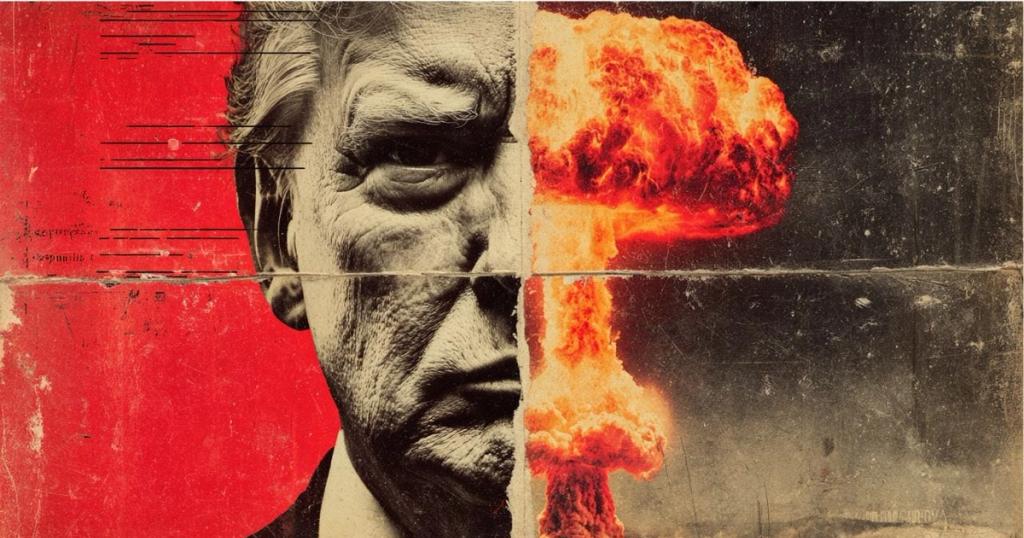
The most dangerous questions in foreign policy are often the ones respectable people avoid asking.
Not because they are fanciful. Quite the opposite. They are avoided because once spoken plainly, they force a confrontation with harsh realities. In the current Middle East crisis, one such question hangs over every discussion of war, alliance and restraint:
What happens when an ally treats a conflict as existential, possesses nuclear weapons, and believes it can pressure the United States into fighting on its behalf?
The question is uncomfortable for obvious reasons. It cuts against decades of ritual language about shared values, ironclad bonds and strategic partnership. It also challenges a deeply ingrained assumption in Washington: that the United States controls escalation because it is the larger power. But size alone does not guarantee control. Not when domestic politics reward submission, not when policymakers fear the costs of refusal, and not when the smaller ally can imply that the alternative to support may be regional or even civilizational catastrophe.
This is the territory where alliance ends and coercion begins.
No serious analyst should claim certainty about secret threats or private ultimatums without evidence. But foreign policy is not only made through explicit declarations. It is shaped by signals, by atmospheres of fear, by calculated ambiguity and by the strategic use of worst-case scenarios. In that sense, direct blackmail need not be spoken aloud to be effective. If decision-makers in Washington believe that refusing an ally could trigger extreme and uncontrollable escalation, that belief itself exerts pressure.
The pressure becomes more acute when the ally in question has long enjoyed extraordinary indulgence. For decades, American support for Israel has often functioned less like a normal alliance than like a political reflex. Aid, diplomatic cover, military assistance, and rhetorical loyalty have survived changes in government, strategic blunders, and moral catastrophe alike. What might have been a relationship of mutual responsibility has instead become one of asymmetry, in which one side repeatedly demonstrates that it can impose costs on the other without paying meaningful penalties itself.
That dynamic does not produce prudence. It produces impunity.
And impunity, over time, curdles into hubris.
Read more
Listen to CATR on:
Newsletter
Subscribe to Conversations Among the Ruins
Long-form geopolitics and the decline of the unipolar world order. New episodes straight to your inbox.
Free. No spam. View on Substack →
Reader-funded
This is independent, long-form work.
Conversations Among the Ruins is written, not repackaged, and it stays free because readers choose to fund it. If it is worth your time, a paid subscription or a one-off tip keeps it going.
Become a supporter →