
If you wanted to push Iran as close as possible to a nuclear weapon, what would you do?
You would not need to smuggle uranium or hand over missile designs. The more effective strategy would be political. You would destroy the incentives for restraint, eliminate the people arguing against escalation, and make the case for a bomb far more persuasive in Tehran than any speech by a hard-liner ever could.
In fact, this approach has already been tested. It appears to have worked remarkably well.
For years, Washington’s official position was simple: Iran must never obtain a nuclear weapon. But the actual effect of American and Israeli policy has been to move Iran much closer to one. The tragedy is not only that this outcome was avoidable. It is that it was predictable.
Here, then, is the playbook.
Step 1: Tear up the agreement that was working
Before the collapse of the nuclear deal, Iran’s program was under extraordinary scrutiny. It was the most heavily inspected civilian nuclear program in the world. Inspectors monitored facilities, stockpiles, and enrichment levels. Cameras were in place. Surprise inspections were frequent.
And just as important, Iran had accepted real constraints.
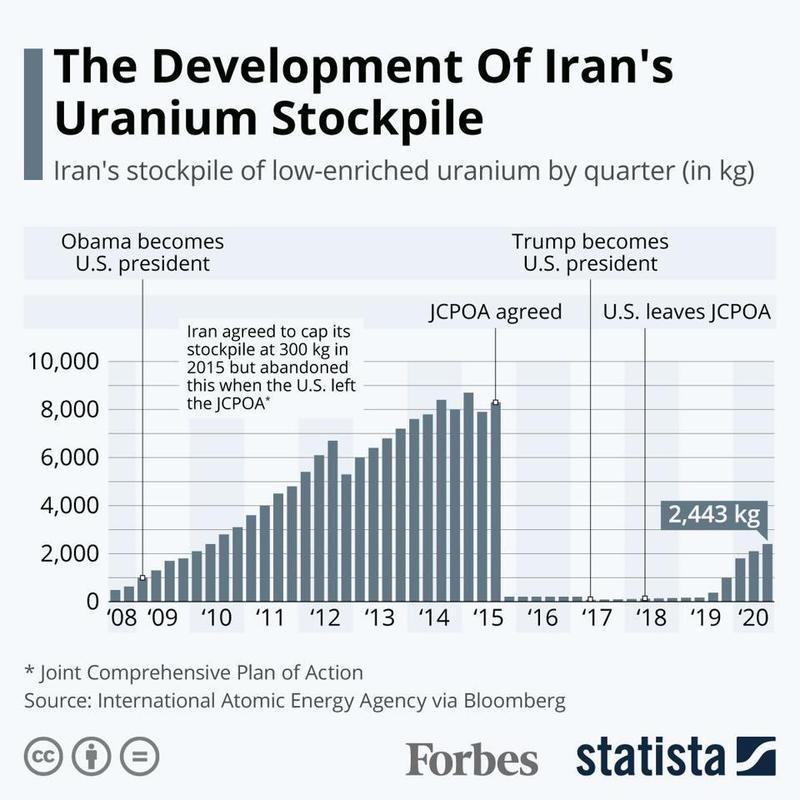
Whatever one thought of the Joint Comprehensive Plan of Action, it achieved the thing its critics claimed to want. It kept Iran away from the bomb and kept the program under constant surveillance. If parts of the agreement were imperfect, they could have been renegotiated as would have been proper when the agreement expired in 2025. If its sunset clauses were too generous, they could have been revisited at that time. That is what diplomacy is for.
Instead, the United States tore it up.
Iran did not immediately abandon its obligations. It continued to comply for a significant period even after Washington walked away and failed to deliver on its own commitments. But no state will observe restrictions forever while the other side shreds the bargain. Eventually, Tehran began moving beyond the limits of the deal.
That was the first great gift to Iran’s nuclear hawks.
Step 2: Wait Until Diplomacy Is About to Work, Then Blow It Up
If you really want to push Iran toward the bomb, do not strike when talks are dead. Strike when they are alive, fragile, and closest to succeeding.
Between April and June 2025, Washington and Tehran completed five rounds of indirect negotiations aimed at restoring meaningful limits on Iran’s nuclear program. A sixth round was scheduled for June 15. By multiple accounts, the two sides were nearing a breakthrough. Mediators said the outline of a deal was almost complete. Iran was reportedly prepared to accept a three-to-five-year freeze on domestic uranium enrichment, strict limits on stockpiles, and the transfer of highly enriched uranium to a third country. In return, the United States and its European allies were prepared to lift a substantial share of sanctions.
In other words, the very thing Western leaders claimed to want was suddenly within reach.
So naturally, the process was destroyed.
On June 12, just seventy-two hours before the next round of talks, the IAEA formally censured Iran for non-compliance, suddenly reviving a years-old claim of uranium traces at undeclared sites. Whatever the technical merits of the censure, the timing was extraordinary. Tehran saw it as a politically loaded move designed to provide a legal and diplomatic pretext for escalation. Critics argued that the agency’s public posture helped create the appearance that diplomacy was failing, even as diplomacy was still underway and making progress.
Then, on June 13, just two days before the next round of scheduled talks, Israel launched a surprise air campaign that killed Iranian scientists and IRGC commanders and damaged nuclear infrastructure.
The message was unmistakable: not merely that the talks were finished, but that compromise would be answered with bombardment.
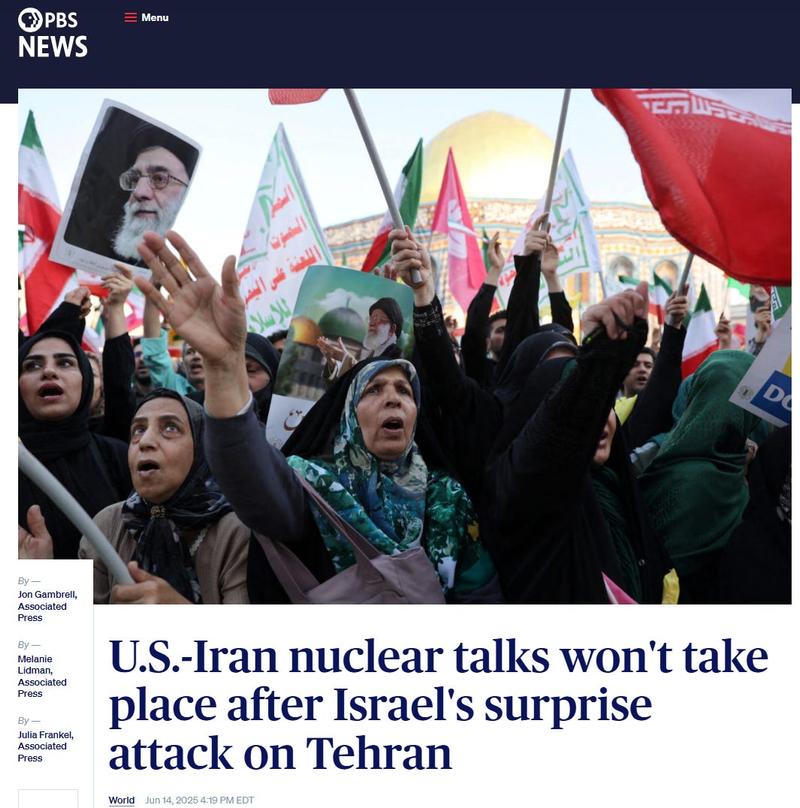
The result was entirely predictable. Iran suspended talks indefinitely. The diplomatic channel vanished. European powers moved toward snapback sanctions, effectively burying what remained of the old nuclear framework, and, in response, Iran ended all IAEA inspections. A path that might have capped enrichment, removed stockpiles, and restored verification was replaced by open-ended escalation.
If your goal is to stop a bomb, you lock in the agreement that freezes enrichment and ships the material out. But if your goal is to make a bomb more likely, you sabotage the agreement just before the signatures, which is exactly what happened last June and again this February.
Step 3: Push Iran to the threshold and call it success
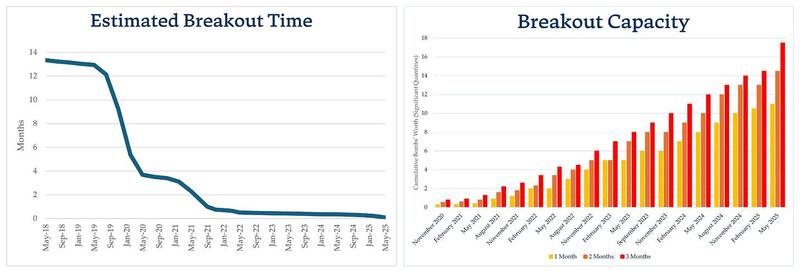
Iran has now enriched uranium to 60 percent. That is not the same as weapons-grade uranium, but it is close enough to make the distinction less comforting than it sounds.
The difficult part of enrichment is at the beginning. The move from 60 percent to 90 percent, the level typically associated with weapons-grade material, is far quicker. The timeline is measured in weeks, not years.
That is what breakout capability means. It means a country can stand just short of the bomb while making clear that, if attacked or cornered, it can cross the line quickly.
This posture is often presented as if it were some mysterious Iranian provocation detached from context. It is not. It is the rational posture of a state that has learned that Washington and Tel Aviv may attack at any time, regardless of conventional deterrents.
If you want a country to conclude that only a nuclear deterrent can guarantee its survival, repeatedly demonstrate that every lesser form of restraint will be ignored.
Step 4: Kill the case for restraint
Once you have wrecked diplomacy and destroyed inspections, there is still one danger left: the possibility that someone on the other side might choose restraint anyway. So remove that too.
On February 28, 2026, the United States and Israel did exactly that. In the opening hours of Operation Epic Fury, they did not merely strike military sites or nuclear infrastructure. They deliberately decapitated the Iranian state. The first wave of attacks hit the leadership core of the regime, obliterating the compound of Ayatollah Ali Khamenei and wiping out much of his family in a single morning.
The Supreme Leader, Ali Khamenei, the man who for decades had prohibited any move towards the development of a nuclear weapon in Iran, was killed. So were his daughter, his son-in-law, and his daughter’s 14-month-old infant. His son, Mojtaba Khamenei, the man who would soon inherit power, survived the attack but lost almost all of his immediate family. His wife was killed. His teenage son was killed. His mother died days later from her injuries. Within less than two weeks, he became the new Supreme Leader, the man now responsible for determining the direction of Iran’s nuclear program.
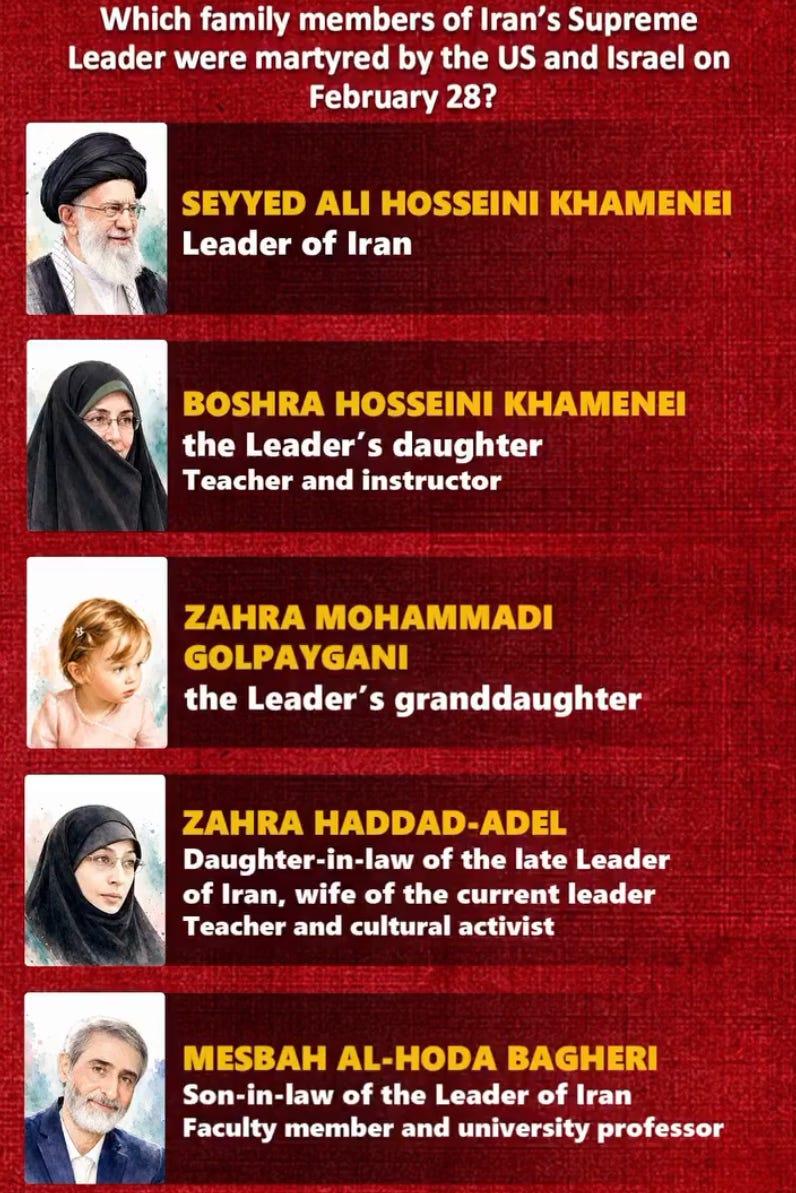
If you wanted to create the least persuadable leader imaginable, this is how you would do it.
Then make sure the country sees the war not as a contest between states, but as a slaughter of its children. About an hour into the assault, two Tomahawk missiles slammed into the Shajareh Tayyebeh Elementary School in Minab. The first strike, reportedly caused by outdated targeting intelligence, collapsed the roof while classes were in session. The second in the double-tap hit as people rushed to the rescue. One hundred sixty-eight people were killed, most of them girls between 7 and 12 years old.
That is how you end any remaining constituency for compromise.
At that point, “restraint” is no longer a strategic option. It is political suicide. It is moral humiliation. It is an invitation to further annihilation. A regime that might once have argued for patience, diplomacy, or religious prohibition is now led by a man whose father, wife, son, and extended family were killed by a joint American-Israeli attack, in a country where schoolgirls were lying under the rubble.
And then, in one of history’s more grotesque performances of self-deception, demand that this leadership still honor the old red lines. Expect them to preserve the fatwa and reject the bomb. And more than that: demand that they end their civilian nuclear program entirely and hand over their enriched uranium to one of the nations that just attacked them.
This is not how you stop nuclear proliferation. This is how you vaporize every argument against it.
Step 5: Make the bomb look like self-defense
This is the inevitable culmination of the previous four. Do not merely threaten a country that does not have a nuclear weapon and has consistently demonstrated that it is not seeking one (per our own intelligence agencies). Convince it that the threat is permanent, personal, and immune to negotiation and that its only route to safety lies in the development of nuclear weapons.
Say over and over that Iran must never have a nuclear weapon. Then destroy the agreement that was preventing it. Enter negotiations and allow them to be undercut by force. Conduct surprise attacks in the middle of diplomacy. Signal that there is no stable path to security through compliance.
And while you are threatening and attacking the country that sought to comply with nuclear safeguards, leave in peace the country that answered your threats with the development of a nuclear weapon. That country, of course, is North Korea.
Has the United Navy assembled its forces off North Korea’s coast? Has it launched decapitation strikes against Kim Jong-un and his family?
The logic is brutally obvious to Iran. North Korea is safe, and Iran is vulnerable. And there are the further examples of Libya, which gave up its program and was destroyed, and of Iraq, which did not have weapons of mass destruction and was invaded on the pretense that it had them. If Iran complied with inspections and still got strangled, sabotaged, and attacked, what conclusion is Tehran supposed to draw? that patience will save it? that trust will protect it?
No serious strategist should expect such an answer.
The uncomfortable truth is that a near-nuclear Iran is not simply the product of Iranian ambition. It is the product of U.S. policy failure on a grand scale. It is what happens when slogans replace strategy and coercion replaces statecraft.
For years, the United States insisted that Iran could not have a nuclear weapon. Yet at each critical juncture, it chose the option most likely to persuade Iran that it needs one.
And so here we are, at the edge of the outcome we claimed to fear most, asking how this could have happened.
The answer is not complicated.
We walked them there.
Listen to CATR on:
Newsletter
Subscribe to Conversations Among the Ruins
Long-form geopolitics and the decline of the unipolar world order. New episodes straight to your inbox.
Free. No spam. View on Substack →
Reader-funded
This is independent, long-form work.
Conversations Among the Ruins is written, not repackaged, and it stays free because readers choose to fund it. If it is worth your time, a paid subscription or a one-off tip keeps it going.
Become a supporter →