
The Great Decoupling: Are We Watching the Beginning of a US-Israel Split?
For years, one of the most durable assumptions in American foreign policy was that any serious rupture between Washington and Israel was impossible. There could be tactical disagreements, angry phone calls, and carefully leaked reports of tension. But when it mattered most, the United States would align itself with Israel’s strategic priorities and absorb the political costs.
That assumption now looks less secure than it once did.
A newly reported memorandum of understanding between the United States and Iran, expected to be formalized in Switzerland, has done more than advance a possible regional ceasefire. It has exposed a question Washington has spent decades avoiding: what happens when Israel’s aims and America’s interests no longer overlap, and when the divergence becomes too obvious to deny?
The immediate source of the strain is clear enough. The reported agreement appears to extend to Lebanon, with an understanding that Israeli military action there must stop and that any broader peace arrangement would require Israeli withdrawal. That is not a technical dispute. It goes to the heart of Israel’s preferred regional posture, which depends on preserving freedom of action in Lebanon elsewhere and retaining the right to escalate at will.
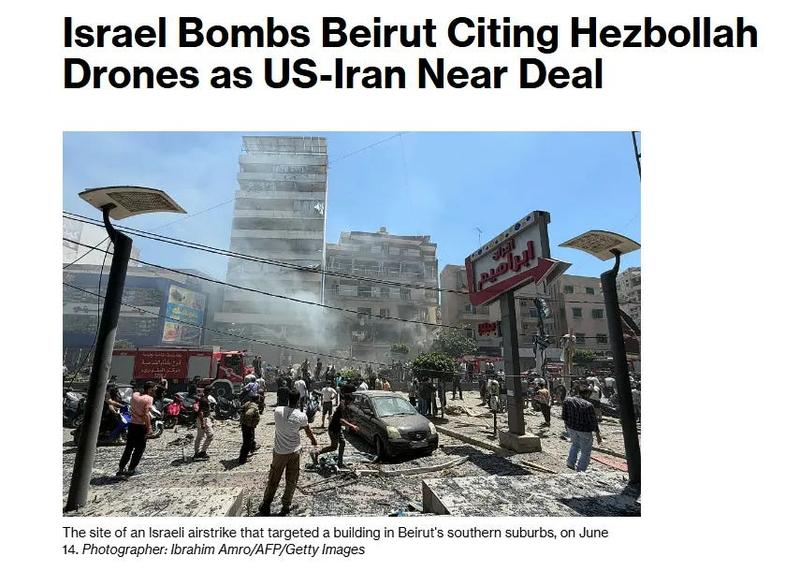
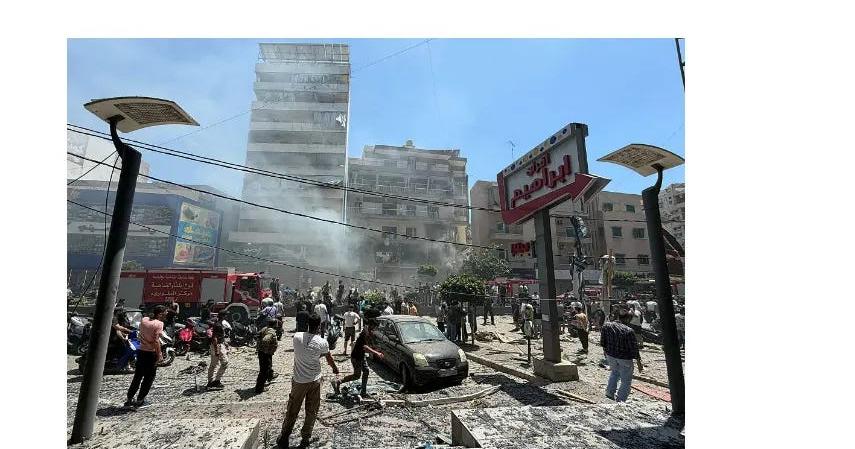
Israel’s response has been revealing. A strike on Beirut’s southern district, launched as reports of a deal were circulating, looked less like an isolated military action than a political message. It appeared designed to test the limits of the agreement before it was even signed and to remind Washington that Israel retains the capacity to sabotage any regional arrangement it does not like. Iranian threats of retaliation quickly followed, and the risk of rapid escalation returned at once.
That sequence clarifies the real issue. The question is not simply whether the United States can reach an accommodation with Iran. It is whether Washington can enforce that accommodation against the objections of Israel.
For decades, American presidents avoided that confrontation. They indulged Israel’s preferences, often absorbed its arguments as their own, and stopped short of any move that would force a true reckoning. Even presidents who quarreled bitterly with Israeli leaders understood the line they would not cross. They might delay weapons shipments or complain about settlements, but they did not fundamentally separate the American interest from the Israeli one in public, and they did not compel Israeli retreat on issues that Israeli leaders considered vital.
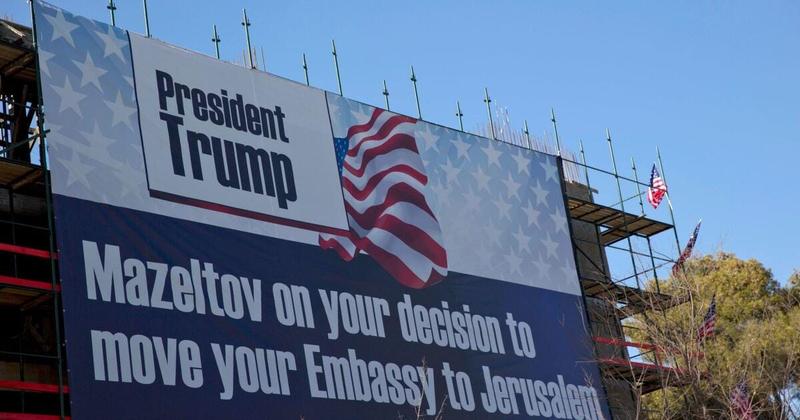
That is one reason this moment is so striking. President Trump, of all people, may be the rare American president with the political room to force the issue. His record gives him unusual cover. He moved the American embassy to Jerusalem, recognized Israeli claims over the Golan Heights, and built a reputation as perhaps the most pro-Israel American president ever. No one can plausibly accuse him of being anything less than a zealous supporter of Israel. That gives him a form of political immunity his predecessors lacked. A president with weaker credentials would be far more vulnerable to charges of betrayal. Mr. Trump, by contrast, can point to how, again and again, he has delivered the goods on behalf of the Zionist cause. That does not mean he will follow through. It means only that he can.
There is a larger reason the possibility of decoupling has emerged now. The war itself has revealed the limits of American leverage and the costs of subordinating American policy to Israeli priorities. The United States entered this phase of the crisis hoping for a dramatic show of force that would, at the very least, weaken Iran and establish Israeli dominance of the region. Instead, it discovered what previous administrations had long feared: Iran could impose costs, retaliate in meaningful ways, and deny Washington and Tel Aviv the clean victory they wanted.
If the reported terms of the new understanding are accurate, they amount to a tacit admission of that reality. Iran is not agreeing to surrender the core components of its regional posture. There is no indication that Tehran will abandon its missile arsenal or sever ties with its allies. Instead, the agreement appears to begin with sanctions relief, the return of frozen funds, and the reopening of the Strait. In substance, that looks less like a dictated peace than a negotiated retreat. That is precisely why Israel is so alarmed. The Israeli strategy vis-à-vis Iran has long depended on the premise that the United States could ultimately be pushed toward a devastating confrontation with Iran. The confrontation has now taken place, yet Iran still stands. What is more, Washington appears to have concluded that the time has come to extricate itself from the conflict, Israeli interests be damned.
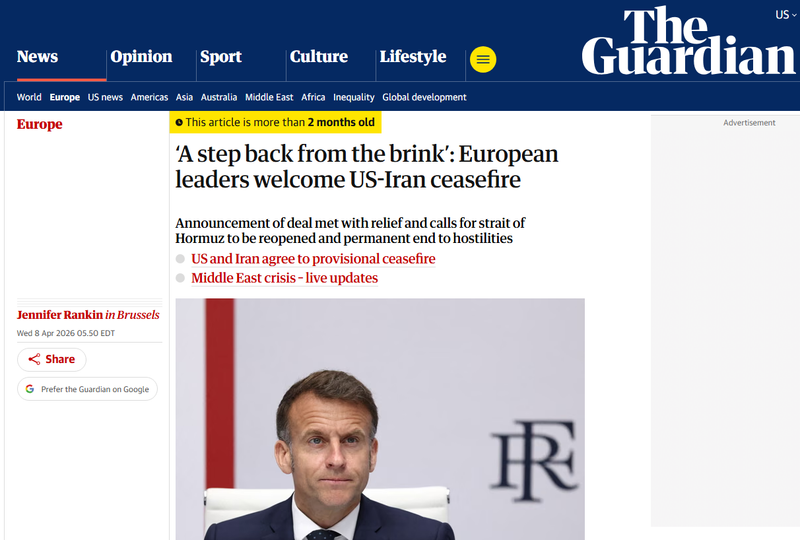
Such a move by Washington exposes an uncomfortable truth. The American public did not want another Middle Eastern war, and much of the broader Western alliance had little or no appetite for it. European leaders, international institutions, and much of Washington’s own policy establishment appear relieved by the prospect of de-escalation. Israel, by contrast, stands almost alone in wanting to preserve the escalatory logic that brought this crisis to the brink.
That isolation could prove politically consequential. If Israel moves to torpedo the agreement by, for example, striking Lebanon again, it will become harder to maintain the familiar fiction that Washington and Jerusalem are simply defending a shared strategic order. The divergence will be obvious to everyone. The United States will be trying to get out, while Israel will be trying to drag the US back in.
That distinction matters more now than it once did. Support for Israel in the United States has not disappeared, but it is plainly much weaker than before. Public patience is fraying. Many Americans are beginning to ask what exactly this alliance delivers to the United States, especially when it repeatedly produces crises that Washington itself then struggles to contain.
None of this guarantees a lasting break. There are good reasons for skepticism. Mr. Trump has often reversed himself, declared success before the terms were secured, and abandoned discipline once the headline moment passed. Israel understands this about Trump and has developed a counterstrategy. It does not need to defeat American pressure immediately. It only needs to outlast it. The Trump administration, for its part, may very well settle for appearances: a signed memorandum, a temporary lull, a round of self-congratulation, followed by the gradual return of the old pattern.
And yet a threshold may have been crossed. The implications reach far beyond the immediate crisis. The current decoupling, however imperfect and temporary it may prove to be, is a sign of a crumbling US Middle East policy architecture. It is an admission that Israeli priorities are not identical to American ones, that regional stability may depend more on accommodation with rival powers than on endless alignment with Israel, and that military strength does not necessarily translate into strategic success.
The United States does not need to become hostile to Israel in order to recover a coherent foreign policy. It does, however, need to rediscover that a distance exists between Washington and Tel Aviv. For too long, the reality of separate interests has been obscured. The result has been a series of wars, crises, and commitments that served a narrow agenda deeply inimical to both US interests and principles.
Whether this becomes a durable lesson remains uncertain. Israel will resist it. Its supporters in Washington will resist it. Much of the American political class will resist it instinctively, because the old habits remain deeply entrenched. But a possibility that once seemed unthinkable has now entered the realm of the plausible.
The question that truly matters now is not whether a memorandum will be signed in Switzerland. It is whether the United States has finally begun to separate its own interests from Israel’s. If that process has started, even imperfectly, then the most consequential development of this crisis will not be a ceasefire, but rather the first visible crack in the “special relationship.”
Listen to CATR on:
Newsletter
Subscribe to Conversations Among the Ruins
Long-form geopolitics and the decline of the unipolar world order. New episodes straight to your inbox.
Free. No spam. View on Substack →
Reader-funded
This is independent, long-form work.
Conversations Among the Ruins is written, not repackaged, and it stays free because readers choose to fund it. If it is worth your time, a paid subscription or a one-off tip keeps it going.
Become a supporter →