
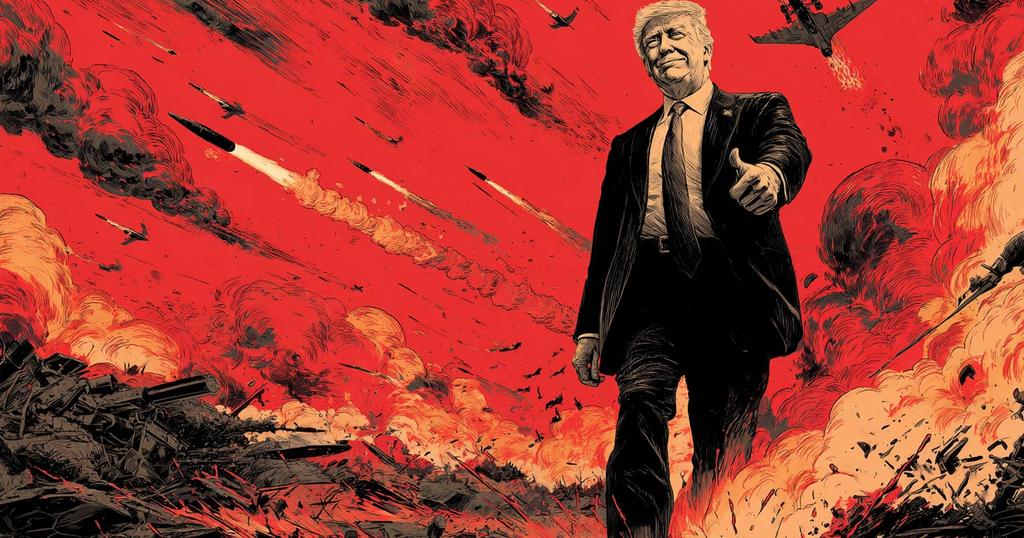
There is a comforting habit in political analysis: to assume that leaders, whatever their flaws, are at least constrained by reality. If the costs mount high enough, if the risks become sufficiently obvious, if the exit ramps remain visible, then surely self-preservation will prevail.
That assumption may be the most dangerous illusion in American politics today.
For months, many observers have consoled themselves with the idea that Donald Trump, whatever his rhetoric, would ultimately want out of a widening war. The reasons seem plain enough. A prolonged conflict threatens oil markets, depletes military stockpiles, strains alliances, destabilizes the global economy and exposes the United States to the kind of strategic overreach that has broken administrations before. A rational leader, faced with those realities, would be looking for a way to step back.
But what if the premise is wrong? What if the mistake is not in the analysis of the war’s costs, but in the assumption that those costs are being processed in a rational way at all?
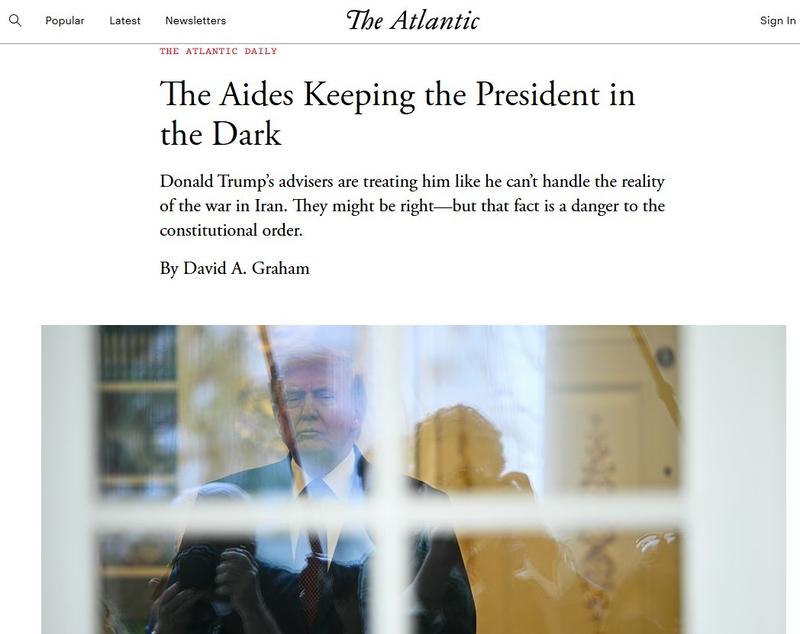
The great danger in moments like this is not only fanaticism or ideology. It is the closed loop of power, where a leader becomes insulated from bad news, dependent on flatterers and increasingly convinced that persistence itself is a strategy. The war then ceases to be merely a policy choice. It becomes a psychological necessity. To retreat is to lose face. To compromise is to concede weakness. To continue, however disastrous, is to preserve the fantasy of eventual triumph.
This is one of the oldest traps in modern statecraft. Once a leader commits to war, the political and personal costs of reversing course often begin to exceed, in that leader’s mind, the costs of escalation. The longer the conflict drags on, the more unbearable the idea of withdrawal becomes. The logic is ruinous but familiar: having paid so much already, one must pay more in the hope that some final exertion will redeem the rest.
The United States has lived this logic before. Vietnam was sustained for years by the belief that one more campaign, one more show of force, one more increment of pressure might finally break the enemy’s will. Instead, the war consumed credibility, treasure and lives while exposing the limits of American power. It ended not with victory, but with the belated recognition that reality had not been impressed by American insistence.
There are signs that Washington may once again be drifting into a renewed confrontation governed less by strategic clarity than by emotion. The military buildup suggests preparation for a larger strike. The stated objectives remain murky. Is the aim deterrence? Punishment? Regime change? A symbolic demonstration of resolve? The absence of a coherent answer is itself an answer. It suggests a government moving toward deeper involvement without a plausible theory of success.
That would be reckless under any circumstances. It is especially reckless now.
The United States is not entering this period of tension with unlimited capacity. Reports of depleted stockpiles are no longer peripheral concerns. They point to a deeper structural weakness. For years, Washington has maintained the image of overwhelming military superiority while allowing the industrial foundations of sustained warfare to atrophy. The country can still destroy. It can still project force. It can still inflict immense damage on weaker states. But destruction is not strategy, and capacity is not infinite.
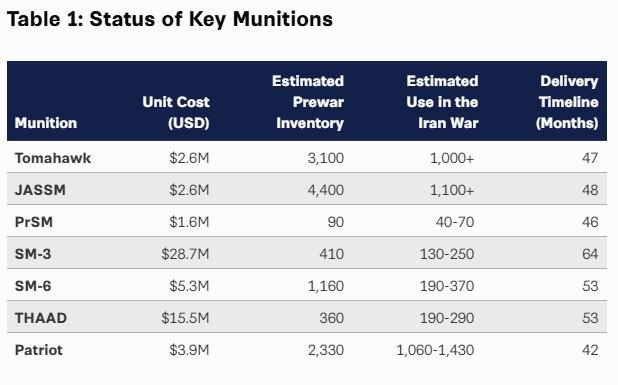
This mismatch has been exposed most vividly by recent wars. America and its allies have spent lavishly on expensive legacy systems while struggling to produce sufficient quantities of basic munitions, interceptors and artillery shells. The problem is not simply waste, though there has been plenty of that. It is a failure of adaptation. The battlefield has changed faster than the institutions responsible for preparing for it.
The age of massed, networked, relatively inexpensive and increasingly autonomous systems is no longer theoretical. Drones, AI-assisted targeting, electronic warfare resilience and surveillance integration are reshaping combat in real time. Private firms, particularly in the technology sector, appear more agile in recognizing this shift than the vast bureaucracies of the traditional military establishment. That may produce a different kind of danger: a more nimble and technologically integrated war machine joined to political leadership that is impulsive, insulated and unrestrained.
The implications stretch far beyond one conflict.
A prolonged American entanglement in the Middle East would not simply drain resources. It would force hard tradeoffs across the map. Assets shifted to one theater leave another exposed. Stockpiles consumed in one crisis cannot deter adversaries elsewhere. If regional guarantees begin to look hollow, allies in Asia and Europe will draw their own conclusions. Security arrangements that have endured for decades rest on a basic bargain: the United States provides stability, including protection of trade routes and energy flows, and in return receives strategic alignment. If Washington can no longer uphold its end reliably, reassessment becomes inevitable.
This is how great powers lose influence. Not always through spectacular defeat, but through cumulative failures of judgment that reveal promises to be unsustainable.
The danger is not confined to foreign policy. War has a way of distorting domestic politics. It centralizes authority, narrows public debate and creates incentives for secrecy, surveillance and coercion. In every era, governments have discovered that external conflict can serve as internal cover. Wartime urgency justifies extraordinary powers. Dissent becomes suspect. Temporary measures acquire permanence.

That possibility is no longer abstract in an age of advanced data systems, algorithmic surveillance and AI-enabled targeting. The same technologies being integrated into modern weapons platforms can also deepen systems of domestic control. The line between battlefield intelligence and civic monitoring is thinner than democracies like to admit. Once a political class accepts permanent emergency as a governing condition, the tools built for war rarely stay abroad.
Americans should resist the temptation to view such warnings as melodramatic. History offers little support for complacency. Countries do not imagine themselves into repression all at once. They drift there through rationalizations, each one tied to some urgent necessity, until what once seemed unthinkable becomes administratively routine.
That is why the most important political task in moments like this is not prediction. It is resistance to false inevitability.
There is nothing inevitable about a wider war. There is nothing inevitable about exhausting military stockpiles for an incoherent objective. There is nothing inevitable about sacrificing alliances, accelerating geopolitical decline and inviting domestic authoritarianism in the name of credibility. Those are choices. They can still be rejected.
But rejection requires seeing the situation clearly. It requires abandoning the reassuring fiction that escalation will be checked automatically by common sense at the top. Common sense is not a guardrail when power is concentrated in the hands of a leader who may no longer be receiving, or accepting, reality as it is.
The most alarming possibility is not merely that the United States could stumble into disaster. It is that too many people still assume someone in charge must understand the danger and be preparing to stop it.
If that assumption fails, everything else may follow.
Listen to CATR on:
Newsletter
Subscribe to Conversations Among the Ruins
Long-form geopolitics and the decline of the unipolar world order. New episodes straight to your inbox.
Free. No spam. View on Substack →
Reader-funded
This is independent, long-form work.
Conversations Among the Ruins is written, not repackaged, and it stays free because readers choose to fund it. If it is worth your time, a paid subscription or a one-off tip keeps it going.
Become a supporter →