
There are moments in history when the official story remains intact long after reality has moved on. Empires are especially prone to this lag. Their institutions continue speaking in the language of dominance even as the conditions that made dominance possible begin to disappear.
That is what this war appears to have revealed.
For years, the central assumption of American foreign policy has been that the United States could escalate almost at will, absorb the costs, and compel adversaries to retreat. The credibility of that assumption rested not only on military force, but on something more important: the belief that American power was inexhaustible. The United States, in this view, was not simply stronger than its rivals. It was durable in a way they were not. It could outlast, outproduce, and out-escalate.
That belief now looks badly shaken.
Even if one grants the immense damage inflicted on Iran, the larger strategic question is hard to avoid: who emerged stronger, and who emerged weaker? A war is not judged only by the destruction it causes. It is judged by what it reveals about the balance of power after the smoke clears.
And what this war has revealed is unsettling for Washington and its allies.
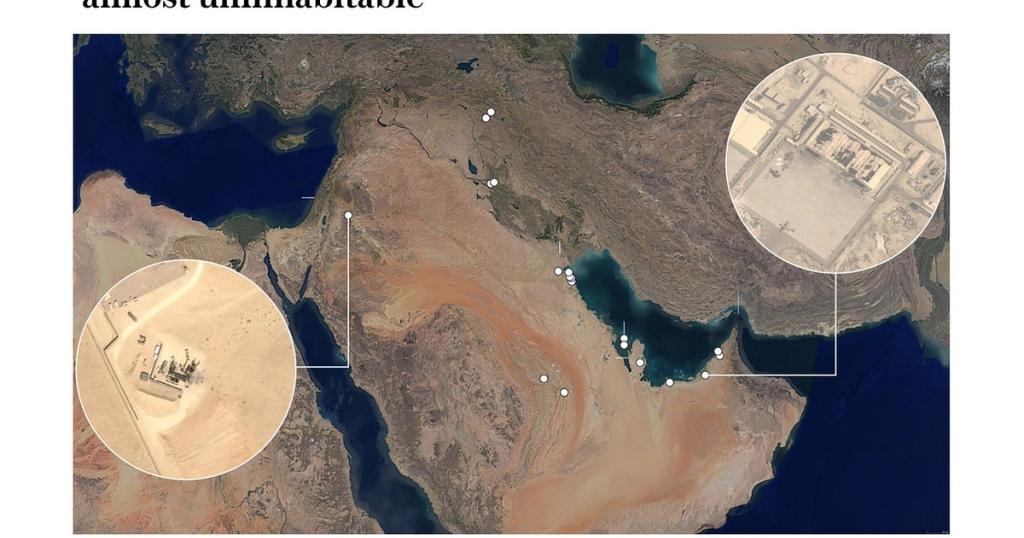
Iran suffered grievously. Thousands were killed. Infrastructure was damaged. Economic losses mounted into the billions. But the country also demonstrated something it had long been assumed either unwilling or unable to do. It proved that it could retaliate forcefully, impose costs, and dismantle the regional architecture on which American power depends.
That matters. Deterrence is not a slogan. It is a lived perception. Before the war, much of the region’s strategic thinking seems to have been built on the assumption that Iran’s retaliatory capabilities were either exaggerated or politically unusable. Now that assumption is harder to sustain. A capability once treated as theoretical has become real.
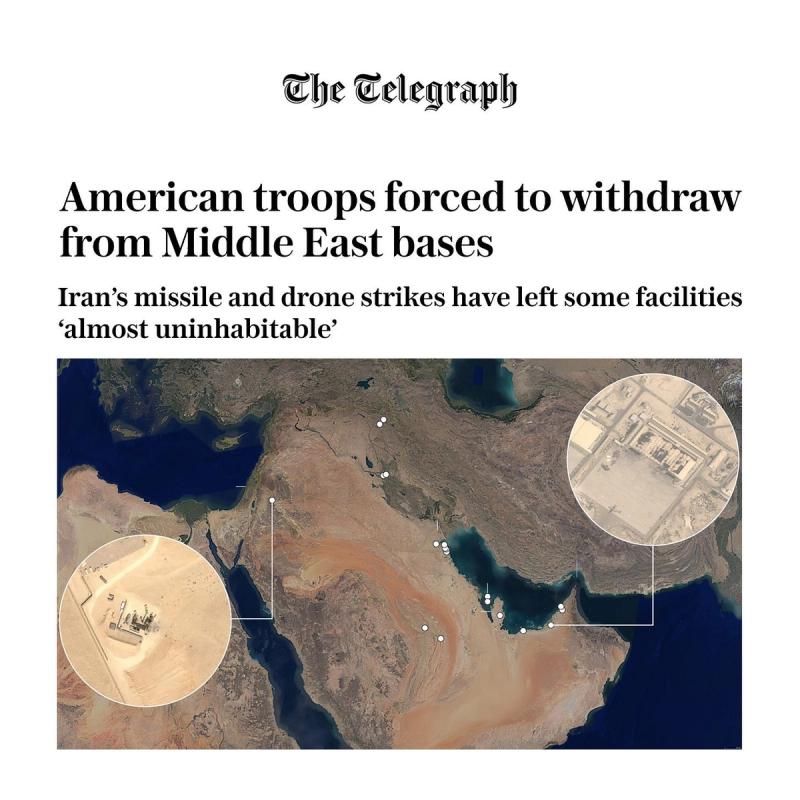
This is not a minor correction. It changes the calculus of future conflict.
The deeper blow, however, may have been dealt not to hardware but to credibility. The American security umbrella has long been one of the chief instruments of U.S. influence. It offered allies and clients a simple proposition: align with Washington, and Washington can protect you. But security guarantees are persuasive only if they survive contact with war. Once military bases become vulnerable, once expensive systems are depleted faster than they can be replaced, once regional assets appear exposed rather than commanding, the guarantee begins to look less like an iron shield and more like a marketing slogan.
The problem is not merely tactical. It is industrial.
Modern war is a test not only of weapon quality, but of productive capacity. A military power that cannot replenish what it expends is not a military power in the old sense. It is a military inheritance living off stockpiles accumulated under different economic conditions. This distinction is now becoming harder to ignore.
The United States has spent years talking about great power competition while allowing the industrial foundations of great power warfare to atrophy. The result is a glaring contradiction. Washington still speaks in the register of global supremacy, but its munitions base increasingly resembles that of a country unprepared for prolonged conflict. Precision weapons can be consumed at a pace wildly out of proportion to peacetime production. Interceptors, launch systems, radar platforms, and other critical assets cannot simply be conjured back into existence on political demand.
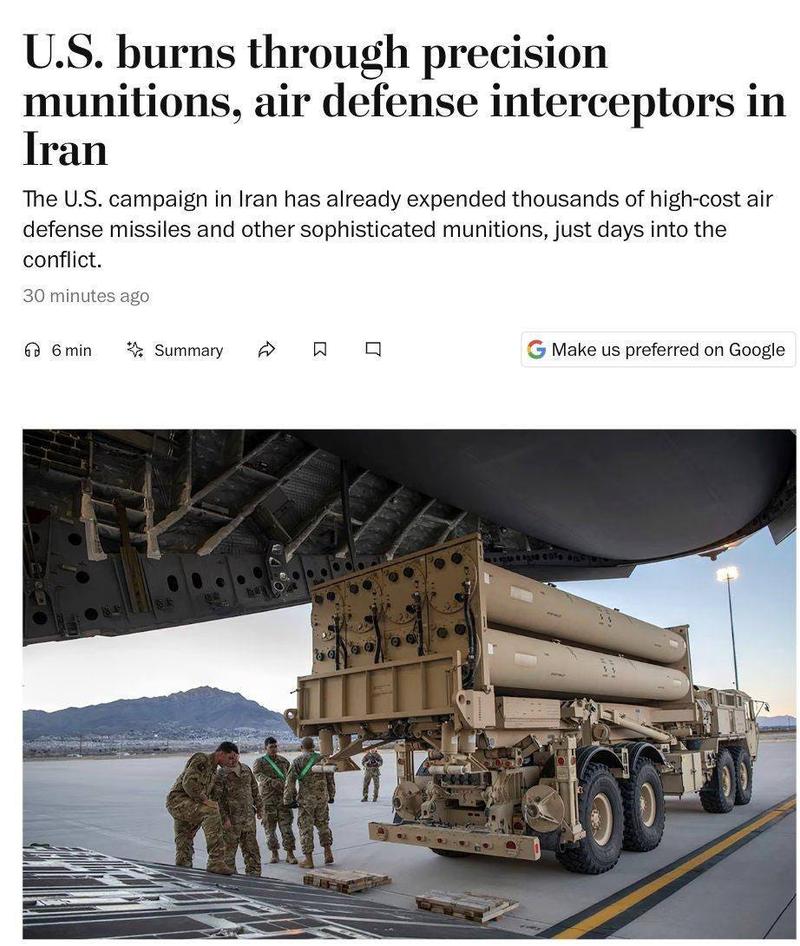
That reality is not merely a procurement issue. It is strategic fact.
If a country can sustain only the opening phase of a war, then its threats become less persuasive the longer the war continues. And if its adversary believes time is on its side, then escalation loses much of its coercive value. In conflicts of attrition, the clock becomes a combatant. The side better able to absorb pain, improvise under pressure, and replenish losses gains an advantage that no amount of rhetoric can erase.
This is where the war’s implications widen beyond the Middle East.
The conflict cannot be understood in isolation from the wider rearrangement now underway in world politics. Over the past two decades, American policy has had a remarkable unifying effect on its adversaries. States that once maintained distance from one another have moved steadily closer, driven less by shared ideology than by shared exposure to U.S. pressure. Russia, China, and Iran do not need to agree on everything to recognize that they face a common adversary. These are strategic partnerships born of necessity.
“Balance” and “divide” have long been long been key entries in the lexicon of imperial statecraft. A hegemon survives by dividing its challengers, balancing among them, and preventing the emergence of a unified counterweight. It weakens itself when it transforms multiple powers into a single strategic bloc by confronting all of them at once. Yet that is precisely what American policy has done. Through sanctions, encirclement, proxy wars, and maximalist demands, Washington has helped produce the very convergence it claims to oppose.
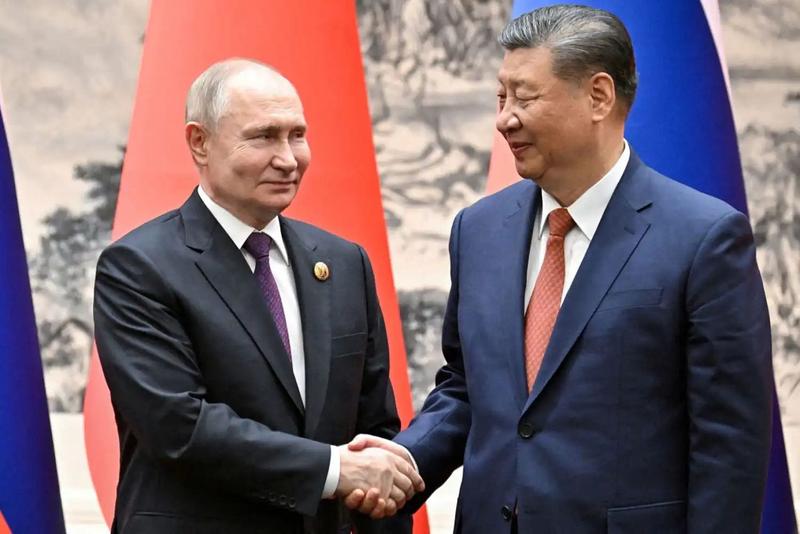
There is a bitter irony here. American officials often describe adversarial cooperation as though it emerged mysteriously, as though hostile powers simply drifted together out of innate malice. In reality, they were pushed together by a foreign policy too arrogant to prioritize. Hubris accomplished what diplomacy should have prevented.
The consequences are already visible. Wars in one theater now affect the balance in another. Munitions diverted to one front reduce flexibility on the next. Strains on logistics, production, and force posture cannot be compartmentalized forever. Nor can commodity shocks. If major trade routes are disrupted, global markets realign around suppliers able to fill the gap. Rivals benefit not only militarily but economically.
The issue, then, is not simply whether the United States can win a given engagement. It is whether it can sustain a system of global military commitments that presumes near-limitless capacity. Increasingly, the answer appears to be no.
What makes this moment especially dangerous is that political elites often respond to decline not with restraint, but with delusion. Great powers rarely surrender their self-image voluntarily. When the gap between rhetoric and reality becomes too wide, leaders do not always adjust downward. Sometimes they double down. They reach for riskier options. They convince themselves that one more display of force, one more act of escalation, one more gamble will restore the credibility already lost.
This is the most alarming possibility now facing the United States and its allies. A power that senses its primacy slipping may become more reckless, not less. It may begin considering actions that would have seemed unthinkable at an earlier stage of the conflict. It may broaden war in the name of preserving order, only to accelerate the disorder it fears. History is full of declining powers making catastrophic choices precisely because they could not accept limits.
And yet there remains another path, one so obvious that its rejection has become one of the great mysteries of contemporary American politics.
The United States is not a weak country. It remains wealthy, secure, geographically blessed, and rich in human and natural resources. It is bordered by oceans, not enemies. It could relinquish the fantasy of global hegemony and still remain one of the most prosperous and influential nations on earth. In many ways, it might become stronger by abandoning commitments that drain its treasury, hollow out its industry, and entangle it in wars with no clear endpoint.
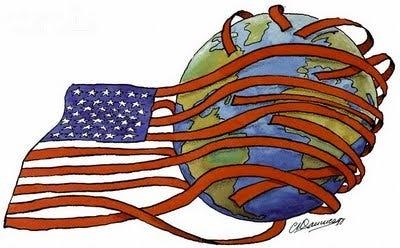
Why, then, is this so difficult?
Part of the answer is psychological. Power is addictive. For elites accustomed to command, retrenchment feels like humiliation, even when it is the rational course. To step back is to admit that history has changed and that the era of unchallenged supremacy has ended. For a political class formed by the habits of supremacy, this is nearly intolerable.
But there is also a structural reason. Entire careers, institutions, alliances, and patronage networks are built on the assumption that American dominance is both natural and necessary. To question hegemony is not merely to question a doctrine. It is to threaten an ecosystem of interests that depends on its continuation.
So the myth persists, even as evidence accumulates against it.
The lesson of this war may not be that the United States has suddenly become powerless. It has not. The lesson is more subtle and more consequential. Power in the twenty-first century is no longer what American strategists assumed it to be. It is not enough to possess superior platforms or larger budgets on paper. Power is the ability to endure, to replenish, to deter, to persuade, and to absorb shocks without unraveling. It is the ability to fight without exhausting oneself. It is the ability to make threats that others still believe.
On those terms, this war has delivered a harsh verdict.
The old unipolar moment is not returning. The aura that sustained it has been punctured. The security umbrella no longer looks absolute. The arsenal no longer looks bottomless. The coalition against U.S. dominance no longer looks fragmented. What remains is a choice between adaptation and denial.
Empires rarely make that choice gracefully. But they do make it, one way or another.
If Washington still believes it can compel history to reverse itself, it may yet drag the world into something even more dangerous. If it can recognize the limits now visible to almost everyone else, it may still find a way to step back from the edge.
The war has already answered one question. It has shown that US military supremacy cannot be assumed. The next question is whether American leaders are capable of learning from that fact before they try to disprove it at far greater cost.
Listen to CATR on:
Newsletter
Subscribe to Conversations Among the Ruins
Long-form geopolitics and the decline of the unipolar world order. New episodes straight to your inbox.
Free. No spam. View on Substack →
Reader-funded
This is independent, long-form work.
Conversations Among the Ruins is written, not repackaged, and it stays free because readers choose to fund it. If it is worth your time, a paid subscription or a one-off tip keeps it going.
Become a supporter →