


Every year, millions of young Chinese people compete fiercely for public institution jobs. One student in Guizhou province recently tried to turn this stressful season into a side hustle by scalping hotel rooms near the testing centers. Instead of making a quick profit, she ended up in a police interrogation room and sparked a massive nationwide debate about the fine line between smart business and illegal behavior.
The Hustle That Went Wrong
According to reports from Sohu News and an official police WeChat account, the young woman traveled to Qixingguan District in Bijie city for her public institution exams. Hoping to cover her travel expenses, she used a hotel booking app to reserve over a dozen rooms near various testing centers. Her plan was simple. She would resell these highly coveted rooms to desperate fellow candidates at a marked-up price on social media.
Thanks for reading Expat Edit! Subscribe for free to receive new posts and support my work.
Local authorities did not see her entrepreneurial spirit as a victimless venture. Qixingguan police tracked her down and opened an investigation under the Public Security Administration Punishments Law for disturbing public order.
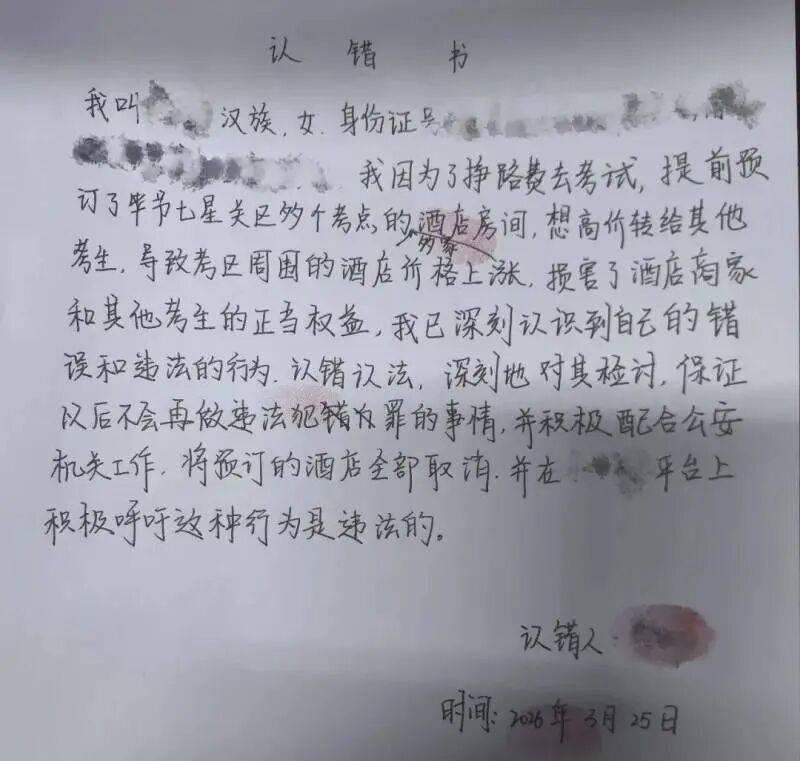
The police publicly released a photo of her handwritten confession. In the letter, she admits that her attempt to flip the rooms for a higher price drove up local accommodation costs and harmed the legitimate rights of both businesses and other students.
Market Economics or Illegal Hoarding?
The news quickly skyrocketed to the top of trending charts on platforms like Zhihu, garnering over a million views and hundreds of polarizing answers. Some commentators applauded the police for cracking down on scalpers who exploit anxious students. However, the overwhelming sentiment pointed out a glaring double standard in the hotel and travel industry.

Many netizens asked why a student is criminally investigated for booking ten rooms while major travel platforms and hotel chains routinely double or triple their prices during exams and public holidays. As one Zhihu user noted, if a corporation hoards resources and raises prices, it is called dynamic pricing and market economics. When an individual without a business license does the exact same thing, it suddenly becomes illegal hoarding and a disruption of public order.
"The real danger of society for young people is seeing corporations execute a business model and mistakenly believing an ordinary citizen can do the exact same thing without consequences."
Legal experts chimed in to clarify the harsh reality of the system. Large booking sites operate with official contracts, pay taxes, and charge service fees within a regulated framework. The student acted as an unlicensed individual operating entirely in a legal gray zone. As professionals pointed out, an ordinary person lacking legal protection and proper business licensing takes on massive risks when attempting these kinds of arbitrage schemes.
The ultimate irony of the situation is the lasting damage to the young woman’s future. Public institution and civil service jobs in China require a strict political background check known as “zhengshen.” By catching a public security penalty for this botched hotel hustle, she has essentially guaranteed that she will fail the vetting process. For a few extra dollars, she completely destroyed her chances of securing the very government job she traveled there to test for.
Thanks for reading Expat Edit! Subscribe for free to receive new posts and support my work.
Enjoyed this article? Subscribe to The Expat Edit on Substack
Curated and translated from Zhihu, China's largest Q&A platform.
Newsletter
Subscribe to The Expat Edit
Chinese perspectives on global events, wars, and great power competition. Curated from Zhihu.
Free. No spam. View on Substack →