
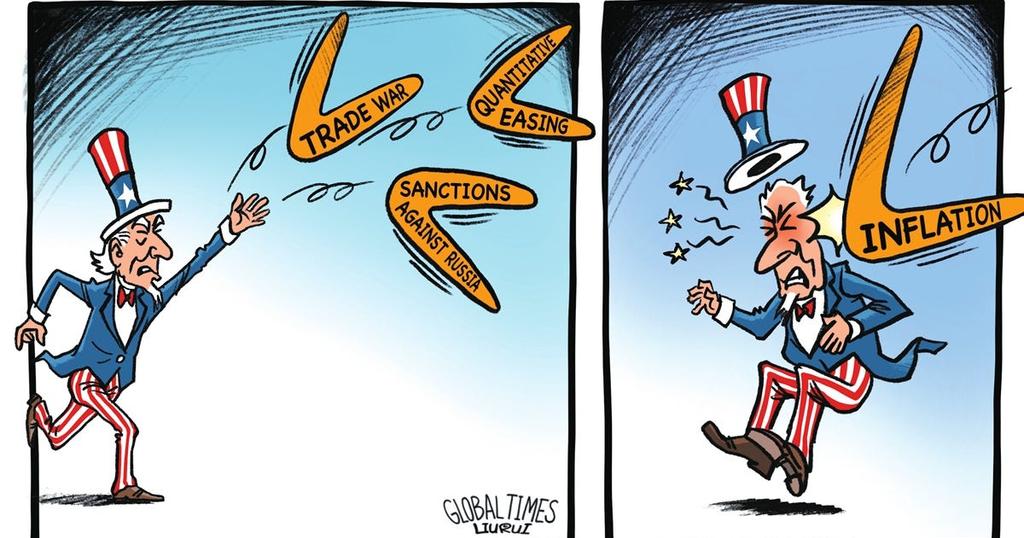
There is a question hanging over American foreign policy that is no longer easy to dismiss as partisan complaint or academic abstraction. Why does the United States keep choosing policies that so obviously weaken its own position?
The pattern is now too consistent to ignore. Washington leans ever more heavily on sanctions, even after sanctions have repeatedly pushed rivals to build alternative financial channels. It threatens countries whose cooperation it depends on. It expands military commitments while its industrial base struggles to sustain them. It treats the dollar’s central role in the world economy as an instrument to be weaponized rather than a privilege to be preserved. And all the while, it borrows on a staggering scale, assuming that global confidence in American power will remain untouched.
The temptation is to explain such behavior as the product of bad individuals. There is some truth in that. Vanity, ideological rigidity, and political cowardice matter. Leaders can accelerate decline by refusing to absorb unwelcome facts. But the deeper problem lies elsewhere. The United States still operates from a worldview formed in the unipolar moment, even though the material basis for that moment has eroded.
For decades, American power rested on an exceptional combination of military reach, financial dominance, energy insulation, allied dependence, and industrial depth. The country could make mistakes and survive them because the surrounding system absorbed the cost. The dollar remained the world’s refuge. Treasury markets remained the world’s safe harbor. Allies complained but complied. Adversaries had limited room to maneuver. Even policy failures could be hidden inside a larger architecture of confidence.
That architecture is now under strain. Yet Washington behaves as though it still has the same margin for error.
Nowhere is this more visible than in the American addiction to sanctions. Sanctions once seemed like the perfect imperial instrument. They promised coercion without invasion, punishment without body bags, and control without formal occupation. They also depended on a simple premise: that access to the dollar system was so essential, and American influence over allies so extensive, that targeted states would either submit or suffocate.
That premise is weakening. China is not a client state. Russia is not economically isolated in the way Washington once imagined. Many countries that have no love for Tehran still understand the danger of living in a world where the United States can, at any time, treat commerce as a weapon and legal agreements as disposable. Each new sanctions package may inflict pain on its target. It also teaches the rest of the world the same lesson: build escape routes.
This is the paradox at the center of current U.S. strategy. Washington is using the power of the dollar in ways that steadily undermine trust in the dollar. It is trying to defend primacy by making primacy less attractive.
The same contradiction is visible in energy policy and the Persian Gulf. American officials still speak as though they can enforce outcomes by declaration. But chokepoints like the Strait of Hormuz are not controlled by press conference. If Iranian oil is forced off the market, prices rise. If shipping through the Gulf becomes unstable, the effects spread far beyond the immediate conflict. Oil is only the first layer. Fertilizer, petrochemicals and other essential goods move through the same arteries. Shortages ripple outward. Insurance rates rise. Supply chains tighten. Inflation returns in forms central bankers cannot easily tame.
In such a setting, “economic warfare” is not a clean substitute for military escalation. It is another name for global self-injury.
The administration’s answer has been to reassure markets that tougher measures will produce stability. But this misunderstands the nature of the problem. Markets do not react only to intent. They react to structure. If a major oil producer is under siege and one of the world’s critical maritime passages is under pressure, no amount of official confidence can erase the underlying risk. Traders see what political messaging tries to blur: the United States has moved from shaping events to reacting to them.
That loss of control would be serious enough on its own. It becomes much more dangerous when paired with America’s fiscal condition.
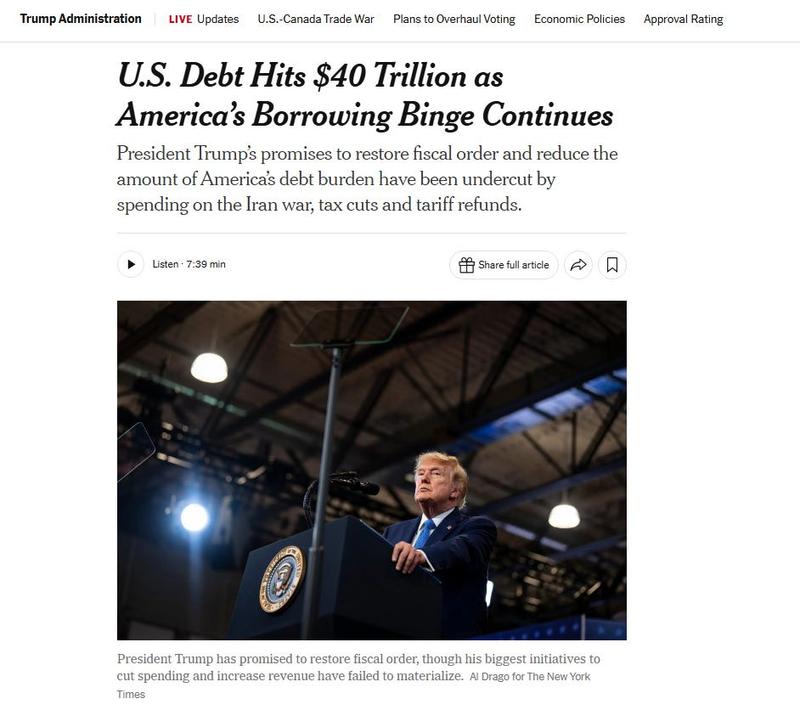
The United States has now crossed $40 trillion in debt. That figure, by itself, does not tell the whole story. Great powers can carry heavy debt loads for long periods if borrowing costs remain low and confidence remains high. For years, the United States enjoyed exactly that advantage. It could issue debt cheaply because investors assumed that no safer destination existed. American deficits were cushioned by the dollar’s status as the global reserve currency and by the unmatched depth of U.S. capital markets.
But reserve-currency privilege is not a law of nature. It is a political and strategic asset sustained by trust. And trust can erode gradually until it suddenly does not.
The recent strain in long-term Treasury markets should be understood in this light. When demand weakens and yields rise, the issue is not simply technical. It is psychological. Investors are asking whether the United States still represents the kind of long-term stability it once did. If the answer becomes less certain, the implications are profound. A country accustomed to financing global primacy through cheap borrowing can no longer assume that the bill will always be deferred.
This is where foreign policy and financial policy meet. Endless coercion abroad feeds doubt about stability at home. If the United States uses its financial system as a weapon against rivals, third countries begin preparing for a world in which they may one day be targets as well. If Washington piles debt upon debt while showing little capacity for strategic discipline, holding dollars no longer feels like an act of prudence. It begins to feel like an exposure.
That shift is already visible in the steady move by central banks toward gold and in the broader search for payment systems less vulnerable to U.S. pressure. None of this means an overnight collapse of the dollar. Reserve systems die slowly, then all at once. The point is not that the dollar will disappear tomorrow. It is that the United States is steadily encouraging the world to imagine life after dollar supremacy.
To read the rest of this analysis, subscribe today. Beyond this point, we look inside Washington to explain why U.S. elites are psychologically incapable of stopping this decline, and how their refusal to adapt to a multipolar world is turning a manageable transition into a historic crisis.
Read more
Listen to CATR on:
Newsletter
Subscribe to Conversations Among the Ruins
Long-form geopolitics and the decline of the unipolar world order. New episodes straight to your inbox.
Free. No spam. View on Substack →
Reader-funded
This is independent, long-form work.
Conversations Among the Ruins is written, not repackaged, and it stays free because readers choose to fund it. If it is worth your time, a paid subscription or a one-off tip keeps it going.
Become a supporter →