
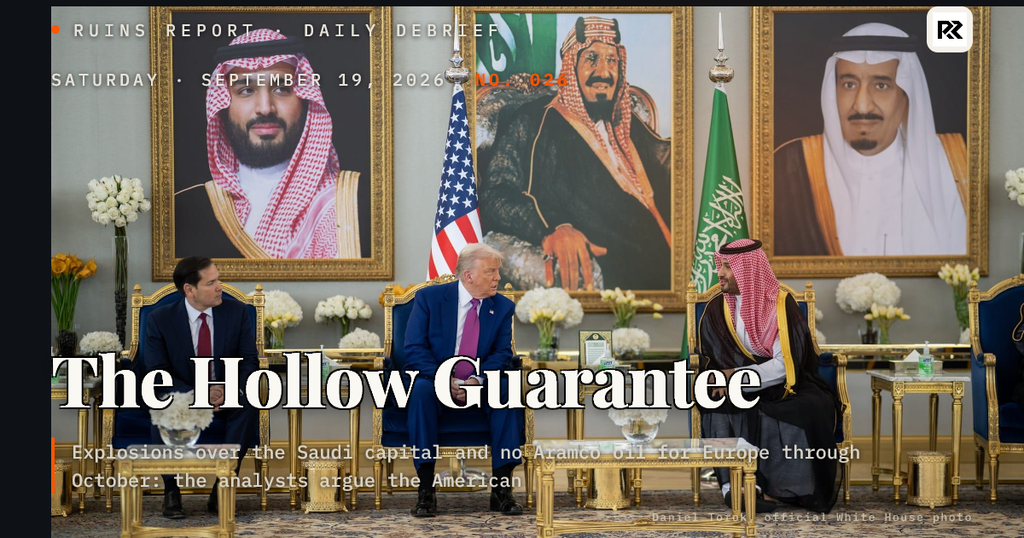
At about three in the morning on 19 September, after a "hostile aerial threat" alert, two explosions were heard over Riyadh. Saudi Civil Defence lifted the alert roughly half an hour later. What is confirmed is the alert and the sound; no impact inside the city has been established. Even so, it is the first time the Saudi capital itself has been touched since the Yemen war reignited in July, and it comes in a week when the kingdom's oil has largely left the world market. The American guarantee that has organized the Gulf for generations was meant to make a night like this impossible. The question the analysts spent the day on is what that guarantee has turned out to be.
The sequence matters. On 18 September, in an interview published a day before the alert, Hussain Albukhaiti, a Yemeni journalist speaking from Sanaa on Daniel Davis's Deep Dive, said that "we will wake up to a major attack against Saudi Arabia and especially against Riyad."¹ Whether the explosions heard hours later were the attack he had in mind is not established. His account of how the war reached this point is nonetheless the clearest on offer. He rejects the description of Ansar Allah as an Iranian proxy, says the Red Sea truce with Saudi Arabia held through Israel's wars on Iran, and says it broke only after Riyadh struck the Sanaa airport in July: "It was the biggest mistake that the Saudi has done."¹ He says the East-West pipeline is already crippled and the threat to Aramco is now the lever for lifting the blockade of Yemen in full. "We are now winning. Now the demand has changed."¹
Chas Freeman, on Dialogue Works, states the diplomatic consequence without ornament: "I think the US Saudi alliance such as it was is now in tatters."² His reading is that Washington refused to help Riyadh against the Houthis when it counted, that Iran now holds escalation dominance in the Persian Gulf, and that the only logical move left to the Saudis is rapprochement with Tehran rather than a renewed lean on Washington.² He puts the struck Saudi pumping stations at three to five weeks from restoration at the earliest, and he does not think the economic contest runs America's way: "The US will not outlast Iran in the economic war of attrition."²
Col. Lawrence Wilkerson, on the same programme, takes the military side. He describes Gulf states scrambling, without success, to Europe for air-defence help that Washington will not provide, and Gulf forces that in his estimate will defeat no one.³ Of the American capacity to intervene: "I don't think we have enough power to stop a flea coming down out of the northern mountains of Yemen, let alone this group."³ In his account Ansar Allah has mastered combined-arms warfare at the tactical, operational and strategic level, and cannot be beaten by Saudi Arabia or the United States without an outside intervention that no one is offering.³
The economics confirm the military picture. Larry Johnson, also on Dialogue Works, argues that the Gulf shortage is structural, a matter of damaged terminals and wells rather than blocked shipping, so that reopening Hormuz would not by itself restore supply. "Everyone, wake up. It's cut off."⁴ He expects the shortage to run at least another four to five weeks even on the most optimistic rebuild, and fuel prices to keep climbing through the November midterms. In his words, "the asymmetry in this favors the Houthis, not the United States and not Saudi Arabia."⁴ John Mearsheimer, on Deep Dive, reports the position as Europe is now hearing it: "Saudi Aramco has told the Europeans that there'll be no oil for the rest of September. And now they've told them there'll be no oil for all of October."⁵ His summary of the balance is that "the Iranians hold almost all the cards," and he sees no evidence the blockade is cracking the regime; if anything the annihilation rhetoric is rallying Iranians behind it.⁵
Jim Jatras, a former American diplomat also on Deep Dive, takes the argument to its structural end. With the East-West workaround lost along with the Red Sea and Hormuz routes, he puts Saudi export capacity near zero and raises the prospect that Riyadh begins selling US Treasuries to stay liquid. The Gulf monarchies, in his description, are client entities, and so is Israel: "can Israel survive without American dominance of the Middle East? I don't think it can."⁶ Daniel Davis, hosting, asked whether the week carried a message "that President Trump is literally in command of nothing and no one listens to him at all, even our closest friends?"⁷ His own evidence was that the president's public demands to Zelensky to stop striking Russian energy and to Netanyahu to stop striking Lebanon were each ignored within hours or days.⁷
Taken together, the analysts are not describing a guarantee that Washington declined to honor. They are describing one that could not have been honored had it tried.
That is where Theodore Postol comes in. The MIT physicist and missile-defence specialist, on Dialogue Works, went frame by frame through video of the Iranian ballistic-missile attack on the Muwaffaq Salti airbase in Jordan, the engagement for which contractors have claimed a 90 percent Patriot success rate. His count of confirmed PAC-3 intercepts: "But, right now, the count's at one."⁸ Against a manoeuvring ballistic missile arriving at more than three kilometres a second, he says, "Against the ballistic missile its probability of intercept is basically zero."⁸ The cheaper Patriot variant now being marketed strips out the lateral-thrust motors and downgrades the homing radar; he calls it useless. Of the performance claims Raytheon and Lockheed Martin have made over 35 years, with what he describes as complicit officials at MIT and the National Academy of Engineering, his verdict is unqualified: "This is outright fraud."⁸
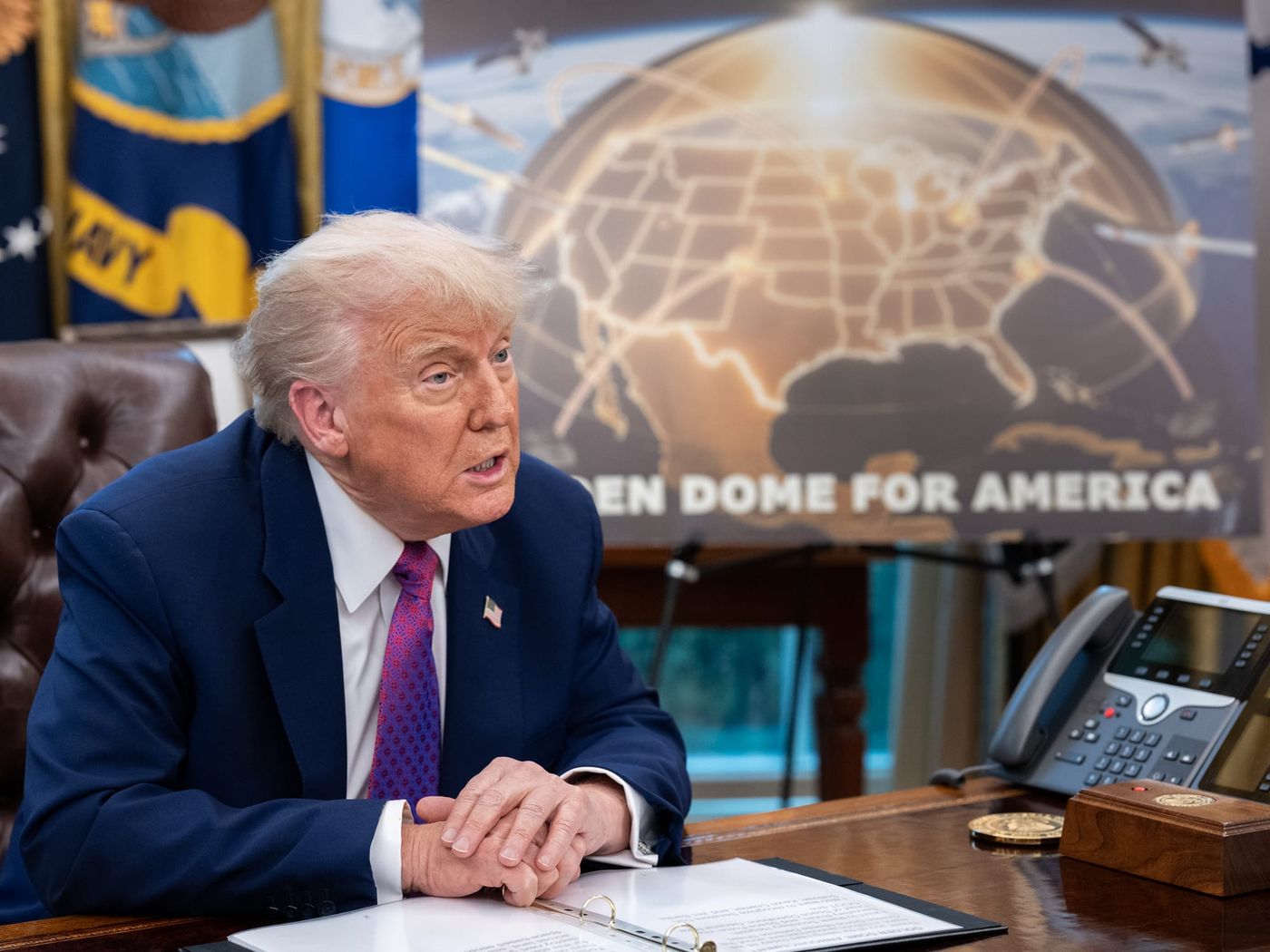
The supply side reinforces him. Johnson notes that the components for Patriot interceptors are not America's to produce at will: "China controls the supply chain. The United States doesn't. Therefore, the United States can't make these weapons."⁴ Mearsheimer adds that Patriot and THAAD stockpiles are being drawn down faster than they can be replaced, and that East Asia, the region he considers most important to the United States, has no spare American capacity left to redirect to it.⁵ Postol's own warning reaches past the Gulf to Western Europe, which he says should not assume its missile defences would fare any better against Russia. His counsel is short: "so don't start something you can't finish."⁸
“But let me tell you, the dumbest thing you can do is think you have air defenses that will work. They won't.”
The deeper cause, then, is not a distracted president or an ally taken for granted. It is that the Gulf's security architecture rested on hardware that was sold as one thing and performs as another, and the war has now run the test that the marketing never had to pass. Freeman's tatters, Wilkerson's flea and Mearsheimer's empty October are the same finding read from three directions.
Further afield
A number on Ukraine arrived from an unexpected source. Alexander Mercouris, on his own daily programme, reports that Polish prime minister Donald Tusk told the Polish parliament Ukraine is losing "27,000 killed and wounded every month,"⁹ a figure close to Putin's own estimate and well above anything Zelensky has claimed. Mercouris reads it as confirmation of a manpower crisis that tracks a collapsing front, with Ukrainian forces encircled at Orekhov, and states his conclusion plainly: "The war is being won."⁹ John Mearsheimer, on Glenn Diesen's programme and just back from Moscow, says he met no one there who did not believe Russia would win, and that Russia is now destroying Ukraine's energy infrastructure. "Ukraine is committing national suicide."¹⁰
On the economy, Ray Zucaro, an investor and portfolio manager appearing on The Duran with Mercouris, argues that the Federal Reserve is fighting a Middle East supply shock with interest-rate policy, the wrong tool for the job, and raising Washington's own rollover costs on eleven trillion dollars of debt coming due within twelve months. "I again don't see how we don't have a recession sometime in the next 12 to 18 months because of these shocks."¹¹ Mercouris, on the same programme, frames the limit of the Fed's reach the same way: "a political crisis needs a political solution, not ultimately a monetary one."¹¹
At home, Daniel Davis, alone on Deep Dive, took up the president's decision to ban CNN, MS NOW and Politico from the White House, following the Pentagon's earlier purge of press credentials. He calls it retaliation for unfavourable coverage rather than any standard of truth: "President Trump rarely tells the truth. Almost nothing he says is accurate."¹² The result, in his description, is a White House press operation that has become "a media propaganda arm."¹²
Sources
- Hussain Albukhaiti, *Deep Dive* · Says Ansar Allah is winning, has crippled the East-West pipeline, and warned a day before the Riyadh alert of a major attack on Saudi Arabia and especially Riyadh · watch ▶ 63:12
- Chas Freeman, *Dialogue Works* · The US-Saudi alliance is in tatters, Iran holds escalation dominance in the Gulf, and Riyadh's only logical move is rapprochement with Tehran · watch ▶ 12:25
- Col. Lawrence Wilkerson, *Dialogue Works* · The US lacks the power to stop Ansar Allah, Gulf forces will defeat no one, and Washington will not supply the air defence the Gulf is begging Europe for · watch ▶ 7:57
- Larry Johnson, *Dialogue Works* · The Gulf oil supply is cut off structurally, the asymmetry favors the Houthis, and China controls the supply chain for Patriot interceptors · watch ▶ 15:57
- John Mearsheimer, *Deep Dive* · Reports Aramco has told Europe there will be no oil for the rest of September or all of October; the Iranians hold almost all the cards and US interceptor stockpiles are depleting · watch ▶ 36:24
- Jim Jatras, *Deep Dive* · Saudi export capacity is near zero, Riyadh may start dumping Treasuries, and Israel cannot survive without American dominance of the Middle East · watch ▶ 29:09
- Daniel Davis, *Deep Dive* · Asks whether Trump is in command of nothing after Zelensky and Netanyahu ignored his public demands within hours or days · watch ▶ 32:52
- Theodore Postol, *Dialogue Works* · Frame-by-frame analysis of the Jordan airbase attack finds one confirmed Patriot intercept against a claimed 90 percent; calls the contractor claims outright fraud · watch ▶ 9:15
- Alexander Mercouris, *Alexander Mercouris* · Reports Tusk's admission of 27,000 Ukrainian killed and wounded a month and reads it as a manpower crisis on a collapsing front · watch ▶ 1:41
- John Mearsheimer, *Glenn Diesen* · Back from Moscow, says no one there doubts a Russian victory and that Ukraine is committing national suicide · watch ▶ 32:44
- Ray Zucaro, *The Duran* · The Fed is fighting a supply shock with the wrong tool and a recession within 12 to 18 months is hard to avoid · watch ▶ 8:26
- Daniel Davis, *Deep Dive* · Trump's ban on CNN, MS NOW and Politico is retaliation for coverage, from a president who rarely tells the truth · watch ▶ 1:08
By Ruins Report, a daily synthesis of what our tracked analysts said, not original reporting. Every numbered claim is sourced, dated, and timestamped above.
Newsletter
Get the Daily Debrief
One email each morning: what the analysts we track actually said, and every call timestamped to its source. Free.
Free. No spam. View on Substack →
Support the Report
Free to read, every day.
The Debrief is compiled each morning from what the analysts we track actually said, sourced and timestamped. No paywall, no ads, no investors. If it earns a place in your inbox, you can help keep it independent.
Support the report →