
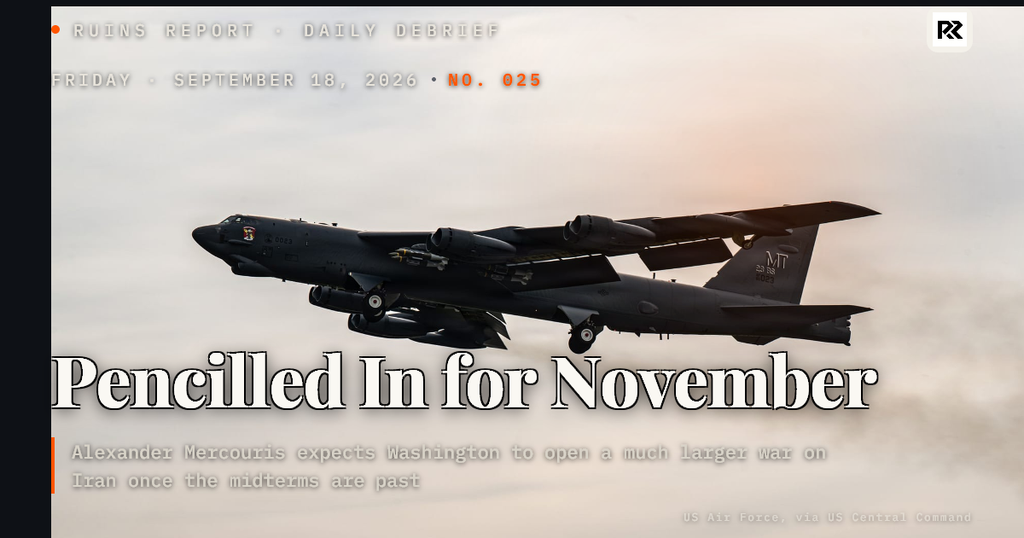
A war that has not been declared is already being given a date. The question the analysts worked through today is whether Washington, having fought Iran once this year and stopped short of anything it could plausibly call victory, is preparing to do it again on a far larger scale once the November elections are behind it, and whether it still has the bombs, the partners and the political room to carry such a thing through.
Alexander Mercouris, speaking on The Duran, was the one to put the date on it. His forecast, offered as his own reading of where events point, is that Washington will "keep going for the next two months and then the big war against the Iranians in November will begin."¹ He calls it a massive gamble, and he describes the present as a holding pattern: the pressure is kept on, the Gulf partners are kept from folding, and the decisive move waits for the ballots to be counted.¹
Richard Wolff, on Dialogue Works, sees the preparation already under way. The United States, he says, has authorized shipping 40,000 tons of its largest bombs to Israel, so that Israel rather than Washington carries the blame for an attack he expects to land on Iran. He calls what is coming a war crime and a horror show.² Whatever one makes of the judgement, the underlying observation is not in dispute among the people we track: the escalation is being stocked for, not ruled out.
The cost of the interval is falling first on the Gulf. Mercouris, again on The Duran, describes "the greatest crisis that Saudi Arabia has faced": the East-West pipeline is down, and the kingdom can export neither through Hormuz nor through the Red Sea. He adds that "Saudi Arabia's financial reserves are not especially deep."¹ Alastair Crooke, on Daniel Davis's Deep Dive, states the position more bluntly: "Saudi Arabia is exporting zero barrels of oil."³ The effects have reached the American pump. Wolff notes that "Diesel fuel is now costing $6.50 a gallon here in the United States, which is about twice what it used to be a few months ago,"² and Crooke expects the price of aviation fuel to double within a month or so.³ Mercouris, on his own daily program, adds that the worldwide diesel shortage and the inflation riding on it are driven mainly by the Hormuz closure and the Red Sea crisis, not by Ukrainian strikes on Russian refineries, and that the new American sanctions bill aimed at Russia's oil buyers is toothless, with India and China openly defying it.⁴ On Washington's professed neutrality toward the Saudi war, Mercouris is unpersuaded: the Americans are undoubtedly still supplying intelligence and satellite data, so the disengagement is more rhetorical than real.¹
That is the case for a second war: the machinery is being loaded, the allies are bleeding, and the clock is set for November. The case against it was made just as plainly today, and it rests not on Washington's intentions but on its means.
Crooke begins by dismissing the premise that Tehran is looking for a way out. "Iran is not begging for a deal at all."³
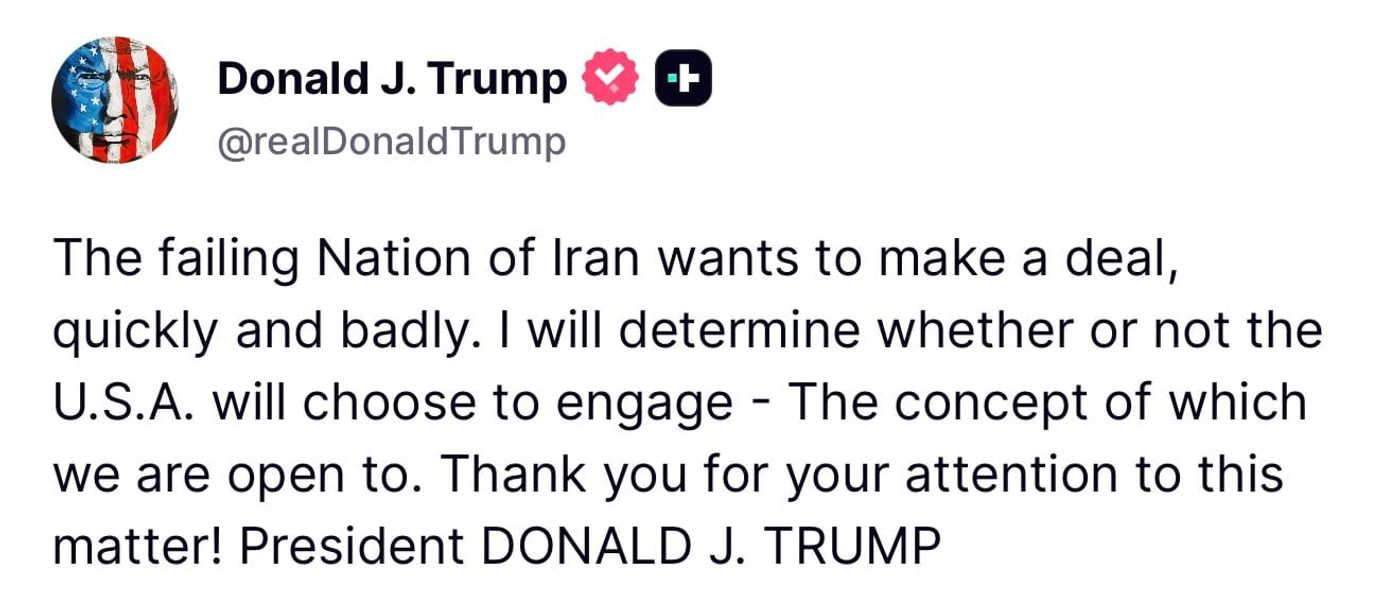
His central point is that even if the fighting pauses, the United States cannot easily start it again. The munitions expended in the first round, along with the air-defense and radar systems that were used up or destroyed, take years to replenish. Personnel who fought the campaign are war-weary and reluctant to redeploy, and American opinion has no appetite for returning to a fight that did not succeed the first time.³ Iran, in his account, understands this and is escalating in calculated, metered steps "to put further pressure on the United States in the leadup to the midterm elections and even after."³ Mercouris, for all that he expects the war, agrees that economic strangulation on its own "will never be enough to cause a change of regime": Iran's BRICS partners, China and Russia and possibly India, can offset the pressure.¹
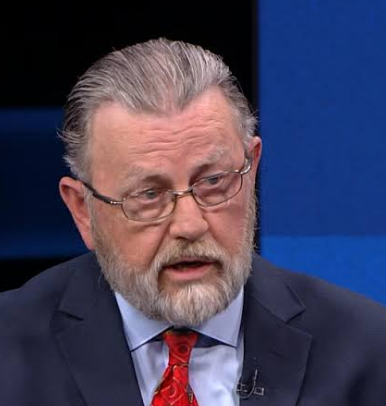


The second constraint is domestic, and it is the one Mercouris's timetable depends on. Rich Baris, the pollster, told Deep Dive that the Iran war and the talk of annihilating the Iranian government are deeply unpopular with American voters, and that Iranian public opinion has hardened against the United States, which hands Tehran leverage over the president going into the midterms. His forecast for the Republicans is stark: "I think the dam's going to break and we're going to get slaughtered."⁵ He puts a number on it: "Democrats could get 54 seats in the US Senate."⁵ He does not blame the president for the drift so much as the people around him: "the neocons are the betrayers here. They're the ones who betrayed the president."⁵
Crooke draws the same line to its end. "If support in the Senate wanes, then I think he's on a road to impeachment or some other catastrophe."³ Behind the politics sits the money: "the bond market is in deep trouble."³ Daniel Davis, hosting both of these conversations, held to his own position across both episodes: the president should declare victory and walk away from Iran rather than risk widening a war whose strikes cannot honestly be said to have achieved regime change or the destruction of the program.
Put the two readings side by side and they describe the same war from opposite ends. Mercouris expects it because the pressure is being maintained and the bombs are being shipped. Crooke doubts it because the stockpiles, the personnel and the voters are not there. What both accounts share is the fact underneath them: the first round settled nothing and cost more than Washington has admitted, and the decision to fight a second is no longer Washington's alone. It now runs through arsenals that take years to refill, through Gulf treasuries that are not deep, and through a Senate that may not survive November.
The deeper cause is the one Wolff names. The first war did not merely fail to end the Iranian program; it changed what the world understood about American power.

“The United States is no longer invincible. Iran has proven it.”
Wolff draws the lesson without comfort: "the world is governed by brute strength, not by rules."² Crooke, from a different tradition, arrives at the same place, describing a region "on the cusp of reverting to the old power paradigm," in which the terms of the Gulf are set by the states that live there rather than the one that patrols it.³ If that is right, then the war pencilled in for November is less a plan than a wager that the old arrangement can be restored by force, made by a government that no longer holds the means to enforce it.
Beyond the Gulf
Pepe Escobar, back from Russia and speaking on Dialogue Works, reports that the national consensus in Moscow has hardened and that no one there retains faith in the Trump administration's framework. His summary of what the Russian establishment now wants leaves no room for a negotiated middle: "they want total capitulation, a zillion% total capitulation from Kiev. That's it. There's no plan B."⁶ Mercouris, on his solo program, describes the battlefield conditions behind that confidence: "Ukrainian air defense effectively does not exist," and Putin, in his view, has no reason to change course or to compromise.⁴
Against the day's general read that the dollar order is coming apart under the strain of Hormuz and sanctions, Yanis Varoufakis, on Glenn Diesen's program, offered a dissent. The dollar-recycling system, he argues, still works, and neither Europe nor Russia is in a position to bring it down. "It will only stop working when the Chinese decide to decouple from the American dollar system."⁷
Sources
- Alexander Mercouris, *The Duran* · Forecasts the big war on Iran beginning in November after two months of holding on; Saudi Arabia in its greatest crisis, exporting through neither Hormuz nor the Red Sea, with reserves that are not deep; strangulation alone will never change the regime watch ▶ 17:19
- Richard Wolff, *Dialogue Works* · The United States is no longer invincible and Iran has proven it; 40,000 tons of bombs shipped to Israel so that Israel takes the blame; diesel at $6.50 a gallon watch ▶ 42:49
- Alastair Crooke, *Daniel Davis / Deep Dive* · Iran is not begging for a deal; Washington cannot easily restart the war because munitions and air defenses take years to replenish; Saudi Arabia exporting zero barrels; a Senate collapse puts the president on the road to impeachment watch ▶ 5:47
- Alexander Mercouris, *Alexander Mercouris* · The diesel shortage is a Hormuz and Red Sea story, not a refinery-strike story; the sanctions bill is toothless; Ukrainian air defense effectively does not exist and Putin has no reason to change course or compromise watch ▶ 84:34
- Rich Baris, *Daniel Davis / Deep Dive* · The Iran war is deeply unpopular; Republicans face a slaughter in November and Democrats could reach 54 Senate seats; the neocons betrayed the president watch ▶ 34:00
- Pepe Escobar, *Dialogue Works* · Moscow's consensus has hardened: total capitulation from Kiev, no plan B, no faith in the Trump framework watch ▶ 31:12
- Yanis Varoufakis, *Glenn Diesen* · The dollar-recycling system still works and will only stop when China decides to decouple from it watch ▶ 48:45
By Ruins Report, a daily synthesis of what our tracked analysts said, not original reporting. Every numbered claim is sourced, dated, and timestamped above.
Newsletter
Get the Daily Debrief
One email each morning: what the analysts we track actually said, and every call timestamped to its source. Free.
Free. No spam. View on Substack →
Support the Report
Free to read, every day.
The Debrief is compiled each morning from what the analysts we track actually said, sourced and timestamped. No paywall, no ads, no investors. If it earns a place in your inbox, you can help keep it independent.
Support the report →