

Washington is about to get the thing it has wanted for years: an Israel without Benjamin Netanyahu. Gadi Eisenkot and his coalition say they have the votes. President Isaac Herzog will almost certainly hand him the mandate, and within a month or so, there will be a new prime minister in Jerusalem, one who does not carry an indictment, does not hold a rally with Ben-Gvir, and does not make Chuck Schumer wince on the Senate floor. The relief in Democratic offices will be audible. It will also be the most dangerous moment in this war.
The relief is understandable. American support for Israel was already slipping before October 7, 2023, slowly but steadily, and then came the destruction of Gaza and, this year, the war with Iran. The two together have been a one-two punch to the relationship, and this week’s midterms showed what that looks like at the ballot box. The vice president himself, in a tweet that has no real precedent for a sitting vice president, listed the Iran war first among the reasons his party was wiped out, and the relationship with Israel fourth, with inflation and the failure to put America first in between. Five years ago a statement like that would have been denounced as antisemitism from one end of the political spectrum to the other. This week, it was met with something close to a shrug, including, notably, from the editorial pages of newspapers that have spent decades defending Israel without reservation. The thing could no longer be denied, so nobody bothered.
For the Democratic establishment, Netanyahu has long been the convenient explanation for all of this. Schumer went to the Senate floor more than two years ago to call for his removal. The line ever since has been that the problem is not Israel, it is this man, and that once he is gone, the alliance can return to the comfortable arrangement that prevailed before him. Eisenkot is the fulfillment of that wish. He is a general, not a demagogue. He is sober. He is, by the standards of Israeli politics, a centrist. He will be welcomed in Washington the way Yitzhak Rabin once was.
Here is the problem. Eisenkot does not want to end the war with Iran. He wants to finish it. He comes out of the Israel Defense Forces, and the IDF’s position on Iran has been consistent and openly stated: the June strikes angered the beast without seriously wounding it, and Israel must go back. Senior officers have complained about the Trump administration’s preference for a short, intense campaign because they want a long one. It was not Netanyahu or Bezalel Smotrich who killed the children of Gaza. It was the army. And it is the army, not any one politician, that is pressing to return to Tehran.
The army has also been very careful about when it will go. In early October, Netanyahu tried to order a strike on Iran days before the Israeli election, and the IDF refused, saying it would not act on the prime minister’s word alone and needed proper authorization from the Knesset. The stated reason was that being used as a political weapon by one man or one party would erode public trust in the institution. That was true, and it was also convenient. A lame-duck prime minister trying to kick off a war to save his own career is exactly the kind of order a general staff can decline. A new prime minister who is one of their own, freshly installed with a parliamentary majority and the goodwill of the United States, is a different matter. When Eisenkot takes office and the generals tell him the moment has come, he will say yes. There is nothing in his record to suggest otherwise.
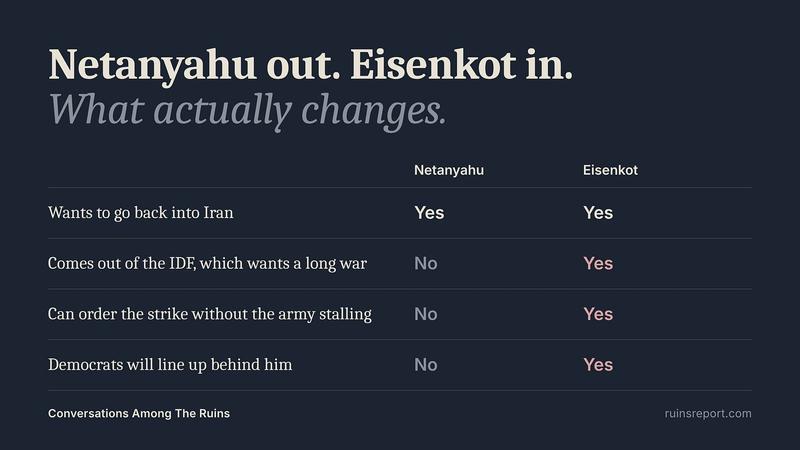
Which brings us back to Washington, and to what the Democrats will do when that happens. Nearly everything they have said about this war has been tethered to Netanyahu. The objection was never to the war itself; it was to the man running it. Remove the man, and the objection dissolves. Already, a Democratic senator has said that the party may have no choice but to keep funding the Iran war. Schumer, who denounced Netanyahu, is a self-described Zionist who has spent his career inside the relationship, and he wants the majority leader’s gavel back. So does Hakeem Jeffries, in the House. The progressive wing that actually powered this week’s wave is not happy about either of them, and it is right not to be. These are not people who will stand against a war led by a respectable Israeli general with a security rationale and a coalition of the sensible behind him. They will line up. All but a handful, the Rashida Tlaibs and the Ilhan Omars, will line up. Those who were skeptical of Israel only insofar as Netanyahu embodied it will discover that they were never skeptical of Israel at all.
That is why the change of government in Jerusalem may make the situation worse, not better. Under Netanyahu, a renewed American strike on Iran would have been politically toxic in both parties, the act of a president dragged into another man’s war by a leader most Americans have come to despise. Under Eisenkot, the same strike becomes a bipartisan enterprise. The Democrats get to say they stood with a reformed Israel against a theocracy. The Republicans get to say they finished the job. Everyone in the capital gets to pretend that the message of Tuesday’s election, which was unmistakably to stop this and focus on the cost of living at home, said something else.
Notice, too, what Eisenkot’s coalition actually is. It exists because the Arab parties agreed to vote against Netanyahu and for him. They will provide the margin that gets him to a majority. And they will not be in his government. Eisenkot will take their votes and give them nothing, no ministry, no portfolio, no seat at the table. In any normal parliamentary system, that would be an insult. In Israel, it is the arrangement. A fifth of the citizenry is useful for arithmetic and unwelcome for governance, which tells you how much the new prime minister intends to change about the state he will lead.
The honest view is bleaker than Washington wants to hear. The Israeli left, such as it is, supports the IDF and looks up to it; that is part of what it means to be an Israeli, even a leftist one. The genuine anti-war voices, the Gideon Levys, amount to a few brave names with nothing behind them. There is no faction waiting in the wings to take the country down a different road. A change of government changes the face. It does not change the trajectory, and the trajectory runs through Iran.
The only thing that might change it is the one thing the American political class will not contemplate: cutting Israel off. Not a sterner letter, not a conditioned shipment of two-thousand-pound bombs, but a real withdrawal of arms and money, the kind of shock that would force Israelis to ask whether the people running their country can actually protect them. Even that might fail. A society that has concluded it is alone with its guns may simply lash out harder. But it is at least a strategy. Swapping Netanyahu for a general and calling it progress is not a strategy. It is a way of changing the subject so the war can go on.
Americans just voted, in overwhelming numbers, to end this. The response from their leaders is shaping up to be a new Israeli prime minister, a new round of strikes, and a new consensus that the old consensus was fine all along. When the missiles start again, no one should be permitted to say the problem was Netanyahu.
Listen to CATR on:
Newsletter
Subscribe to Conversations Among the Ruins
Long-form geopolitics and the decline of the unipolar world order. New episodes straight to your inbox.
Free. No spam. View on Substack →
Reader-funded
This is independent, long-form work.
Conversations Among the Ruins is written, not repackaged, and it stays free because readers choose to fund it. If it is worth your time, a paid subscription or a one-off tip keeps it going.
Become a supporter →