
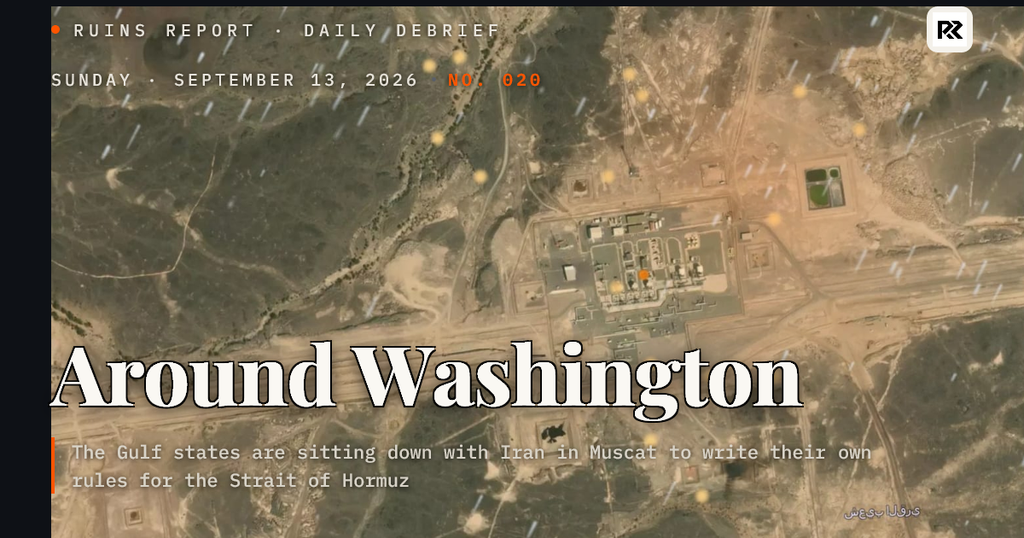
The most consequential meeting of the coming week will not be held in Washington, and Washington will not be in the room. According to Daniel Davis, Iran and the Gulf Arab states will meet in Muscat on Monday to establish a joint Iran-Oman shipping route through the Strait of Hormuz, and the United States has not been invited.¹ That last detail is the story. For half a century the security of the Gulf and the passage of its oil have been understood, in Riyadh and Abu Dhabi as much as in Washington, as an American responsibility. On Monday the states that live on that water will sit down with the state they were told to fear and begin writing the rules themselves.
Pepe Escobar describes what is on the table as a system of navigation across the strait that is deliberately provisional, good for the next few weeks or a month or two, after which the parties will turn to the final arrangement.² The modesty of the first step should not obscure the direction of travel. A temporary mechanism agreed between Iran, Oman and the Gulf monarchies is still a mechanism that none of them is asking Washington to approve. Larry Wilkerson reads it in harder terms: the new Iran-Oman corridor amounts to an almost impregnable blockade of the route the United States has been trying to keep open. "They're going to shut down that route," he said.³ Whatever traffic moves through Hormuz will move on terms set in Muscat and Tehran, not by the Fifth Fleet. Wilkerson does not pretend this is a happy outcome. "This is not good for world commerce. Not good at all."⁴
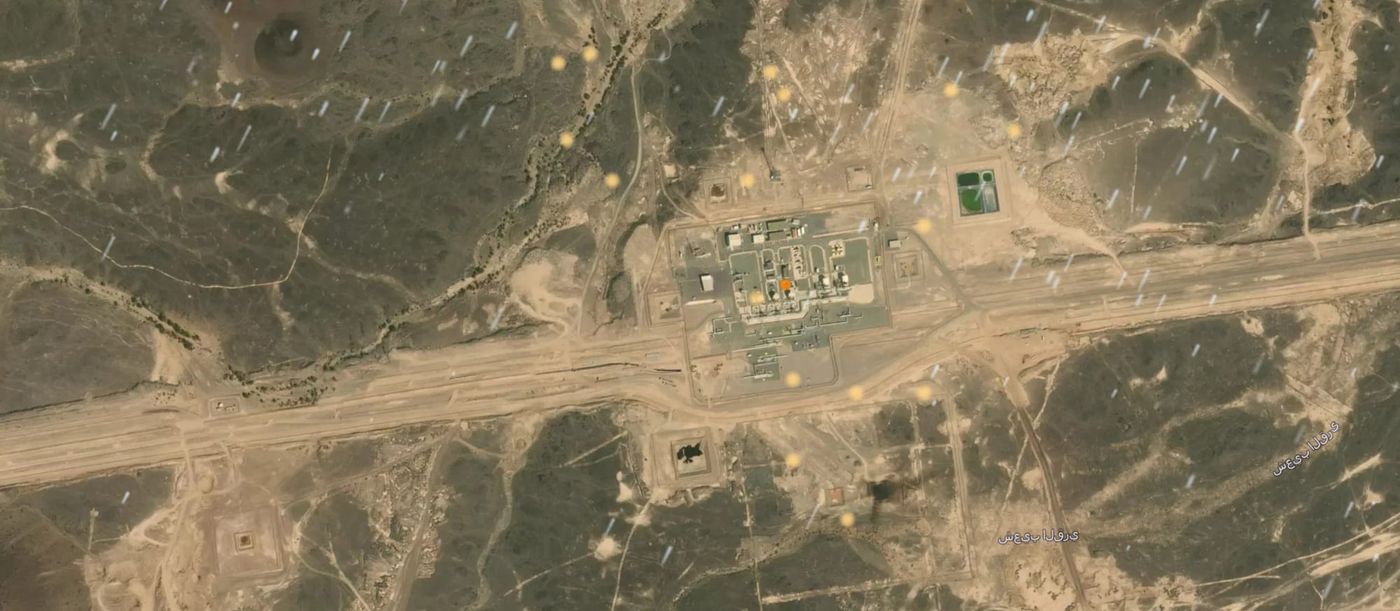
How Riyadh arrived here is a matter of arithmetic, not sentiment. Larry Johnson put it bluntly: "The Saudis have kicked over a hornets' nest and the hornets are swarming them, stinging them everywhere they can possibly reach."⁵ Strikes by the Houthis and the Iraqi resistance have knocked out the kingdom's East-West pipeline and Aramco's southern oil facilities. The East-West line was the hedge, the route that let Saudi crude reach the Red Sea and skip the strait altogether; with the pumping stations that feed it hit, the hedge is gone, and Riyadh is left with no good option but a deal. Davis made the point that an attack of this kind was always going to end in one of two ways, retaliation or accommodation. "Nobody is going to have their pipelines hit and do nothing about it and just say, oh I forgive the other side."⁶ Riyadh has chosen accommodation, because retaliation required a partner willing to fight on its behalf, and that partner is not showing up.
The isolation runs wider than Washington. Escobar notes that Pakistan and Turkey have both told Riyadh that this is not their war, which leaves Saudi Arabia with no one in the neighborhood prepared to stand behind it. Johnson forecasts that Iran will now make a diplomatic gesture to the Gulf Cooperation Council whose content is simple: you cannot trust the United States, so work with us.⁷ Monday's meeting suggests the gesture has already been received. Robert Barnes, speaking on Dialogue Works, regards the Gulf's turn toward Tehran as the most promising way out of the war. "The best intervention that could get us out of the conflict before the midterms is if the Gulf Coast countries step up and cut their own deal with Iran," he said.⁸ It is a striking thing for an American to say. The exit from an American war runs through a deal to which America is not a party, and Barnes draws the lesson the Gulf capitals appear to have drawn already: that alignment with Washington has become the more hazardous position.⁹
“It's much more dangerous to be the US's friend than to be the US's enemy.”
The thesis, then, is not that the Gulf has defected. It is that the Gulf has stopped waiting. Riyadh asked for protection and did not get it; the pipelines burned; the neighbors declined; and so the kingdom is doing what states do when a guarantee fails, which is to negotiate directly with the party it was guaranteed against. What makes this moment different from earlier Gulf hedging is that the United States is in no position to object. Wilkerson's assessment of American capacity is a single sentence: "We are running out of assets."¹⁰ Barnes widens the frame. "We've got three wars going on at the same time and the West triggered all three and the West is losing all three at the same time."¹¹ A power fighting on three fronts and short of assets cannot veto a shipping arrangement negotiated by the very states it was supposed to be defending. It can only watch.
Davis's larger claim is that this is the collapse of alliance credibility happening in real time, and that both adversaries and allies now see that America's word means nothing. That is a severe judgment, but Monday's guest list is evidence for it. The Gulf states are not adversaries. They are the clients on whom the entire American position in the region was built, and they are the ones who have concluded that the protection was notional. The contrast with the posture in Washington is hard to miss. The president has taken to calling the waterway by his own name, while the document that will actually govern passage through it is being drafted in Oman without an American signature.
Davis expects the gap between rhetoric and control to close from the outside. "This war doesn't get taken out of President Trump's hand, maybe even before the midterms," he said, meaning that the shape of the ending will be decided by others.¹² Escobar's version is less procedural. "The whole house of cards collapsing has already started."¹³
Here is the deeper cause, and it is the one worth stating plainly. The American security guarantee to the Gulf did not fail this month. It was already hollow: a guarantee that assumed no one would ever call it, extended by a power that had been spending its assets elsewhere for two decades. What the pipeline strikes and the empty chair in Muscat have done is disclose the hollowness to the people who were relying on it. Riyadh is not being reckless in dealing with Tehran. It is reading the balance sheet honestly for the first time, and a security order built on a promise that no one will test does not survive the test. The Gulf is now building around the ruin. Whether the provisional mechanism Escobar describes hardens into a durable order, or whether Wilkerson's blockade is the more accurate name for it, the ordering party is no longer Washington.
Beyond the strait
On Ukraine, Alexander Mercouris reads Putin's latest warning about European deployments as a formal red line rather than a rhetorical one, summarizing the Russian position as follows: "the European states that send those troops to Ukraine are at war with Russia."¹⁴ He pairs it with a battlefield judgment that the Donbass front is now giving way, and that "it cannot be long before Dobropolye itself falls."¹⁵ Davis, on the American side of the same question, argues that Trump will not take the United States into a war over Lithuania even if Russia moves against it, and dismisses sanctions as leverage over Moscow: "You can't throw dollar bills at the Russians and do anything to them."¹⁶
The diplomatic track that opened at Anchorage is, by the account of the man who sat across from it, closed. Sergey Lavrov, speaking to Andrew Napolitano on Judging Freedom, delivered the Russian foreign minister's verdict: "We have buried Anchorage. America is with us now... We are all against Russia again."¹⁷ He added that Washington continues to extend sanctions while, in his telling, the Treasury has said that "global energy markets need to be brought under the control of the United States."¹⁸ Read alongside the Muscat meeting, the two remarks describe the same ambition meeting the same resistance in two different theatres.
Behind the realignment sits an economic argument, and Steve Hanke makes it without hedging. On sanctions as a weapon: "These things always backfire. They never work as intended."¹⁹ His view lands as the BRICS declaration out of New Delhi brands unilateral and secondary sanctions illegal, which gives the Gulf states a legal vocabulary for trading with Iran that did not exist a year ago. Hanke's warning for Saudi Arabia is specific: the kingdom moved more than nine million barrels a day through the strait last year, and under the emerging arrangement that flow "will be a trickle."²⁰
Sources
- Daniel Davis, *Daniel Davis / Deep Dive* · Iran and the Gulf states meet in Muscat on Monday on a joint Iran-Oman Hormuz route, Washington not invited watch ▶ 17:27
- Pepe Escobar, *Dialogue Works* · a temporary Hormuz navigation deal now, the final arrangement later watch ▶ 21:07
- Larry Wilkerson, *Dialogue Works* · the Iran-Oman mechanism shuts down the US-backed route watch ▶ 30:15
- Larry Wilkerson, *Dialogue Works* · not good for world commerce, not at all watch ▶ 35:12
- Larry Johnson, *Dialogue Works* · the Saudis kicked over a hornets' nest watch ▶ 1:17
- Daniel Davis, *Daniel Davis / Deep Dive* · nobody has their pipelines hit and does nothing watch ▶ 7:54
- Larry Johnson, *Dialogue Works* · Iran will tell the GCC you can't trust the US, work with us watch ▶ 8:08
- Robert Barnes, *Dialogue Works* · the Gulf states cutting their own deal with Iran is the exit ramp watch ▶ 25:55
- Robert Barnes, *Dialogue Works* · more dangerous to be the US's friend than its enemy watch ▶ 40:29
- Larry Wilkerson, *Dialogue Works* · we are running out of assets watch ▶ 17:16
- Robert Barnes, *Dialogue Works* · three wars, the West triggered all three and is losing all three watch ▶ 4:25
- Daniel Davis, *Daniel Davis / Deep Dive* · the war may be taken out of Trump's hands, maybe before the midterms watch ▶ 19:16
- Pepe Escobar, *Dialogue Works* · the house of cards has already started collapsing watch ▶ 35:47
- Alexander Mercouris, *Alexander Mercouris* · European troops in Ukraine means those states are at war with Russia watch ▶ 6:36
- Alexander Mercouris, *Alexander Mercouris* · it cannot be long before Dobropolye falls watch ▶ 80:52
- Daniel Davis, *Daniel Davis / Deep Dive* · you can't throw dollar bills at the Russians and do anything to them watch ▶ 12:58
- Sergey Lavrov, *Judging Freedom* · we have buried Anchorage, we are all against Russia again watch ▶ 7:39
- Sergey Lavrov, *Judging Freedom* · Washington wants global energy markets under US control watch ▶ 12:20
- Steve Hanke, *Dialogue Works* · sanctions always backfire and never work as intended watch ▶ 5:44
- Steve Hanke, *Dialogue Works* · Saudi oil through the strait will be a trickle watch ▶ 28:58
By Ruins Report, a daily synthesis of what our tracked analysts said, not original reporting. Every numbered claim is sourced, dated, and timestamped above.
Newsletter
Get the Daily Debrief
One email each morning: what the analysts we track actually said, and every call timestamped to its source. Free.
Free. No spam. View on Substack →
Support the Report
Free to read, every day.
The Debrief is compiled each morning from what the analysts we track actually said, sourced and timestamped. No paywall, no ads, no investors. If it earns a place in your inbox, you can help keep it independent.
Support the report →