
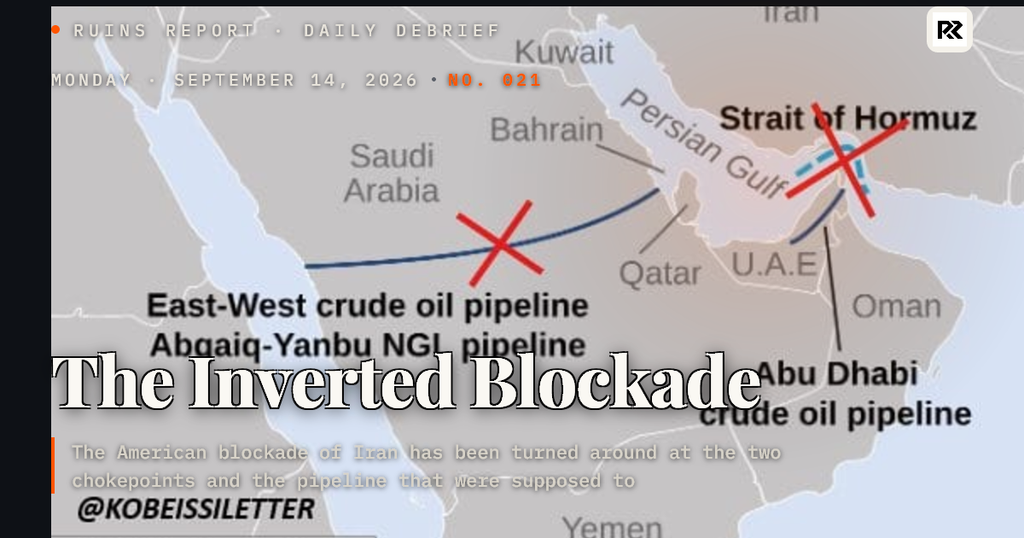
A blockade is a thing one state does to another. It is meant to run in one direction: the stronger navy closes the weaker economy's sea lanes and waits. The question that ran through nearly every episode the analysts we track put out late on the 13th and into the 14th was which way the arrow now points. Washington set out in the spring to blockade Iran. What the day's material describes, from a University of Chicago political scientist, a maritime historian, a former CIA analyst and the host of Dialogue Works, is a Persian Gulf, a Red Sea and a Saudi export system that are closed to almost everyone except Iran and the parties Iran chooses to let through.
Robert Pape gives the argument its shape. Interviewed by Tom Switzer, he describes Iran, the Houthis, the IRGC advisers he says have been in Yemen since mid-July and the Iraqi Shia militias as running a single, coordinated campaign against three targets: the Strait of Hormuz, the Bab el-Mandeb and the Saudi East-West pipeline that was built precisely so the kingdom could export without Hormuz. "They're tightening the noose in a coherent strategic manner increment by increment," he said, and the past three days, in his account, were the decisive increment: "this last 72 hours was a huge huge move in that direction."¹ ² He expects Riyadh to try to patch the pipeline within a week or two, which is a repair estimate rather than a solution; a patched line can be struck again.³
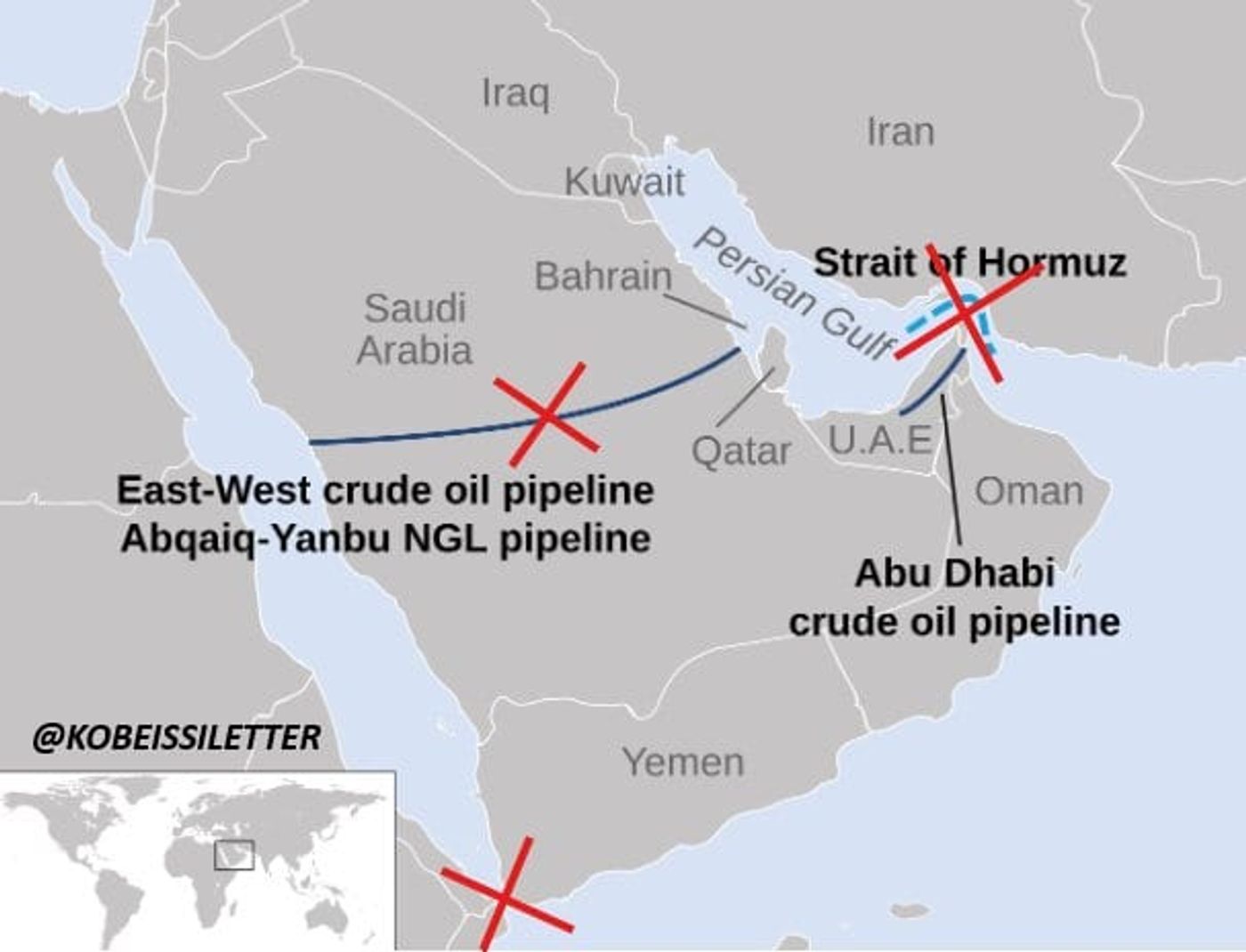
The rate sheet says what that map costs. Sal Mercogliano, who forecasts nothing and reads the market reporting aloud, went through the week's numbers from Lloyd's List, Clarksons and gCaptain. The Baltic Exchange index for very large crude carriers running from the Persian Gulf to China sits at nearly a million dollars a day and has doubled over the past month; Clarksons puts the route above the million mark.⁴ "Pre-war VLCCs were getting 50 to 100,000. This is 10 to 20 times higher than that."⁵ A 20-day voyage, on those numbers, nets a single ship $20 million.⁶ Even the Oman-to-China rate, for tankers that load by ship-to-ship transfer outside the strait rather than run it, is at $571,387 a day, up 113 percent on the week and 300 percent on the month.⁷ The premium is pulling in commercial operators, Greek owners especially, alongside the state-linked fleets. Mercogliano's one firm prediction is that if war-risk insurance climbs the way it did during the Houthi campaign two years ago, ships go back around Africa, "guaranteed".⁸
Who is paying? Not, on the day's evidence, Tehran. Larry Johnson, the former CIA analyst, told Nima Alkhorshid that Riyadh's problem is cash flow: the Saudis "can't keep this up for weeks and weeks without cash flow coming in" and "are going to have to make a deal", because no outside power is able or willing to rescue them. "There's no help for Saudi Arabia. They're toast."⁹ ¹⁰ The financial instrument Washington reached for in parallel, dollar sanctions, misses the target in his reading, because Iran's trade with Russia and China clears in local currencies; "the US dollar sanctions don't have much effect on that at all", while the closed strait feeds directly into American gasoline, diesel and food prices.¹¹
Nima Alkhorshid, speaking in his own voice on Dialogue Works, supplies the ground picture and the strongest claims of the day, which are his rather than this page's. He says Iran-aligned Yemeni forces are beating the Saudi-backed side outright and that airpower without troops cannot reverse it: "Saudi Arabia is losing and has lost in my opinion. There is no way for Saudi Arabia to get back in Yemen."¹² After the strikes on the multi-point East-West pipeline and the Jizan facilities, "the export of Saudi Arabia has collapsed totally as we talk", with no repair timeline he can find.¹³ His forecast is that Ansarallah's share of the country rises from roughly 80 percent to 96 or 99, depending on how Riyadh behaves.¹⁴ His verdict is the least hedged sentence anyone uttered: "the whole Middle East or the west Asia has collapsed overnight in my opinion by the war against Iran."¹⁵
Put those four accounts together and the thesis needs stating only once. The blockade has changed hands. The two chokepoints and the pipeline that were meant to squeeze Iran are now squeezing the Gulf exporters, the tanker market and the American consumer, and Iran, whose exports were the original target, is the party deciding what moves.
The obvious objection was put on the record, and it deserves its space. Switzer pressed Pape on the fact that a Hormuz-driven global shock has been forecast for months and has not arrived: "You think this time it's different?"¹⁶ He listed Iran's own weaknesses, a deteriorating economy, high inflation, unemployment and discontent at home, and noted oil at around $110 a barrel. Pape's answer was that Chinese demand destruction has masked a larger shock so far, that oil, gas and bond yields have all been rising since 12 July, and that $110 is probably not the ceiling.¹⁷ That is a disagreement about timing and magnitude, not direction, and it is the honest state of the question.

“since World War I, economic blockades alone have never won a major war”
Why did the instrument turn? The day's material points past personalities to an older assumption. Pape, whose academic work is on exactly this question, offers it as a historical finding rather than an opinion.¹⁸ A blockade coerces only when the blockading power controls the chokepoints and the target has no way to answer in kind. Washington assumed both. Iran, with its allies on the Yemeni coast and in Iraq, has shown it can answer at Hormuz, at the Bab el-Mandeb and on the pipeline route at the same time; Johnson's point about local-currency settlement is the same lesson applied to the dollar. The tools were designed for a world in which the United States was the only party that could close anything. "Iran is not taking its foot off our throat," Pape said, "it's putting their foot on our throat."¹⁹
Neither man expects a quick exit. Pape puts the odds "at least 30, 40 percent, maybe even higher" that this runs through 2027, not just to January, and counts roughly 60 days to the midterms with Iran, in his judgment, "not done yet".²⁰ ²¹ Johnson says Tehran's terms, an end to the blockade, an end to sanctions, American forces out and Iranian control of Hormuz, have not moved since the tanker strike near Hangam Island, and that Trump, already pulling back from retaliatory strikes, will take no real step on either Iran or Ukraine before November.²² ²³ Whether the Gulf's own channel to Tehran, opened in Muscat, becomes that exit is a question for another day.
Also heard today
Europe's negotiating position. Michael von der Schulenburg, a sitting member of the European Parliament and a former UN diplomat, told Daniel Davis that the West is responsible for the collapse of the 2022 Istanbul terms: "We killed it. The west killed it. We wanted to continue the war."²⁴ The consequence, in his account, is that any negotiation now happens from the losing side, "we would now negotiate as losers", and that "the European Union will not survive this war as it is now. Russia will survive it."²⁵ ²⁶ Davis agreed there is no military solution left.
Lavrov on German rearmament. Sergey Lavrov is the Russian foreign minister, not an analyst, and what he told Andrew Napolitano on Judging Freedom is an official position. He quoted Merz's stated ambition that Germany "must, in my view, once again rise to become the main military power on the continent", adding that "this is not a Freudian slip. They truly believe this."²⁷ He expects NATO members to push toward 5 percent of GDP on defence regardless of any settlement in Ukraine,²⁸ and attached a warning: "if this talk means you are preparing an attack, then I assure you the war will be completely different and very short."²⁹
BRICS in Delhi. M.K. Bhadrakumar, a former Indian ambassador, told Glenn Diesen that BRICS, meeting in Delhi, has "outstripped G7 in terms of its GDP" and already "bypasses dollar in terms of its clearing system", which is the lesson Johnson drew from Iran's trade, at continental scale.³⁰ ³¹ He expects "a golden moment in India Russia relationship" to follow.³²
Sources
- Robert Pape, *Tom Switzer* · Iran and its allies are tightening the noose on Hormuz, the Bab el-Mandeb and the Saudi pipeline "in a coherent strategic manner increment by increment" watch ▶ 20:23
- Robert Pape, *Tom Switzer* · "this last 72 hours was a huge huge move in that direction" watch ▶ 23:53
- Robert Pape, *Tom Switzer* · expects Saudi efforts to patch the East-West pipeline within a week or two watch ▶ 15:30
- Sal Mercogliano, *What's Going on With Shipping?* · citing the Baltic Exchange index, Persian Gulf to China VLCC rates near a million dollars a day, doubled in a month; Clarksons puts the route over $1 million watch ▶ 19:10
- Sal Mercogliano, *What's Going on With Shipping?* · pre-war VLCCs earned $50,000 to $100,000 a day; current rates are 10 to 20 times higher watch ▶ 19:28
- Sal Mercogliano, *What's Going on With Shipping?* · a 20-day voyage nets $20 million, "an insane rate" watch ▶ 19:36
- Sal Mercogliano, *What's Going on With Shipping?* · Oman to China ship-to-ship rate at $571,387 a day, up 113 percent week on week and 300 percent month on month watch ▶ 20:12
- Sal Mercogliano, *What's Going on With Shipping?* · if war-risk insurance climbs as it did during the Houthi attacks, ships head back around Africa, "guaranteed" watch ▶ 8:50
- Larry Johnson, *Dialogue Works* · "There's no help for Saudi Arabia. They're toast." watch ▶ 11:20
- Larry Johnson, *Dialogue Works* · the Saudis will have to make a deal because they cannot go weeks without cash flow watch ▶ 18:53
- Larry Johnson, *Dialogue Works* · dollar sanctions have little effect on Iran's local-currency trade with Russia and China watch ▶ 29:17
- Nima Alkhorshid, *Dialogue Works* · "Saudi Arabia is losing and has lost in my opinion. There is no way for Saudi Arabia to get back in Yemen." watch ▶ 25:00
- Nima Alkhorshid, *Dialogue Works* · Saudi exports have "collapsed totally" after strikes on the East-West pipeline and Jizan watch ▶ 17:47
- Nima Alkhorshid, *Dialogue Works* · predicts Ansarallah's control of Yemen rises from 80 percent to 96 or 99 percent depending on Saudi behaviour watch ▶ 39:16
- Nima Alkhorshid, *Dialogue Works* · "the whole Middle East or the west Asia has collapsed overnight in my opinion by the war against Iran" watch ▶ 47:22
- Tom Switzer, *Tom Switzer* · presses Pape on why the long-forecast Hormuz shock has not materialised: "You think this time it's different?" watch ▶ 26:20
- Robert Pape, *Tom Switzer* · with oil around $110, says it will probably go higher watch ▶ 21:17
- Robert Pape, *Tom Switzer* · "since World War I, economic blockades alone have never won a major war" watch ▶ 30:45
- Robert Pape, *Tom Switzer* · "Iran is not taking its foot off our throat, it's putting their foot on our throat" watch ▶ 35:58
- Robert Pape, *Tom Switzer* · puts the odds at 30 to 40 percent or higher that the war runs through 2027, not just to January watch ▶ 35:47
- Robert Pape, *Tom Switzer* · about 60 days to the midterms, "and I think Iran's not done yet" watch ▶ 37:54
- Larry Johnson, *Dialogue Works* · Iran's demands stand: lift the blockade and sanctions, US forces out, Iranian control of Hormuz; "Iran's not backing off of that" watch ▶ 1:15
- Larry Johnson, *Dialogue Works* · predicts no real step from Trump on Ukraine or Iran before the midterms, though he is already pulling back on retaliatory strikes watch ▶ 27:04
- Michael von der Schulenburg, *Daniel Davis / Deep Dive* · on the Istanbul terms: "We killed it. The west killed it. We wanted to continue the war." watch ▶ 20:58
- Michael von der Schulenburg, *Daniel Davis / Deep Dive* · "We would now negotiate as losers. We have to accept that we are the losers." watch ▶ 18:31
- Michael von der Schulenburg, *Daniel Davis / Deep Dive* · "The European Union will not survive this war as it is now. Russia will survive it." watch ▶ 18:15
- Sergey Lavrov, *Judging Freedom* · quotes Merz on Germany becoming "the main military power on the continent" and says "this is not a Freudian slip" watch ▶ 17:45
- Sergey Lavrov, *Judging Freedom* · NATO states will push to 5 percent of GDP on defence regardless of a Ukraine peace deal watch ▶ 9:51
- Sergey Lavrov, *Judging Freedom* · "if this talk means you are preparing an attack, then I assure you the war will be completely different and very short" watch ▶ 11:49
- M.K. Bhadrakumar, *Glenn Diesen* · BRICS has outstripped the G7 in GDP watch ▶ 5:59
- M.K. Bhadrakumar, *Glenn Diesen* · BRICS "bypasses dollar in terms of its clearing system" watch ▶ 8:42
- M.K. Bhadrakumar, *Glenn Diesen* · "this is going to be a golden moment in India Russia relationship" watch ▶ 28:43
By Ruins Report, a daily synthesis of what our tracked analysts said, not original reporting. Every numbered claim is sourced, dated, and timestamped above.
Newsletter
Get the Daily Debrief
One email each morning: what the analysts we track actually said, and every call timestamped to its source. Free.
Free. No spam. View on Substack →
Support the Report
Free to read, every day.
The Debrief is compiled each morning from what the analysts we track actually said, sourced and timestamped. No paywall, no ads, no investors. If it earns a place in your inbox, you can help keep it independent.
Support the report →