
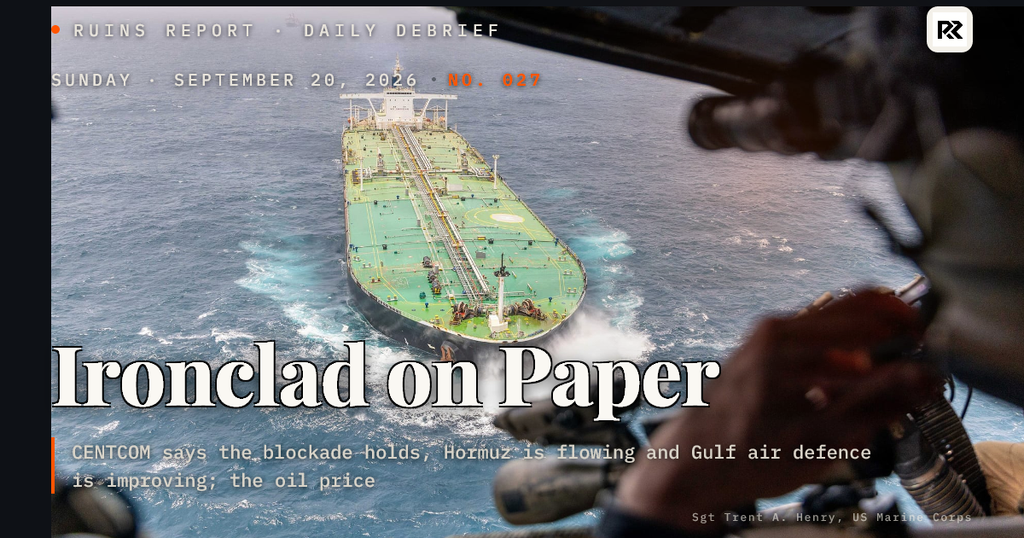
Every war produces two accounts of itself: the one the command briefs and the one the evidence eventually writes. Ordinarily time closes the gap between them. In the Gulf, the analysts we track argued today, the gap is being held open by three things the command does not control, the oil price, the interceptor stockpile and the sky over Saudi Arabia, and it is widening rather than closing.
The official version arrived on 19 September from Admiral Brad Cooper, the CENTCOM commander, in a filmed update. American-escorted forces, he said, had supported more than a billion barrels of crude leaving the Gulf and over 2,000 commercial transits through the Strait of Hormuz in two months. The primary lanes were clear of mines. Traffic over the past two weeks was the highest since the war began. Iran had exported zero barrels "thanks to our ironclad blockade." He described work with Gulf Cooperation Council partners on air defence and a new anti-drone coalition unit. The figures are CENTCOM's own; no independent audit accompanies them.
Take the air-defence promise first, because it is the one the Gulf states are being asked to bank on. Anthony Aguilar, on *Dialogue Works*, went at Cooper's briefing directly and called the messaging to the Gulf capitals "used car salesmanship." The underlying problem, in his account, is arithmetic: "the United States is critically low on interceptors and precision strike munitions and interception systems."¹ New Patriot interceptor capacity able to change the picture over the Gulf does not, on his dating, arrive until August 2028.² Larry Johnson, on the same programme, reached the same conclusion from the same starting point: "the United States has depleted its missile supply force and it doesn't have an effective air defense to offer anybody."³
Whether or not the shortage is that severe, the sky over Saudi Arabia has already delivered its own verdict. Daniel Davis read the Houthi strike on Saudi Aramco and King Khaled airfield as the settling of an old argument: offensive missile and drone power now beats the defence, and eleven years and roughly $7 billion of American, Israeli and Saudi effort have not subdued the movement that fired them. "Saudi Arabia cannot defend its airspace," he said.⁴ Mohammad Marandi supplied the history behind that. The 2025 American campaign against Yemen ran out of targets within days and left Ansar Allah's capabilities intact; the movement now has indigenous deep-strike weapons reaching far inside the kingdom and fires them on its own timetable rather than Tehran's. "The Saudis are completely vulnerable."⁵ Johnson added the ground picture, in which "the Houthis are rapidly advancing and defeating the Saudi proxy forces,"⁶ and Steve Hanke the net effect: "the Houthis are even stronger than they were and the Saudis have less support."⁷
Then the figures. A billion barrels and 2,000 transits are the kind of numbers a market notices, and Hanke, an economist by trade, made the simplest objection of the day. If supply through Hormuz had been restored to anything like the degree claimed, the price would reflect it. "Why in the world is the oil price so high? It doesn't match up."⁸ He expects the next quarter's data to show "some serious downdraft," with Saudi oil and phosphate output disrupted.⁹ Johnson pointed to the terminals themselves: the war-damaged Gulf oil infrastructure will take "at a minimum weeks, if not months" to repair, whatever the escort count says.¹⁰ Aguilar's charge was blunter. Cooper's throughput claims for oil and LNG do not match what the market shows, and the reason, he argued, is not error: "it's dishonest, it's disingenuous. It's an attempt to try to continue to sell this war for the administration that it's successful. It is not."¹¹ Nima Alkhorshid reported the same mismatch from the buyers' side: some European purchasers have been told they may not see Saudi oil until November or later,¹² a schedule that sits awkwardly beside a fortnight of record transits. "Saudi Arabia is naked."¹³
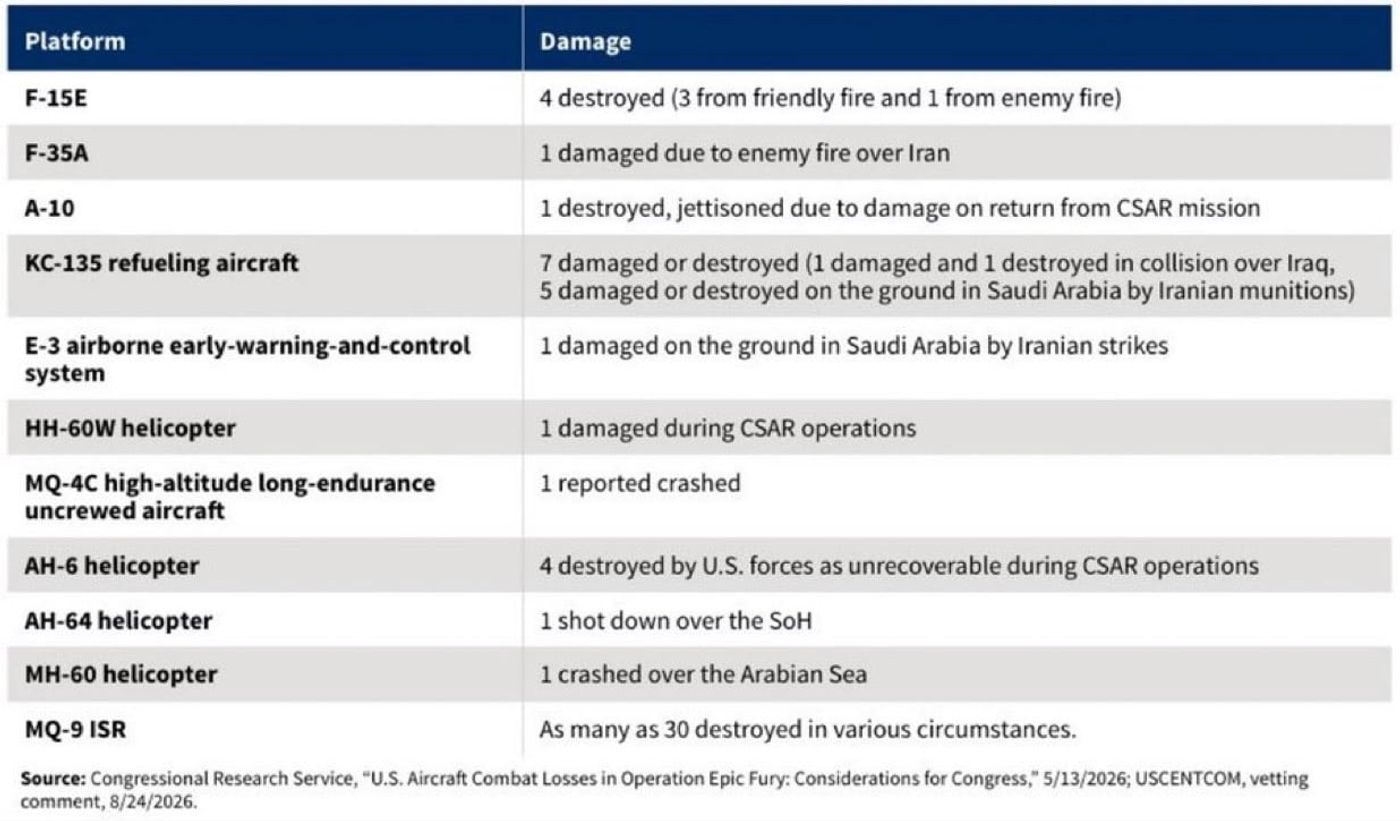
The losses matter because they are the only line of the ledger anyone outside the command has checked, and the checked line does not read like a war being won at low cost. Aguilar extended the point to the ground: "the most US military bases in the Middle East have been irreparably damaged by Iranian strikes that would take decades to rebuild."¹⁴ Set against one another, these are not six complaints about a briefing. They amount to a single finding. The official account of the Gulf war describes a position the United States does not hold.
Why the account persists anyway is the harder question, and Joe Kent, on *Glenn Diesen*'s programme, located the answer somewhere other than any one admiral's slides. The problem is not the briefing but the premise underneath it, a picture of American power that predates the war and has not been revised by it.
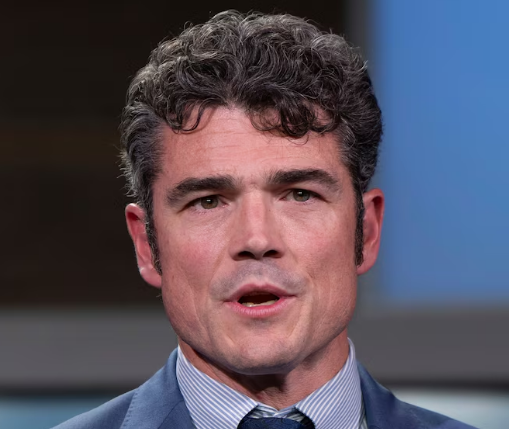
Kent's test case is the one that has already embarrassed the official picture. Of Ansar Allah, he said: "whether we like it or not, they have more leverage over us than we do of them."¹⁵ The conclusion follows from the premise, and he stated it without hedging: "at some point we will end up cutting a deal with them."¹⁶ The interceptor shortfall, the undefended Saudi sky and the stubborn oil price are, on this reading, not separate failures but the same one seen from three angles: a strategy sized for a world that would bend, applied to one that has not.
The bill is already arriving at home. Johnson, on the fuel and grocery prices Americans are now paying, was categorical: "there's nothing Trump can do in the next six weeks that's going to turn this around."¹⁷
Beyond the Gulf
Ukraine's infrastructure. Alexander Mercouris, on *The Duran*, counted the damage from the Russian strike campaign: 500 locomotives destroyed and, on his estimate, between 30 and 60 percent of Ukraine's warehouses demolished against 3 percent of Russia's. "There are no more warehouses in Kiev."¹⁸
The victory Ukraine is being promised. Davis, on *Daniel Davis / Deep Dive*, responded to remarks by David Petraeus, who argued that Ukraine still has a path to victory if the West crushes Russia's war economy. Davis rejected both halves: Russia is "sanction proof now," and holding out the prospect of winning to a country in Ukraine's position is, in his words, "the cruelest thing you can do."¹⁹
Iran-linked hackers and the ships. Sal Mercogliano, on *What's Going on With Shipping?*, reported that "US Coast Guard and FBI personnel boarded two commercial vessels bound for the United States in the Gulf of Mexico last month after indications that hackers had broken into their computer networks."²⁰ His own view is that the image of a hacked ship steered into a bridge is media hype; the real exposure is in cargo, power and control systems, and the busiest American container port for global trade foiled more than 120 million intrusion attempts in August alone.
Sources
- Anthony Aguilar, *Dialogue Works* · The United States is critically low on interceptors and precision strike munitions watch ▶ 11:22
- Anthony Aguilar, *Dialogue Works* · New Patriot interceptor capacity for the Gulf does not arrive until August 2028 watch ▶ 21:21
- Larry Johnson, *Dialogue Works* · Washington has depleted its missile supply and has no effective air defence to offer anyone watch ▶ 2:57
- Daniel Davis, *Daniel Davis / Deep Dive* · Saudi Arabia cannot defend its airspace after the Aramco and King Khaled strikes watch ▶ 32:35
- Mohammad Marandi, *Dialogue Works* · The Saudis are completely vulnerable to Ansar Allah's indigenous deep-strike capability watch ▶ 7:00
- Larry Johnson, *Dialogue Works* · The Houthis are rapidly advancing and defeating Saudi proxy forces watch ▶ 12:14
- Steve Hanke, *Dialogue Works* · The Houthis are stronger than before and the Saudis have less support watch ▶ 2:17
- Steve Hanke, *Dialogue Works* · If supply were restored the oil price would not be this high watch ▶ 41:26
- Steve Hanke, *Dialogue Works* · Next quarter's data will show a serious downdraft with Saudi oil and phosphate output disrupted watch ▶ 24:14
- Larry Johnson, *Dialogue Works* · War-damaged Gulf oil terminals will take weeks, if not months, to repair watch ▶ 22:08
- Anthony Aguilar, *Dialogue Works* · Cooper's throughput claims are a dishonest attempt to sell the war as a success watch ▶ 20:21
- Nima Alkhorshid, *Dialogue Works* · Some European buyers told they may not get Saudi oil until November or later watch ▶ 28:22
- Nima Alkhorshid, *Dialogue Works* · Saudi Arabia is naked; CENTCOM's figures do not match the oil and gas market watch ▶ 19:11
- Anthony Aguilar, *Dialogue Works* · Most US bases in the Middle East irreparably damaged by Iranian strikes watch ▶ 27:11
- Joe Kent, *Glenn Diesen* · Ansar Allah has more leverage over the United States than the United States has over it watch ▶ 12:58
- Joe Kent, *Glenn Diesen* · Washington will end up cutting a deal with Ansar Allah watch ▶ 53:56
- Larry Johnson, *Dialogue Works* · Nothing Trump can do in six weeks will turn around fuel and grocery prices watch ▶ 39:58
- Alexander Mercouris, *The Duran* · There are no more warehouses in Kiev after the Russian strike campaign watch ▶ 0:46
- Daniel Davis, *Daniel Davis / Deep Dive* · Telling Ukraine there is a path to victory is the cruelest thing you can do watch ▶ 8:26
- Sal Mercogliano, *What's Going on With Shipping?* · Coast Guard and FBI boarded two US-bound vessels after hackers broke into their networks watch ▶ 4:26
By Ruins Report, a daily synthesis of what our tracked analysts said, not original reporting. Every numbered claim is sourced, dated, and timestamped above.
Newsletter
Get the Daily Debrief
One email each morning: what the analysts we track actually said, and every call timestamped to its source. Free.
Free. No spam. View on Substack →
Support the Report
Free to read, every day.
The Debrief is compiled each morning from what the analysts we track actually said, sourced and timestamped. No paywall, no ads, no investors. If it earns a place in your inbox, you can help keep it independent.
Support the report →