
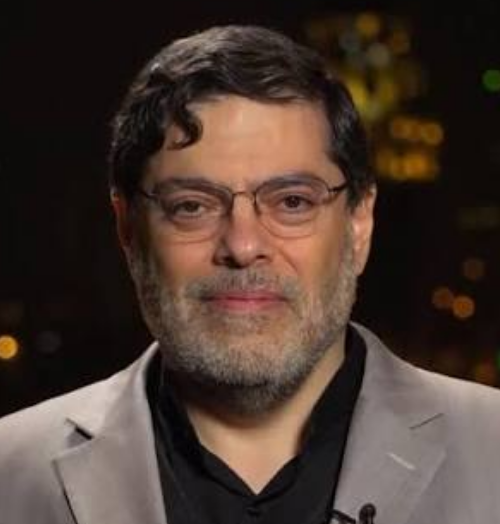
Mohammad Marandi
Seyed Mohammad Marandi is a professor of English Literature and Orientalism at the University of Tehran, and a prominent US-born Iranian political analyst and commentator. Born in Virginia and raised in the United States until his family moved to Iran after the 1979 revolution, he is a frequent guest on international broadcasters including the BBC, RT, CNN, and Al Jazeera, as well as Glenn Diesen, Dialogue Works, and Judging Freedom. He speaks from close proximity to the Iranian government’s perspective, presenting Iran’s strategic case in the region’s ongoing conflicts.
Where they stand
A short read of where Mohammad Marandi lands on each front we follow, drawn from their recent appearances and refreshed whenever they turn up in a debrief.
Iran
Iran already routes around the US squeeze via small-ship transshipment and Chinese, Iraqi and Emirati trade, is more prepared for war than ever with fast-improving missile and drone R&D, and will hit back hard if Washington tries to strangle its economy. Ansarallah's rout of the Saudi/UAE-backed, US- and British-armed coalition in Yemen was an extraordinary, near-miraculous victory that has decisively shifted the regional balance toward Iran and the axis of resistance. The IAEA and other Western-dominated bodies have lost all credibility as tools of empire, and continued pressure over Iran's nuclear file could push Tehran to leave the NPT. Now says Iran will not negotiate until Washington implements the ceasefire it already signed and abandoned, that Tehran reads US coercion as failing, and that Iran is planning for a war lasting until the end of Trump's presidency under a newly assertive Supreme National Security Council chair. Now insists Iran is not desperate and will remain steadfast under the siege until the US implements the MOU (end genocide, end the Lebanon occupation, return stolen assets, unblock oil sales): "Iran is not desperate. Iran will tolerate this situation until whenever." Says Ansar Allah now effectively governs 70-80 percent of Yemen's population and is strangling Saudi oil exports and Red Sea shipping outright. Now says Iran’s power lies not only in missiles, drones and underground bases but in its regional alliances with Iraq and Yemen, which the West consistently underestimates, and that Iran will not normalize relations with Washington until it ends the war in Gaza, ends the occupation of Lebanon and hands back Iranian assets.
as of 2026-09-17
Israel
Frames Netanyahu as a desperate, election-losing figure and says Iran's security council has threatened to target him after Israel's assassination campaigns and the war on Gaza. The Lebanon operation was staged election theater for Netanyahu since Hezbollah had already emptied the area, and he reads Israel's regime as dependent on Western backing and drifting toward strategic demise. Even so, a desperate Netanyahu could still launch a war against Iran before the October 27 election. Now says no agreement is possible unless the Gaza war ends and Israel withdraws from Lebanon, and argues it is Netanyahu's bombing of Lebanon rather than Iran that keeps breaking ceasefires. Now says Netanyahu deliberately wrecked the Lebanon ceasefire by carpet-bombing and killing hundreds, and that Trump let it slide by claiming Netanyahu wasn't bound by the deal, showing Israel can violate agreements with US cover while Gaza's genocide continues unchecked. Now says Washington has never really been a friend to the region, that its only real ally is Netanyahu’s Israel, and that everyone else, the Gulf states and Ukraine alike, gets sacrificed for it.
as of 2026-09-17
East Asia
China is a close, cooperating partner still drawing oil out of the Persian Gulf including Iranian crude, part of the sanctions-evasion network that keeps Iran’s economy functioning under siege. Now says Iran's relationship with China and Russia is very good and strengthening, with foreign ministers meeting on the BRICS/SCO sidelines and Iran's FM travelling to Beijing ahead of the Xi-Trump meeting, and expects deeper Iran-China-Russia economic collaboration once the war ends.
as of 2026-09-15
American power
The 12-day and 40-day wars already broke the US foothold in Iraq and the Gulf, devastated bases, and forced a creeping US withdrawal he frames as "the beginning of the end of the US empire" that has reigned since World War II. Washington and its Gulf and Jordanian proxies have now failed against both Yemen and Iran, and US bases and regional alliances are growing more brittle by the day. He puts no fixed timeline on it, but says the decline of US regional hegemony will continue. Now says the Gulf states are too bound to Washington diplomatically and financially to send the American military away on their own, even as Iran, strengthened after the SCO and BRICS summits, offers them its own security arrangement instead. Now adds that Gulf monarchies are brittle, compromised client states, blackmailable by the West including through Epstein-linked exposure, who privately admit the US doesn't protect them but still lack the will to break away toward China or Russia despite real multipolar alternatives now existing. Now says US client regimes in the Persian Gulf are increasingly fragile and were exposed as unprotected once Iran and the Houthis struck the Jordan air base and the Bab el-Mandeb, and that the American Congress is the Knesset 2.0.
as of 2026-09-17
The global economy
Gulf petrostates no longer have surplus wealth to buy US bonds and are being forced toward selling US assets, while yen and bond-market stress show the dollar system straining under the cost of the siege on Iran. The Yemen and Red Sea war has pushed oil above 00 a barrel and left Gulf monarchies, Saudi Arabia, the UAE, Qatar, Kuwait and Bahrain, having spent trillions plus hundreds of billions more, growing financially brittle. Washington will not let them liquidate their US bonds and stocks to cover the losses. Now says the real price of oil and the shortages of diesel, LNG, helium, sulphur and fertiliser are far worse than the official Brent and WTI numbers suggest, and that Iran has shifted to a wartime economy built to endure years of it. Now says the Yemen war and Iran-linked energy war are wrecking Saudi and Gulf state finances outright, with regimes hemorrhaging money and forced toward selling treasury holdings and bonds Washington won't actually let them fully cash out. Now says Gulf oil and gas economies are heading toward a sudden collapse as revenue dries up, and that the instability could push Gulf states to pull their assets out of US bond and stock markets.
as of 2026-09-17
Recent appearances
The US is now the Gulf worst enemy
Judging Freedom · 2026-09-17
2026-09-15 · Dialogue Workswatch ↗
Super Tankers & Drones Hit in Hormuz as Saudi-Yemeni War Burns Bab al-Mandab (w/ Nima Alkhorshid)