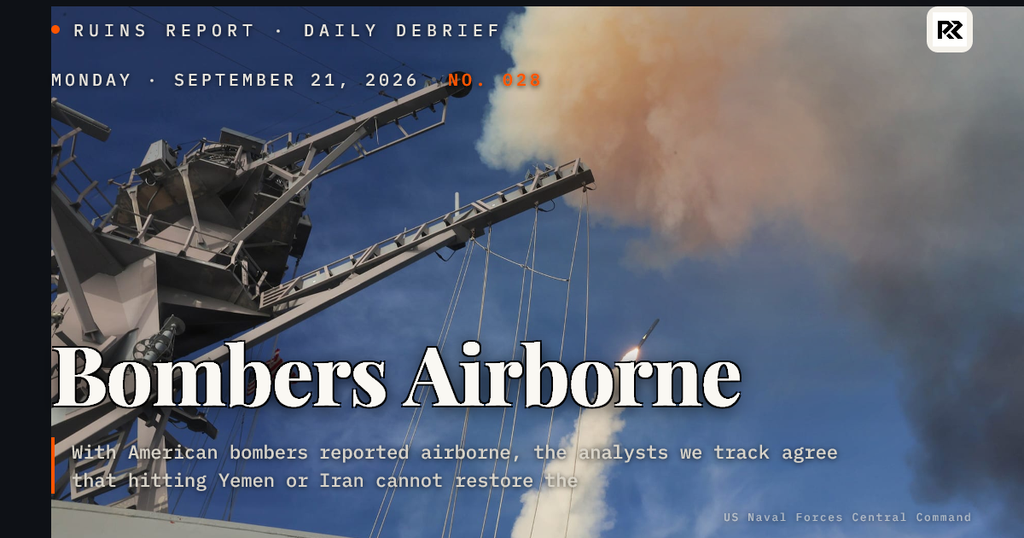
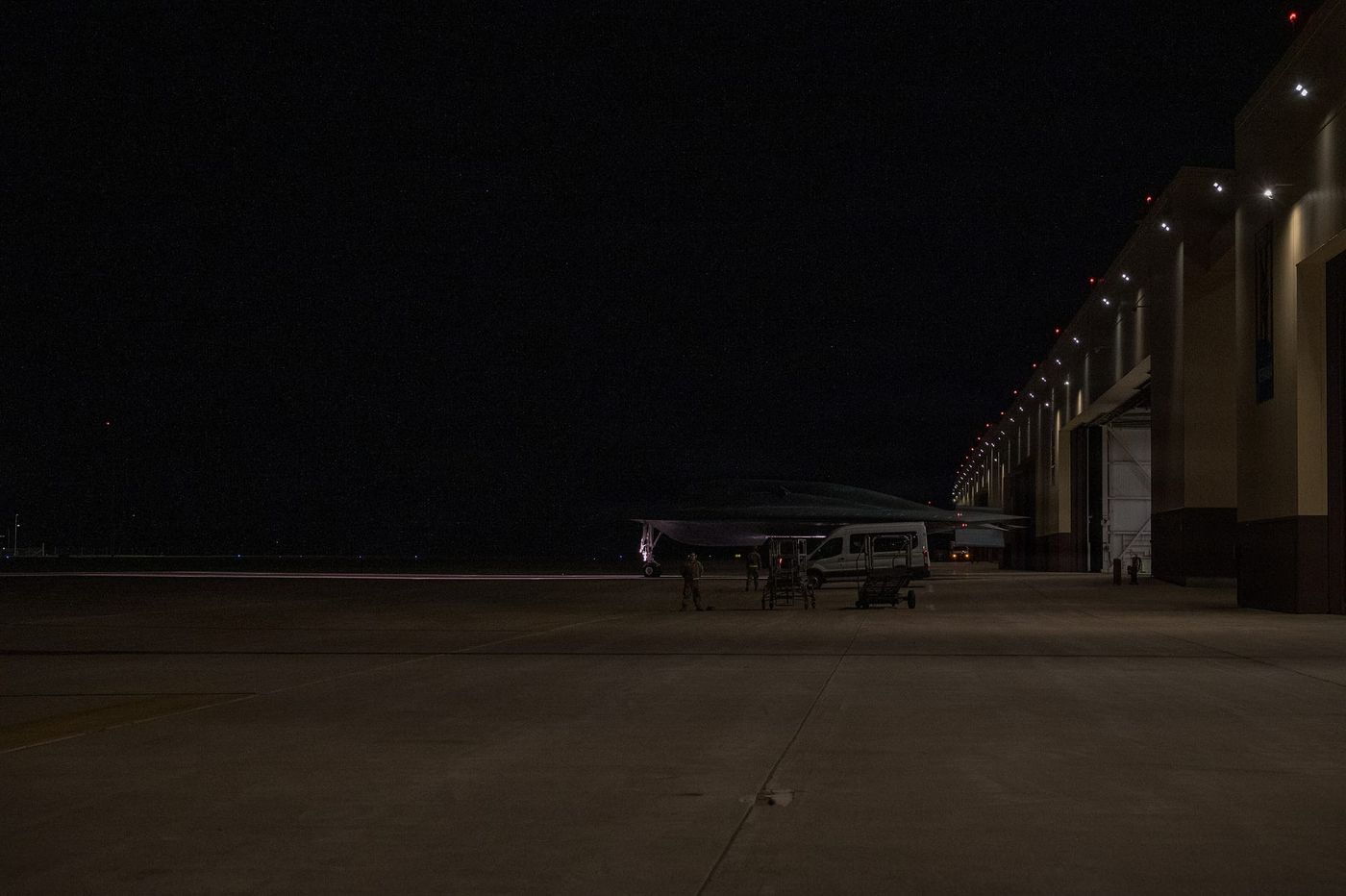
By the time the analysts we track sat down to record on 20 September, the reports were already circulating: American bombers up from British bases and heading toward the Middle East, with a large strike expected within hours. Alexander Mercouris, reading those reports on his daily programme, judged the target most likely to be the Houthis in Yemen, with Iran itself the less plausible but not excluded alternative.¹ Mohammad Marandi, speaking with Glenn Diesen, was prepared to say it outright: "in the coming hours or coming days the United States will launch heavy strikes whether it's on Yemen or on Iran or against both."² Nobody on the roster doubted that something was coming. The question that occupied them was a different one. What can such a strike actually accomplish, and if the answer is very little, why is it being attempted at all?
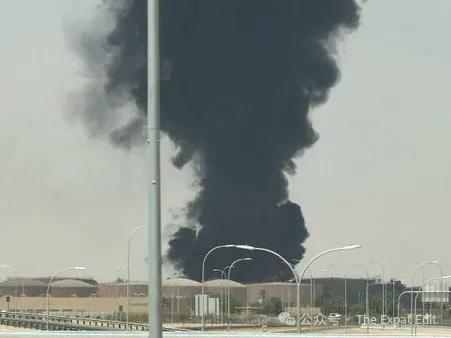
The proximate cause is Saudi Arabia. Over the past week the Houthis have carried the war to the kingdom's oil infrastructure and, for the first time, to Riyadh itself, where a fuel depot near King Khalid International Airport burned on 19 September and Saudi air defences confirmed intercepting a ballistic missile aimed at the capital. On The Duran, Mercouris reported that Mohammed bin Salman "telephoned Trump twice asking Trump to bomb the Houthis."³ The crown prince's position, in Mercouris's reading, is close to untenable. Iran and its Houthi allies now sit on the key chokepoints and on the East-West pipeline route, and Saudi oil has nowhere to go. "He does not have the Strait of Hormuz," Mercouris said of the crown prince.⁴ Ray McGovern, on Dialogue Works, put the same judgment more bluntly: "the Saudis, I think, are relatively impotent."⁵
So Washington is being asked to rescue an ally. What the analysts doubt is that it has the means. Daniel Davis spent most of his programme working through the three options the president has publicly floated for Iran: destroy it, strangle it economically, or cut a deal. He found none of them viable. "There is no scenario where we can wipe Iran out," he said, and added that this holds even if nuclear weapons were used.⁶ Economic strangulation, in his account, wounds the United States nearly as much as Iran, and Tehran's own seven conditions for talks make a deal impossible on any terms Washington could accept. "The bottom line is there is no military solution."⁷ On the narrower question of forcing Tehran to change course, he was flat: "We don't have the military power to compel that. We don't."⁸

“There is no scenario where we can wipe Iran out.”
Marandi's account from Tehran arrives at the same conclusion by a different road. Iranian assets are dispersed and hardened underground, drone defences have improved since the spring, and the forty-day war already demonstrated that Iran cannot be defeated from the air; he called that war "idiotic from the beginning" and its continuation idiotic as well.⁹ What a new strike would do, he argued, is invite a reply that Washington and its Gulf partners cannot absorb. "You don't have to bomb a factory to shut it down. All you have to do is make it impossible to manage," he said of the Gulf's energy plant.¹⁰ Iran, in his phrase, "has literally infinite targets to strike."¹¹ A war that touches Iran's own oil would, in his view, collapse the global economy almost immediately; even a strike confined to military targets closes the Strait of Hormuz and pushes the world into deep recession.¹¹
McGovern supplied the constraint the others tend to take for granted: "the US has run out of ammunition."¹² Its Gulf allies are exposed because the interceptors that would defend them are not there to be fired. Nima Alkhorshid, hosting McGovern, observed that Iran is the only actor capable of striking across the whole region at once, and that nothing Washington can do will force it into capitulation or a decisive shift on the battlefield.¹³ Against that background, Mercouris's forecast that "everything is pointing to us being in a major escalation cycle in the Middle East" reads less as alarm than as arithmetic.¹⁴
Put these together and the shape of the day's read is clear. Not one of the analysts we track expects the strike to work, if working means restoring Saudi exports, ending Houthi attacks, or moving Iran's position by a single inch. The bombers are in the air anyway. This is not a plan being executed. It is an assumption being tested, again.
The assumption belongs to Riyadh and Washington alike. On The Duran, Mercouris located the Saudi error precisely: the Saudis "obviously assumed that the Americans were more powerful or more willing to exert power in the Middle East than they really are." The United States, he noted, cannot even supply MBS with Patriot missiles.¹⁵ Alex Christoforou traced how the bet was placed, on Trump personally and on Trump-family business ties, with the BRICS track abandoned along the way, so that the kingdom now stands stranded when Washington fails to deliver.¹⁶ Davis saw a related transaction in Riyadh's abrupt exit from a Chinese yuan-oil platform, made immediately after pressing Trump for help against the Houthis. It looks, he said, like a trade to prop up the petrodollar, and his worry is that the price will be paid in another unwinnable Yemen campaign.¹⁷
Diesen framed the American half of the problem as a failure of adjustment: a state that has not made the mental shift from hegemonic dominance to a multipolar order, and so defaults to coercion even after coercion has stopped producing results.¹⁸ Marandi named the mechanism. "You underestimate your adversaries and by underestimating your adversaries you make foolish decisions," he said, and described the trajectory of American policy in the region as looking "more like a plane that's crashing."¹⁹ ²⁰ Davis, for his part, could see only one exit: a unilateral American walk-away that lets Iran claim it won, however bitter that is to swallow. Anything else runs into an adversary that will not yield. "I'm promising you, they will eat grass and they will suffer all kinds of loss and they will not give up."²¹
Beyond the strike
The Houthi campaign against Saudi infrastructure has a bill the market has not finished paying, in the view of Nate of Canadian Prepper. "You can kiss Saudi Aramco goodbye," he said, expecting Saudi export capacity to be gone for the next couple of months.²² The consequence he watches most closely is fuel: "this diesel crisis is likely going to get much, much worse," and it worsens into winter.²³
Ukraine's 2,000-drone attack on Moscow drew a hard verdict from Mercouris. "This drone war is turning into a disaster for Ukraine," he said, reading the raid as an enormously expensive and militarily futile exercise staged for Kiev's Western backers, while Russia's far cheaper campaign continues to grind down Ukraine's economy.²⁴
Mercouris also turned to Washington's new secondary-sanctions bill aimed at Chinese and Indian buyers of Russian energy, and to the rare-earths counter-blockade he thinks it invites. His rule for such measures is short: "one should never bluff China because the bluff is always called."²⁵
Sources
- Alexander Mercouris, *Alexander Mercouris* · With US bombers reported airborne from UK bases, the target is most likely the Houthis rather than Iran directly watch ▶ 71:47
- Mohammad Marandi, *Glenn Diesen* · Predicts heavy US strikes on Yemen, Iran or both within hours or days watch ▶ 1:59
- Alexander Mercouris, *The Duran* · MBS telephoned Trump twice asking him to bomb the Houthis watch ▶ 5:08
- Alexander Mercouris, *The Duran* · Iran and the Houthis hold the chokepoints; Saudi Arabia cannot get its oil out watch ▶ 0:39
- Ray McGovern, *Dialogue Works* · The Saudis are relatively impotent watch ▶ 6:23
- Daniel Davis, *Daniel Davis / Deep Dive* · No scenario exists in which the US can wipe Iran out, even with nuclear weapons watch ▶ 3:38
- Daniel Davis, *Daniel Davis / Deep Dive* · None of Trump's three options works; there is no military solution watch ▶ 7:01
- Daniel Davis, *Daniel Davis / Deep Dive* · The US lacks the military power to compel Iran watch ▶ 18:35
- Mohammad Marandi, *Glenn Diesen* · The forty-day war was idiotic from the start and proved Iran cannot be militarily defeated watch ▶ 44:21
- Mohammad Marandi, *Glenn Diesen* · Gulf energy plant can be shut down by making it impossible to manage, not by bombing it watch ▶ 16:30
- Mohammad Marandi, *Glenn Diesen* · Iran has infinite targets; any strike closes Hormuz and drives a deep global recession watch ▶ 24:01
- Ray McGovern, *Dialogue Works* · The US has run out of ammunition to defend its Gulf allies watch ▶ 46:37
- Nima Alkhorshid, *Dialogue Works* · Iran alone can strike across the whole region; Washington cannot force capitulation or a battlefield shift watch ▶
- Alexander Mercouris, *Alexander Mercouris* · Everything points to a major escalation cycle in the Middle East watch ▶ 75:46
- Alexander Mercouris, *The Duran* · The Saudis assumed an American power and willingness to act that no longer exists; Washington cannot even supply Patriots watch ▶ 9:38
- Alex Christoforou, *The Duran* · MBS bet everything on Trump personally and Trump-family business ties, abandoning the BRICS track watch ▶
- Daniel Davis, *Daniel Davis / Deep Dive* · Saudi exit from a Chinese yuan-oil platform looks like a petrodollar trade whose price may be another Yemen campaign watch ▶
- Glenn Diesen, *Glenn Diesen* · Washington has not made the mental shift from hegemony to multipolarity and defaults to coercion that no longer works watch ▶
- Mohammad Marandi, *Glenn Diesen* · Underestimating adversaries produces foolish decisions watch ▶ 53:59
- Mohammad Marandi, *Glenn Diesen* · US policy in the region looks like a plane that is crashing watch ▶ 58:17
- Daniel Davis, *Daniel Davis / Deep Dive* · Iranians will eat grass and suffer every loss before they give up; the only exit is a US walk-away watch ▶ 21:46
- Nate, *Canadian Prepper* · Saudi Aramco export capacity is gone for the next couple of months watch ▶ 3:40
- Nate, *Canadian Prepper* · The diesel crisis will get much worse into winter watch ▶ 4:04
- Alexander Mercouris, *Alexander Mercouris* · Ukraine's 2,000-drone raid on Moscow is a costly, futile gesture aimed at its Western backers watch ▶ 50:31
- Alexander Mercouris, *Alexander Mercouris* · The secondary-sanctions bill is a bluff China will call, inviting a rare-earths counter-blockade watch ▶ 86:57
By Ruins Report, a daily synthesis of what our tracked analysts said, not original reporting. Every numbered claim is sourced, dated, and timestamped above.
Newsletter
Get the Daily Debrief
One email each morning: what the analysts we track actually said, and every call timestamped to its source. Free.
Free. No spam. View on Substack →
Support the Report
Free to read, every day.
The Debrief is compiled each morning from what the analysts we track actually said, sourced and timestamped. No paywall, no ads, no investors. If it earns a place in your inbox, you can help keep it independent.
Support the report →