
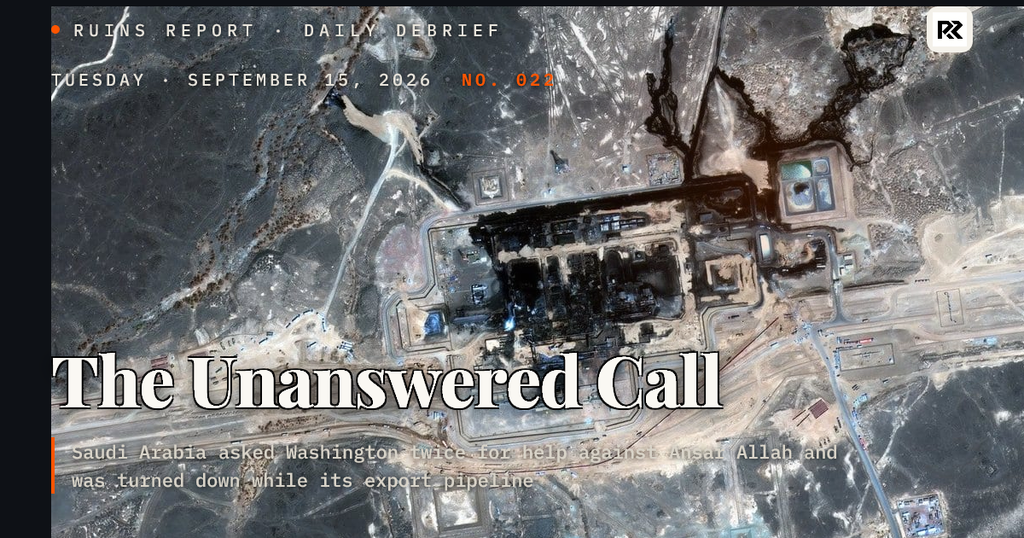
For eighty years the arrangement in the Gulf rested on a single understanding. Saudi Arabia would keep the oil flowing and price it in dollars, and the United States would keep the kingdom safe. Over the past week that understanding was tested in the most direct way possible, and the analysts we track say it failed. According to Larry Johnson, Mohammed bin Salman went to Donald Trump twice and asked for American military help against Ansar Allah, and Trump declined both times, treating the Yemen war as a "pre-existing condition" that was not Washington's to cure.¹ The question that follows is not whether the refusal was wise. It is whether the guarantee it was meant to honour still exists, and if it does not, who now sets the price of the commodity it was built to protect.
The military picture explains the urgency of the request. Johnson said that "in roughly two days the Houthis captured 4,000 square kilometers of territory," routing the Saudi-backed forces meant to hold the coast and taking the approaches to the Bab el-Mandeb.² "Yemen is rapidly falling apart as far as the Saudis are concerned," he said.³ Anthony Aguilar, a retired Army lieutenant colonel, described the same forces as "formidable opponents" with ballistic missile and drone capability,⁴ expects their push south to take the city and province of Taiz within days,⁵ and dismissed the official line from Washington and Riyadh outright: "We've got a handle on it. No, we don't. We don't have a handle on it."⁶ Chas Freeman, who served as American ambassador in Riyadh, was blunter about where this ends. "Saudi Arabia is now at war with Ansarallah again," he said,⁷ and "the prospect of a military solution to this is nil."⁸ He called the outcome, already, "a defeat for Saudi Arabia."⁹
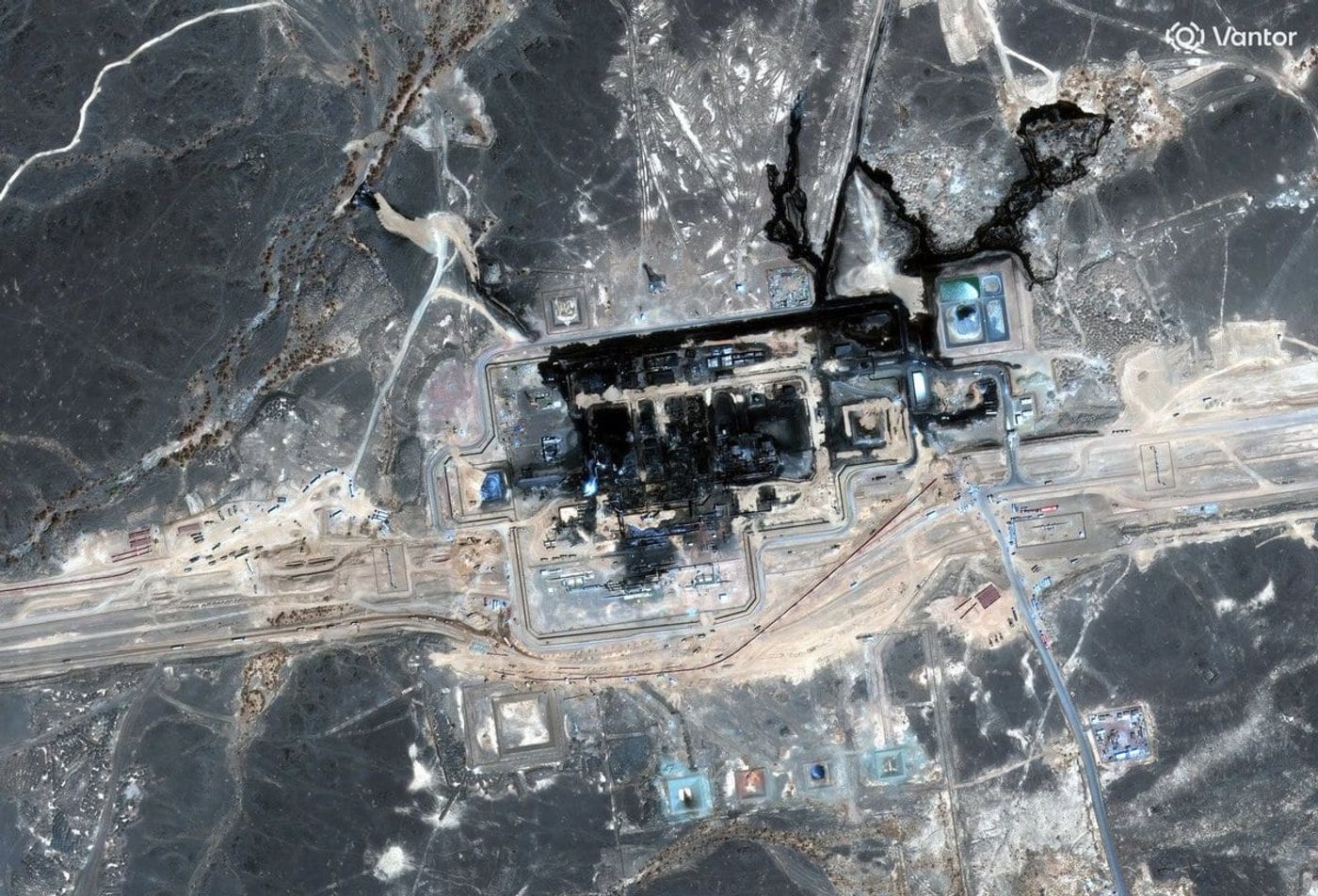
What makes this more than a regional war is what it has done to the pipeline built to insulate Saudi exports from exactly this kind of trouble. The East-West line carries crude from the Gulf fields across the peninsula to Yanbu on the Red Sea, so that tankers never need to pass Hormuz. With the Yemeni coast in Ansar Allah's hands and the pumping stations struck, both doors are now shut. Aguilar reported the line "shut down, not operating."¹⁰ Alastair Crooke put the consequence in the plainest terms available: "it's my understanding at the moment Saudi oil sales are zero zero."¹¹ He was insistent that this is not a weekend's work: "It's not going to come back. It's not going to be oh we'll repair it by the weekend. No, no, no."¹² Johnson's figures were more specific. The crude sitting in the Yanbu storage tanks can still be loaded onto tankers, but "within another 5 days that's going to be done,"¹³ and "the estimate is it's going to take more than a month to repair that pipeline."¹⁴ Mohammad Marandi, speaking from Tehran, cited estimates of "weeks or many weeks" before Saudi output returns to where it stood a few days ago.¹⁵
The price is following the physics. Aguilar put the national average for a gallon of regular petrol at $4.32,¹⁶ and expects that "by the end of September, we're going to see fuel prices at a range that no one ever thought possible."¹⁷ The White House has attributed the diesel spike to Ukrainian strikes on Russian refineries. None of the analysts accepts that. Johnson called the claim "simply not true": "It has nothing to do with Russia."¹⁸ Crooke said he "can't imagine that attacks on Russian diesel fuel have anywhere near the effect on the cost of gasoline in the United States that the closure of the straits does," and called the explanation "just a PR stunt by the president."¹⁹
The political clock is short. "This is going to kill Donald Trump in the midterm election," Johnson said.²⁰ Freeman, who is sparing with predictions, expects "a political reckoning I think in early November" over petrol prices and wars of aggression.²¹
That is the ground on which the larger claim rests. Johnson's image for the alliance was domestic: "I think we're at that stage in a relationship where we're going to start seeing other people. I don't know if it's an actual divorce yet, but it's certainly headed in that direction."¹ Freeman's was historical. The bargain struck in 1945 has collapsed, Washington can no longer protect Saudi Arabia any more than it can protect Ukraine or Israel, and the only exit he sees for Riyadh runs through Iranian mediation.⁹ Crooke reads the week as a realignment a century in the making, with power draining from the Gulf monarchies back toward Iran and Yemen, and says flatly that "Saudi is in deep trouble as a consequence of this."²²
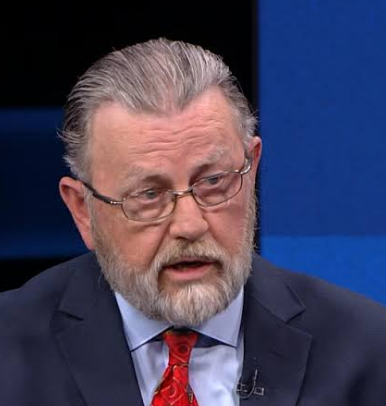
“I think we're at that stage in a relationship where we're going to start seeing other people. I don't know if it's an actual divorce yet, but it's certainly headed in that direction.”
Marandi supplies the complication, and it is a serious one. He agrees that the guarantee is hollow, and he is explicit about who now holds the leverage: "If Iran wants to end oil and gas exports, all they have to do is destroy the oil and gas installations. Pipelines mean nothing and ships mean nothing if the oil wells and the gas installations are destroyed."²³ His offer to the Gulf is equally direct: "If you want this to end, just dump the US military. Don't dump the Americans as your business partners... but dump their military... and we'll have our own security arrangements and this will be over."²⁴ But he does not expect the offer to be taken. The Gulf states, in his account, are too bound to Washington diplomatically and financially to send the bases away on their own, however little those bases did for Riyadh this month. A guarantee can be worthless and still be impossible to discard. Tehran, he added, is planning "for a war that will go on until the end of Trump's presidency."²⁵
So the answer the analysts give is a divided one, but the division is narrower than it looks. That the United States would not, or could not, defend Saudi oil when asked is not disputed by anyone quoted here. What divides them is what Riyadh does with that knowledge. Johnson and Freeman expect it to look elsewhere; Marandi expects it to stay, resentfully, where it is. On who sets the price of oil in the meantime there is no dispute at all. Whoever controls the pumping stations and the two straits does, and this week that was not Washington.
Beyond the Gulf
Alexander Mercouris reads the Gulf and Ukraine as a single failure rather than two, and expects Russia to open a major campaign against Ukraine's energy system over the coming weeks. "We are indeed losing both wars, both the one in Ukraine and the one in the Middle East," he said.²⁶
Paulo Nogueira Batista Jr., who represented Brazil on the IMF's executive board, argued on Dialogue Works that the dollar's diminishing role is not the work of any rival's design but of sanctions overreach by the country that issues it. "We are not against the dollar. The dollar is against us."²⁷
Colonel William Astore marked the twenty-fifth anniversary of the September 11 attacks by totalling the bill for the wars that followed: "It's driven our debt up to 40 trillion dollars and has been the biggest strategic mistake we've made probably in the history of our country."²⁸
Sources
- Larry Johnson, *Judging Freedom* · MBS twice asked Trump for military help against Ansar Allah and was refused; the alliance is headed toward divorce watch ▶ 17:54
- Larry Johnson, *Judging Freedom* · Ansar Allah captured 4,000 square kilometers in roughly two days watch ▶ 12:13
- Larry Johnson, *Judging Freedom* · Yemen is rapidly falling apart as far as the Saudis are concerned watch ▶ 14:59
- Anthony Aguilar, *Dialogue Works* · Ansar Allah are formidable forces with ballistic missile and drone capability watch ▶ 56:29
- Anthony Aguilar, *Dialogue Works* · expects the push south to take Taiz city and province in the coming days watch ▶ 1:07:08
- Anthony Aguilar, *Dialogue Works* · the US and Saudi claim to have a handle on Yemen is hollow watch ▶ 1:09:33
- Chas Freeman, *Glenn Diesen* · Saudi Arabia is at war with Ansar Allah again watch ▶ 3:22
- Chas Freeman, *Glenn Diesen* · the prospect of a military solution is nil watch ▶ 4:13
- Chas Freeman, *Glenn Diesen* · this is a defeat for Saudi Arabia; the 1945 bargain has collapsed and the only exit runs through Iranian mediation watch ▶ 14:20
- Anthony Aguilar, *Dialogue Works* · the East-West pipeline is shut down and not operating watch ▶ 11:12
- Alastair Crooke, *Judging Freedom* · Saudi oil sales are currently zero watch ▶ 25:58
- Alastair Crooke, *Judging Freedom* · the pipeline damage will not be repaired quickly watch ▶ 26:18
- Larry Johnson, *Judging Freedom* · the crude in the Yanbu tanks will be gone within another five days watch ▶ 20:20
- Larry Johnson, *Judging Freedom* · repairing the East-West pipeline is estimated to take more than a month watch ▶ 20:23
- Mohammad Marandi, *Daniel Davis / Deep Dive* · estimates put Saudi recovery to prior output at weeks or many weeks watch ▶ 20:59
- Anthony Aguilar, *Dialogue Works* · the national average for regular petrol is $4.32 a gallon watch ▶ 8:40
- Anthony Aguilar, *Dialogue Works* · by the end of September fuel prices will reach a range no one thought possible watch ▶ 1:02:04
- Larry Johnson, *Judging Freedom* · the diesel spike has nothing to do with Ukrainian strikes on Russia watch ▶ 11:08
- Alastair Crooke, *Judging Freedom* · blaming Russian refinery strikes for US fuel prices is a PR stunt; the closure of the straits is the cause watch ▶ 10:17
- Larry Johnson, *Judging Freedom* · fuel prices will kill Trump in the midterm election watch ▶ 22:22
- Chas Freeman, *Glenn Diesen* · expects a political reckoning in early November over petrol prices and wars of aggression watch ▶ 6:11
- Alastair Crooke, *Judging Freedom* · Saudi Arabia is in deep trouble as power shifts back toward Iran and Yemen watch ▶ 25:29
- Mohammad Marandi, *Daniel Davis / Deep Dive* · pipelines and ships mean nothing if Iran chooses to destroy the wells and gas installations watch ▶ 30:07
- Mohammad Marandi, *Daniel Davis / Deep Dive* · the Gulf can end this by dumping the US military and accepting an Iranian security arrangement watch ▶ 40:09
- Mohammad Marandi, *Daniel Davis / Deep Dive* · Iran is planning for a war that lasts until the end of Trump's presidency watch ▶ 23:10
- Alexander Mercouris, *Alexander Mercouris* · the West is losing both wars, in Ukraine and in the Middle East watch ▶ 1:17:15
- Paulo Nogueira Batista Jr., *Dialogue Works* · the dollar is turning against its users through sanctions overreach watch ▶ 36:07
- Colonel William Astore, *Judging Freedom* · the post-9/11 wars drove US debt to $40 trillion and were the biggest strategic mistake in American history watch ▶ 6:08
By Ruins Report, a daily synthesis of what our tracked analysts said, not original reporting. Every numbered claim is sourced, dated, and timestamped above.
Newsletter
Get the Daily Debrief
One email each morning: what the analysts we track actually said, and every call timestamped to its source. Free.
Free. No spam. View on Substack →
Support the Report
Free to read, every day.
The Debrief is compiled each morning from what the analysts we track actually said, sourced and timestamped. No paywall, no ads, no investors. If it earns a place in your inbox, you can help keep it independent.
Support the report →