
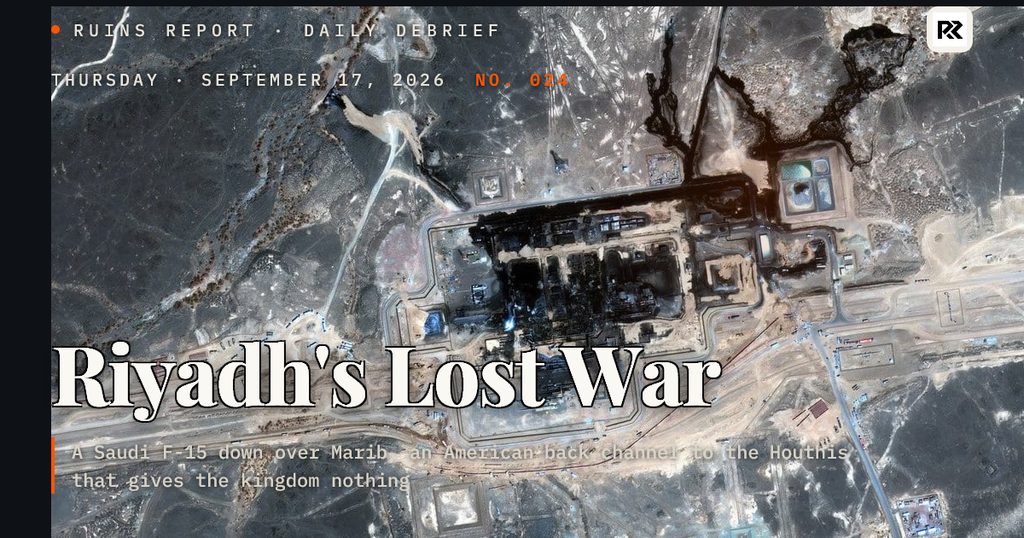
There is a version of the Yemen war that Riyadh has told itself for years, in which the campaign is costly but contained, a Saudi problem with a Saudi solution and an American guarantee standing behind it. The analysts we track no longer describe that war. The one they described today runs in the other direction. Yemen is not something Saudi Arabia is doing to the Houthis. It is something the Houthis are doing to Saudi Arabia, and the United States has stopped pretending it will step in.
Three developments drove the convergence. Ansarallah air defenses brought down a Saudi F-15 over Marib. Washington opened a back channel to the Houthis that, by every account we heard, offers Riyadh nothing. And Saudi Arabia told its European buyers that oil will not be moving before November. Four analysts, all on Dialogue Works over the course of the day, read each item the same way: the kingdom's war is lost, and its American alliance is not the thing that will rescue it.
Start with the jet. Elijah Magnier called the shootdown a major and unprecedented leap in Ansarallah's air-defense capability, and set it against a map. By his count the movement now holds roughly 35 to 38 percent of Yemen's territory and 70 to 80 percent of its population, and is advancing on Marib and Taiz. The list of those who have tried to stop it is long in his telling: the United States, Saudi Arabia, Israel, Egypt, and the Pakistan and Turkey "Mecca pact." None has defeated Ansarallah or deterred Iran's allies. The beneficiary, he argued, sits far from the Red Sea. "China is delighted to see Iran fighting America and America involved in the Iranian quagmire, because that means the reality of the American force is exposed."¹
Scott Ritter, on the same program, drew the conclusion in the plainest terms of the day. "Yemen is killing Saudi Arabia. Killing it. Literally killing it. We're looking at the death of a nation."² His argument is that Ansarallah is no longer an insurgency but a sophisticated military force that has studied Iran's methods and is now degrading Saudi Arabia's ability to function as a state. He sees no path back. The war, in his reading, is unrecoverable.
“Yemen is killing Saudi Arabia. Killing it. Literally killing it. We're looking at the death of a nation.”
Then the American piece. The reported offer to the Houthis, no air support and no strikes in exchange for calm at Bab al-Mandab, was presented in Washington as restraint. Laith Marouf read it as confession. "The Americans are offering not to do something that they cannot do,"³ he said, and supplied the reason. American carriers sent to enforce anything in those waters "will be sunk as fast as if they tried to attack Iran right now with these aircraft carriers."⁴ The offer costs Washington nothing because Washington had nothing left to put on the table. Nor does Marouf see a substitute waiting in the wings. Egypt, Turkey and Pakistan, in his view, will not come to the Saudi side's rescue.
Larry Johnson traced the collapse further back, to the six months of Iranian missile fire that preceded it. "It's wiped out the US presence, forced the US to retreat, exposed the hollowness of the US defensive shield, the Patriot missiles don't work, the THAADs don't work."⁵ Gulf governments watched those systems fail and drew their own conclusions; they are now, in his phrase, voting with their feet and distancing themselves from Washington. Air power has no better record. "Dropping bombs on the Houthis is not going to defeat the Houthis, no more than the US dropping bombs on Iran was going to defeat Iran."⁶
The oil is where the damage becomes measurable. Magnier said Saudi Arabia has exported no oil through its Red Sea ports since Saturday and has informed several European governments that shipments are cancelled or delayed until at least November.⁷ Marouf was blunter about the present: zero oil and gas deliveries for September, and a bombed east-west pipeline that officials insist will be repaired in time for the November date. He does not believe them. "It is unrealistic to rebuild Saudi Arabia's bombed east-west pipeline and export facilities in six months, let alone by the November timeline officials are citing."⁸
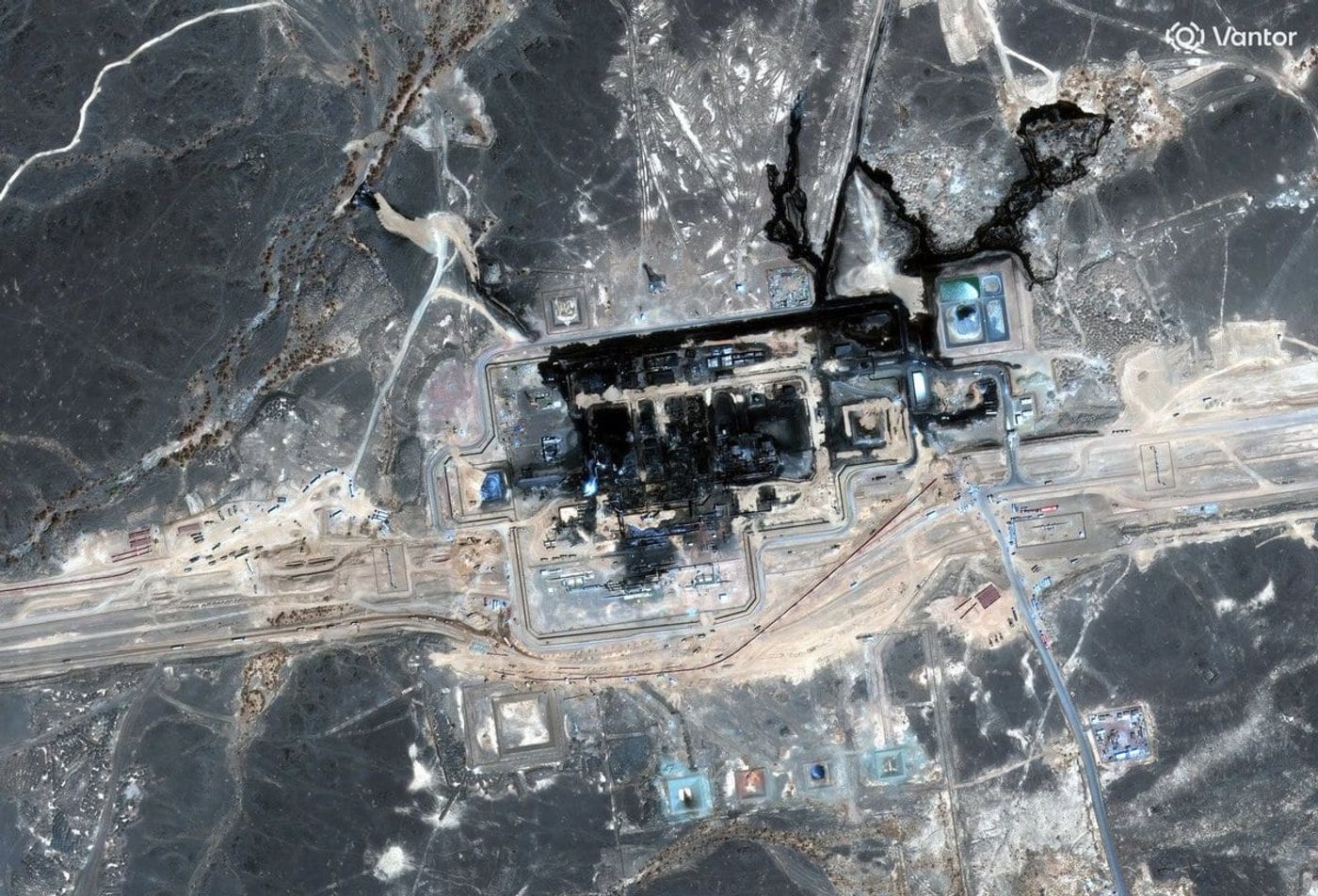
Ritter goes furthest. "Saudi Arabia will not meet its obligations to Europe in November. Nor will they meet them in December. They won't meet them at all in 2026," he said, adding that his guess extends the failure into 2027.⁹ That is a dated, checkable forecast, and the Ledger will hold him to it.
If every analyst can see where the war ends, the question is why it continues. Johnson offered the least flattering answer. "There's too much money being made off this war. Once the money train stops, the war stops."¹⁰
The convergence is the story. Four analysts, no dissent on the direction, and three separate symptoms of one condition: a fighter lost, a back channel opened, ports closed. Where they differ is only on the calendar. Marouf measures the damage in months of pipeline repair; Ritter measures it in years and, in his darkest line, in the life of the state itself. Neither expects Washington to alter the outcome, and that may be the more consequential finding. A client that has watched its patron's air defenses fail, watched it bargain directly with the enemy, and watched it offer as a concession strikes it was never going to fly has learned something it will not unlearn.
Three other threads
Ukraine's front and its endgame. Alexander Mercouris said Orekhov "is not only falling" but that "a disaster for the Ukrainian army is playing out" there,¹¹ and reported Russian forces closing around Dobropolye, which would open the way toward Slavyansk, while Ukraine's Krasny Liman counteroffensive has yielded only marginal, politically driven gains. Gilbert Doctorow, on Judging Freedom, took the longer view. "I think the war will come to an early end,"¹² he said, arguing that Russia's strangulation of Western drone and munitions supply, combined with strikes on Kiev's heating and warehousing, leaves Ukraine unable to sustain the fight much past this winter.
The multipolar ledger. Jeffrey Sachs, in conversation with Glenn Diesen, closed the book on the post-1991 era of American primacy. "That time is passed. We are now truly in a multipolar world."¹³ His arithmetic: China's output is now roughly 30 percent larger than America's when measured at purchasing-power parity, and BRICS, at 41 percent of world output, has overtaken the G7.
Who Washington works for. Phil Giraldi, on Judging Freedom with Judge Napolitano, called the planned gift of 40,000 2,000-pound bombs to the Netanyahu government a case of American pilots doing Israel's "dirty work," since Israel lacks the aircraft to deliver them, and said Congress and the president are "owned by Israel." The message he wants Washington to send instead: "It's over, guys. Netanyahu, it's over. We're not going to give you any more support to kill Gazans, to kill Palestinians, and to attack Iran. We don't need this."¹⁴
Sources
- Elijah Magnier, *Dialogue Works* · Reads the F-15 shootdown as an unprecedented Ansarallah air-defense leap and says the war exposes the reality of American force, to China's delight watch ▶ 56:51
- Scott Ritter, *Dialogue Works* · "Yemen is killing Saudi Arabia," Ansarallah is degrading the kingdom's ability to function as a state watch ▶ 6:30
- Laith Marouf, *Dialogue Works* · The US no-strikes offer to the Houthis is an offer not to do what Washington cannot do watch ▶ 2:13
- Laith Marouf, *Dialogue Works* · American carriers in those waters would be sunk as fast as if they attacked Iran watch ▶ 2:35
- Larry Johnson, *Dialogue Works* · Iran's missile campaign wiped out the US presence and exposed the failure of Patriot and THAAD watch ▶ 24:12
- Larry Johnson, *Dialogue Works* · Bombing will not defeat the Houthis any more than it defeated Iran watch ▶ 2:41
- Elijah Magnier, *Dialogue Works* · No Saudi oil exported via Red Sea ports since Saturday; European shipments cancelled or delayed until at least November watch ▶ 41:57
- Laith Marouf, *Dialogue Works* · Rebuilding the bombed east-west pipeline and export facilities by November is unrealistic watch ▶ 25:32
- Scott Ritter, *Dialogue Works* · Saudi Arabia will not meet its oil obligations to Europe in November, December or at all in 2026, and probably not 2027 watch ▶ 32:48
- Larry Johnson, *Dialogue Works* · Too much money is being made off the war; once the money train stops, the war stops watch ▶ 34:55
- Alexander Mercouris, *Alexander Mercouris* · Orekhov is falling and a disaster for the Ukrainian army is playing out there; Russian forces encircling Dobropolye watch ▶ 10:31
- Gilbert Doctorow, *Judging Freedom* · The war will come to an early end; Ukraine cannot sustain the fight much past this winter watch ▶ 16:25
- Jeffrey Sachs, *Glenn Diesen* · The era of US dominance is over; China is roughly 30% larger than the US at PPP and BRICS has overtaken the G7 watch ▶ 42:49
- Phil Giraldi, *Judging Freedom* · The 40,000-bomb gift means American pilots doing Israel's dirty work; Washington should tell Netanyahu it is over watch ▶ 17:00
By Ruins Report, a daily synthesis of what our tracked analysts said, not original reporting. Every numbered claim is sourced, dated, and timestamped above.
Newsletter
Get the Daily Debrief
One email each morning: what the analysts we track actually said, and every call timestamped to its source. Free.
Free. No spam. View on Substack →
Support the Report
Free to read, every day.
The Debrief is compiled each morning from what the analysts we track actually said, sourced and timestamped. No paywall, no ads, no investors. If it earns a place in your inbox, you can help keep it independent.
Support the report →