
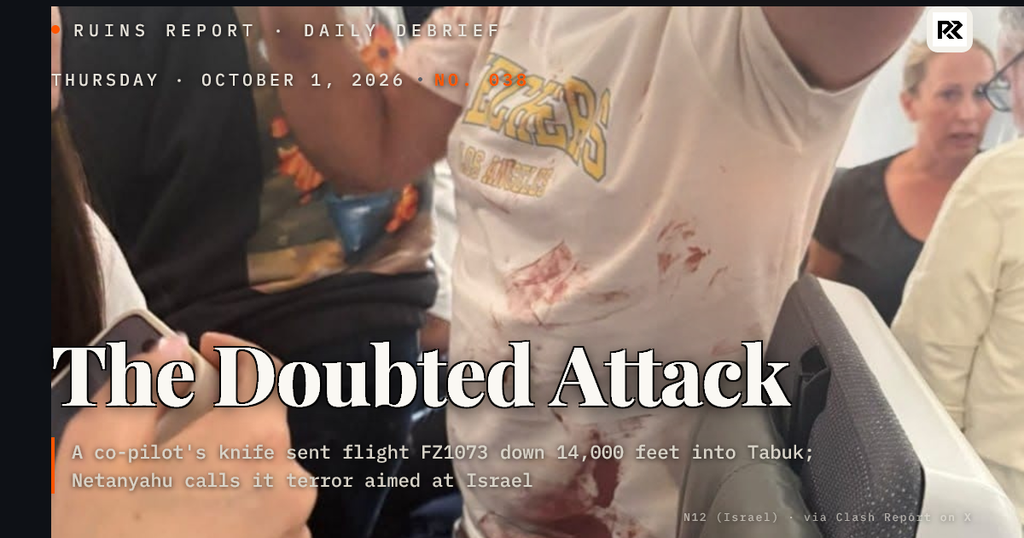
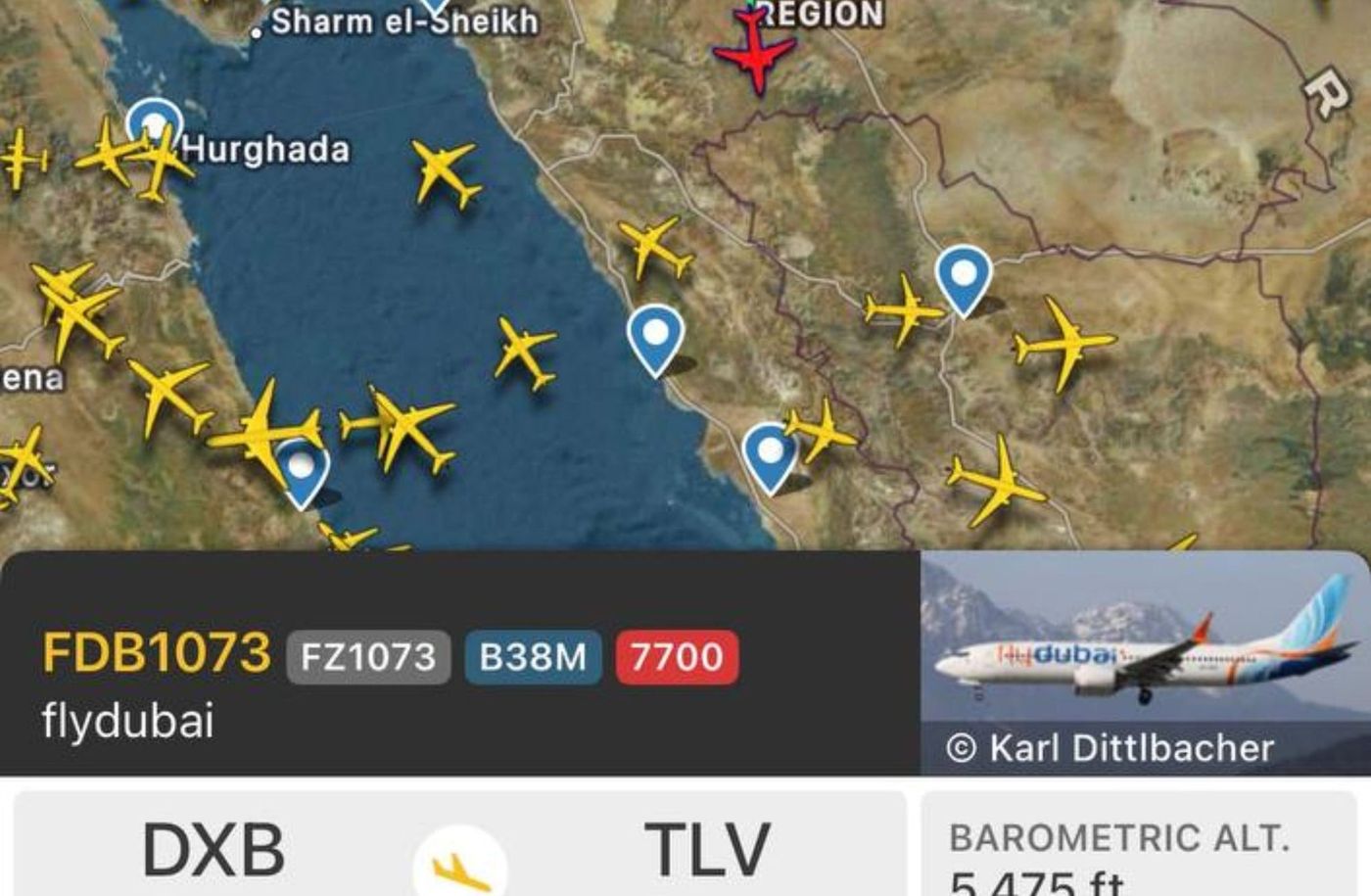
Fly Dubai flight FZ1073 left Dubai for Tel Aviv early on 30 September carrying "around 149 Israeli" nationals, by Elijah Magnier's count,¹ and flew normally for a little over two hours. Then, as Daniel Davis laid out the timeline on his own show, "it plummeted 14,000 ft in about 30 seconds,"² its transponder code "changed to a general emergency and then to unlawful interference,"³ and it landed at Tabuk in Saudi Arabia. What happened in the cockpit, according to the early reporting Davis relayed, was that "the co-pilot attacked the pilot with a knife."⁴ The aircraft was saved, Magnier said, because "another team of trainers, pilot trainers who were on board" helped to subdue him.⁵ Nobody died. Both pilots are in Saudi custody. Benjamin Netanyahu called it a terror attack whose aim was to crash the aircraft into Israel.
The day before, at Tel Nof air base, Netanyahu had warned that Israel's enemies would try to attack before the 27 October election, a warning Shaiel Ben-Ephraim described as the claim "that some kind of big attack is coming."⁶ Israel's own security establishment did not wait for the attack to disown the warning. IDF radio reported the same day that the security establishment was surprised by the prime minister's statements and that "there is no new intelligence warning regarding an imminent attack,"⁷ which, in the broadcaster's own words, "reinforces the narrative that the alarm was politically motivated."⁸ Larry Johnson, listening as Mario Nawfal read that report on air, added that the denial was not only the army's: "It was Mossad" too.⁹ Ben-Ephraim, an Israeli analyst appearing separately on Nawfal's channel, said he had spoken to someone in Aman, Israeli military intelligence, who told him an attack before the election "seems unlikely according to their estimates,"¹⁰ for a reason that is itself a verdict on the prime minister: "no one wants to strengthen" Netanyahu before the vote.¹¹
After the RAF Fairford arrests, the first instinct of nearly every analyst was to ask whether this incident had been staged as well. Two things set FZ1073 apart. Something plainly happened on board, with blood in the cockpit and a near-fatal descent to show for it. And the doubt about what it means did not originate with Washington's critics. It came from inside Israel's own services.
Davis, who dealt with Fairford and the flight in the same broadcast, was careful to keep them apart. Fairford looked shady to him; the flight did not, "because something actually did happen there and there was lots of bloodshed and it could have been catastrophic."¹² What it was is another question. "We don't know if there was some kind of a maybe a mental breakdown," he said, recalling the Egyptian airliner suspected of the same thing decades ago,¹³ and it is "just way too early" to be making "categorical claims."¹⁴ That has not restrained the prime minister, who "wants to milk this for all it's worth."¹⁵ Nawfal, reviewing the same evidence with Johnson, landed in the same place. "This one seems more to me like it was actually an attack. Someone that's been radicalized. I don't think Iran's behind it,"¹⁶ he said; to him it looked "like a lone wolf attack."¹⁷ He then did what few others did and checked whether the incident had helped the man accused of exploiting it. On the betting markets, he said, the odds on the opposition dipped from about 46 to 43 when the news broke and recovered within hours.¹⁸ Whatever FZ1073 was, by that measure it gave Netanyahu nothing.
Johnson does not believe the account at all. "Story doesn't add up," he told Nima Alkhorshid on Dialogue Works.¹⁹ Every airliner since 2001 has flown with the cockpit sealed: "Or did they lock the goddamn door?"²⁰ If the door was locked, he asked, how did "pilots in the back magically know" that an attack was under way,²¹ and so "the story's got big holes in it."²² On Nawfal's show he was blunter, describing a wounded pilot who somehow leaves his seat, unlocks the door and calls for help just as an Israeli pilot runs forward to save the day: "this thing smells of cow manure."²³ He also predicted how the official version would read. "Mark my words," he said: "This is another Iranian plot."²⁴
Ben-Ephraim's quarrel is less with the event than with what Israel has done with it. In the first hours, he said, the explanation offered was "this is a mental health crisis"; then it was a quarrel between a Ukrainian and a Russian;²⁵ then the "Israeli defense minister came out and said this is a jihadist attack" by an Omani national, "with no evidence yet at all," on the strength of an unnamed official's leak to Reuters.²⁶ The IDF, he said, "does not find particularly convincing" the narrative that emerged.²⁷ The nationality matters, because "Oman is currently at the fulcrum of negotiations" between Iran and the United States "that Israel is trying to torpedo."²⁸ Israel then mounted what he called a full-court press "to force Saudi Arabia to normalize," including flights from the kingdom, which the Saudis refused.²⁹ "Israel is using it for all kinds of things," he said.³⁰ Magnier's account of Riyadh's conduct fits that reading: "Saudi Arabia rejected the Israeli offer to send the military plane" to bring the passengers home,³¹ and "there is an American mediation" to settle the matter between the two governments.³² His explanation for the prime minister's behaviour was the shortest of the day. "Benjamin Netanyahu needs an enemy."³³
Set the three readings side by side and what stands out is not the disagreement but the ground beneath it. Nawfal and Davis think the attack was real and Johnson thinks it was not, yet all three, like Ben-Ephraim's contacts in Aman, assume the prime minister will exploit it. An incident that by most accounts actually happened is being met with reflexive suspicion, and the suspicion reaches into the government on whose territory the flight was meant to end. That is the story, and the script for it already existed. Iran's semi-official Fars agency has published a warning, in a report Alkhorshid read to Magnier, that Israel is "planning a regional terrorist attack potentially targeting aircraft or airports" and would blame Iran for it.³⁴ When Fars can publish exactly such a plot and IDF radio can call the prime minister's warning political, there is no version of events a government in Jerusalem can announce that will simply be believed.

“one of these days something true is going to happen and they're going to need you to believe it”
Davis, on Redacted, named the cost. "We have been lied to so many times," he said, that "now we can't take anything at face value," even though "it's entirely possible that this is exactly the way it came out."³⁵ A public that can no longer believe its own government or its allies is in "a dangerous place," because "one of these days something true is going to happen and they're going to need you to believe it."³⁶ "It's the classic boy who cried wolf," and the wolf, this time, may have been real.³⁷ The co-pilot of FZ1073 may yet prove to be exactly what Netanyahu says he was. What the analysts converged on is that, for a government that has spent its credibility, it would no longer make much difference.
Baghdad's budget, a diesel ban and the Kiev grid
The last American forces left Iraq on 30 September, the deadline set for their departure, 23 years after the invasion that brought them; the Pentagon says the final units relocated to Jordan, and Operation Inherent Resolve has formally ended. Matthew Hoh, on Dialogue Works, pointed to what did not leave. Oil revenues, 80 to 90 percent of Iraq's federal budget, still clear through the Federal Reserve in New York,³⁸ so that "the United States has left but still controls the money of Iraq."³⁹
Donald Trump is considering a ban on American diesel exports, and the prospect has alarmed London. Jeff Snider, on Mario Nawfal's show, said the world has been staring at the wrong chokepoint: "everybody should be talking about diesel and refinery and refining capacity not the flow of oil out of Hormuz."⁴⁰ Export bans, in his experience, backfire, and the price ends higher than when the ban began.
Russia's overnight strike on Ukraine's grid hit the Kiev hydroelectric plant, the Tripolskaya thermal plant and a key substation, and the Russian defence ministry's list, as relayed, put blackouts as far east as Slavyansk and Kramatorsk. Alexander Mercouris tied the strike to the state of the front: Moscow's "incentive to settle for less than the optimal is much less now than it was before because the Russians are almost there when they can achieve their objectives on the battlefields."⁴¹ A grid this degraded, he expects, is "ripe for a further attack."⁴²
Sources
- Elijah Magnier, Dialogue Works · "around 149 Israeli" nationals were on the plane · watch ▶ 1:56
- Daniel Davis, Daniel Davis / Deep Dive · "it plummeted 14,000 ft in about 30 seconds" · watch ▶ 1:09
- Daniel Davis, Daniel Davis / Deep Dive · The squawk "changed to a general emergency and then to unlawful interference" · watch ▶ 2:20
- Daniel Davis, Daniel Davis / Deep Dive · "the co-pilot attacked the pilot with a knife" · watch ▶ 1:35
- Elijah Magnier, Dialogue Works · "another team of trainers, pilot trainers who were on board" helped neutralize the co-pilot · watch ▶ 1:05
- Shaiel Ben-Ephraim, Mario Nawfal · "Netanyahu's warning yesterday that some kind of big attack is coming" · watch ▶ 1:37
- Mario Nawfal, Mario Nawfal · Reading IDF radio: "There is no new intelligence warning regarding an imminent attack" · watch ▶ 6:31
- Mario Nawfal, Mario Nawfal · Reading IDF radio: the lack of a new warning "reinforces the narrative that the alarm was politically motivated" · watch ▶ 6:43
- Larry Johnson, Mario Nawfal · The denial was not only the IDF's: "It was Mossad" · watch ▶ 6:48
- Shaiel Ben-Ephraim, Mario Nawfal · A source in Aman says an attack before the elections "seems unlikely according to their estimates" · watch ▶ 2:06
- Shaiel Ben-Ephraim, Mario Nawfal · "no one wants to strengthen" Netanyahu before the elections · watch ▶ 2:11
- Daniel Davis, Daniel Davis / Deep Dive · Unlike Fairford, on the flight "something actually did happen there" · watch ▶ 7:15
- Daniel Davis, Daniel Davis / Deep Dive · "We don't know if there was some kind of a maybe a mental breakdown" · watch ▶ 2:58
- Daniel Davis, Daniel Davis / Deep Dive · "It's just way too early to make any categorical claims" · watch ▶ 1:54
- Daniel Davis, Daniel Davis / Deep Dive · Netanyahu "wants to milk this for all it's worth" · watch ▶ 3:41
- Mario Nawfal, Mario Nawfal · "Someone that's been radicalized. I don't think Iran's behind it." · watch ▶ 7:54
- Mario Nawfal, Mario Nawfal · It looks "like a lone wolf attack" · watch ▶ 9:32
- Mario Nawfal, Mario Nawfal · "I looked at the betting platform": the opposition's odds dipped from about 46 to 43 and recovered within hours · watch ▶ 9:34
- Larry Johnson, Dialogue Works · "Story doesn't add up" · watch ▶ 5:36
- Larry Johnson, Dialogue Works · "Or did they lock the goddamn door?" · watch ▶ 5:57
- Larry Johnson, Dialogue Works · How did "pilots in the back magically know" an attack was under way · watch ▶ 6:16
- Larry Johnson, Dialogue Works · "the story's got big holes in it" · watch ▶ 6:27
- Larry Johnson, Mario Nawfal · "this thing smells of cow manure" · watch ▶ 4:08
- Larry Johnson, Dialogue Works · "Mark my words. This is another Iranian plot." · watch ▶ 16:20
- Shaiel Ben-Ephraim, Mario Nawfal · The first explanation was "this is a mental health crisis," then a Ukrainian and a Russian in a quarrel · watch ▶ 3:13
- Shaiel Ben-Ephraim, Mario Nawfal · The "Israeli defense minister came out and said this is a jihadist attack" by an Omani national, with no evidence · watch ▶ 3:27
- Shaiel Ben-Ephraim, Mario Nawfal · The IDF "does not find particularly convincing" the narrative · watch ▶ 3:00
- Shaiel Ben-Ephraim, Mario Nawfal · "Oman is currently at the fulcrum of negotiations" between Iran and the United States · watch ▶ 3:44
- Shaiel Ben-Ephraim, Mario Nawfal · Israel pressed "to force Saudi Arabia to normalize," which the Saudis denied · watch ▶ 4:00
- Shaiel Ben-Ephraim, Mario Nawfal · "Israel is using it for all kinds of things" · watch ▶ 5:35
- Elijah Magnier, Dialogue Works · "Saudi Arabia rejected the Israeli offer to send the military plane" to evacuate the Israelis · watch ▶ 2:02
- Elijah Magnier, Dialogue Works · "there is an American mediation" between the Saudis and the Israelis · watch ▶ 2:17
- Elijah Magnier, Dialogue Works · "Benjamin Netanyahu needs an enemy" · watch ▶ 25:44
- Nima Alkhorshid, Dialogue Works · Reading the semi-official Fars agency: "Israel is planning a regional terrorist attack potentially targeting aircraft or airports" and would blame Iran · watch ▶ 30:22
- Daniel Davis, Redacted · "we have been lied to so many times" that "now we can't take anything at face value" · watch ▶ 7:05
- Daniel Davis, Redacted · "one of these days something true is going to happen and they're going to need you to believe it" · watch ▶ 7:48
- Daniel Davis, Redacted · "It's the classic boy who cried wolf" · watch ▶ 7:51
- Matthew Hoh, Dialogue Works · Oil revenues, "80 to 90% of Iraq's federal budget," go through the Federal Reserve in New York · watch ▶ 6:44
- Matthew Hoh, Dialogue Works · "the United States has left but still controls the money of Iraq" · watch ▶ 6:37
- Jeff Snider, Mario Nawfal · "everybody should be talking about diesel and refinery and refining capacity not the flow of oil out of Hormuz" · watch ▶ 6:17
- Alexander Mercouris, Alexander Mercouris · Moscow's "incentive to settle for less than the optimal is much less now" because Russia is almost at its battlefield objectives · watch ▶ 47:03
- Alexander Mercouris, Alexander Mercouris · The degraded grid is "ripe for a further attack" · watch ▶ 24:16
By Ruins Report, a daily synthesis of what our tracked analysts said, not original reporting. Every numbered claim is sourced, dated, and timestamped above.
Newsletter
Get the Daily Debrief
One email each morning: what the analysts we track actually said, and every call timestamped to its source. Free.
Free. No spam. View on Substack →
Support the Report
Free to read, every day.
The Debrief is compiled each morning from what the analysts we track actually said, sourced and timestamped. No paywall, no ads, no investors. If it earns a place in your inbox, you can help keep it independent.
Support the report →