
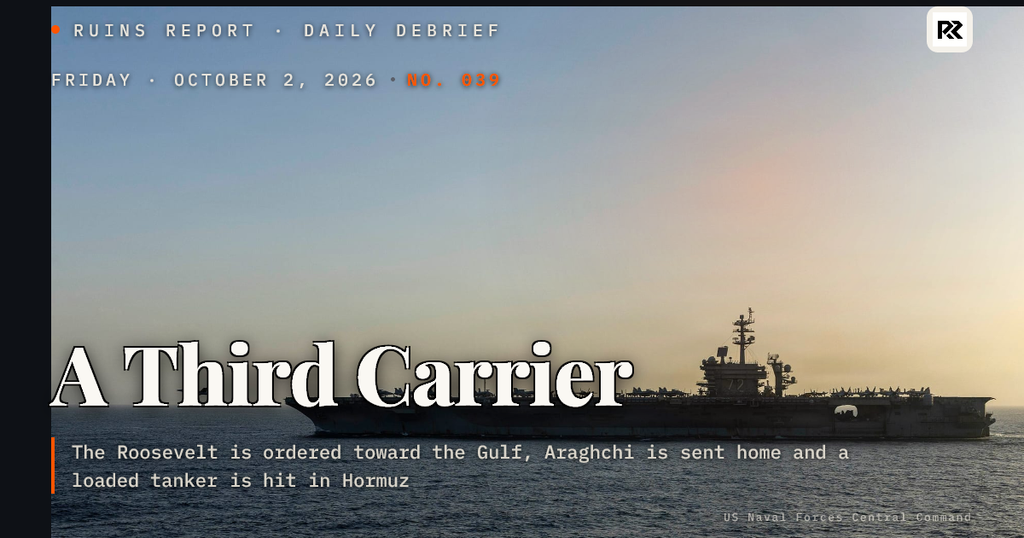
The USS Theodore Roosevelt left San Diego on 28 September and, by Anthony Aguilar's reckoning on Dialogue Works, should reach Central Command's waters around 24 or 25 October, which would put three American carriers within reach of Iran.¹ In the same days Secretary of State Marco Rubio expelled the delegation of Iran's foreign minister, Abbas Araghchi, from the UN General Assembly, and Donald Trump repeated that Iran would be annihilated unless it signed what he called a fair deal, a sequence Mohammad Marandi laid out for Daniel Davis from the Valdai conference in Moscow.² Then, after the 30 September blockade ultimatum passed without an American move, a loaded supertanker was hit in the Strait of Hormuz. Larry Johnson read the strike as proof that Iran, not the US Navy, still decides what moves through the strait.³ John Mearsheimer, speaking with Glenn Diesen, counted four ships hit in a single night, "and the United States is not retaliating."⁴
Taken together, the week looks like an escalation: a third carrier, a negotiator sent home, a threat of annihilation. Whether it adds up to a war Washington can finish by force, or to a posture its forces cannot back, divided the day's commentary cleanly, and the split is the story.
Charles Finfrock, a former CIA officer, made the case for force on Mario Nawfal's program, hosted that day by Brandon Weichert. Iran is the party losing, he argued, and the blockade is the evidence: "Zero Iranian oil ships filled up in September. Zero."⁵ Killing the leadership and choking the oil will work, in his view, and there is nothing left to discuss. "I'm not saying negotiate. Absolutely not. Negotiation time is done."⁶ If the midterms go to the Republicans, he said, the Revolutionary Guard and the government behind it cannot hold up.⁷
Bobby Jones, a retired Navy commander sitting across from him, answered with the arithmetic of the strait. "We cannot bomb our way out of this situation,"⁸ he said, and the Navy cannot sail its way out either, because "the most powerful warships on this planet cannot go through 21 miles of water."⁹ Iran decentralized and prepared for this for decades; the United States is short of munitions and will be in the theatre for years rather than months, absent a ground insertion that Americans will not tolerate.¹⁰ The protection the Gulf monarchies bought from Washington, he said, "was destroyed in 2026."¹¹ In any settlement he could foresee, access to Hormuz ends up under Iranian and Omani control, with a surcharge on passage that becomes a new floor under the price of oil.¹²
Johnson, on Dialogue Works, put the question the tanker makes awkward for Finfrock's side: if Trump has full control of the strait, as he claims, how did a ship get blown up in it?³ On the reported plan to resume strikes after the midterms, he was blunter about the force now assembling. "Whatever additional forces they bring back to the region, they're not going to be able to sustain combat operations beyond a week, two weeks tops,"¹³ he said, because the munitions spent in the spring have not been replaced, and this time American ships would be shot at as they have never been before.
Mearsheimer offered the reading that explains how the threat and the restraint can coexist. Washington, he said, has in fact stopped escalating. "The United States has no interest in escalation," and Iranian attacks on shipping now go unanswered.⁴ What remains is the blockade and Scott Bessent's economic strangulation, and Mearsheimer does not expect either to produce a surrender. Iran has enough oil already on the water to sustain itself "probably into December,"¹⁴ and when the pressure reaches breaking point, he expects the response to be strikes on Ras Tanura, the Saudi pipeline and the ports of the Emirates rather than capitulation.¹⁵

“when you face an existential threat, you don't quit. You escalate.”
He added that he would "bet a lot of money" that Trump's advisers, behind closed doors, "are deeply worried about where this is headed."¹⁶
From Moscow, Marandi described how the threat lands on the side it is aimed at. Trump's words, he said, "are not going to have any impact on the Iranian decision-making process."² The country "has to be prepared for war. There's no other option. And Iran is preparing for war."¹⁷ The government has shifted to "a wartime economic policy"¹⁸ and is planning for "a war that will continue until the end of Trump's presidency and perhaps beyond."¹⁹ Should the United States strike Iranian infrastructure, the retaliation would fall on the Gulf's energy, and there would be "not a drop of oil or natural gas or LNG" leaving the Persian Gulf for what he said could be years.²⁰ He put the chances of "a major military confrontation" at "very high."²¹
Which leaves the carrier. Aguilar's reading of the Roosevelt is that it is not a relief ship. "Washington stays, the Roosevelt adds on,"¹ he said, joining the Bush and the Boxer already in the region. Its arrival window falls between the Israeli election on 27 October and the American midterms on 3 November, and Aguilar does not think that is a coincidence: he expects Washington and Israel to use the week's accumulated pretexts to strike Iran again around the vote.²²
What the day's commentary converges on, across the split, is that the force now gathering is being measured against dates rather than against Iran. Finfrock's collapse of the regime waits on a Republican midterm. Aguilar's strike waits on a carrier arriving between two elections. Mearsheimer's advisers are worried because the blockade's clock, by his count, runs only to December, and the Iranian answer to its expiry is escalation. The buildup, in other words, is sized to a calendar that Tehran did not write and does not have to keep. Johnson drew the conclusion that follows: Trump "won't end it. It'll be ended and he'll have to accept the outcome."²³



A written warning over Kaliningrad, and who is exporting the diesel
Russian embassies have told European governments in writing that Russia would use all of its arsenal, nuclear weapons included, if NATO isolates or blockades Kaliningrad. Alexander Mercouris called the note "the first explicit warning about nuclear weapons use that Russia has made since the start of the special military operation in February 2022,"²⁴ and noted that Baltic and Finnish officials have since denied holding any plan against the exclave. Daniel Davis, on his own show, drew the lesson for Europe's planners: "don't think that there is no Russian red lines. Don't confuse patience for a lack of resolve."²⁵
Trump and Bessent have blamed Ukrainian strikes on Russian refineries for the diesel shortage. Richard Wolff, on Dialogue Works, placed the cause in Hormuz and the price at home. "The companies here are making a fortune by exporting diesel fuel to where they can make more money,"²⁶ he said, which is why Trump is now floating an export ban on the fuel his own refiners are shipping abroad.
Sources
- Anthony Aguilar, Dialogue Works (Nima Alkhorshid) · The Roosevelt, due around 24 or 25 October, adds to the Washington rather than replacing it: "Washington stays, the Roosevelt adds on" · watch ▶ 3:34
- Mohammad Marandi, Daniel Davis / Deep Dive · On Trump's annihilation threats and Rubio's expulsion of Araghchi's delegation: the threats "are not going to have any impact on the Iranian decision-making process" · watch ▶ 2:41
- Larry Johnson, Dialogue Works (Nima Alkhorshid) · Asks how a supertanker got blown up in a strait Trump claims to fully control · watch ▶ 2:05
- John Mearsheimer, Glenn Diesen · "The United States has no interest in escalation... the Iranians hit four ships overnight and the United States is not retaliating." · watch ▶ 0:41
- Charles Finfrock, Mario Nawfal · "Zero Iranian oil ships filled up in September. Zero." · watch ▶ 26:32
- Charles Finfrock, Mario Nawfal · "I'm not saying negotiate. Absolutely not. Negotiation time is done." · watch ▶ 26:01
- Charles Finfrock, Mario Nawfal · If the midterms go Republican, the IRGC and the regime are finished · watch ▶ 57:20
- Bobby Jones, Mario Nawfal · "We cannot bomb our way out of this situation." · watch ▶ 39:50
- Bobby Jones, Mario Nawfal · "the most powerful warships on this planet cannot go through 21 miles of water" · watch ▶ 63:41
- Bobby Jones, Mario Nawfal · US forces will be in Iran's theatre for years, not months, absent a ground insertion Americans will not tolerate · watch ▶ 16:48
- Bobby Jones, Mario Nawfal · The Gulf's "guarantee of protection was destroyed in 2026" · watch ▶ 67:36
- Bobby Jones, Mario Nawfal · In any peace deal Iran and Oman control access to Hormuz and countries pay a surcharge, a new price floor · watch ▶ 43:47
- Larry Johnson, Dialogue Works (Nima Alkhorshid) · "whatever additional forces they bring back to the region, they're not going to be able to sustain combat operations beyond a week, two weeks tops" · watch ▶ 13:59
- John Mearsheimer, Glenn Diesen · Iran has "enough oil out on the open seas that they can sell to sustain them probably into December" · watch ▶ 10:00
- John Mearsheimer, Glenn Diesen · Pushed to breaking point by the blockade, Iran will escalate against Ras Tanura, the Saudi pipeline and UAE ports: "I think what they're going to do is escalate" · watch ▶ 10:30
- John Mearsheimer, Glenn Diesen · "I'd bet a lot of money that behind closed doors, the two of them and Trump's other advisers are deeply worried about where this is headed." · watch ▶ 12:43
- Mohammad Marandi, Daniel Davis / Deep Dive · "It has to be prepared for war. There's no other option. And Iran is preparing for war." · watch ▶ 28:22
- Mohammad Marandi, Daniel Davis / Deep Dive · Iran's government "has shifted its economic policy to a wartime economic policy" · watch ▶ 28:27
- Mohammad Marandi, Daniel Davis / Deep Dive · Iran is preparing for "a war that will continue until the end of Trump's presidency and perhaps beyond" · watch ▶ 28:35
- Mohammad Marandi, Daniel Davis / Deep Dive · If the US strikes Iranian infrastructure, "there will not be a drop of oil or natural gas or LNG" leaving the Persian Gulf "for many perhaps years to come" · watch ▶ 12:06
- Mohammad Marandi, Daniel Davis / Deep Dive · "the chances for a major military confrontation are very high" · watch ▶ 31:54
- Anthony Aguilar, Dialogue Works (Nima Alkhorshid) · Expects the US and Israel to use the manufactured pretexts to "strike Iran again," near the midterms or after them · watch ▶ 12:17
- Larry Johnson, Dialogue Works (Nima Alkhorshid) · On Iran and Ukraine, Trump "won't end it. It'll be ended and he'll have to accept the outcome" · watch ▶ 48:32
- Alexander Mercouris, Alexander Mercouris · The Kaliningrad note is "the first explicit warning about nuclear weapons use that Russia has made since the start of the special military operation in February 2022" · watch ▶ 1:33
- Daniel Davis, Daniel Davis / Deep Dive · "don't think that there is no Russian red lines. Don't confuse patience for a lack of resolve" · watch ▶ 35:45
- Richard Wolff, Dialogue Works (Nima Alkhorshid) · "The companies here are making a fortune by exporting diesel fuel to where they can make more money." · watch ▶ 8:27
By Ruins Report, a daily synthesis of what our tracked analysts said, not original reporting. Every numbered claim is sourced, dated, and timestamped above.
Newsletter
Get the Daily Debrief
One email each morning: what the analysts we track actually said, and every call timestamped to its source. Free.
Free. No spam. View on Substack →
Support the Report
Free to read, every day.
The Debrief is compiled each morning from what the analysts we track actually said, sourced and timestamped. No paywall, no ads, no investors. If it earns a place in your inbox, you can help keep it independent.
Support the report →