
Donald Trump posted on Friday that Europe had agreed to release "a massive amount" of diesel from its stocks. Emmanuel Macron supplied the figure a few hours later: G7 governments would coordinate the release of up to 100 million barrels of oil and diesel from their strategic reserves over roughly four months, working through the International Energy Agency. Larry Johnson reported that the White House had opened by demanding 120 million barrels from France and Germany alone, to be delivered over four to six months, and he set that figure against a world that burns about 29 million barrels of diesel a day and trades about 8 million of them across borders.¹ Within days of Trump first floating a ban on diesel exports, the threat had produced the pledge.
Whether the pledge does anything for the shortage is a separate question, and on that question the analysts converged almost without exception. The world burns a little over 100 million barrels of oil a day, and Michael Hudson did the arithmetic on Dialogue Works. "100 million barrels is... one day's overall supply. So, it's not an enormous amount. It's a token amount that they negotiated. It gives Trump an ability to claim and pretend to the public that you see, I'm holding down diesel oil prices."² Spread over four months, he said, the volume is "certainly not enough to resolve the diesel shortage," and the arrangement itself is "obviously part of a shakedown deal that Trump has organized on them Trump style."³

“100 million barrels is... one day's overall supply. So, it's not an enormous amount. It's a token amount that they negotiated. It gives Trump an ability to claim and pretend to the public that you see, I'm holding down diesel oil prices.”
The reason a reserve release cannot do more is that the shortage, in Johnson's account, was never a disruption of a few weeks. The Strait of Hormuz has been closed since 28 February, and the world has been living off inventory since. "From middle of April on the world was drawing on its savings account," he told Nima Alkhorshid, "and by second week of August that savings account was empty."⁴ On Judging Freedom he put it without qualification: "this global shortage of diesel is baked in. It's a structural shortage that is not going to be corrected for months, potentially years."⁵ On Garland Nixon's broadcast he gave the physical reason. The damage to Gulf infrastructure, he said, "has cut the potential supply by at least 50%."⁶ Alastair Crooke reached the same conclusion from the other end of the pipeline, telling Danny Haiphong that an American export ban would not bring the price down either: "even if they put a lock on this export of diesel it's still the price isn't going to come down because as I said it's structural. It's also about shipping."⁷ China's suspension of diesel exports for October, reported across the day's broadcasts, took another supplier out of the market at the same moment.
Johnson's sharpest objection was to the premise. Trump has spent the week insisting that the strait is open and that record volumes of oil are leaving it. "If they're getting all that oil out," Johnson asked on Daniel Davis's program, "why are we putting the arm on France and Germany?"⁸
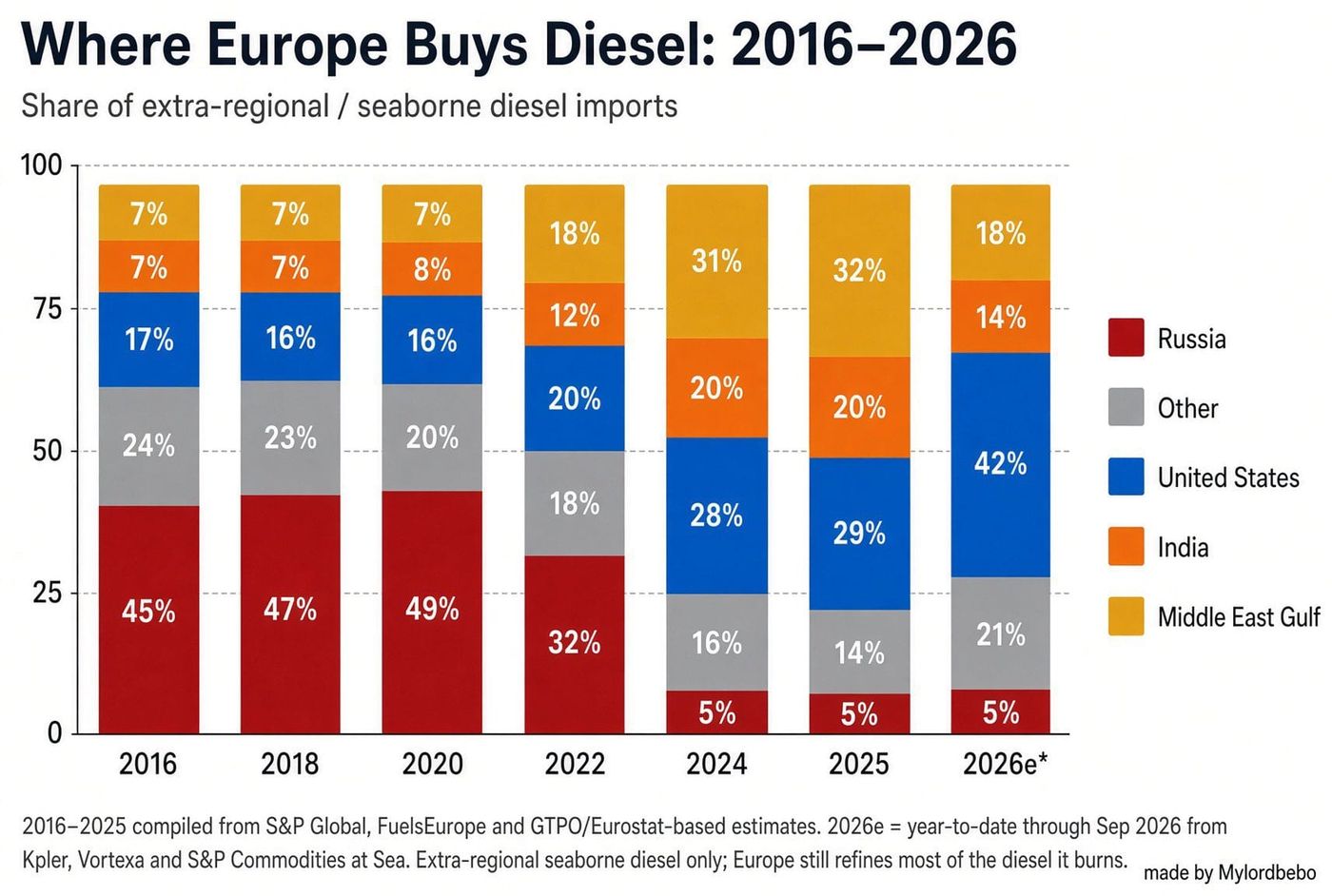
That question leads to the part of the story the analysts found more interesting than the barrels. Garland Nixon reduced the week's diplomacy to a sentence: "Trump says, 'You better do what I tell you or I'll cut you off from diesel fuel.'"⁹ The threat worked because it could. Europe spent a decade after 2016 replacing Russian diesel, which once made up 45 percent of its imports from outside the region, and the United States now supplies 42 percent of that trade. Hudson placed the episode in a larger design. With Iran, Venezuela and Russia all under American pressure, he said, "The United States has now blocked them all and it has a monopoly in oil and it's using that monopoly to secure its monopoly in information technology."¹⁰ He went further: "Trump's idea of peace is in a way a declaration of war against the whole rest of the world's sovereignty."¹¹
Col. Lawrence Wilkerson, sharing the Dialogue Works panel with Johnson, was blunt about what the European governments have to show for their energy measures so far. "It's not working in France. It's not working in Britain. It's not working in Europe in general. and when they start freezing it to death this winter, it really won't be working."¹² Nixon expected the consequences to arrive in the streets: "I believe they're going to have riots. They're going to have fuel riots."¹³
The timing is not incidental. Alexander Mercouris stated the obvious plainly: "the United States is now trying to get the European states to release diesel oil from their reserves to try to bring down the price of diesel, obviously ahead of the midterm elections in November."¹⁴ Those elections fall on 3 November, and the analysts who tried to date the release's failure put it in the same window. Hudson expects that "sometime between from early November to December, you're going to see an inability of oil releases from reserves" to hold down prices or deliver physical diesel.¹⁵ Johnson noted that companies which borrowed about 40 million barrels from the US reserve on a promise to return them within a couple of weeks are "not going to replace them in a couple of weeks."¹⁶ Wilkerson added that the American reserve has already been drawn below its legal floor, that China cancelled diesel and jet fuel contracts across Asia after Xi Jinping's meeting with Trump, and that markets will stay disrupted for a long while "no matter what Donald Trump does."¹⁷
Russia enters the story twice. Trump and Scott Bessent have blamed Moscow's own export ban, imposed after Ukrainian strikes on Russian refineries, for the shortage. Johnson measured the claim: Russia "is now providing about 150,000 barrels per day... the total global consumption of diesel is 29 million barrels... that's one half of 1%."¹⁸ Mercouris, meanwhile, caught a detail from Valdai that nobody else mentioned. Vladimir Putin, he said, "appeared to link any Russian decision to lift" its diesel export ban to sanctions relief, "a quid pro quo," while insisting that Russia's domestic market is fully covered.¹⁹ If so, the one exporter with spare diesel has named its price, and it is not one Washington is offering.
The convergence, then, is complete on the central point: a reserve release of one day's global supply, metered out over four months, changes the price for a few weeks and the shortage not at all. What it does change is the public understanding of who holds Europe's fuel. Johnson's advice was addressed to anyone still treating this as a passing squeeze: "people that are banking upon a return to normal, forget about it. It's going to be a while before we get a return to normal."²⁰
Kiev's Southern Bridge and the siege of Taiz
Russia struck Kiev's Dnieper bridges for the first time, closing the southernmost, the Southern Bridge, which carries much of the capital's cross-river road traffic, and hit a thermal plant and a substation in the same raid. Alexander Mercouris read the attack as a message to the embassies as much as to the government: "as the situation in Kiev deteriorates, there is going to be more discussion and more talk in Western capitals about the wisdom of keeping their people in Kiev. And if the West leaves, probably so will much of the government."²¹ Rachel Blevins made the simpler point that the bridges had been available all along: "Russia could have targeted this bridge at any point. There was nothing stopping them."²²
In Yemen, Ansarallah forces have Taiz under siege and reportedly struck a Saudi headquarters, and Riyadh has taken delivery of more Patriot batteries. Ahmad Suliaman, on Daniel Davis's program, expected the city to go quickly: "it's very likely that [the city] is going to basically fall in the next 24 to 48 hours."²³ Chas Freeman, on Dialogue Works, saw a longer war. "What is happening in Yemen is inconclusive and doesn't look to be concluded anytime soon."²⁴ The two are not necessarily in contradiction; a city can fall and a war go on. But they describe different tempos, and the Saudi Patriots suggest Riyadh is planning for Freeman's.
Sources
- Larry Johnson, Judging Freedom (Judge Napolitano) · The White House demanded 120 million barrels from France and Germany over four to six months, against global diesel consumption of about 29 million barrels a day and exports of about 8 million · watch ▶ 25:47
- Michael Hudson, Dialogue Works (Nima Alkhorshid) · "100 million barrels is, as I said, one day's overall supply. So, it's not an enormous amount. It's a token amount that they negotiated." · watch ▶ 2:35
- Michael Hudson, Dialogue Works (Nima Alkhorshid) · "it's certainly not enough to resolve the diesel shortage... it's obviously part of a shakedown deal that Trump has organized on them Trump style." · watch ▶ 1:28
- Larry Johnson, Dialogue Works (Nima Alkhorshid) · "from middle of April on the world was drawing on its savings account and by second week of August that savings account was empty." · watch ▶ 3:05
- Larry Johnson, Judging Freedom (Judge Napolitano) · "this global shortage of diesel is baked in. It's a structural shortage that is not going to be corrected for months, potentially years." · watch ▶ 26:28
- Larry Johnson, Garland Nixon · Gulf infrastructure damage "has cut the potential supply by at least 50%." · watch ▶ 21:05
- Alastair Crooke, Danny Haiphong · "even if they put a lock on this export of diesel it's still the price isn't going to come down because as I said it's structural. It's also about shipping." · watch ▶ 35:39
- Larry Johnson, Daniel Davis / Deep Dive · "if they're getting all that oil out, why are we putting the arm on France and Germany?" · watch ▶ 42:09
- Garland Nixon, Garland Nixon · "Trump says, 'You better do what I tell you or I'll cut you off from diesel fuel.'" · watch ▶ 22:31
- Michael Hudson, Dialogue Works (Nima Alkhorshid) · "The United States has now blocked them all and it has a monopoly in oil and it's using that monopoly to secure its monopoly in information technology" · watch ▶ 35:08
- Michael Hudson, Dialogue Works (Nima Alkhorshid) · "Trump's idea of peace is in a way a declaration of war against the whole rest of the world's sovereignty" · watch ▶ 21:51
- Col. Lawrence Wilkerson, Dialogue Works (Nima Alkhorshid) · "It's not working in France. It's not working in Britain. It's not working in Europe in general. and when they start freezing it to death this winter, it really won't be working." · watch ▶ 20:16
- Garland Nixon, Garland Nixon · "I believe they're going to have riots. They're going to have fuel riots." · watch ▶ 25:07
- Alexander Mercouris, Alexander Mercouris · "the United States is now trying to get the European states to release diesel oil from their reserves to try to bring down the price of diesel, obviously ahead of the midterm elections in November." · watch ▶ 1:21:33
- Michael Hudson, Dialogue Works (Nima Alkhorshid) · "sometime between from early November to December, you're going to see an inability of oil releases from reserves" to hold down prices · watch ▶ 40:12
- Larry Johnson, Garland Nixon · Companies that borrowed about 40 million barrels from the US reserve are "not going to replace them in a couple of weeks." · watch ▶ 34:47
- Col. Lawrence Wilkerson, Dialogue Works (Nima Alkhorshid) · The SPR is below its legal floor; China cancelled diesel and jet fuel contracts across Asia after Xi's meeting with Trump; markets stay disrupted "no matter what Donald Trump does" · watch ▶ 11:32
- Larry Johnson, Garland Nixon · Russia "is now providing about 150,000 barrels per day... the total global consumption of diesel is 29 million barrels... that's one half of 1%." · watch ▶ 31:43
- Alexander Mercouris, Alexander Mercouris · Putin at Valdai "appeared to link any Russian decision to lift" the diesel export ban to sanctions relief, "a quid pro quo"; Russia's domestic market is fully covered · watch ▶ 1:22:18
- Larry Johnson, Garland Nixon · "people that are banking upon a return to normal, forget about it. It's going to be a while before we get a return to normal." · watch ▶ 23:58
- Alexander Mercouris, Alexander Mercouris · "as the situation in Kiev deteriorates, there is going to be more discussion and more talk in Western capitals about the wisdom of keeping their people in Kiev. And if the West leaves, probably so will much of the government." · watch ▶ 55:34
- Rachel Blevins, Rachel Blevins · "Russia could have targeted this bridge at any point. There was nothing stopping them." · watch ▶ 5:56
- Ahmad Suliaman, Daniel Davis / Deep Dive · Taiz: "it's very likely that [the city] is going to basically fall in the next 24 to 48 hours" · watch ▶ 40:14
- Chas Freeman, Dialogue Works · "what is happening in Yemen is inconclusive and doesn't look to be concluded anytime soon." · watch ▶ 5:25
By Ruins Report, a daily synthesis of what our tracked analysts said, not original reporting. Every numbered claim is sourced, dated, and timestamped above.
Newsletter
Get the Daily Debrief
One email each morning: what the analysts we track actually said, and every call timestamped to its source. Free.
Free. No spam. View on Substack →
Support the Report
Free to read, every day.
The Debrief is compiled each morning from what the analysts we track actually said, sourced and timestamped. No paywall, no ads, no investors. If it earns a place in your inbox, you can help keep it independent.
Support the report →