
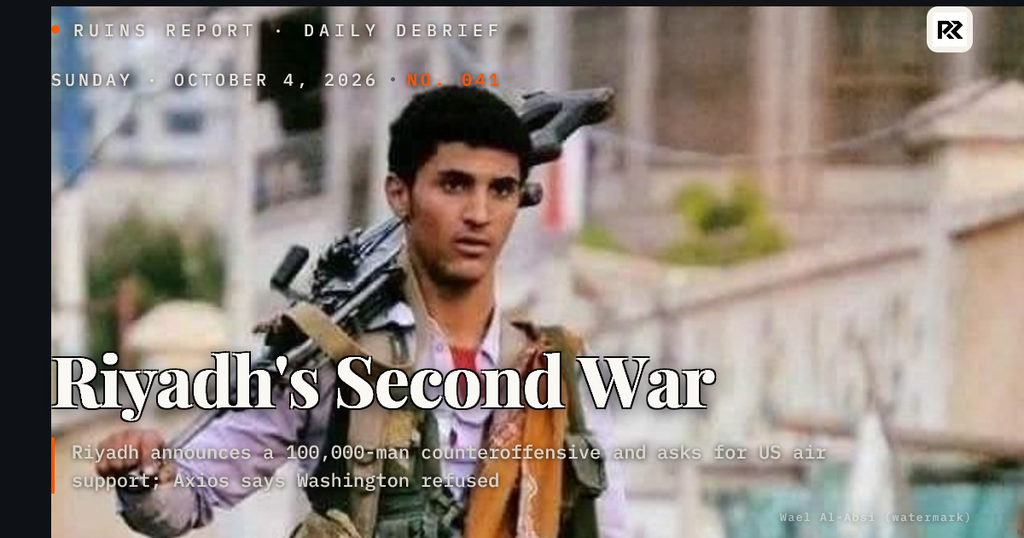
Houthi missiles reached Aramco twice on Saturday, striking a facility outside Riyadh and, by Nima Alkhorshid's account on Dialogue Works, oil installations in the Eastern Province near Bahrain, while Saudi aircraft flew more than 60 raids on Sanaa in 24 hours, up from 14 to 16.¹ Alkhorshid also relayed Riyadh's announcement of a counteroffensive of some 100,000 troops drawn from the Presidential Leadership Council's forces, and its statement that it would retake the Bab el-Mandeb. According to an Axios report he cited, the operation had been planned for weeks; Khalid bin Salman briefed Pete Hegseth and asked for American air support, and Washington decided against kinetic action, with Donald Trump and Central Command both reported to be opposed.² Separately, Trump's senior officials met on Friday at Camp David on Iran and Yemen, a meeting attended, by Anthony Aguilar's count on Brandon Weichert's show, by Vance, Rubio, Hegseth, Witkoff, Ratcliffe and General Caine.³
Saudi Arabia, in other words, has reopened a war it could not win the first time, with its refineries now inside the enemy's range and its protector declining to fly. Whether it can win this one is what Larry Johnson, Seyed Mohammad Marandi, Steve Hanke and Bobby Jones each weighed on Saturday, from different trades and different politics, and their answers converged.
The first reason is arithmetic. "There's less infrastructure to hit in Sanaa compared to all of the petrochemical, oil pipeline, oil terminals, oil storage tanks that exist in Saudi Arabia," Johnson said on Dialogue Works. "So I think on the surface that the Houthis can be far more effective with their strikes with ballistic missiles than the Saudis can with their air bombs dropped from airplanes."⁴ Marandi, on the same show, described the kingdom as "vulnerable from the north," "vulnerable from Yemen," "vulnerable from Iran," and said that "all they have is pipelines that take oil. Without that oil, those pipelines are worthless."⁵
The second is manpower. Johnson treated the announced offensive as theatre: "Tell you how many guys they got, tell you where they're going to attack. This is simply nothing more than just a PR move, propaganda designed to reassure Saudi allies."⁶ The harder problem is that the Saudi-backed forces must hold Marib, which Alkhorshid noted contains nearly all of Yemen's oil and gas, and the south at the same time. "I don't think the Saudis have enough troops to defend two different locations," Johnson said. "So they're going to have to make a choice, figure out which one they want to defend."⁷ Around the siege of Taiz, Alkhorshid put Ansarallah six kilometres from Turba, and Johnson expects that once Turba falls the Saudi-aligned force will be caught in a cauldron: "the Saudis, they're in a war that they're losing and are going to lose."⁸ Hanke, an economist rather than a soldier, reached the same reading from the reports he receives: "it looks like the Houthis could take them out if they wanted to. They are doing a classic encirclement strategy right now of Taiz."⁹ Some Houthi commanders, he added, are now talking seriously of moving into the three Saudi provinces north of the border that the Houthis say belong to Yemen.¹⁰
The third is money. "The third quarter numbers will look pretty bad and probably end up getting worse in Saudi Arabia," Hanke said. "Why they decided to stir up the Houthis again is mind-boggling."¹¹ Marandi, on Neutrality Studies, said the strikes on Saudi oil installations have been running for weeks and that "if the war with Iran continues, it may more easily bring down Saudi Arabia."¹²
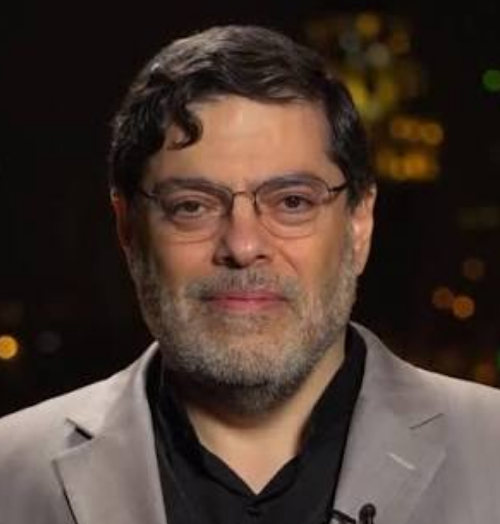
“Saudis can kill people in their air strikes, but they can't change the balance of power. But Yemen can destroy Saudi infrastructure, and Saudi oil infrastructure is what props up the regime.”
The shipping data complicate this picture, and Sal Mercogliano laid them out without reference to the strikes at all. "Saudi Arabia also resumed crude loadings at its Red Sea terminals at Yanbu and Al Mu'ajjiz after its East-West pipeline returned to service," he reported on What's Going on With Shipping. "At the same time, tankers, specifically Saudi tankers, are avoiding the southern Red Sea where possible," at a cost of roughly 22 extra days around Africa.¹³ Gulf crude exports as a whole rebounded in September to about 16.33 million barrels a day, 80 percent of the pre-war level by Splash247's figures,¹⁴ and the Houthis "have so far limited their attacks to Saudi Arabian ships," which is one reason more than 140 container ships have returned to the Suez route since May.¹⁵ Weichert, for his part, said the East-West pipeline was struck again within the last 48 hours,¹⁶ and Hanke does not believe the recovery. "If you listen to the spin doctors in Washington DC, you would think nothing has happened," he said; the tanker trackers he follows show one or two ships a day through Hormuz.¹⁷
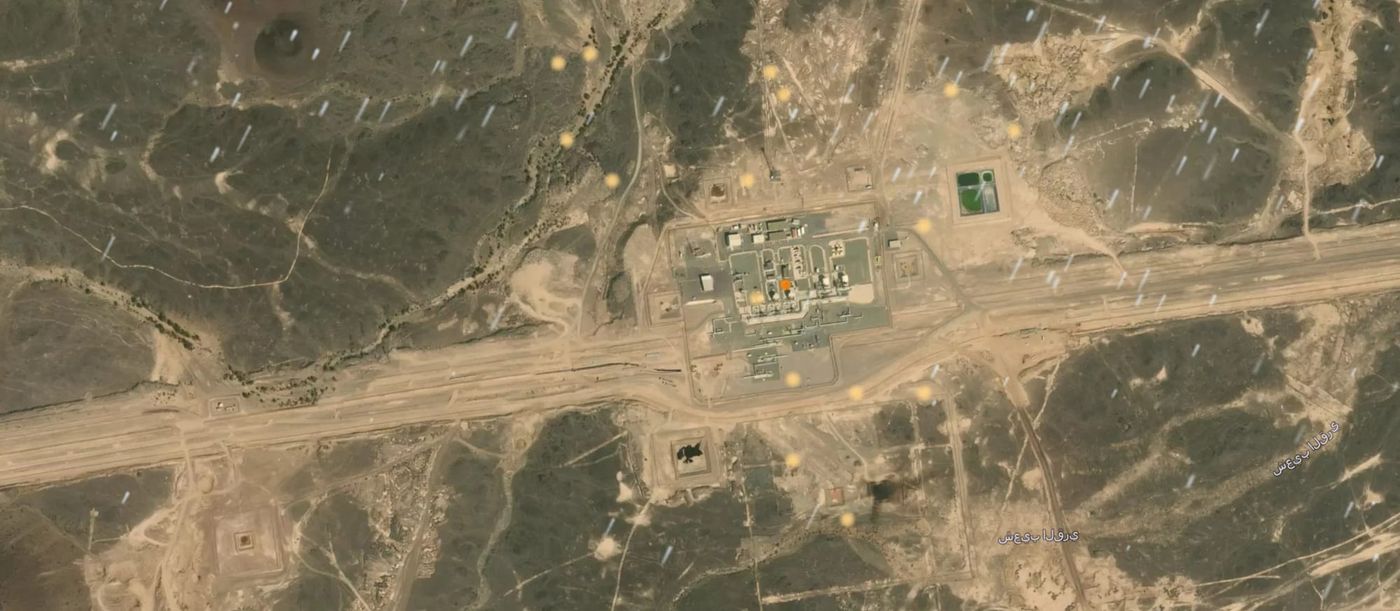
What the loading figures cannot measure is the geography forming on the strait itself. Jones, a retired Navy commander, read the previous day's map on Weichert's show: "They are not only taking over and cutting off and isolating the Bab el-Mandeb, they're creating a long, continuous area of dominance where Saudi Arabia is like, 'We are about to be isolated.'"¹⁸ Aguilar traced the war's spread outward from Iran: "It started here, then within a few months it expanded, and now it has expanded to where Yemen, the Bab el-Mandeb, the Horn of Africa becomes that."¹⁹
Nor is this a theatre Washington can easily enter, even if it chose to. Aguilar counted what the United States will have in the region by late October: three carrier groups, two Marine Expeditionary Units and more than 80,000 troops. "We're now 7 months and 5 days into this war," he said. "The political goals have not been achieved. In fact, I say that we're in a worse place in each of those categories now than before the United States and Israel started this war."²⁰ Jones was blunter about what the ships could do for Riyadh: "A ship is a fool to fight a fort. All those ships can only do so much on the ground."²¹
Set beside one another, these readings arrive at a judgment rather than a dated prediction: Saudi Arabia cannot win the war it has restarted, and Mercogliano's loadings show only that it has not yet lost the one thing that pays for it. The deeper problem is the one Marandi kept returning to. The kingdom's position rests on exporting oil under American protection, and on Saturday both halves of that arrangement were in doubt. "If the United States attacks Iran, Saudi Arabia will feel the pain," he said, "and if the United States strikes Iranian infrastructure, then I think that's the end of Saudi Arabia."²² Pascal Lottaz, hosting him on Neutrality Studies, relayed Leif Maru's argument that Washington ordered Riyadh to reopen the war because it needs another front. Marandi declined to choose between that and a Saudi decision taken alone: "either way works. Saudi Arabia is already in deep trouble because of its assistance in the war against Iran."²³ Ray McGovern, on Dialogue Works, reached the same end by the shorter road: "The Houthis have the advantage because they have the weaponry, they have the resolve, they have the training. I don't think even Israel can help the Saudis here."²⁴ Either way, Riyadh has gone back to war without the one ally who could alter the result.
Two bridges over the Dnieper, a diplomat at the airport and a November promise
Russian strikes have now closed both of Kiev's road bridges over the Dnieper, the Northern joining the Southern Bridge hit reported yesterday, and the Russian Foreign Ministry has repeated its warning that foreign diplomats should leave the city. Alexander Mercouris, citing on The Duran a Guardian report that Western embassies are drawing up plans to move to Lvov or eastern Poland, saw a single design: "This is all clearly now a policy to isolate Kiev."²⁵ On his own show he followed the thought to its end, a city that "would no longer be functioning as Ukraine's capital city."²⁶
Ian Proud, the former British diplomat, was held for three hours by counterterrorism police at a UK airport late on Saturday on his way home from the Valdai conference in Moscow. "They detained me for 3 hours. They confiscated all of my electronic devices. They took DNA swabs, photographs," he told Daniel Davis on Deep Dive, adding that he had no right to remain silent.²⁷ He was not deterred: "they can take my telephone, they can take my computer, they can interrogate me for 3 hours, but they're not going to stop me from saying that we need peace."²⁸
Trump said on Friday that the Iran war will be over right after the 3 November midterms, or even before. Davis, on his own show, does not believe either date, because in his reading the leverage runs the other way: "The only way we get out of this now is to submit to the Iranian side."²⁹
Sources
- Nima Alkhorshid, Dialogue Works · as host: Aramco struck outside Riyadh and in the Eastern Province near Bahrain; 60-plus Saudi raids on Sanaa in 24 hours, up from 14 to 16; Ansarallah six kilometres from Turba · watch ▶
- Nima Alkhorshid, Dialogue Works · as host, relaying Axios: counteroffensive planned for weeks, Khalid bin Salman asked Hegseth for air support, US decided against kinetic action; Saudi says it will retake the Bab el-Mandeb · watch ▶
- Anthony Aguilar, Mario Nawfal · Camp David meeting on Iran and Yemen attended by Vance, Rubio, Hegseth, Witkoff, Ratcliffe and General Caine · watch ▶
- Larry Johnson, Dialogue Works · "There's less infrastructure to hit in Sanaa compared to all of the petrochemical, oil pipeline, oil terminals, oil storage tanks that exist in Saudi Arabia." · watch ▶ 4:44
- Seyed Mohammad Marandi, Dialogue Works · "They're vulnerable from the north. They are vulnerable from Yemen. They're vulnerable from Iran. And all they have is pipelines that take oil." · watch ▶ 17:14
- Larry Johnson, Dialogue Works · the announced 100,000-man offensive is "nothing more than just a PR move, propaganda designed to reassure Saudi allies." · watch ▶ 7:59
- Larry Johnson, Dialogue Works · "I don't think the Saudis have enough troops to defend two different locations." · watch ▶ 10:45
- Larry Johnson, Dialogue Works · once Turba falls the Saudi force at Taiz is surrounded in a cauldron; "they're in a war that they're losing and are going to lose." · watch ▶ 47:48
- Steve Hanke, Mario Nawfal · "It looks like the Houthis could take them out if they wanted to. They are doing a classic encirclement strategy right now of Taiz." · watch ▶ 7:31
- Steve Hanke, Mario Nawfal · "very serious talk from some Houthi commanders" of moving into the three Saudi provinces north of Yemen · watch ▶ 7:45
- Steve Hanke, Mario Nawfal · "The third quarter numbers will look pretty bad and probably end up getting worse in Saudi Arabia." · watch ▶ 7:14
- Seyed Mohammad Marandi, Neutrality Studies · Yemen has been bombing Saudi oil installations for weeks; "if the war with Iran continues, it may more easily bring down Saudi Arabia." · watch ▶ 36:03
- Sal Mercogliano, What's Going on With Shipping? · Saudi crude loadings resumed at Yanbu and Al Mu'ajjiz after the East-West pipeline returned to service; Saudi tankers avoiding the southern Red Sea · watch ▶ 2:55
- Sal Mercogliano, What's Going on With Shipping? · Gulf crude exports about 16.33 million barrels a day in September, 80 percent of pre-war, per Splash247 · watch ▶ 2:40
- Sal Mercogliano, What's Going on With Shipping? · the Houthis "have so far limited their attacks to Saudi Arabian ships"; 140-plus container ships back on Suez since May · watch ▶ 2:08
- Brandon Weichert, Mario Nawfal · as host: Abqaiq hit days ago, then an Aramco facility outside Riyadh; East-West pipeline struck again in the last 48 hours · watch ▶
- Steve Hanke, Mario Nawfal · "If you listen to the spin doctors in Washington DC, you would think nothing has happened."; trackers show one or two tankers a day through Hormuz · watch ▶ 10:11
- Bobby Jones, Mario Nawfal · "They are not only taking over and cutting off and isolating the Bab el-Mandeb, they're creating a long, continuous area of dominance." · watch ▶ 22:25
- Anthony Aguilar, Mario Nawfal · the war "started here, then within a few months it expanded, and now it has expanded to where Yemen, the Bab el-Mandeb, the Horn of Africa becomes that." · watch ▶ 39:08
- Anthony Aguilar, Mario Nawfal · "We're now 7 months and 5 days into this war. The political goals have not been achieved."; three carrier groups, two MEUs, 80,000-plus troops by late October · watch ▶ 1:44
- Bobby Jones, Mario Nawfal · "A ship is a fool to fight a fort. All those ships can only do so much on the ground." · watch ▶ 23:02
- Seyed Mohammad Marandi, Dialogue Works · "If the United States strikes Iranian infrastructure, then I think that's the end of Saudi Arabia." · watch ▶ 2:15
- Seyed Mohammad Marandi, Neutrality Studies · on whether Washington ordered the Saudi resumption: "either way works. Saudi Arabia is already in deep trouble because of its assistance in the war against Iran." · watch ▶ 35:30
- Ray McGovern, Dialogue Works · "The Houthis have the advantage because they have the weaponry, they have the resolve, they have the training. I don't think even Israel can help the Saudis here." · watch ▶ 35:13
- Alexander Mercouris, The Duran · "This is all clearly now a policy to isolate Kiev." · watch ▶ 4:06
- Alexander Mercouris, Alexander Mercouris · "Kiev would no longer be functioning as Ukraine's capital city." · watch ▶ 1:14:36
- Ian Proud, Daniel Davis / Deep Dive · "They detained me for 3 hours. They confiscated all of my electronic devices. They took DNA swabs, photographs." · watch ▶ 1:01
- Ian Proud, Daniel Davis / Deep Dive · "they're not going to stop me from saying that we need peace" · watch ▶ 0:23
- Daniel Davis, Daniel Davis / Deep Dive · "The only way we get out of this now is to submit to the Iranian side." · watch ▶ 9:09
By Ruins Report, a daily synthesis of what our tracked analysts said, not original reporting. Every numbered claim is sourced, dated, and timestamped above.
Newsletter
Get the Daily Debrief
One email each morning: what the analysts we track actually said, and every call timestamped to its source. Free.
Free. No spam. View on Substack →
Support the Report
Free to read, every day.
The Debrief is compiled each morning from what the analysts we track actually said, sourced and timestamped. No paywall, no ads, no investors. If it earns a place in your inbox, you can help keep it independent.
Support the report →