
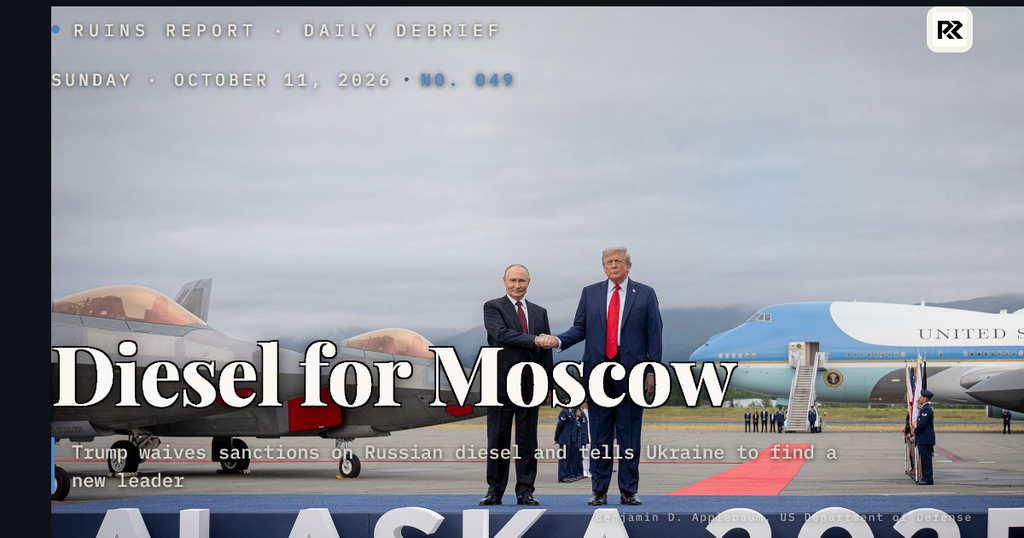
Donald Trump stood outside the White House on Saturday 10 October and told a Ukrainian reporter that Ukraine needs a new president. Volodymyr Zelensky "could have settled this war many times," Trump said; he had told him not to hit Russian refineries, and Zelensky hit them anyway; Ukraine should get "a new leader who can make a deal."¹ The remarks came a day after Trump, following a call with Vladimir Putin on Friday 9 October, announced that Russia would put more than four million tons of diesel on the market, 300,000 tons at once, 500,000 in November, a million after that and a further three million depending on the state of Russian refineries, and the Treasury issued a general licence waiving sanctions on Russian diesel through April 2027.² The deal had surfaced only as a footnote the day before. On Saturday it was the story, and the analysts who followed it spent the day on two questions: what did the waiver actually buy, and does Washington still control the war it says it is ending?
Rachel Blevins laid out the sequence. Axios's Barak Ravid reported that Trump cut the deal with Putin after Zelensky ignored his request to stop striking Russian refineries, an anonymous official adding that Zelensky was eroding goodwill built up over six months, and Axios and the Financial Times both reported that Steve Witkoff and Jared Kushner had threatened to cut off intelligence sharing with Ukraine if the strikes went on.³ Alexander Mercouris supplied the count and the measure. By Axios's account Trump asked six times and was refused six times; the Guardian carried Zelensky's verdict on the arrangement, "absolutely terrible" and "not fair"; and what Moscow gave in return, by Mercouris's arithmetic, is roughly nine days of US diesel consumption at most.⁴ Then came the answer from Kiev. John Helmer said Zelensky authorised an attack on a Russian refinery within hours of Trump's announcement and that Ukrainian officials left the Miami talks early.⁵ Mark Sleboda, on Danny Haiphong's show, put the refinery strike on the night after the deal was announced and said Zelensky pulled his negotiators back from the United States in protest.⁶
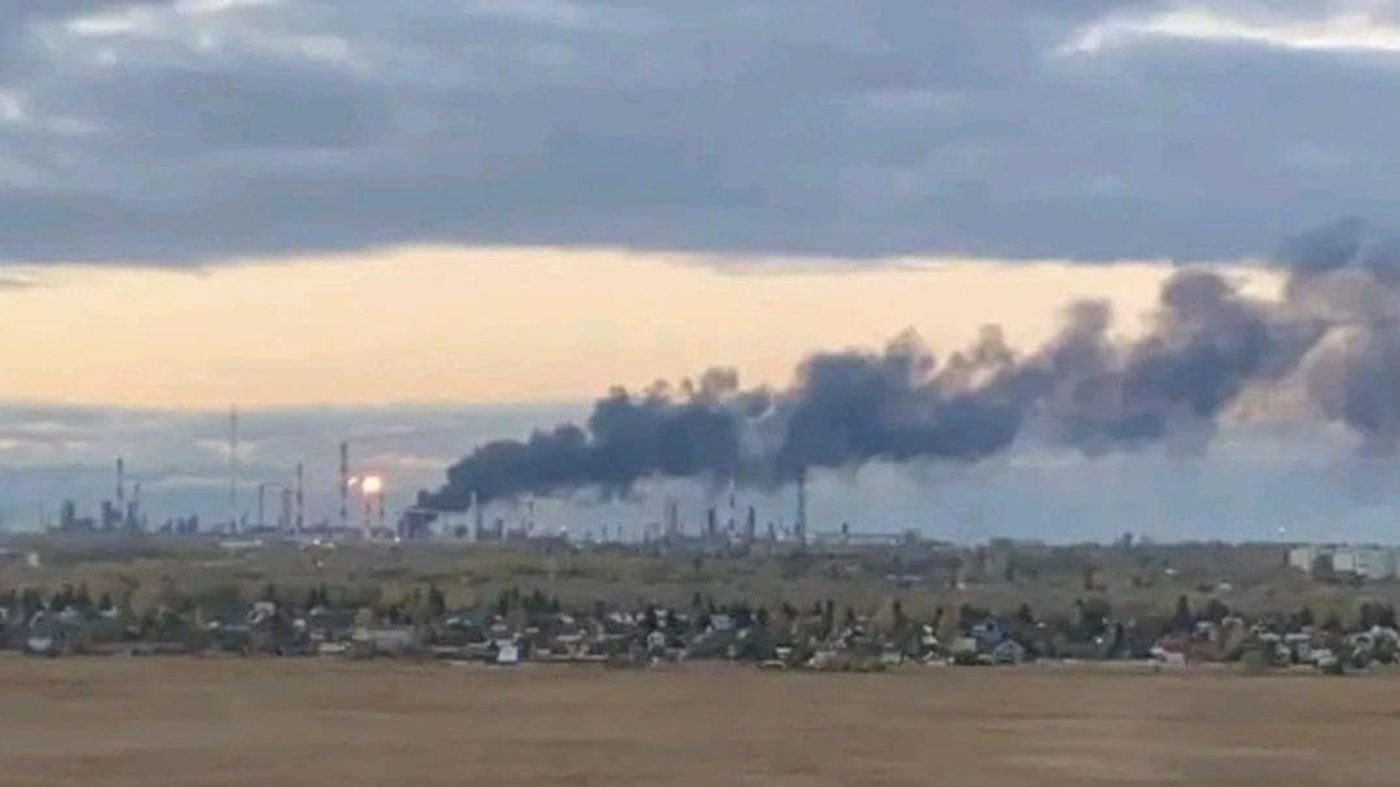
Daniel Davis heard a break. He recalled the February 2025 Oval Office blowup, after which the Europeans consoled Zelensky and Trump did not follow through, and set Saturday against it: "that was strike one. And I don't know what strike two was, but this appears to be strike three. You're out."⁷ He allowed for a repeat, "and he gets mollified somehow," but his reading was that Trump now treats the war as "a thorn in my side that I'm not going to deal with anymore," and that there is a strong chance the president simply walks away.⁸
Blevins and Sleboda watched the same feud and saw a performance. "I see this big public feud between Trump and Zelensky as a bunch of theater," Blevins said.⁹ Her reason is mechanical rather than psychological: "The US is still providing the intelligence. So they can sit there and tell Kiev, don't target Russian oil refineries all they want to, but as long as they provide the targeting data and everything else, then what would stop Kiev from carrying out those attacks?"¹⁰ Mercouris went further on who runs the campaign. "I believe it has been mostly a CIA operation," he said of the refinery strikes, and hardliners in Washington would block any cut-off of intelligence whatever Witkoff and Kushner threatened; the proxy, in his reading, is slipping out of American control.¹¹ Sleboda, who also believes the CIA directs the targeting and doubts the deal will hold, put the president at the centre of the uncertainty: "Trump doesn't know what the hell he's doing, right? He's swayed every 15 minutes by the last person he talked to."¹² The split is a real one. Davis reads a president who has run out of patience with his client. Blevins and Sleboda read a president whose own agencies supply the behaviour he complains about, which makes the complaint a performance whether or not he means it.
Moscow, on these accounts, has priced the contradiction and is testing it. "President Putin is betting now on a demonstration, not an appeasement of Trump, but a test of Trump," Helmer said.¹³ "It's a test of whether Trump can order Zelensky to do anything."¹⁴ By Helmer's account Russia has put its own goods on the table: its diesel export ban, in force since 8 July, was extended after the call, and the tanker Minerva Zen, which left St Petersburg on 22 September with diesel, is within sailing distance of New York, so the first deliveries could arrive within 48 to 72 hours.¹⁵ What Moscow has withheld is the one thing Washington says it wants. Mercouris, reading Yuri Ushakov's account of the call, said Putin told Trump that Russia is reviewing whether to resume the trilateral talks at all, because Kiev's drone strikes on Moscow and on polling stations during the Duma elections had disrupted the process, and that Trump would pass the message to the Ukrainian delegation in Miami.¹⁶ Mercouris called it the first time in the war that Russia has turned down a proposal for direct negotiations with Ukraine.¹⁷

“It is the first time in the course of this war that the Russians have rejected a proposal for direct negotiations between the Ukrainians and themselves.”
So what did the waiver buy? On the diesel itself, the measurements converge on very little. "The amount of diesel fuel that Russia is shipping in by October can't make a significant difference to the diesel price," Helmer said;¹⁸ futures rose 5% on Friday 9 October before easing to 2%, and "the diesel price betting is on going up, not down."¹⁹ The deal exists, by his account, because the alternatives are closed to Trump. He could not impose a US diesel export ban against the refinery lobby and Congress, and his red-dyed diesel order only postponed a tax until Christmas: "Trump isn't prepared, isn't able, and isn't willing to fight his own oil lobby."²⁰ Mercouris located the shortage somewhere Russia cannot fix. "Most of the diesel oil and the crude oil which gets refined into diesel has in fact been coming from the Persian Gulf," he said, and the Gulf is where the Iran war has cut it off.²¹ Sleboda gave the week's tally from that front: Iran has hit about 16 verified ships in the Strait of Hormuz in the past week, and diesel rather than crude is the real crisis, with Europe squeezed and Trump wanting a lower pump price before the midterms.²² Blevins put the Russian view in a line, "Russia's like, 'Sure, you want to buy our diesel at this escalated price? Sure, why not?'" and then the limit: "This does nothing to quote unquote end the war in Ukraine. This is not a ceasefire."²³
That leaves the politics, and here Helmer was blunt about the calendar. "Most of the betting money is also on Trump losing the midterm election on November three," he said, and he reads the deal as a domestic measure that cannot move the polls.²⁴ The pattern of the two days is then not hard to describe. The United States has issued a sanctions waiver to its adversary in order to discipline its client. The client answered within hours with the strike the waiver was meant to stop, using, on three of these accounts, targeting data that Washington itself supplied. The adversary accepted the waiver, shipped the diesel and placed the negotiations under review. Whether Trump walks away, as Davis expects, or is mollified once more, as Davis fears, the control he asserted on the lawn is control that neither Kiev nor, by this reading, his own intelligence agencies have conceded to him.
Twelve dead at King Khalid, the wildest tanker market since the 1970s and the terms left at Istanbul
The deadliest of the missile strikes on Riyadh's King Khalid International Airport now has a toll. The Saudi civil aviation authority reported 12 killed and 309 injured, the airport suspended all operations, and a second missile struck King Fahd airport at Dammam, as Mario Nawfal reported.²⁵ The earlier strikes on the airport had hit aircraft on the ground and killed several; this one killed twelve. Daniel Davis drew the long conclusion: "there may not be a Saudi Arabia when this war with the Houthis is done."²⁶
Sal Mercogliano brought the shipping numbers. Lloyd's List counts at least 13 attacks on tankers and gas carriers since 28 September, the highest weekly level in seven months, and Black Sea wheat loadings fell to 1.6 million tons in September, down 77.8% on the year.²⁷ "I think what we're seeing here is the greatest volatility we've ever seen in the tanker market since the 1970s," he said.²⁸
Mary Dejevsky, on Tom Switzer's show, said she gave up her weekly Independent column at the end of June partly over the shrinking room for dissent on Russia and Ukraine in the British press.²⁹ Her view of where the war's diplomacy stands is the one the column had no room for: "the terms that were on offer in Istanbul in April 2022 are better than anything Ukraine is going to be able to get."³⁰
Sources
- Daniel Davis, Daniel Davis / Deep Dive · Trump's clip on the White House lawn: Ukraine needs a new president, Zelensky "could have settled this war many times," he was told not to hit refineries · watch ▶
- Rachel Blevins, Rachel Blevins · Trump's Friday 9 October announcement: 300,000 tons at once, 500,000 in November, a million after that, up to a further three million; Treasury general licence waiving sanctions on Russian diesel through April 2027 · watch ▶
- Rachel Blevins, Rachel Blevins · Axios: Trump cut the deal after Zelensky ignored his request on refineries; Axios and the FT: Witkoff and Kushner threatened to cut intelligence sharing · watch ▶
- Alexander Mercouris, Alexander Mercouris · Axios: Trump asked six times and was refused; the Guardian: Zelensky called the deal "absolutely terrible"; the waiver is roughly nine days of US diesel consumption at most · watch ▶
- John Helmer, Dialogue Works · Zelensky authorised a refinery strike hours after Trump's announcement; Ukrainian officials left the Miami talks early · watch ▶
- Mark Sleboda, Danny Haiphong · Ukrainian drones hit a Rosneft refinery the night after the deal; Zelensky pulled his negotiators back early in protest · watch ▶
- Daniel Davis, Daniel Davis / Deep Dive · "that was strike one. And I don't know what strike two was, but this appears to be strike three. You're out." · watch ▶ 3:15
- Daniel Davis, Daniel Davis / Deep Dive · "this is a thorn in my side that I'm not going to deal with anymore"; "We'll see if we have a repeat of February 2025 and he gets mollified somehow" · watch ▶ 4:06
- Rachel Blevins, Rachel Blevins · "I see this big public feud between Trump and Zelensky as a bunch of theater." · watch ▶ 15:24
- Rachel Blevins, Rachel Blevins · "as long as they provide the targeting data and everything else, then what would stop Kiev from carrying out those attacks?" · watch ▶ 11:33
- Alexander Mercouris, Alexander Mercouris · "I believe it has been mostly a CIA operation." · watch ▶ 53:38
- Mark Sleboda, Danny Haiphong · "Trump doesn't know what the hell he's doing, right? He's swayed every 15 minutes by the last person he talked to" · watch ▶ 8:45
- John Helmer, Dialogue Works · "President Putin is betting now on a demonstration, not an appeasement of Trump, but a test of Trump." · watch ▶ 20:52
- John Helmer, Dialogue Works · "It's a test of whether Trump can order Zelensky to do anything." · watch ▶ 8:31
- John Helmer, Dialogue Works · Russia's diesel export ban, in force since 8 July, was extended after the call; the tanker Minerva Zen left St Petersburg on 22 September and is within sailing distance of New York · watch ▶
- Alexander Mercouris, Alexander Mercouris · Ushakov's readout: Putin told Trump Russia is reviewing whether to resume trilateral talks after Kiev's drone strikes on Moscow and on Duma polling stations · watch ▶
- Alexander Mercouris, Alexander Mercouris · "It is the first time in the course of this war that the Russians have rejected a proposal for direct negotiations between the Ukrainians and themselves." · watch ▶ 63:10
- John Helmer, Dialogue Works · "The amount of diesel fuel that Russia is shipping in by October can't make a significant difference to the diesel price" · watch ▶ 10:09
- John Helmer, Dialogue Works · Diesel futures rose 5% on Friday before easing to 2%; "The diesel price betting is on going up, not down." · watch ▶ 26:53
- John Helmer, Dialogue Works · "Trump isn't prepared, isn't able, and isn't willing to fight his own oil lobby." · watch ▶ 23:26
- Alexander Mercouris, Alexander Mercouris · "Most of the diesel oil and the crude oil which gets refined into diesel has in fact been coming from the Persian Gulf" · watch ▶ 29:00
- Mark Sleboda, Danny Haiphong · Iran has hit about 16 verified ships in the Strait of Hormuz in the past week after a period of tolled passage; diesel, not crude, is the real crisis and Trump wants lower prices before the midterms · watch ▶
- Rachel Blevins, Rachel Blevins · "Sure, you want to buy our diesel at this escalated price? Sure, why not?"; "This does nothing to quote unquote end the war in Ukraine. This is not a ceasefire." · watch ▶ 6:24
- John Helmer, Dialogue Works · "Most of the betting money is also on Trump losing the midterm election on November three." · watch ▶ 27:03
- Mario Nawfal, Mario Nawfal · Saudi civil aviation authority: 12 killed and 309 injured at King Khalid International Airport, all operations suspended; a second missile hit King Fahd airport at Dammam · watch ▶ 14:23
- Daniel Davis, Daniel Davis / Deep Dive · "there may not be a Saudi Arabia when this war with the Houthis is done" · watch ▶ 32:18
- Sal Mercogliano, What's Going on With Shipping? · Lloyd's List: at least 13 tanker and gas carrier attacks since 28 September, the highest weekly level in seven months; Black Sea wheat loadings down 77.8% year on year to 1.6 million tons · watch ▶
- Sal Mercogliano, What's Going on With Shipping? · "I think what we're seeing here is the greatest volatility we've ever seen in the tanker market since the 1970s" · watch ▶ 10:22
- Mary Dejevsky, Tom Switzer · Gave up her weekly Independent column at the end of June partly over the shrinking room for dissent on Russia and Ukraine in British media · watch ▶
- Mary Dejevsky, Tom Switzer · "the terms that were on offer in Istanbul in April 2022 are better than anything Ukraine is going to be able to get." · watch ▶ 29:05
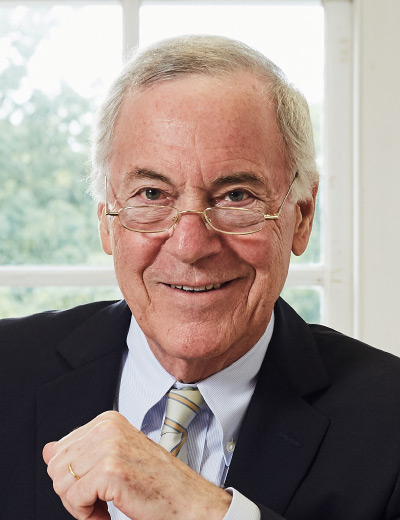
- Steve Hanke, Dialogue Works · "we're talking about the equivalent of 5 days worth of diesel consumption in the United States. So it's peanuts." · watch ▶ 5:30
- Peter Schiff, Peter Schiff · Trump signed a bill allowing up to 100% tariffs on buyers of Russian oil three weeks earlier: "what is the explanation for this flip-flop? What's changed in 3 weeks?" · watch ▶ 20:43
By Ruins Report, a daily synthesis of what our tracked analysts said, not original reporting. Every numbered claim is sourced, dated, and timestamped above.
Newsletter
Get the Daily Debrief
One email each morning: what the analysts we track actually said, and every call timestamped to its source. Free.
Free. No spam. View on Substack →
Support the Report
Free to read, every day.
The Debrief is compiled each morning from what the analysts we track actually said, sourced and timestamped. No paywall, no ads, no investors. If it earns a place in your inbox, you can help keep it independent.
Support the report →