
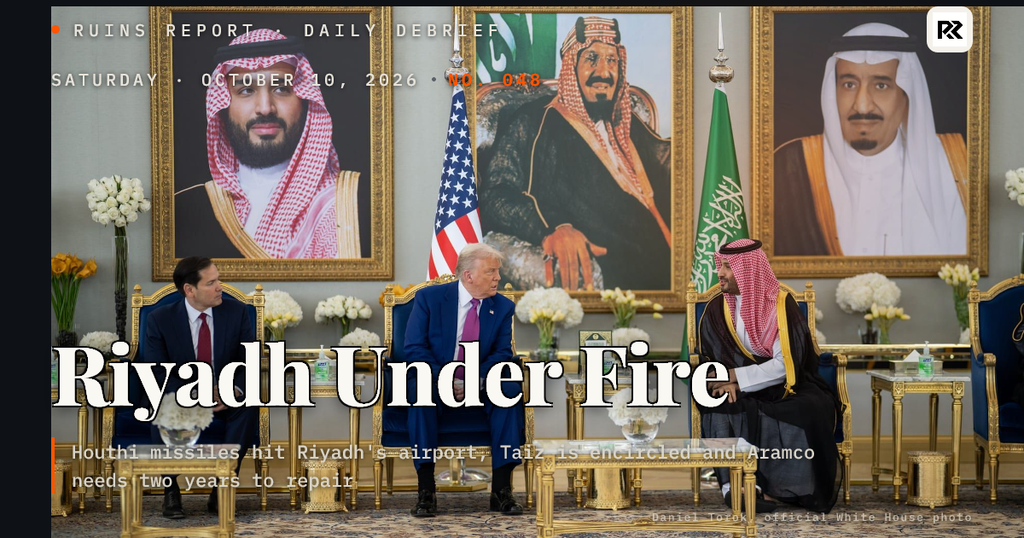
Saudi Arabia's civil aviation authority has confirmed two attacks on King Khalid International Airport outside Riyadh, strikes that hit at least three aircraft on the ground and killed several Saudi citizens, as Nima Alkhorshid reported on Dialogue Works on Friday 9 October.¹ The missiles that reached the airports at Jizan and Najran earlier in the week have now reached the capital's main airport, and the capital is not the only new target. Larry Johnson, on Judging Freedom's Intel Roundtable, listed what else has been hit in the past fortnight: four of the 13 pumping stations on the pipeline to Yanbu, the export terminals around Ras Tanura, the refineries at Jazan and Jeddah, and King Fahd air base.² John Mearsheimer, on his own channel, cited reports that the pipeline carrying Saudi crude from the Gulf coast to the Red Sea has once again been shut.³ In Yemen itself, Alexander Mercouris said on The Duran, the key town of Taiz is reported encircled.⁴ For nine years the war in Yemen was a border war that Saudi Arabia could afford to lose slowly. The analysts who spoke on Friday 9 October no longer describe it that way. The question they put is whether the Saudi state, and the crown prince who runs it, can survive the war he reopened.
Begin with the scale. "The Houthis have done more damage to Saudi Arabia in the last two weeks than they did in 9 years of war," Johnson said,⁵ and the damage is not the kind a ceasefire repairs. He cited an Aramco warning that the oil infrastructure will take a minimum of two years to restore.⁶ The consequence for the treasury follows directly: "Saudi Arabia can't afford to pay its bills. Its cash flow is kaput," and the kingdom will have to sell US Treasuries to cover the gap.⁷ Mearsheimer set the geography under those figures. The Houthis control the Bab el-Mandeb, and with the pipeline to the Red Sea cut they can throttle the flow of Gulf oil to world markets from both ends.⁸ Chas Freeman, Alkhorshid's guest, placed the Saudi losses inside a larger contest. The pressure on Saudi exports "is part of the war of economic attrition that the United States and Iran are now engaged in,"⁹ a fight that began over Saudi and Yemeni grievances rather than at Tehran's direction, and that suits Tehran all the same.¹⁰ Alexander Christoforou, Mercouris's co-host, read the cost at the other end of that attrition: "the 10-year note above 5.35, first time in 24, 25 years. This is not going well for the US economy."¹¹
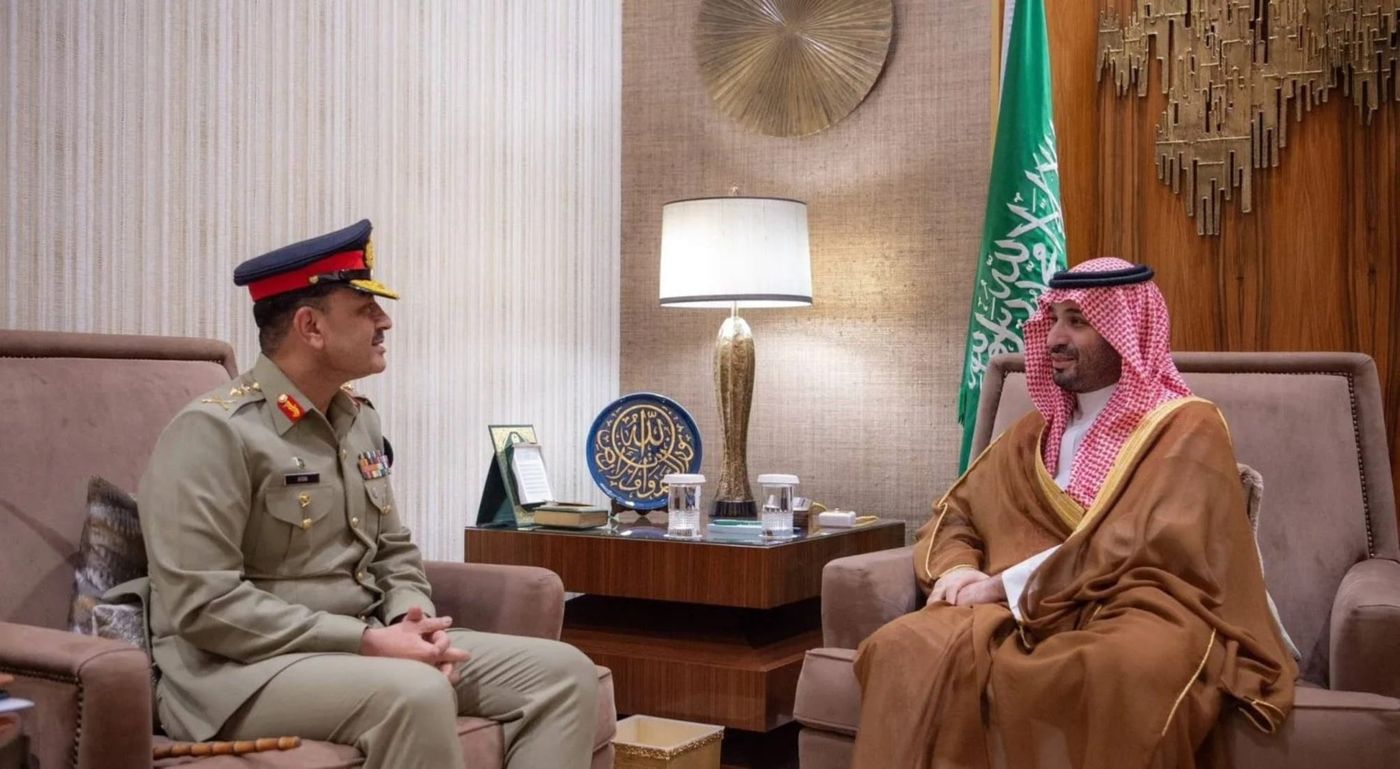
A state under this kind of pressure looks for an army, and the search for one is where the analysts most converged. "What MBS needs is tough, effective ground troops, and so far they don't seem to be coming," Mercouris said.¹² Freeman reported that the tripartite entente between Saudi Arabia, Pakistan and Turkey has been invoked to put troops behind Saudi lines, and that Riyadh has gone further afield, asking Syria's Ahmed al-Sharaa for 20,000 fighters.¹³ By Mercouris's account the Syrian request was refused.¹⁴ The Pakistani deployment, confirmed by Islamabad's own army spokesman, carries less than it appears to in Johnson's reading: "The reports in Reuters and other Western news outlets about Pakistan getting involved in this fight are completely false," and Pakistan will not come to the kingdom's defence.¹⁵ Lawrence Wilkerson, on Glenn Diesen's channel, went further about the pact itself. "The Mecca pact is a farce. This is not a pact," he said, calling it symbolic and aimed at Israel rather than at the Houthis,¹⁶ and his conclusion was unhedged: "That means the Houthi is going to win."¹⁷ Riyadh, Freeman added, refuses a ceasefire until it retakes the territory it has lost,¹⁸ which leaves it fighting for ground with armies that exist on paper.
That leaves the protector of last resort, and here the analysts were of one mind that it will not come. Mearsheimer's answer to a viewer who asked whether the United States should take on the Houthis was that it has no way of defeating them militarily.¹⁹ "We went to war against the Houthis once before. We couldn't beat them then, and we certainly can't beat them now," he said, describing the 2025 campaign as a quit dressed as a victory and the munitions stock as lower now than it was then.²⁰ Any sign of American success would bring Iran in and return the position to square one.²¹ Freeman described a military already in retreat, "basically ... pushed out of the Persian Gulf by Iran,"²² with aircraft losses the Pentagon has understated,²³ and a president who plans to attack Iran after the midterm elections with the depleted force that remains.²⁴ Wilkerson gave the bill for doing what Riyadh would need done: "a million troops, 10 years, several trillion dollars to defeat Iran. We don't have anything close to that."²⁵ Scott Ritter, Johnson's partner on the roundtable, said the oil market would compel the president into a three-day attack that becomes a five-day attack, then a seven-day attack, then a disaster.²⁶ None of that is a rescue of Saudi Arabia. Mercouris drew the implication: should the Houthis look like taking over Yemen, "I actually think Iran is going to fade into the background,"²⁷ because the fall of a Gulf monarchy would become the war's central fact.
This is the turn in the analysis, and it is a sharp one. A week ago the shared read was that Saudi Arabia was losing a war. On Friday 9 October it was that the Saudi state might not outlast it. "Saudi Arabia is toast. They're finished. Ansarallah is thrashing them on the battlefield, thrashing them ... strategically," Ritter said,²⁸ and then put the consequence in personal terms: "Muhammad bin Salman will either be compelled to flee or he's going to die."²⁹ Johnson, more measured, arrived at the same place: "this really could ultimately lead to the collapse of the Saudi Arabian government."³⁰ Ritter put a date on it the same day, on Danny Haiphong's show: "I think the world's going to be shocked when MBS collapses in 2026."³¹ Mercouris reached for the kingdom's whole history: "Saudi Arabia has existed as a kingdom, as a state, for 100 years, but it has never been under as much pressure as it is today."³² His explanation was strategic rather than military. "You never invest everything in one strategy. If you are in the Middle East, you always need to hedge, and he didn't hedge,"³³ and Christoforou named the hedge not taken, a place inside BRICS.³⁴

“Saudi Arabia has existed as a kingdom, as a state, for 100 years, but it has never been under as much pressure as it is today.”
Where they diverged was on whether anything arrests the slide. Christoforou thought diplomacy would still save Saudi Arabia, at least from the Houthi advance,³⁵ while Mercouris raised the opposite possibility, a Western intervention to hold the kingdom together.³⁶ Freeman took the longest view. The kingdom is already diversifying toward China, Russia and India and toward its Turkish and Pakistani partners while the United States retreats to the Western Hemisphere: "I think we're seeing strategic shifts of a tectonic nature."³⁷ Ritter said that losing Saudi Arabia would be an unmitigated disaster for the United States, with a book industry to follow on how Washington got it wrong.³⁸ The deeper cause the analysts kept returning to is not a Houthi missile. It is that the kingdom built its security on a single guarantor, and the guarantor now has neither the munitions nor the appetite to honor the guarantee.
Kiev's west bank goes dark, a diesel deal and the rare earths behind every missile
The Russian strike on a Kiev substation on the night of 8 to 9 October blacked out the city's west bank, stopped the metro and hit the sewage system, Alexander Mercouris said on his own channel, part of a systematic drone campaign against bridges, rail and fuel.³⁹ "I have been saying for weeks that the Russian plan clearly is to cut off Kiev and to make Kiev essentially unusable and uninhabitable,"⁴⁰ he said, and "what were temporary outages last winter will become permanent outages this coming winter."⁴¹
After a Trump-Putin call, Washington announced on Friday 9 October a deal for Russian diesel, 300,000 tons now, 500,000 the next month and a million after that, under a Treasury sanctions waiver running to 7 April, Garland Nixon reported on his own channel, reading it as midterm politics that leaves Europe embarrassed.⁴² "Strategically for Putin, it's brilliant. This ain't about, oh, I love the Americans or I hate the Americans. It is a brilliant move strategically."⁴³
Carl Zha, on Redacted, said the Trump-Xi summit extended the tariff truce to January but left China's rare earth export controls on the US military in place,⁴⁴ with a direct bearing on the war in the Gulf: "each missile US fires against Iranian target is one missile less in the US arsenal, and it's one missile that US could not replenish because they don't have the rare earth shipments coming from China."⁴⁵
Sources
- Nima Alkhorshid, Dialogue Works · Saudi Arabia's civil aviation authority confirms two attacks on King Khalid International Airport outside Riyadh, at least three aircraft hit and several citizens killed · watch ▶
- Larry Johnson, Judging Freedom · four of 13 Yanbu pipeline pumping stations knocked out; Ras Tanura-area terminals, Jazan and Jeddah refineries and King Fahd air base hit · watch ▶
- John Mearsheimer, John Mearsheimer · "Saudi Arabia's principal oil line that goes from the eastern side of Saudi Arabia to the western side has once again been shut down by the Houthis" · watch ▶ 6:47
- Alexander Mercouris, The Duran · the key town of Taiz is reported encircled by Ansar Allah · watch ▶
- Larry Johnson, Judging Freedom · "The Houthis have done more damage to Saudi Arabia in the last two weeks than they did in 9 years of war." · watch ▶ 20:29
- Larry Johnson, Judging Freedom · Aramco warns "it's going to be a minimum of two years before the oil infrastructure is repaired" · watch ▶ 27:38
- Larry Johnson, Judging Freedom · "Saudi Arabia can't afford to pay its bills. Its cash flow is kaput."; the kingdom will have to sell US Treasuries · watch ▶ 27:20
- John Mearsheimer, John Mearsheimer · the Houthis control Bab el-Mandeb and, with the pipeline shut, can throttle Gulf oil to world markets · watch ▶
- Chas Freeman, Dialogue Works · "it is part of the war of economic attrition that the United States and Iran are now engaged in" · watch ▶ 6:50
- Chas Freeman, Dialogue Works · the Saudi-Yemen fight began over Saudi and Yemeni factors, not Iran, but suits Tehran because it squeezes Gulf oil exports · watch ▶
- Alexander Christoforou, The Duran · "the 10-year note above 5.35, first time in 24, 25 years. This is not going well for the US economy" · watch ▶ 16:21
- Alexander Mercouris, The Duran · "What MBS needs is tough, effective ground troops and so far they don't seem to be coming." · watch ▶ 4:26
- Chas Freeman, Dialogue Works · the Pakistan-Saudi-Turkey tripartite entente invoked to put troops behind Saudi lines; the Saudis "have apparently asked" Syria's president "for mercenaries, 20,000 troops" · watch ▶ 5:17
- Alexander Mercouris, The Duran · MBS reportedly approached Syria's Jolani for troops and was refused · watch ▶
- Larry Johnson, Judging Freedom · "The reports in Reuters and other Western news outlets about Pakistan getting involved in this fight are completely false"; Pakistan will not intervene · watch ▶ 20:18
- Lawrence Wilkerson, Glenn Diesen · "the Mecca pact is a farce. This is not a pact."; symbolic, and aimed at Israel rather than the Houthis · watch ▶ 1:35
- Lawrence Wilkerson, Glenn Diesen · "That means the Houthi is going to win" · watch ▶ 3:08
- Chas Freeman, Dialogue Works · Riyadh refuses a ceasefire until it retakes the territory it has lost · watch ▶
- John Mearsheimer, John Mearsheimer · "the United States has no way of defeating the Houthies militarily" · watch ▶ 4:30
- John Mearsheimer, John Mearsheimer · "we went to war against the Houthis once before. We couldn't beat them then and we certainly can't beat them now"; the 2025 campaign ended in a quit declared as victory, and munitions stocks are lower now · watch ▶ 4:39
- John Mearsheimer, John Mearsheimer · if the US appeared to be winning against the Houthis, "the Iranians would then come in and we're back to square one" · watch ▶ 8:46
- Chas Freeman, Dialogue Works · "US military have basically been pushed out of the Persian Gulf by Iran" · watch ▶ 19:01
- Chas Freeman, Dialogue Works · "the number of aircraft destroyed is vastly larger than the Pentagon has said" · watch ▶ 19:20
- Chas Freeman, Dialogue Works · "he plans to attack Iran after the elections" · watch ▶ 9:12
- Lawrence Wilkerson, Glenn Diesen · "a million troops, 10 years, several trillion dollars to defeat Iran. We don't have anything close to that" · watch ▶ 23:19
- Scott Ritter, Judging Freedom · "the president will be compelled to launch a three-day attack that will turn into a five-day attack that will turn into a 7-day attack that will turn into a disaster" · watch ▶ 19:34
- Alexander Mercouris, The Duran · if the Houthis look like taking over Yemen, "I actually think Iran is going to fade into the background" · watch ▶ 7:07
- Scott Ritter, Judging Freedom · "Saudi Arabia is toast. They're finished. Ansarallah is thrashing them on the battlefield, thrashing them strategically." · watch ▶ 24:58
- Scott Ritter, Judging Freedom · "Muhammad bin Salman will either be compelled to flee or he's going to die" · watch ▶ 23:45
- Larry Johnson, Judging Freedom · "this really could ultimately lead to the collapse of the Saudi Arabian government" · watch ▶ 22:25
- Scott Ritter, Danny Haiphong · "I think the world's going to be shocked when MBS collapses in 2026" · watch ▶ 20:01
- Alexander Mercouris, The Duran · "Saudi Arabia has existed as a kingdom as a state for 100 years but it has never been under as much pressure as it is today." · watch ▶ 5:46
- Alexander Mercouris, The Duran · "You never invest everything in one strategy. If you are in the Middle East, you always need to hedge and he didn't hedge" · watch ▶ 12:40
- Alexander Christoforou, The Duran · MBS blundered by not hedging with BRICS · watch ▶
- Alexander Christoforou, The Duran · "Saudi Arabia is going to be saved at least from the Houthi advance", through diplomacy · watch ▶ 14:40
- Alexander Mercouris, The Duran · the Houthi advance threatens Saudi stability and a Western intervention is possible · watch ▶
- Chas Freeman, Dialogue Works · Saudi Arabia diversifies toward China, Russia, India and a Turkey-Pakistan pact as the US retreats to the Western Hemisphere: "I think we're seeing strategic shifts of a tectonic nature" · watch ▶ 28:38
- Scott Ritter, Judging Freedom · losing Saudi Arabia will be an unmitigated disaster for the US, with a book industry to follow on how Washington got it wrong · watch ▶
- Alexander Mercouris, Alexander Mercouris · the strike on the Kiev substation on the night of 8 to 9 October blacked out the west bank, stopped the metro and hit the sewage system, part of a systematic drone campaign on bridges, rail and fuel · watch ▶
- Alexander Mercouris, Alexander Mercouris · "I have been saying for weeks that the Russian plan clearly is to cut off Kiev and to make Kiev essentially unusable and uninhabitable." · watch ▶ 6:58
- Alexander Mercouris, Alexander Mercouris · "what were temporary outages last winter will become permanent outages this coming winter." · watch ▶ 18:19
- Garland Nixon, Garland Nixon · after a Trump-Putin call: 300,000 tons of Russian diesel now, 500,000 the next month, 1 million after, with a Treasury sanctions waiver to 7 April; midterm politics that embarrasses Europe · watch ▶
- Garland Nixon, Garland Nixon · "Strategically for Putin, it's brilliant. This ain't about, oh, I love the Americans or I hate the Americans. It is a brilliant move strategically." · watch ▶ 41:54
- Carl Zha, Redacted · the Trump-Xi summit extended the tariff truce to January but China's rare earth export controls on the US military remain · watch ▶
- Carl Zha, Redacted · "each missile US fires against Iranian target is one missile less in the US arsenal and it's one missile that US could not replenish because they don't have the rare earth shipments coming from China" · watch ▶ 2:43
By Ruins Report, a daily synthesis of what our tracked analysts said, not original reporting. Every numbered claim is sourced, dated, and timestamped above.
Newsletter
Get the Daily Debrief
One email each morning: what the analysts we track actually said, and every call timestamped to its source. Free.
Free. No spam. View on Substack →
Support the Report
Free to read, every day.
The Debrief is compiled each morning from what the analysts we track actually said, sourced and timestamped. No paywall, no ads, no investors. If it earns a place in your inbox, you can help keep it independent.
Support the report →