
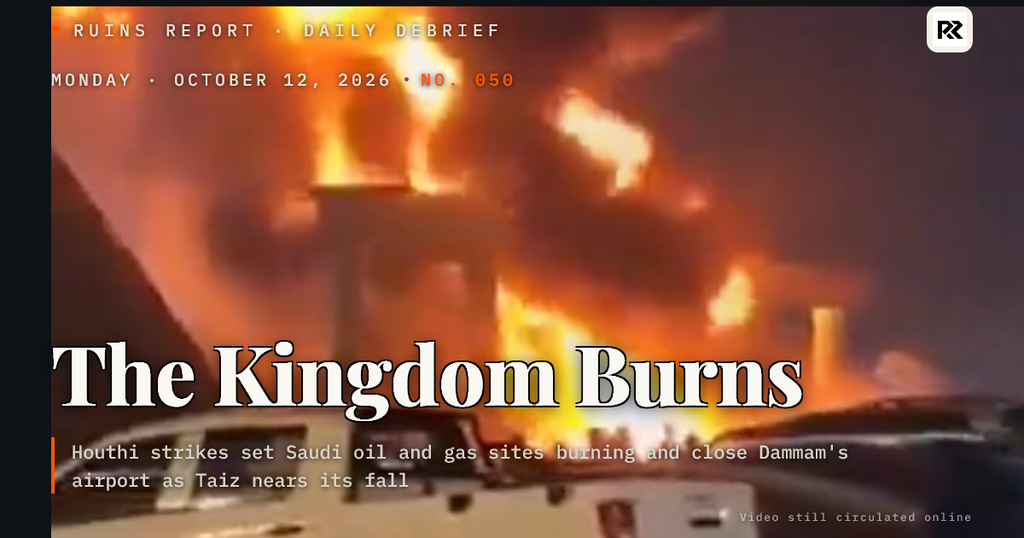
Houthi missiles set fire to oil and gas facilities across Saudi Arabia over the weekend, four of them burning at once on Sunday 11 October by Mario Nawfal's count, while King Khalid International outside Riyadh took another cruise missile, Terminal 4 this time after Terminal 3 the day before, and halted operations again.¹ On the Gulf coast, King Fahd International Airport at Dammam, the kingdom's main eastern airport, was struck a second time and closed for 24 hours, with airlines diverting flights.² The missiles that hit Riyadh's main airport were the week's story. The facilities are a different order of event, because oil is what the kingdom lives on.
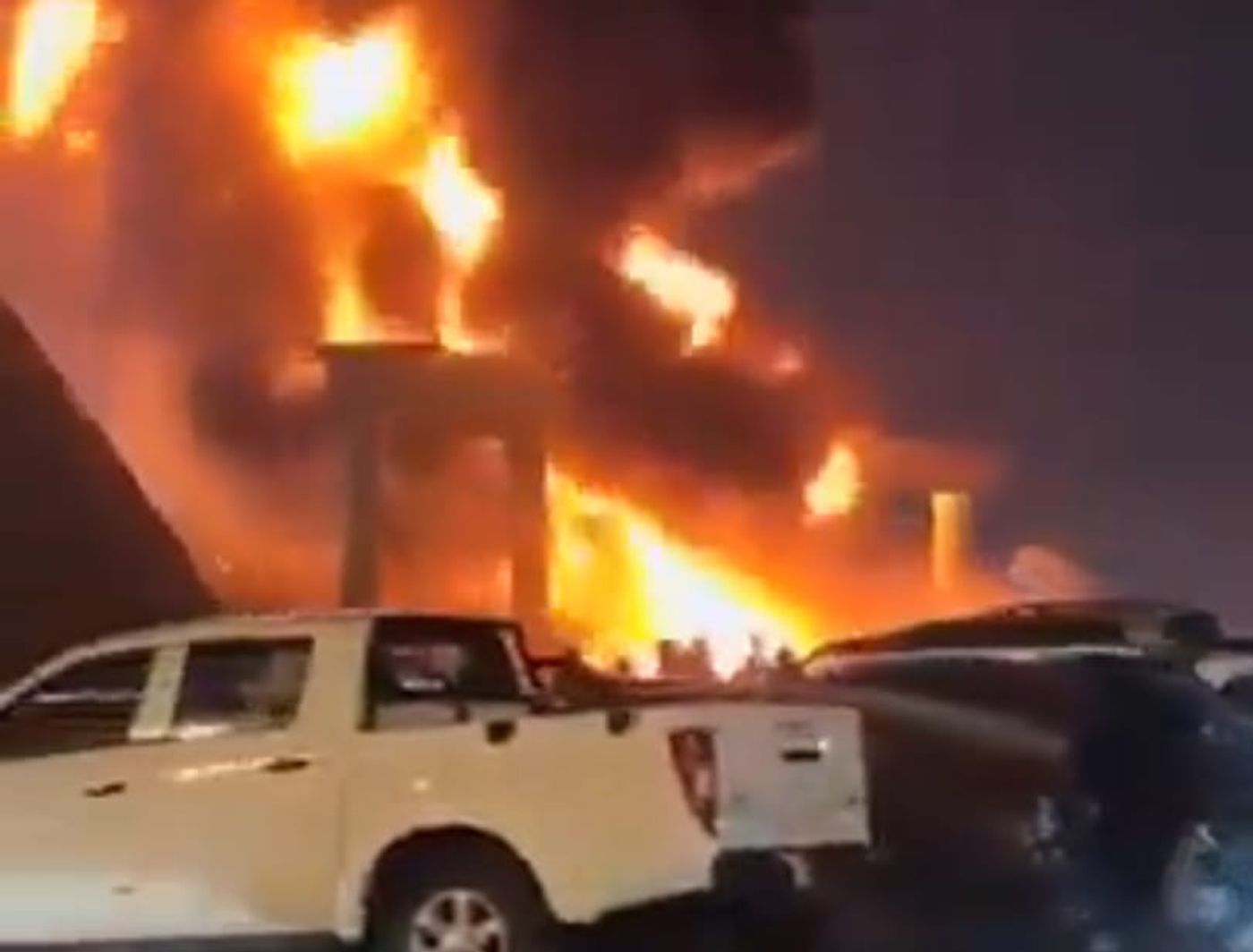
Chris Martenson, on Nawfal's show, had been tracking the fires on NASA's FIRMS satellite data, which reports a fire's radiative power in megawatts. A normal flaring operation runs at one to perhaps twenty, he said; above a hundred, there is damage. The plant he watched on Saturday 10 October, about halfway across the kingdom, registered more than 550 megawatts and was still at 160 a day later, a two-day burn. What the plant does is the point. It processes about 1.8 million barrels a day of crude from the field beside it, "and this is the only processing plant for that stuff," and it pumps 2.8 million barrels of water a day back into the field to hold its pressure; offline, by his account, the kingdom has lost a sizable share of its output for a period nobody can yet state, and that should have been the headline.³ Two gas plants, Shedgum among them, also appear to have been torched. Riyadh has confirmed none of it. "I think Saudi Arabia is just scrambling at this point. They're highly incentivized to keep damages under wraps," Martenson said, and the statement that the East-West pipeline had resumed operations never said at what level.⁴
Taiz is the other front. Mohammad Marandi, on Glenn Diesen's channel, said Yemen's forces have always held part of the city but have now captured everything to its south and west and will take it shortly; it is the country's second city.⁵ On Nawfal's show, Brandon Weichert put the map up: the western entrance to Taiz, the last holdout of the Presidential Leadership Council in that sector, on the road to Mocha and the Red Sea. "It looks like the Saudis are losing this thing quite bigly," he said.⁶ The air blockade holds, the fields are burning and the ground war is going the wrong way, which leaves the question the weekend's analysis converged on: can anyone rescue Riyadh, and what does Iran do if someone tries?
"Saudi Arabia has no one to protect it," Ray McGovern said on Dialogue Works. The United States "really can't," not because it does not want to, but because it has no ammunition or missiles to spare and no real desire to spend what it has.⁷ Pakistan and Turkey have the Mecca agreement, and "it doesn't look like the Pakistanis or the Turks are going to do much"; the Israelis have a full plate.⁸ He imagined the conversation in Washington as a loop: Rubio tells Hegseth to fix it, Hegseth asks how, ships into the Red Sea were tried last year and did not work, and there are no missiles to spare.⁹ The lesson, in his reading, is for every Gulf monarchy: "the US guarantee of security if the Gulfies cooperated with the US with respect to oil and money, that's gone."¹⁰ The only exit he can see for the Saudis is an agreement or truce with Ansar Allah, and after decades of Saudi attacks the antipathy is so deep that he does not see that coming either.¹¹
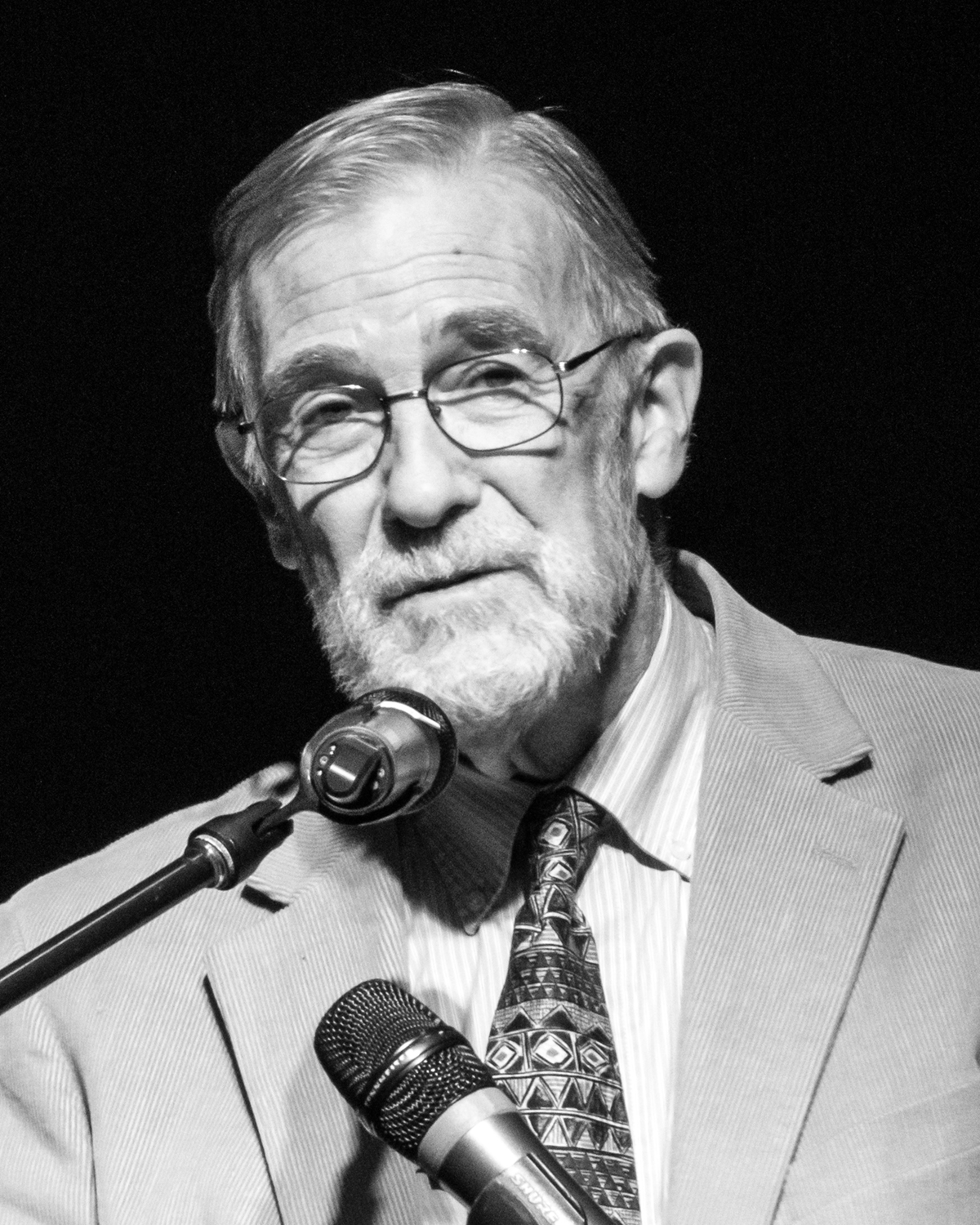
“Saudi Arabia has no one to protect it.”
John Mearsheimer measured the same week from Australia. "I'm actually quite amazed, Tom, at the extent to which the tide has turned in favor of Iran and in favor of the Houthis over the past week," he told Tom Switzer. Iran has mined the Omani channel of Hormuz and is hitting ships in the Sea of Oman and inside the Gulf; the Houthis, with Iran for the first time in the war, are "tearing apart oil infrastructure" that global markets depend on.¹² His answer to the pressure on Trump to act is that there is nothing to do. "There's no way that Trump can intervene militarily and have any real effect on the Houthis," he said; the United States declared war on them in March 2025, fought for two months and quit.¹³
The deeper reason is Iran's stake, and here Mearsheimer was precise about the sequence. "The Iranians have a deep-seated interest in making sure the Houthis don't lose," he said on his own channel. If a US-Saudi campaign ever did put Ansar Allah on the ropes, Iran would join the fight, "and we're back to square one because the United States does not have the military capability to defeat the Iranians," and could do almost nothing to stop them wrecking Saudi oil infrastructure.¹⁴ Marandi, speaking from Tehran's side of the argument, drew the same line from the other end. Nothing Pakistan or Turkey could do will save the kingdom, he said, because Saudi Arabia has nothing but these oil facilities and Mohammed bin Salman's only solution is to end the war.¹⁵ Yemen's missiles and drones are built at home and fired every day: "There are no interceptors that can block them."¹⁶ And if Washington attacks Iran in the coming weeks, the targeting could change. Last time, "Saudi Arabia was not Iran's priority. It was Kuwait," Bahrain, Qatar and the Emirates by turns; now, if Tehran judges that Riyadh is killing Yemeni women and children, "Iran could prioritize Saudi Arabia over the others."¹⁷
That is the arithmetic on which Martenson's verdict rests. He has seen no concession from either side in the Iran talks, which leaves two options: perpetuate a stalemate that has already produced the week's destruction, or try something military, which he called the most malevolent choice available, because Iran has promised to answer by taking out Gulf energy assets. Fifty ballistic missiles aimed not at Abqaiq's storage tanks but at its coking towers, hydro units and refining stacks would be a year's repair at minimum, and the start of a global economic disaster. "There's no credible military solution here at this point in time," he said; what remains is a stalemate heading toward bad economic and probably food outcomes over the next year.¹⁸
McGovern, Mearsheimer, Marandi and Martenson agree on the shape of the thing: the kingdom cannot defend itself, its guarantor cannot defend it, its new allies will not, and the one power that could stop the Houthis has promised to join them instead. The dissent is Charles Finfrock's. The former CIA officer argues the opposite order of operations, that the Houthis are Iran's lever and the lever is removed at its source. The interceptor arithmetic is the test of that argument too.

An unanswered ceasefire, a winter warning for Kiev and a runoff under tariffs
Trump has declared an energy ceasefire between Russia and Ukraine in effect immediately, with both parties agreed; Kiev says it supports the halt and awaits details. Daniel Davis does not expect Moscow to accept a halt Zelensky has sought for months and Russia refused in September, holding every advantage in the air. "This is not even a good checker move," he said; there is no thought behind what any of it means.¹⁹ Garland Nixon reads the diesel waiver the same way, a sanctions holiday to 7 April that exists to move prices before the midterms: "It's between those who want to fake us out for a couple weeks and those who don't even have a desire to fake us out for a couple weeks."²⁰
Kiev is in the dark. Mayor Klitschko has warned residents that it might be a good idea to leave temporarily for the winter, not an evacuation order, Alexander Mercouris noted, from a mayor on bad terms with Zelensky. The repeated outages and an increasingly unstable grid tell Mercouris that strikes are now landing every night "as the Russians tighten their grip on Kiev and continue to work towards cutting off the city from the rest of Ukraine," making daily life and the operation of government there all but impossible.²¹
Brazil goes to a runoff between Lula da Silva and Flavio Bolsonaro. Mark Weisbrot, on Pascal Lottaz's Neutrality Studies, said Bolsonaro backs the boat strikes off South America and the war on Iran, and that after Trump's tariffs and threats "the election has been kind of turned into a kind of regime change operation," the pattern he says Washington ran in Honduras and Colombia.²²
Sources
- Mario Nawfal, Mario Nawfal · Multiple Saudi oil and gas facilities struck, four burning; King Khalid hit again, Terminal 4 after Terminal 3, operations halted · watch ▶
- Brandon Weichert, Mario Nawfal · King Fahd International at Dammam shut for 24 hours after a second strike; airlines diverting flights · watch ▶ 1:16
- Chris Martenson, Mario Nawfal · NASA FIRMS showed a 550-plus megawatt fire at the plant, still 160 a day later; "about 1.8 million barrels a day. And this is the only processing plant for that stuff" · watch ▶ 5:44
- Chris Martenson, Mario Nawfal · "I think Saudi Arabia is just scrambling at this point. They're highly incentivized to keep damages under wraps." · watch ▶ 9:29
- Mohammad Marandi, Glenn Diesen · Yemen's forces have taken the areas south and west of Taiz and will take the second city shortly · watch ▶ 17:30
- Brandon Weichert, Mario Nawfal · "It looks like the Saudis are losing this thing quite bigly." · watch ▶ 29:49
- Ray McGovern, Dialogue Works · "Saudi Arabia has no one to protect it." · watch ▶ 4:00
- Ray McGovern, Dialogue Works · Pakistan and Turkey will not do much to defend Saudi Arabia; the Israelis have a full plate · watch ▶ 4:34
- Ray McGovern, Dialogue Works · Rubio tells Hegseth to fix it and Hegseth asks how; the US has no missiles to spare · watch ▶
- Ray McGovern, Dialogue Works · "the US guarantee of security if the Gulfies cooperated with the US with respect to oil and money, that's gone." · watch ▶ 7:51
- Ray McGovern, Dialogue Works · The Saudis cannot get out without an agreement or truce with Ansar Allah, and the antipathy is too deep for him to see it coming · watch ▶ 5:23
- John Mearsheimer, Tom Switzer · "I'm actually quite amazed, Tom, at the extent to which the tide has turned in favor of Iran and in favor of the Houthis over the past week." · watch ▶ 30:16
- John Mearsheimer, Tom Switzer · "There's no way that Trump can intervene militarily and have any real effect on the Houthis." · watch ▶ 33:01
- John Mearsheimer, John Mearsheimer · "The Iranians have a deep-seated interest in making sure the Houthis don't lose." · watch ▶ 0:29
- Mohammad Marandi, Glenn Diesen · Nothing Pakistan or Turkey could do will save Saudi Arabia; Mohammed bin Salman's only solution is to end the war · watch ▶ 18:11
- Mohammad Marandi, Glenn Diesen · "There are no interceptors that can block them." · watch ▶ 20:17
- Mohammad Marandi, Glenn Diesen · "Saudi Arabia was not Iran's priority. It was Kuwait"; now "Iran could prioritize Saudi Arabia over the others." · watch ▶ 20:49
- Chris Martenson, Mario Nawfal · Fifty ballistic missiles on Abqaiq's coking towers, hydro units and refining stacks would be a year's fix at minimum; "There's no credible military solution here at this point in time." · watch ▶ 24:09
- Daniel Davis, Daniel Davis / Deep Dive · "This is not even a good checker move." Russia will not accept the energy ceasefire; there is no strategy behind it · watch ▶ 2:29
- Garland Nixon, Garland Nixon · "It's between those who want to fake us out for a couple weeks and those who don't even have a desire to fake us out for a couple weeks." · watch ▶ 40:24
- Alexander Mercouris, Alexander Mercouris · "as the Russians tighten their grip on Kiev and continue to work towards cutting off the city from the rest of Ukraine" · watch ▶ 37:48
- Mark Weisbrot, Neutrality Studies · "the election has been kind of turned into a kind of regime change operation" · watch ▶ 10:38
- Charles Finfrock, Mario Nawfal · "the best thing we can do to support the Saudis with their war against the Houthis is to cut the head off the snake and the head in this case being Iran." · watch ▶ 6:35
- Larry Johnson, Mario Nawfal · "I would estimate we've got less than 500 PAC-3s throughout the entire inventory of the US military." · watch ▶ 14:20
- Stanislav Krapivnik, Dialogue Works · "For the cost of one American interceptor, you can make 50 freaking cruise missiles." · watch ▶ 24:21
By Ruins Report, a daily synthesis of what our tracked analysts said, not original reporting. Every numbered claim is sourced, dated, and timestamped above.
Newsletter
Get the Daily Debrief
One email each morning: what the analysts we track actually said, and every call timestamped to its source. Free.
Free. No spam. View on Substack →
Support the Report
Free to read, every day.
The Debrief is compiled each morning from what the analysts we track actually said, sourced and timestamped. No paywall, no ads, no investors. If it earns a place in your inbox, you can help keep it independent.
Support the report →