
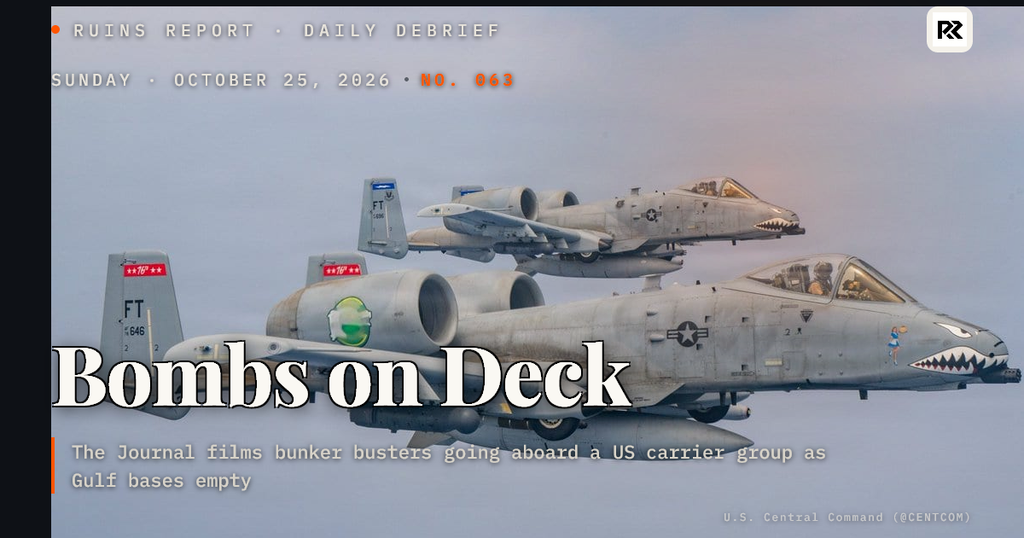
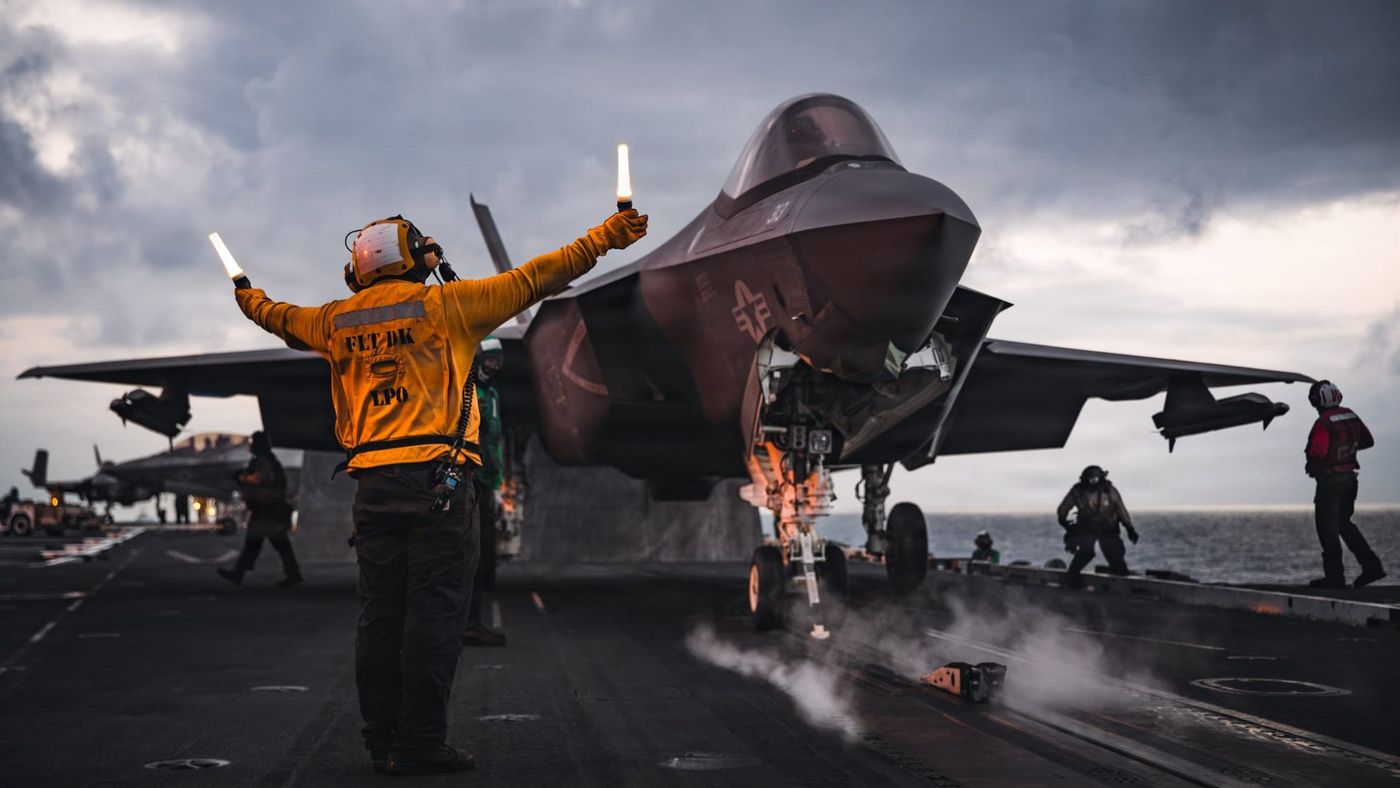
The bunker-buster bombs and standoff land-attack missiles going aboard the USS George Washington strike group in the Arabian Sea were loaded in front of a Wall Street Journal camera, and the footage was on the shows by Saturday 24 October alongside reports of a US-Israeli plan for a campaign against Iran shorter and more intense than the one that ran from 28 February to 10 April.¹ In the same week the United States is withdrawing forces from its Persian Gulf bases, days after embassy families were ordered out of Qatar, Jordan and Bahrain, and Egypt is weighing whether to send troops to defend Saudi Arabia.² A military that means to strike does not ordinarily invite a newspaper to film the ordnance. A government that wants to be seen preparing to strike does. The analysts who spoke on Saturday divided over which of those two the deck footage is, and, if it is the first, over what Iran hits in return.
Larry Johnson's answer is the second. He asked what purpose was served by handing reporters the loadout: "they're giving the press operational information that could be used to defeat the US attack. Does that make sense to you? Not at all."³ His reading is that "the United States is doing the haka right now, without actually intending to follow through on it," the war dance performed before the contest rather than in it.⁴ The next 24 hours, he allowed, were "the last period that Trump could try to do something" before the election, and a strike inside that window, he said, would have a very negative effect on markets.⁵ Thursday's argument over whether the strike comes now or after the 3 November midterms resolves, in his telling, into neither: after 3 November Trump will be at his weakest, and "the last thing he'll want to do is start a new war."⁶
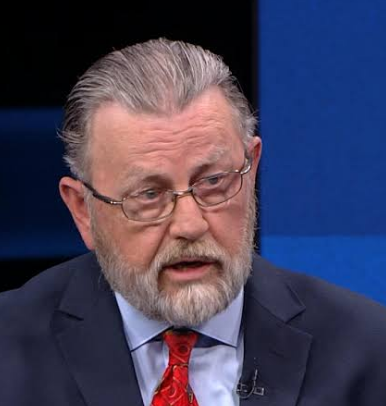
“I think the United States is doing the haka right now, without actually intending to follow through on it.”
Daniel Davis reads the same footage as the first. One more very large US-Israeli strike package, he said, "is an inevitability and it's going to have really bad implications," because Israel sees this as its last chance with Trump before the new Congress is seated in January, and Israel may be supplying the intelligence used to justify it.⁷ What he does not believe is that it can work. The targets that matter are under mountains: "Nothing we have can penetrate that. Not a JASSM, not a Tomahawk, not a MOAB, not one of the bunker busters that they talk about. Not a nuclear weapon."⁸ And Iran, he said, "will never surrender. They would be fools to do it."⁹ The bombs in the Arabian Sea are, in Davis's account, real and insufficient at once: a campaign that will happen and cannot reach what it is for.
The question of what Iran does in return arrived the same day as an intelligence warning. CBS reported that the Director of National Intelligence, Jay Clayton, had told Marco Rubio in an unclassified memo that Iran has sharply increased its efforts to target US personnel abroad, with plots at advanced stages.¹⁰ The New York Times, following an Axios account of the memo, reported that US agencies put the threat to Americans in the region at its highest since February and believe Iran may have operatives inside the United States.¹¹ Davis was unmoved. "They have not struck an American base. They have not launched out anything. They've not assassinated," he said, and if Iran has not acted by now, with the midterms ten days off, he doubts it will, since there would be little to gain.¹² ¹³
Joe Kent, who served at the National Counterterrorism Center, takes the warning seriously and still thinks it points the wrong way. "I think we'd be fools to think that Iran wouldn't target our officials," he said, but he does not expect Tehran to spend its resources that way: "I think they're going to go with what's going to be the most effective in the long run for them."¹⁴ ¹⁵ What is effective, in his view, is economic. "Why wouldn't they hit Gulf energy infrastructure? Why wouldn't they sever internet cables?"¹⁶ That is the list Iran itself put out on Friday, with Dimona added and Brent at $117, and the pain it inflicts lands on American pump prices rather than on American officials. Kent attaches one condition: if Trump escalates "in a meaningful way" with Iran's back against the wall, an operation against US officials becomes something Iran "would attempt."¹⁷ On a deal he is flat. "He wants a deal and he's not going to get it," because Iran does not trust Trump and could not sell an agreement at home if it did.¹⁸ "I'm hoping he walks away. I don't think he will."¹⁹
Chas Freeman supplies the one piece of evidence neither side disputes, Trump's own stated timetable. "When Donald Trump says he won't do something until the given time, one is immediately suspicious that that is a deception and that in fact it indicates he does intend to do something before that time. So I think we're going to watch this weekend with considerable interest."²⁰ Israel votes on Tuesday 27 October, the US midterms follow a week later, and in Freeman's account the cost of a resumed war "is going to fall heavily on Israel as well as the Gulf Arabs," while regime change in Iran is "not a feasible" objective in the first place.²¹
Ramzy Baroud takes the argument one step past feasibility. Another round, he said, does not merely fail; it strengthens the target. "Anything that they are going to do is not going to change the outcome. There will be a new Middle East. Iran is going to be a powerful player in the Middle East."²² The Gulf states, in his forecast, "are going to realize that Israel and the US are incapable of protecting them," which is one way to read Egypt's deliberation over Saudi Arabia and the Doha-led pact of Indonesia, Pakistan, Qatar and Turkey that Freeman described forming beside the Mecca alliance.²³ ²
Put the readings side by side and the disagreement is narrower than it sounds. Johnson's performance and Davis's inevitability share a premise: the bombs on the deck cannot deliver the outcome they are meant to threaten. Davis says nothing in the inventory can reach the sites that matter, and Johnson's judgment on Saturday was that Saudi Arabia could not sustain another air campaign of the length of the one that ended on 10 April.²⁴ The deeper cause is the one Johnson named when he turned from the carrier to the economy. With Brent at $116.72 and Dow futures down more than 600 points after Friday's 517-point fall, he rejected the Treasury Secretary's claim that Gulf exports had recovered with his own figures from Fujairah: "while the Emiratis may have recovered some of their crude exports, everything else is gone. It's been broken."²⁵ Davis made the parallel case from the price of oil, WTI near $103 against roughly $66 before the war, and a Hormuz standoff that keeps pushing the world "into recession territory" whether or not the war restarts.²⁶ "Donald Trump is facing a global economic crisis," Johnson said, "and instead of dealing with that crisis he's trying to bully Iran."²⁷ That is what the five readings share beneath the disagreement about intent: a government with a strait it cannot reopen, a deal it cannot get and a campaign it cannot finish, loading the one thing it can still be seen to do.

Kiev's lights at Russia's discretion, and 719 proofs from a machine China may not use
Russian strikes this week hit the Zaporozhye bridge to Khortitsa island and generating plants in Kiev that city officials say are damaged beyond quick repair, and Alexander Mercouris reads the two together as a softening-up of both cities ahead of a later ground offensive. "The Russians are now able to switch off the electric power to Kiev whenever they choose," he said, adding that Marco Rubio's framing of the war as a question of Donbass alone is already out of date.²⁸
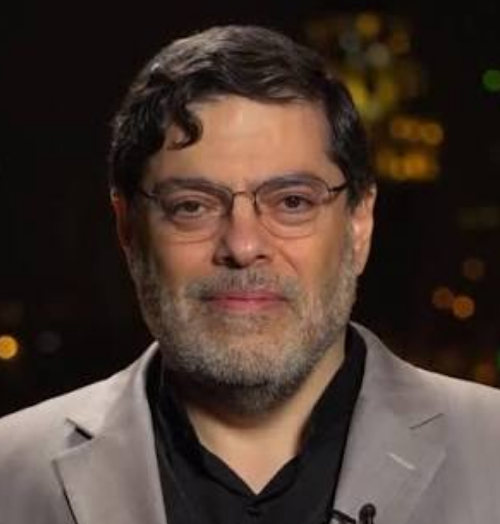
The other item of the day concerns a weapon of a different kind. On 6 October OpenAI announced that an internal model had produced 722 mathematical manuscripts covering 372 research results on open problems; three were withdrawn the next day, leaving an official count of 719, and some of the proofs can be checked automatically with the Lean proof checker.²⁹ Babak Haghighat, a mathematician based in China, told Pascal Lottaz on Neutrality Studies what the best of them amount to once they withstand checking: "if a mathematician had done that, this would be a straight Fields Medal."³⁰ The model is unreleased, so American mathematicians cannot use it either, but the asymmetry he described runs one way. US law and company policy bar users in China from frontier American models, and the Chinese models, about a hundred times cheaper by API and often open source, are built for coding rather than research mathematics and are not, he said, at this level.³⁰ A researcher in China is left to choose between not using the frontier models and ceasing to compete, and the gap compounds, since better control of mathematics builds better models, which build better mathematics: "even a 6-month period is not a small thing."³¹ "Mathematics has always been a public good," Haghighat said, and "if you want to take a public good such as mathematics and give a small number of private interests control over it, you turn this public good basically into private capital."³² ³³ Lottaz supplied the conclusion that ties it to the rest of the day's news: "the one thing we can be absolutely certain of is that the United States will use any technology it has immediately in the realm of its military."³⁴ A mathematician in China can read all 719 manuscripts; what he will not be allowed to do, under American law and company policy, is ask the model for the 720th.
Sources
- Wall Street Journal, as read on Dialogue Works · the USS George Washington strike group in the Arabian Sea is loading standoff land-attack missiles and bunker-buster bombs, with reports of a shorter, more intense US-Israeli campaign plan · watch ▶
- Chas Freeman, Glenn Diesen · the US is withdrawing forces from Persian Gulf bases while Egypt weighs sending troops to defend Saudi Arabia and a Doha-led pact of Indonesia, Pakistan, Qatar and Turkey forms beside the Mecca alliance · watch ▶
- Larry Johnson, Dialogue Works · "they're giving the press operational information that could be used to defeat the US attack. Does that make sense to you? Not at all." · watch ▶ 1:32
- Larry Johnson, Dialogue Works · "I think the United States is doing the haka right now, without actually intending to follow through on it." · watch ▶ 5:57
- Larry Johnson, Dialogue Works · "the next 24 hours is the last period that Trump could try to do something"; a strike now would hit markets hard · watch ▶ 61:10
- Larry Johnson, Dialogue Works · after 3 November Trump will be at his weakest and "the last thing he'll want to do is start a new war" · watch ▶ 32:09
- Daniel Davis, Deep Dive · one more big US-Israeli strike "is an inevitability and it's going to have really bad implications"; Israel sees a last chance with Trump before the new Congress is seated and may be the source of the intelligence · watch ▶ 26:04
- Daniel Davis, Deep Dive · "Nothing we have can penetrate that. Not a JASSM, not a Tomahawk, not a MOAB, not one of the bunker busters that they talk about. Not a nuclear weapon." · watch ▶ 22:04
- Daniel Davis, Deep Dive · Iran "will never surrender. They would be fools to do it." · watch ▶ 12:03
- CBS, as read on Deep Dive · DNI Jay Clayton's unclassified memo to Rubio says Iran has sharply increased efforts to target US personnel abroad, with plots at advanced stages; State is adjusting staffing at Middle East posts · watch ▶
- New York Times, as read on Mario Nawfal · following an Axios account of the memo, US agencies believe the threat to Americans in the Middle East is the highest since February and Iran may have operatives inside the US · watch ▶
- Daniel Davis, Deep Dive · "They have not struck an American base. They have not launched out anything. They've not assassinated." · watch ▶ 8:00
- Daniel Davis, Deep Dive · if Iran has not carried out a plot by now it probably will not before the midterms, "because there wouldn't be a lot of gain there" · watch ▶ 9:26
- Joe Kent, Mario Nawfal · "I think we'd be fools to think that Iran wouldn't target our officials." · watch ▶ 12:22
- Joe Kent, Mario Nawfal · Iran will not dedicate resources to assassinating a US official: "they're going to go with what's going to be the most effective in the long run for them" · watch ▶ 14:21
- Joe Kent, Mario Nawfal · "why wouldn't they hit Gulf energy infrastructure? Why wouldn't they sever internet cables?" · watch ▶ 13:38
- Joe Kent, Mario Nawfal · if Trump escalates "in a meaningful way" with Iran's back against the wall, Iran would attempt an operation against US officials · watch ▶ 18:28
- Joe Kent, Mario Nawfal · "he wants a deal and he's not going to get it. The Iranians have basically said that because I think the Iranians don't trust him" · watch ▶ 23:51
- Joe Kent, Mario Nawfal · "I'm hoping he walks away. I don't think he will." · watch ▶ 24:15
- Chas Freeman, Glenn Diesen · "when Donald Trump says he won't do something until the given time, one is immediately suspicious that that is a deception"; "we're going to watch this weekend with considerable interest" · watch ▶ 41:19
- Chas Freeman, Glenn Diesen · regime change in Iran is "not a feasible" objective and "the cost of a resumed war is going to fall heavily on Israel as well as the Gulf Arabs" · watch ▶ 36:35
- Ramzy Baroud, Danny Haiphong · "Anything that they are going to do is not going to change the outcome. There will be a new Middle East. Iran is going to be a powerful player in the Middle East." · watch ▶ 40:32
- Ramzy Baroud, Danny Haiphong · "I think Gulf countries are going to realize that Israel and the US are incapable of protecting them." · watch ▶ 40:38
- Larry Johnson, Dialogue Works · Saudi Arabia cannot sustain another air campaign like the one from 28 February to 10 April · watch ▶ 54:46
- Larry Johnson, Dialogue Works · disputes Scott Bessent's claim that Gulf exports have passed pre-war levels, citing Fujairah refined-product stocks down sharply; Brent shown at 116.72 and Dow futures down more than 600 points after Friday's 517-point drop: "while the Emiratis may have recovered some of their crude exports, everything else is gone. It's been broken." · watch ▶ 16:03
- Daniel Davis, Deep Dive · WTI near $103 against about $66 before the war; the Hormuz status quo "is going to be pushing us more and more, even if the war doesn't restart, into recession territory" · watch ▶ 18:12
- Larry Johnson, Dialogue Works · "Donald Trump is facing a global economic crisis and instead of dealing with that crisis he's trying to bully Iran." · watch ▶ 48:56
- Alexander Mercouris, Alexander Mercouris · strikes on the Zaporozhye bridge to Khortitsa and Kiev's generating plants read as softening up both cities for a later offensive: "the Russians are now able to switch off the electric power to Kiev whenever they choose." · watch ▶ 35:03
- Babak Haghighat, Neutrality Studies · "on October the 6th of this year... there was an announcement by the company OpenAI where they published 722 mathematical manuscripts covering 372 research results"; three were withdrawn the next day, leaving 719, some checkable with the Lean proof checker · watch ▶ 0:58
- Babak Haghighat, Neutrality Studies · on the best of the results once they withstand checking: "if a mathematician had done that, this would be a straight Fields Medal"; the Chinese models are not at this level · watch ▶ 6:58
- Babak Haghighat, Neutrality Studies · better mathematical control builds better models, which build better mathematics, so "even a 6-month period is not a small thing" · watch ▶ 14:32
- Babak Haghighat, Neutrality Studies · "mathematics has always been a public good" · watch ▶ 15:12
- Babak Haghighat, Neutrality Studies · "if you want to take a public good such as mathematics and give a small number of private interests control over it, you turn this public good basically into private capital." · watch ▶ 46:55
- Pascal Lottaz, Neutrality Studies · "the one thing we can be absolutely certain of is that the United States will use any technology it has immediately in the realm of its military." · watch ▶ 17:32
By Ruins Report, a daily synthesis of what our tracked analysts said, not original reporting. Every numbered claim is sourced, dated, and timestamped above.
Newsletter
Get the Daily Debrief
One email each morning: what the analysts we track actually said, and every call timestamped to its source. Free.
Free. No spam. View on Substack →
Support the Report
Free to read, every day.
The Debrief is compiled each morning from what the analysts we track actually said, sourced and timestamped. No paywall, no ads, no investors. If it earns a place in your inbox, you can help keep it independent.
Support the report →