
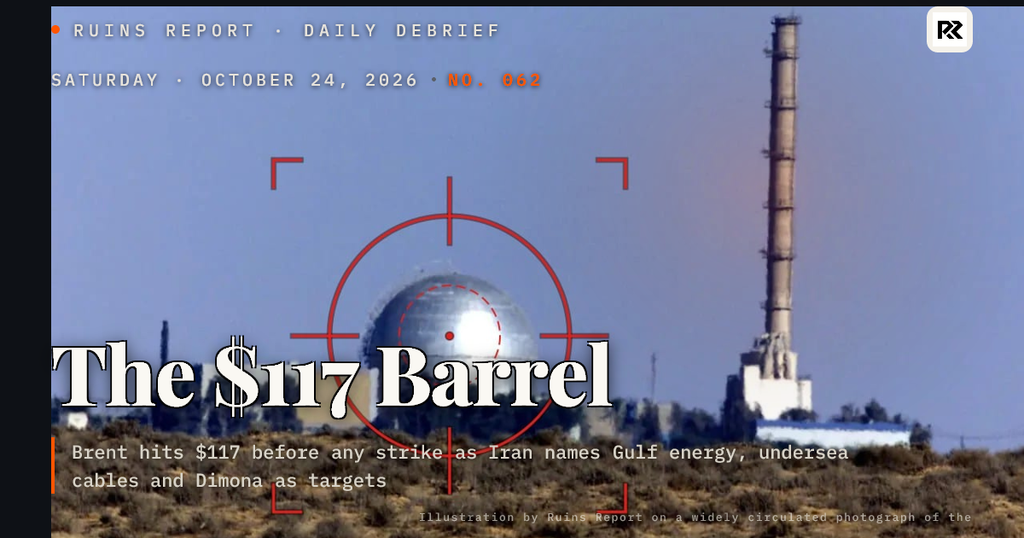
Brent crude went from $111 to $117 overnight into Friday 23 October without a single new strike on Iran to explain it, and on the same day Reuters reported that Iran has detailed plans to cut the underwater internet cables of the Persian Gulf if the war with the United States resumes.¹ The market, in other words, has started paying for the next round before it begins. What moved it was not a bomb but a list. Over the week Iran's side set out, through official channels and semi-official ones, what it would hit if the United States and Israel come back: the energy infrastructure of the Gulf states, the cables that carry the region's finance and communications under the water, and the Israeli reactor at Dimona. Daniel Davis put the asymmetry in one sentence: "whereas we don't have anything new to hit, they do."²
The question the price raises is the one Washington has so far managed to avoid. The argument over whether the strike comes this weekend or after the 3 November midterms treats the date as the decision. With oil at $117 before a shot is fired, the harder question is what a renewed round would cost the world economy, and whether that bill, rather than the date, is the real constraint on the United States.
Start with what the current round already costs, because Sal Mercogliano has the numbers and they cut in both directions. In week 33 of the Hormuz conflict, Gulf oil shipping costs have topped $37 a barrel, "five times the pre-war level," with tanker rates to East Asia running at $1.4 million to $1.6 million a day and global storage sitting below its ten-year range.³ "As of October 23rd that we're filming this, Straight of Hormuz is disrupted," he said. "We don't have a reliable commercial waterway. It is contested."⁴ That is the bill the world is already paying, and it is why a $111 barrel was the floor rather than a spike.
But Mercogliano is also the sober counterweight to the scare, and the piece would be dishonest without him. The American blockade, he says, "especially since it's been restarted in mid July, has been extremely effective"; the Iranian tankers at sea are nearly empty, so that "basically Iran has no more oil afloat which means it can't generate any more revenue."⁵ ⁶ Oil is still leaving the region, about 14.24 million barrels a day between 22 September and 19 October by the Tanker Trackers figures he cited, with 10.92 million of that through Hormuz itself and the Saudi Red Sea loadings at Yanbu back near 4 million barrels a day.⁴ And on the mines Iran claims to have laid, he has seen none; the one tanker hit near Sharjah on 9 October took a single drone and had its fire out in two or three minutes. "We know ships are being attacked. There's no question about that. The question is the extent of damage being done."⁷ On his evidence the strait is contested but not closed, and Iran is being squeezed harder than the Gulf is.
So the $117 barrel is not pricing today's shortage. It is pricing the list. That is the thesis the day's analysts converged on from different directions: the constraint on Washington is not when it can strike but what a strike would cost, and the cost has already begun to arrive.

Chas Freeman does the arithmetic over the longest horizon. If the energy infrastructure of Iran and the Gulf is hit, and he points to Ansar Allah's strikes this week on the Saudi east-west pipeline and on Aramco's Dhahran and Abqaiq facilities as the template, "we're talking about 5 to 7 years at least of very inflated energy prices."⁸ Europe faces the first installment this winter: "this is going to be a very bad winter. They do not have the natural gas that they need."⁹ And the bill is not only economic. Freeman expects the Gulf states that host American bases not to want them back: "when this war is over there will be no American military presence in the Persian Gulf because the countries that have hosted that presence will not want to host it again."¹⁰

“when this war is over there will be no American military presence in the Persian Gulf because the countries that have hosted that presence will not want to host it again.”
Michael Hudson goes further than inflation. "Trump is anticipating to go to war with Iran in the Persian Gulf," he said, and a Gulf oil cutoff, in his reading, would produce not a price shock but a multi-year world depression, landing on a United States that is financialized, uncompetitive and the world's largest official debtor.¹¹ He places the war inside a larger pattern: "You're having what seemed to be the last gasp of America trying to maintain its world empire and its military spending abroad."¹² Davis reaches the same conclusion by a shorter route. Iran, he argued, "and many people are going to find this hard to believe, but the evidence is overwhelming, has been pretty restrained in how it's responded to every round so far," and the next round would end that restraint against Gulf and Israeli energy and the undersea cables, gutting the global economy and the Hormuz oil flow together.¹³ His summary of the American position: "I see every every everything to lose, Clayton, and absolutely nothing to gain."¹⁴
Stephen Semler brings the bill home to the voter who will decide the midterms. "It's the most unpopular war since polling began," he said; by the Economist/YouGov series he cites, net support for the Iran war started at minus 13 and now stands at minus 35, and it has only grown more unpopular over time.¹⁵ A Moody's analysis he cited puts the war's cost to the average household at about $2,000 through inflation and fuel prices, and cost of living is the top issue for voters.¹⁶ The $1.1 trillion military budget that pays for it, he noted, "exceeds, adjusted for inflation, the average amount the US spent on its military each year from 1942 to 1945 by about 90 billion."¹⁷
Put the pieces together and the shape of the day is clear. Mercogliano's data say the blockade is working and the strait, though contested, is still moving oil; the price is not panic over what has happened. Freeman, Hudson, Davis and Semler say it is a forecast of what the target list implies: years of expensive energy, a bad European winter, a depression in the worst case, and an electorate already paying $2,000 a household for a war it dislikes more than any before it. Whether a strike comes this weekend or after 3 November, with embassy families already out of the Gulf, Washington is deciding against a bill that is already on the table: $37 a barrel to move Gulf oil, a strait with no reliable commercial waterway at week 33, and a $2,000 household cost that the voters of 3 November are already paying. Another round would add the Gulf's power grids, its undersea cables and Dimona to that account, and that, more than any date, is what the United States has to weigh.



Slaviansk empties as Putin rejects the buffer plan, and carriers a thousand miles out
The Economist's leak of the Witkoff and European plan for the Donbas, a demilitarized zone around Slaviansk and Kramatorsk with Ukraine inside the EU and outside NATO, met a flat rejection from Putin, and Alexander Mercouris said the response should surprise no one: "Anybody who is looking or expecting the Russians to shift on this position is whistling into the wind."¹⁸ The Ukrainian authorities, meanwhile, have ordered the evacuation of both cities. Dmitry Polyanskiy, the Russian diplomat, set out the sequence Moscow will accept and the one it will not: no ceasefire before a settlement roadmap, because a pause would hand Kiev "this breathing space that they desperately need," with trilateral talks expected in mid-November.¹⁹
John Mearsheimer drew a lesson from the Iran war for the Pacific. The American carriers had to stand about a thousand miles off Iran to stay out of range, and against an adversary with far deeper reach the problem compounds: "if you're planning a containment strategy against China, I think aircraft carriers are basically useless."²⁰
Sources
- Reuters, as read on Dialogue Works · Iran has detailed plans to target underwater internet cables in the Persian Gulf if war with the US resumes; Brent rose from 111 to 117 overnight · watch ▶
- Daniel Davis, Redacted · "whereas we don't have anything new to hit, they do." · watch ▶ 14:51
- Sal Mercogliano, What's Going on With Shipping? · "Gulf oil shipping costs topped $37 a barrel... That is five times the pre-war level." · watch ▶ 24:57
- Sal Mercogliano, What's Going on With Shipping? · "As of October 23rd that we're filming this, Straight of Hormuz is disrupted... we don't have a reliable commercial waterway... It is contested." · watch ▶ 25:59
- Sal Mercogliano, What's Going on With Shipping? · "The US blockade, especially since it's been restarted in mid July, has been extremely effective." · watch ▶ 12:29
- Sal Mercogliano, What's Going on With Shipping? · "So basically Iran has no more oil afloat which means it can't generate any more revenue." · watch ▶ 14:04
- Sal Mercogliano, What's Going on With Shipping? · "We know ships are being attacked. There's no question about that. The question is the extent of damage being done" · watch ▶ 3:13
- Chas Freeman, Dialogue Works · "we're talking about 5 to 7 years at least of very inflated energy prices." · watch ▶ 12:51
- Chas Freeman, Dialogue Works · "this is going to be a very bad winter. They do not have the natural gas that they need" · watch ▶ 16:21
- Chas Freeman, Dialogue Works · "when this war is over there will be no American military presence in the Persian Gulf because the countries that have hosted that presence will not want to host it again." · watch ▶ 20:27
- Michael Hudson, Glenn Diesen · "Trump is anticipating to go to war with Iran in the Persian Gulf."; a Gulf oil cutoff would cause a multi-year world depression · watch ▶ 1:24
- Michael Hudson, Glenn Diesen · "You're having what seemed to be the last gasp of America trying to maintain its world empire and its military spending abroad." · watch ▶ 38:40
- Daniel Davis, Redacted · Iran "has been pretty restrained in how it's responded to every round so far"; strikes on Gulf and Israeli energy and undersea cables would gut the global economy · watch ▶ 13:12
- Daniel Davis, Redacted · "I see every every everything to lose, Clayton, and absolutely nothing to gain." · watch ▶ 15:19
- Stephen Semler, Tucker Carlson · "It's the most unpopular war since polling began."; Economist/YouGov net support from -13 to -35 · watch ▶ 0:49
- Stephen Semler, Tucker Carlson · Moody's analysis: the war cost the average household about $2,000; cost of living is the top voter issue · watch ▶ 32:43
- Stephen Semler, Tucker Carlson · The $1.1 trillion budget "exceeds, adjusted for inflation, the average amount the US spent on its military each year from 1942 to 1945 by about 90 billion." · watch ▶ 43:31
- Alexander Mercouris, Alexander Mercouris · "Anybody who is looking or expecting the Russians to shift on this position is whistling into the wind." · watch ▶ 15:26
- Dmitry Polyanskiy, Daniel Davis / Deep Dive · No ceasefire before a settlement roadmap; a pause would give Kiev "this breathing space that they desperately need" · watch ▶ 27:59
- John Mearsheimer, John Mearsheimer · "if you're planning a containment strategy against China, I think aircraft carriers are basically useless" · watch ▶ 4:50
By Ruins Report, a daily synthesis of what our tracked analysts said, not original reporting. Every numbered claim is sourced, dated, and timestamped above.
Newsletter
Get the Daily Debrief
One email each morning: what the analysts we track actually said, and every call timestamped to its source. Free.
Free. No spam. View on Substack →
Support the Report
Free to read, every day.
The Debrief is compiled each morning from what the analysts we track actually said, sourced and timestamped. No paywall, no ads, no investors. If it earns a place in your inbox, you can help keep it independent.
Support the report →