
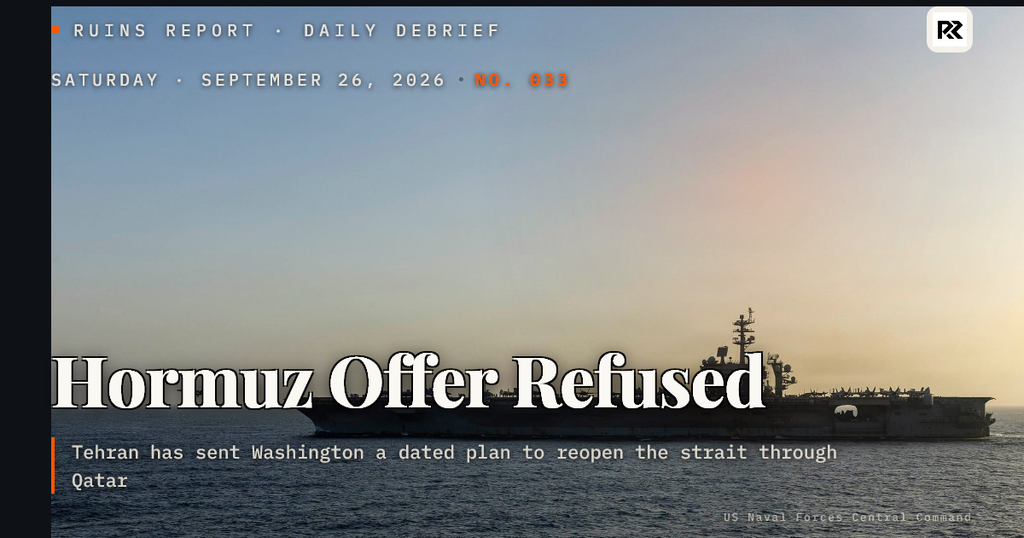
On 25 September, Iran's foreign minister, Abbas Araghchi, said Tehran had "conveyed to the United States through Qatar a concrete 7-day plan" under which, if the conditions are met, "the strait can be reopened and normal maritime passage restored within 7 days," and that "the choice now rests with the United States."¹ Washington's answer came the same day, by way of the Wall Street Journal: President Trump has rejected the proposed seven-day ceasefire, has privately told aides he expects to resume bombing Iran after the November midterms, and has told Iran and the mediators that he has no intention of ending the blockade.² The United States, which says it wants the Strait of Hormuz open, has declined the first dated offer to open it.
The plan is narrower than the word "ceasefire" suggests. As Araghchi laid it out in the clip Nima Alkhorshid played on Dialogue Works, the American steps required "can be taken in four five days," so that "in day six the strait will be open and on day seven the talks with the US will be started for the final deal"; those steps, he said, "are already under the commitments of the United States" in the earlier memorandum of understanding.¹ Nima summarised Iran's terms as three: lift the blockade, unfreeze Iranian assets, end the war on every front including Lebanon.¹ Chas Freeman said the arrangement was negotiated with the Omanis and has not yet been endorsed by the Gulf Cooperation Council, and that "the end of the American blockade is indeed the principal condition for the opening of the strait."³ Iran will open Hormuz when the blockade lifts. Washington will not lift the blockade.
The reasoning behind the refusal, as the Journal reported it and Nima read it out, is that Trump wants the nuclear file settled first and believes continued economic pressure will force Tehran to accept his terms, with indirect talks continuing through Qatar and Pakistan in the meantime.⁴ The specific demand, as Nima described it, is reportedly that roughly 400 to 450 kilograms of enriched uranium be physically shipped to the United States, and on that he was categorical: "they're not going to send it to the United States. It's impossible. Zero."⁵ His broader objection was to the theory of pressure itself: "the more you put pressure on someone the harder it gets. This is the reality of the human being."⁶ Freeman, on the same programme, reached the same place from the other end: "I see no evidence that Donald Trump is in a mood to compromise."⁷ Larry Johnson, asked on Judging Freedom whether the post-midterm plan amounts to an invasion, pointed to the absence of any troop build-up and said Trump "may try some more air strikes, but that already has proven to be a fruitless, feckless effort."⁸
What holding the blockade buys, then, is time and leverage that none of these analysts believe will convert into the uranium. What it costs is measured first in the Gulf. The Journal also reported that Saudi Arabia and the United Arab Emirates are urging Washington to keep the sanctions and the blockade rather than offer Iran concessions, while Qatar and Oman push for renewed talks and a phased reopening. Freeman called that "a very accurate report," and explained it by the UAE's part in the war and its alignment with Israel through the Abraham Accords, and by a Saudi leadership that is desperate, has asked the United States, Egypt, Turkey, Pakistan and Europe for help without a positive response, and is influenced by Israel.⁹ Nima added that a planned meeting in Oman between the GCC states and Iran had been cancelled, reportedly by Riyadh, and that the army chiefs of Turkey, Pakistan and Saudi Arabia had met in emergency session in Riyadh.¹⁰ Patrick Henningsen was blunt about what those chiefs command: "There is no Saudi military. It's the US military with Saudi flags painted on the planes."¹¹
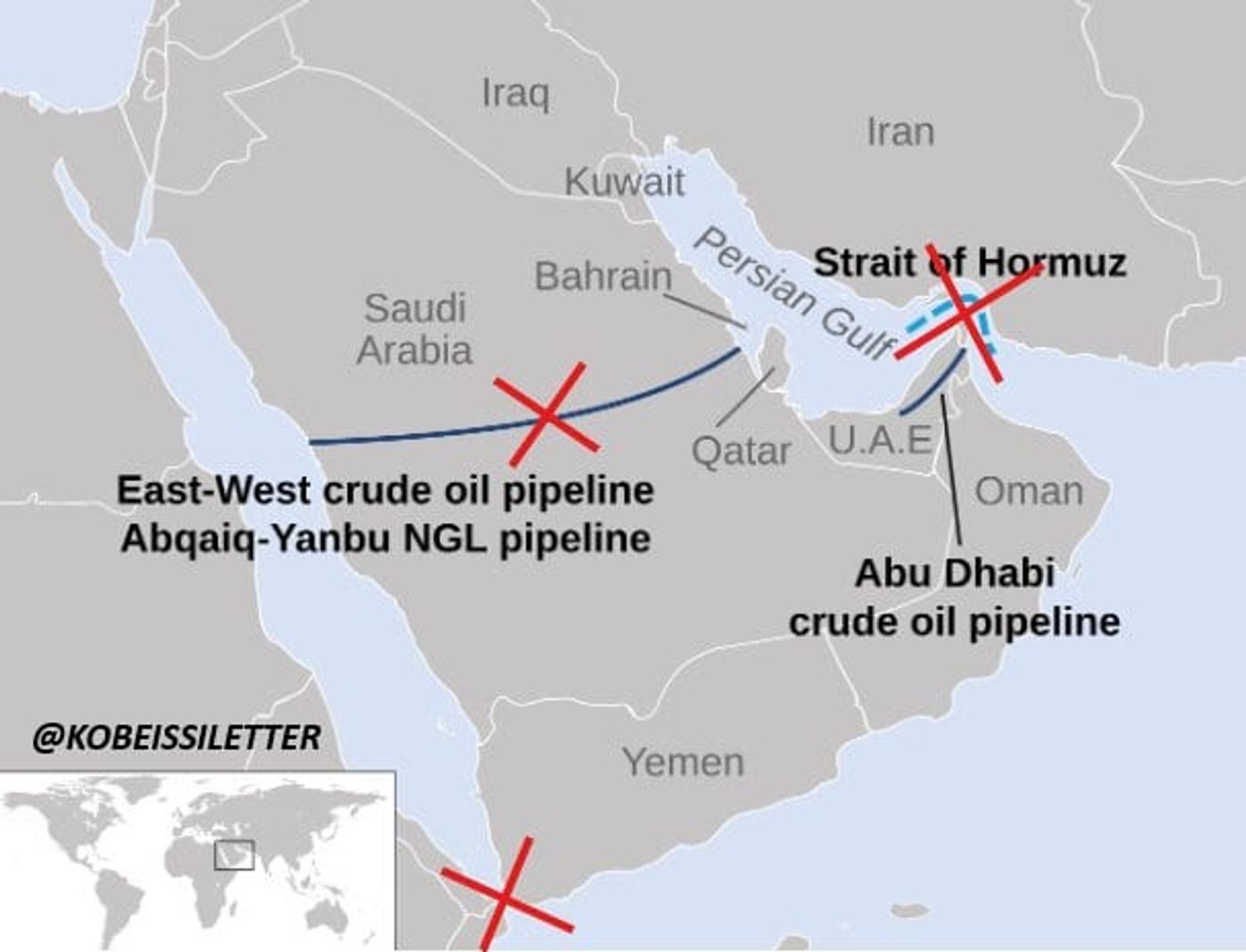
Freeman's case is that Riyadh's position defeats itself. Saudi Arabia, he said, "needs a mediator to restore a relationship with Ansar Allah that both can live with and the only mediator I can think of under current circumstances is Iran. So to argue for the continuation of maximum pressure on Iran in this circumstance seems to me to be rather shortsighted."¹² The Yemen front is already contracting: Nima counted Saudi air strikes falling from 57 a day on 13 September to 14 or 16 in the latest 24 hours.¹³ Henningsen's projection was that if the Yemen war runs another year at this pace, Saudi Arabia will be unable to defend its own territory,¹⁴ and his message to the Gulf capitals was the one Tehran has been sending through Doha: "Iran's not your enemy. That's what the Gulf needs to understand."¹⁵ Freeman put the change in Washington's role in a single line: "The United States has changed from a protector into a predator."¹⁶
The second cost is at sea, and Sal Mercogliano spent his programme on it. The bulker Cape Dao, carrying coal, was struck in the strait; one Indian crew member was killed and others wounded, in what he called one of the deadliest months of the seven-month conflict.¹⁷ Traffic through Hormuz, on the UK Maritime Trade Operations figures he read out, remains roughly 75 percent below its pre-conflict level.¹⁸ His reply to the Treasury secretary's suggestion that ships simply sail on is the line of the day.

“They don't just sail on, Secretary Bessent. They get hit. They get caught on fire. Crew members get killed, wounded. This is not just sailing on. This is war.”
"I don't think the Trump administration understood what they were doing regards to global shipping," Mercogliano said,¹⁹ and he put a number on the cushion that is running out: shoreside oil stocks are "heading toward 3 billion barrels stored ashore. The lowest level we've seen over the past 10 years."²⁰ Freeman drew the price from the same fact. Oil, he said, is "headed for $130 a barrel, which is way above where they have been even during this war, because we have run out of stored oil" with which to moderate the market.²¹
The third cost is the calendar, which Iran now controls. Pepe Escobar reported that the Supreme National Security Council has set a deadline of "next Wednesday, September 30th," for the blockade to be lifted, after which Iran goes on the offensive, and his own expectation is that the war then spreads into the Indian Ocean.²² Nima's version is narrower and earlier: if the blockade holds, Iran may strike it pre-emptively before the midterms rather than wait for the bombing the Journal says is coming after them.²³ Escobar also reported that Xi Jinping handed Trump an offramp at their summit, go back to the memorandum, go back to diplomacy, and the strait reopens, with Taiwan the only red line Xi drew,²⁴ and that "China will be supporting Iran from now on even more than they have been supporting so far."²⁵ The offramp is the same one Araghchi described through Qatar. Escobar's scenario one, if it is not taken, is "an attack by land, air, and sea next months."²⁶ Freeman does not think the last round's damage can be undone: "I don't think there is any possibility that the bases will be rebuilt."²⁷
The analysts we track do not disagree about the mechanism. Washington is holding a blockade to extract a concession Iran will not make, on behalf of Gulf clients it can no longer defend, at a cost in ships, crews and stored oil that rises every week, against a deadline set in Tehran rather than Washington. Iran has named the day it opens the strait. The United States has named the month it resumes bombing.
Dobropolye and Greenland
Ukraine's economy. Alexander Mercouris reported that "for the first time in a hundred years, a century which included the Second World War, steel production in Ukraine has stopped entirely,"²⁸ and that on the front "we are actually looking at a formal siege of Dobropolye, a situation whose closest analog in this war is Mariupol in 2022."²⁹ Gilbert Doctorow took the same reading to the budget on Judging Freedom: "I don't see how Ukraine can survive whatever lack of financial support that it desperately would need in two months time when the budget money runs out,"³⁰ and, on the state itself, "I don't think that they will see the spring."³¹
Greenland. Trump announced a Greenland security deal with Denmark, brokered by NATO's Mark Rutte after other European governments pressed Copenhagen to concede. Mercouris, on The Duran, read the text as confirmation rather than compromise: "The actual deal in effect gives the US military control of Greenland in exactly the way that we said,"³² and "the Danes in effect sold the Greenlanders out."³³ His hedged forecast is that if the United States ever withdraws into its own sphere of influence, "then they will simply annex Greenland."³⁴
Sources
- Abbas Araghchi, via Nima Alkhorshid, Dialogue Works · Iran has conveyed to the US through Qatar a concrete seven-day plan; the strait open by day six, talks on day seven; "the choice now rests with the United States" · watch ▶ 0:56
- Wall Street Journal, read by Nima Alkhorshid, Dialogue Works · Trump rejected the seven-day ceasefire, expects to resume bombing after the midterms, and has "no intention of ending the blockade" · watch ▶ 3:45
- Chas Freeman, Glenn Diesen · The Omani-negotiated arrangement is not yet endorsed by the GCC; "the end of the American blockade is indeed the principal condition for the opening of the strait" · watch ▶ 1:41
- Wall Street Journal, read by Nima Alkhorshid, Dialogue Works · Trump wants the nuclear file settled first and believes economic pressure will force Iran to accept; indirect talks continue through Qatar and Pakistan · watch ▶ 6:01
- Nima Alkhorshid, Dialogue Works · On shipping 400 to 450 kg of enriched uranium to the US: "It's impossible. Zero." · watch ▶ 18:14
- Nima Alkhorshid, Dialogue Works · "the more you put pressure on someone the harder it gets. This is the reality of the human being." · watch ▶ 37:29
- Chas Freeman, Dialogue Works · "I see no evidence that Donald Trump is in a mood to compromise." · watch ▶ 20:20
- Larry Johnson, Judging Freedom · No troop build-up for an invasion; more air strikes would be "a fruitless, feckless effort" · watch ▶ 15:28
- Chas Freeman, Dialogue Works · The WSJ report that Saudi Arabia and the UAE want the blockade kept while Qatar and Oman push for talks "sounds like a very accurate report" · watch ▶ 21:11
- Nima Alkhorshid, Dialogue Works · GCC-Iran meeting in Oman cancelled, reportedly by Saudi Arabia; Turkish, Pakistani and Saudi army chiefs meet in Riyadh · watch ▶ 6:58
- Patrick Henningsen, Dialogue Works · "There is no Saudi military. It's the US military with Saudi flags painted on the planes." · watch ▶ 9:43
- Chas Freeman, Dialogue Works · Saudi Arabia needs Iran as the mediator with Ansar Allah, so maximum pressure on Iran is "rather shortsighted" · watch ▶ 22:53
- Nima Alkhorshid, Dialogue Works · Saudi air strikes on Yemen down from 57 a day on 13 September to 14 or 16 in the last 24 hours · watch ▶ 22:18
- Patrick Henningsen, Dialogue Works · Another year of the Yemen war at this pace leaves Saudi Arabia unable to defend its own territory · watch ▶ 41:42
- Patrick Henningsen, Dialogue Works · "Iran's not your enemy. That's what the Gulf needs to understand." · watch ▶ 56:30
- Chas Freeman, Glenn Diesen · "The United States has changed from a protector into a predator." · watch ▶ 23:15
- Sal Mercogliano, What's Going on With Shipping? · The bulker Cape Dao struck in Hormuz, one Indian crew member killed; September among the deadliest months of the war · watch ▶ 0:31
- Sal Mercogliano, What's Going on With Shipping? · UKMTO weekly figures: Hormuz traffic roughly 75 percent below pre-conflict levels · watch ▶ 5:50
- Sal Mercogliano, What's Going on With Shipping? · "I don't think the Trump administration understood what they were doing regards to global shipping." · watch ▶ 15:16
- Sal Mercogliano, What's Going on With Shipping? · Shoreside oil stocks "heading toward 3 billion barrels stored ashore. The lowest level we've seen over the past 10 years." · watch ▶ 25:11
- Chas Freeman, Dialogue Works · Oil "headed for $130 a barrel" because the stored oil used to moderate prices has run out · watch ▶ 7:29
- Pepe Escobar, Judging Freedom · Iran's Supreme National Security Council sets 30 September as the deadline for lifting the blockade; after that Iran goes on the offensive, possibly into the Indian Ocean · watch ▶ 19:38
- Nima Alkhorshid, Dialogue Works · If the blockade is not lifted, Iran may launch a pre-emptive attack on it before the midterms · watch ▶ 38:48
- Pepe Escobar, Judging Freedom · Xi told Trump he had an offramp on Iran: back to the memorandum and diplomacy, and the strait reopens; Taiwan the only red line · watch ▶ 3:06
- Pepe Escobar, Judging Freedom · "China will be supporting Iran from now on even more than they have been supporting so far." · watch ▶ 25:49
- Pepe Escobar, Judging Freedom · "It will be an attack by land, air, and sea next months. That's scenario number one" · watch ▶ 24:28
- Chas Freeman, Glenn Diesen · "I don't think there is any possibility that the bases will be rebuilt" · watch ▶ 9:29
- Alexander Mercouris, Alexander Mercouris · For the first time in a hundred years, steel production in Ukraine has stopped entirely · watch ▶ 2:21
- Alexander Mercouris, Alexander Mercouris · "a formal siege of Dobropolye, a situation whose closest analog in this war is Mariupol in 2022" · watch ▶ 53:08
- Gilbert Doctorow, Judging Freedom · Ukraine cannot survive the loss of financial support when the budget money runs out in two months · watch ▶ 22:10
- Gilbert Doctorow, Judging Freedom · "I don't think that they will see the spring." · watch ▶ 22:43
- Alexander Mercouris, The Duran · "The actual deal in effect gives the US military control of Greenland in exactly the way that we said." · watch ▶ 1:02
- Alexander Mercouris, The Duran · "The Danes in effect sold the Greenlanders out." · watch ▶ 4:26
- Alexander Mercouris, The Duran · If the US ever withdraws into its own sphere of influence, "then they will simply annex Greenland" · watch ▶ 5:57
By Ruins Report, a daily synthesis of what our tracked analysts said, not original reporting. Every numbered claim is sourced, dated, and timestamped above.
Newsletter
Get the Daily Debrief
One email each morning: what the analysts we track actually said, and every call timestamped to its source. Free.
Free. No spam. View on Substack →
Support the Report
Free to read, every day.
The Debrief is compiled each morning from what the analysts we track actually said, sourced and timestamped. No paywall, no ads, no investors. If it earns a place in your inbox, you can help keep it independent.
Support the report →