
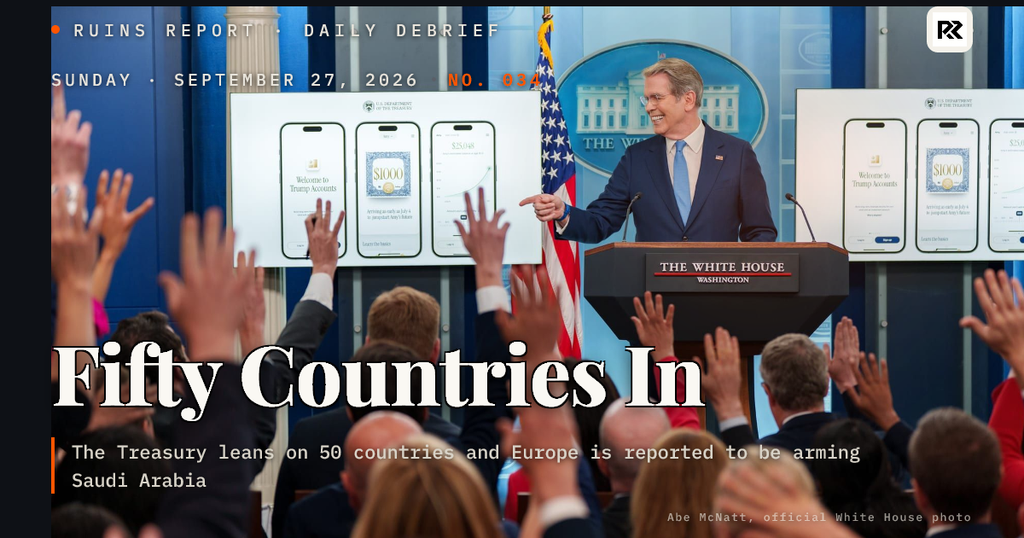
Having turned down Tehran's seven-day plan to reopen the Strait of Hormuz, Washington spent the next day widening the siege rather than rethinking it. The Wall Street Journal reported on 26 September that the Treasury Department has met with more than 50 countries to press them into severing aviation and banking ties with Iran, a campaign Nima Alkhorshid read aloud on Dialogue Works: "the Trump administration is intensifying its economic pressure on Iran. Pushing countries across the Middle East and Europe to sever aviation and banking ties with Tehran."¹ On the same day, Britain, France and Greece were reported to be sending refuelling tankers, air-defence systems and troops to Saudi Arabia for its war with Yemen's Ansar Allah,² and Saudi air strikes on Yemen went from 14 or 16 the day before to 27.³ The four analysts who took up the story on Dialogue Works, Steve Hanke, Larry Johnson, Mark Sleboda and Mohammad Marandi, arrived at one conclusion from four directions: a wider coalition cannot repair a blockade that is not working, and it places Europe on the Gulf's weakest flank.
A flight ban the flights ignore
The financial campaign is the part of the siege Washington can most easily count, and the Treasury Secretary has put a clock on it.
Johnson's objection is practical. The flight ban was meant to isolate Iran, and the Iranian flights to East Asia, Turkey, Russia and China have not been cancelled.⁴ "The United States is trying to isolate Iran with that flight ban and it's failing," he said. "Turkey initially implied that they would do it, but clearly they're not doing it."⁵ Bessent's bet that pressure brings Tehran to its knees he dismissed flatly: "Bessent's just been dead wrong, reflecting ignorance of the area."⁶ Beneath that is a structural claim: "the relationships with China and Russia supersede any sanctions that the United States can apply."⁷ The campaign is also generating friction where Washington least wants it. Alkhorshid reported protests in Baghdad and Basra on 26 September against the Arab embargo on Iran.⁸
Hanke reached the same verdict on the method. "You have various actors with a lot of ad hoc policies," he said. "They don't know what their next step is going to be because they don't really have a strategy and they don't have a plan to execute the strategy."⁹ He has a name for it: "It is chaotic because there is no strategy. There is no plan of executing on a strategy. It's what I call ad-hocracy. It's data-dependent."¹⁰
What the tankers say about Hormuz
The blockade the coalition is meant to reinforce is, on the shipping data, already tight, and that is not the good news it sounds. When Alkhorshid cited a figure of 40 million barrels leaving Hormuz the previous day, Hanke disputed it from the tracker he follows daily: by Kpler's count, no tankers went through Hormuz that day at all. "All the private trackers by the way have very very few ships going out of Hormuz."¹¹ His check is the price. If Iran were exporting near capacity, oil would be falling. "The oil price is staying up. It's not going down. It's staying up. And I think it's going to go up higher, by the way."¹²
Sleboda put numbers on the same point. Brent has been hovering just below $110, and Russian grades have been selling around $20 a barrel above the benchmark. "Russian oil is selling at a global premium right now," he said, an outcome of the war in West Asia that no sanctions designer intended.¹³ The instrument Washington has used to hold prices where they are is running out. "The strategic petroleum reserve continues to run down. There's another two or three months in it... at the rate that they are expending oil out to try to keep global oil prices from rising too high. But they can't keep that up for that much longer."¹⁴ He also relayed Iranian media reports, flagged as such, that the US naval vessels enforcing the blockade of Iranian ports have had to pull back beyond the Gulf of Oman.¹⁵ Alkhorshid noted that Iran's Persian Gulf shipping authority has issued a notice warning charterers off unapproved routes through the strait, citing the risk of financial losses and loss of life.¹⁶
Europe takes the Saudi flank
The second widening is military. Riyadh is asking for more of both: Alkhorshid relayed a report that Saudi Arabia wants Iran to face further economic pressure after attacks on Gulf shipping and growing threats to its Red Sea oil exports.¹⁷ Sleboda set out the ladder of European commitment. Britain's publicly acknowledged role is limited to refuelling, which he treats as a first step rather than a small one, since its purpose is "so that Saudi fighter aircraft can continue bombing Yemen for longer periods of time." France, he said, has gone further: the reported commitment involves troops, air-defence specialists and air-defence units, "actual French military troops being sent to Saudi Arabia to protect the dictatorship there, the kingdom."¹⁸ Greece was reported to be helping with air defence, after talks with the Israelis and the Americans.¹⁹ Marandi supplied the reason they are wanted: "last night there were reports of explosions in Riyadh and in Khamis Mushait, in the city of Abha as well, in the southwest of Saudi Arabia."²⁰ The Greek systems, he said, are already in the kingdom trying to defend it, France has signalled it has sent air defences, and Britain is providing the tankers.²
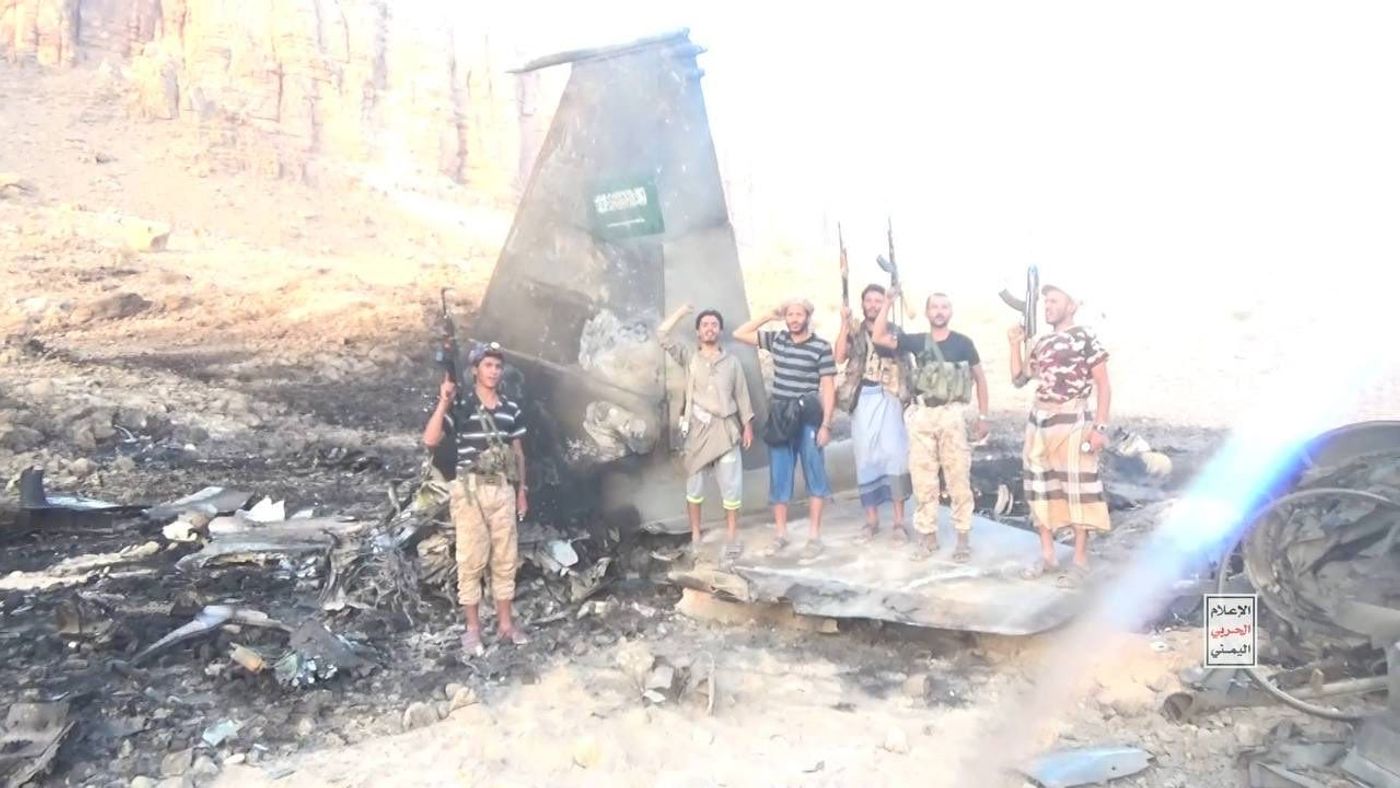
Johnson's assessment of the Greek Patriot batteries, reported by Foreign Policy, was that they change little. "There are hardly any missiles left. Patriot system is basically toast. It's irrelevant."²¹ "It looks like the Greeks got a good deal. They sold a system that's not really useful and the Saudis paid an expensive price for some junk."²² Sleboda's forecast for the Europeans stepping into a war with Ansar Allah was short: "I think they're going to come to deeply regret that."²³ Marandi cut at the coalition's founding assumption, that the Gulf monarchies are the side with staying power: "Iran will survive no doubt but these countries it's not clear if they will survive."²⁴ He counted some 25 American refuelling aircraft in Qatar a few days ago²⁵ and called Doha "just as complicit in this war of aggression as the Saudis and the Emiratis and the Kuwaitis and the Bahrainis and Jordan."²⁶ Hanke made the same point from the balance sheet. The UAE "had a business model... it was working pretty well until the war started. And now a lot of people are saying we really don't know if this is going to be viable going forward."²⁷
Before the midterms, not after
The one split of the day was over the calendar. The Journal's reporting places the next American escalation after the November midterms. Marandi disagreed: escalation comes "before midterm elections as things stand, I think escalation is not far off at all."²⁸ What it would look like he described without hedging. "If the United States goes and Trump goes after Iran's electrical power plants... the Iranians will retaliate and destroy everything on the other side of the Persian Gulf and those countries will collapse and then the global economy will collapse."²⁹ Sleboda drew the same line independently: "if they start going after Iranian infrastructure then Iran will just destroy all of the Arabs' energy infrastructure, not just damage it, destroy it."³⁰ He expects the war to outlast the calendar Washington is working to. "This conflict is not over and it could carry on well into next year and beyond."³¹
Widening a siege is what a government does when it cannot tighten one, and none of the four believed the additions on 26 September change the balance. Hanke's summary of where the United States stands: "they basically lost this war of choice that they started with the Israelis against Iran."³² Johnson's is about who is now setting the pace.³³
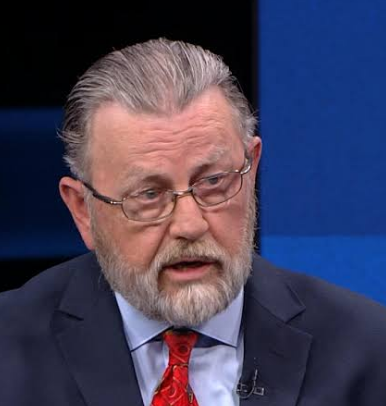
“Trump's lost control. He's not in a powerful position where he can dictate terms. He's in a completely reactive mode.”
Fifty governments, three European militaries and a rising strike count have been added to a blockade whose trackers show it holding and whose oil price shows it failing.
A 7 percent mortgage, Zelensky's winter and a diplomat's alarm
Daniel Davis tallied the bill the war is presenting at home. The 30-year mortgage rate "has now gone up to 7.03%",³⁴ the 10-year Treasury yield is "up over 5.179%",³⁵ and "gasoline now over $5 a gallon and diesel at an all-time high of $6.52 and going north."³⁶ His conclusion was that the question of who fires first no longer matters to the outcome: "It doesn't matter who actually starts the next round if the next round starts, we lose."³⁷
Alexander Mercouris reported that Vladimir Putin, speaking to reporters in St Petersburg, rejected Zelensky's appeals for a truce, at a moment when Zelensky says Ukraine needs $27 billion from Europe or its drone-production funds run out this winter.³⁸ Mercouris did not expect Moscow to relent: "Zelensky and the Ukrainians, as the Russians must see, are on the ropes. Why should the Russians let them get off?"³⁹
Ian Proud, a former British diplomat who served as Economic Counsellor in Moscow from 2014 to 2019, told Glenn Diesen that European leaders are trapped by their own narratives and that Britain has swapped diplomacy for espionage. "I do actually think the risk of war is at its highest that it's been really since the Cold War."⁴⁰ On where the enterprise ends: "This will be a bigger failure for Europe than Vietnam was for the United States."⁴¹
Sources
- Wall Street Journal, read by Nima Alkhorshid, Dialogue Works · Treasury met with more than 50 countries to sever aviation and banking ties with Tehran · watch ▶ 1:02
- Mohammad Marandi, Dialogue Works · Greek air defences in Saudi Arabia, French air defences signalled, British refuelling tankers · watch ▶ 29:40
- Nima Alkhorshid, Dialogue Works · Saudi strikes on Yemen rose from 14 or 16 to 27 · watch ▶ 26:40
- Nima Alkhorshid, Dialogue Works · Iranian flights to East Asia, Turkey, Russia and China not cancelled · watch ▶ 3:58
- Larry Johnson, Dialogue Works · "trying to isolate Iran with that flight ban and it's failing" · watch ▶ 4:52
- Larry Johnson, Dialogue Works · "Bessent's just been dead wrong, reflecting ignorance of the area" · watch ▶ 5:59
- Larry Johnson, Dialogue Works · "relationships with China and Russia supersede any sanctions" · watch ▶ 1:48
- Nima Alkhorshid, Dialogue Works · protests in Baghdad and Basra against the Arab embargo on Iran · watch ▶ 3:34
- Steve Hanke, Dialogue Works · "a lot of ad hoc policies... they don't really have a strategy" · watch ▶ 7:42
- Steve Hanke, Dialogue Works · "It's what I call ad-hocracy. It's data-dependent." · watch ▶ 17:04
- Steve Hanke, Dialogue Works · Kpler shows zero ships through Hormuz; private trackers show very few · watch ▶ 14:06
- Steve Hanke, Dialogue Works · "The oil price is staying up... I think it's going to go up higher" · watch ▶ 13:16
- Mark Sleboda, Dialogue Works · Brent just below $110; Russian grades $20 above the benchmark · watch ▶ 46:06
- Mark Sleboda, Dialogue Works · "another two or three months" in the strategic petroleum reserve · watch ▶ 28:48
- Mark Sleboda, Dialogue Works · Iranian media report US blockade vessels pulling back beyond the Gulf of Oman · watch ▶ 20:23
- Nima Alkhorshid, Dialogue Works · PGSA notice warning charterers off unapproved Hormuz routes · watch ▶ 35:25
- Nima Alkhorshid, Dialogue Works · Saudi Arabia wants further economic pressure on Iran after attacks on Gulf shipping and Red Sea exports · watch ▶ 17:58
- Mark Sleboda, Dialogue Works · British refuelling, French troops and air-defence units to Saudi Arabia · watch ▶ 3:04
- Mark Sleboda, Dialogue Works · Greece helping with air defence after talks with Israel and the US · watch ▶ 16:01
- Mohammad Marandi, Dialogue Works · explosions reported in Riyadh, Khamis Mushait and Abha · watch ▶ 29:21
- Larry Johnson, Dialogue Works · "Patriot system is basically toast. It's irrelevant." · watch ▶ 44:40
- Larry Johnson, Dialogue Works · "the Saudis paid an expensive price for some junk" · watch ▶ 45:26
- Mark Sleboda, Dialogue Works · Europeans going to war with Ansar Allah "are going to come to deeply regret that" · watch ▶ 8:38
- Mohammad Marandi, Dialogue Works · "Iran will survive no doubt but these countries it's not clear if they will survive" · watch ▶ 17:10
- Mohammad Marandi, Dialogue Works · about 25 American refuelling planes in Qatar · watch ▶ 9:31
- Mohammad Marandi, Dialogue Works · Qatar "just as complicit in this war of aggression" as the Saudis, Emiratis, Kuwaitis, Bahrainis and Jordan · watch ▶ 12:00
- Steve Hanke, Dialogue Works · the UAE business model "was working pretty well until the war started" · watch ▶ 21:17
- Mohammad Marandi, Dialogue Works · escalation "before midterm elections as things stand" · watch ▶ 17:43
- Mohammad Marandi, Dialogue Works · a strike on Iran's power plants would bring destruction across the Persian Gulf and global economic collapse · watch ▶ 34:50
- Mark Sleboda, Dialogue Works · "Iran will just destroy all of the Arabs' energy infrastructure" · watch ▶ 13:12
- Mark Sleboda, Dialogue Works · "this conflict is not over and it could carry on well into next year and beyond" · watch ▶ 19:48
- Steve Hanke, Dialogue Works · "they basically lost this war of choice that they started with the Israelis against Iran" · watch ▶ 2:50
- Larry Johnson, Dialogue Works · "Trump's lost control... He's in a completely reactive mode." · watch ▶ 54:09
- Daniel Davis, Daniel Davis / Deep Dive · 30-year mortgage rate at 7.03% · watch ▶ 6:23
- Daniel Davis, Daniel Davis / Deep Dive · 10-year Treasury yield over 5.179% · watch ▶ 7:09
- Daniel Davis, Daniel Davis / Deep Dive · gasoline over $5, diesel at an all-time high of $6.52 · watch ▶ 7:28
- Daniel Davis, Daniel Davis / Deep Dive · "It doesn't matter who actually starts the next round... we lose." · watch ▶ 9:25
- Alexander Mercouris, Alexander Mercouris · Putin rejects a truce; Zelensky says Ukraine needs $27 billion or drone funds run out this winter · watch ▶ 5:07
- Alexander Mercouris, Alexander Mercouris · "Why should the Russians let them get off?" · watch ▶ 35:14
- Ian Proud, Glenn Diesen · "the risk of war is at its highest that it's been really since the Cold War" · watch ▶ 26:16
- Ian Proud, Glenn Diesen · "a bigger failure for Europe than Vietnam was for the United States" · watch ▶ 23:18
By Ruins Report, a daily synthesis of what our tracked analysts said, not original reporting. Every numbered claim is sourced, dated, and timestamped above.
Newsletter
Get the Daily Debrief
One email each morning: what the analysts we track actually said, and every call timestamped to its source. Free.
Free. No spam. View on Substack →
Support the Report
Free to read, every day.
The Debrief is compiled each morning from what the analysts we track actually said, sourced and timestamped. No paywall, no ads, no investors. If it earns a place in your inbox, you can help keep it independent.
Support the report →