
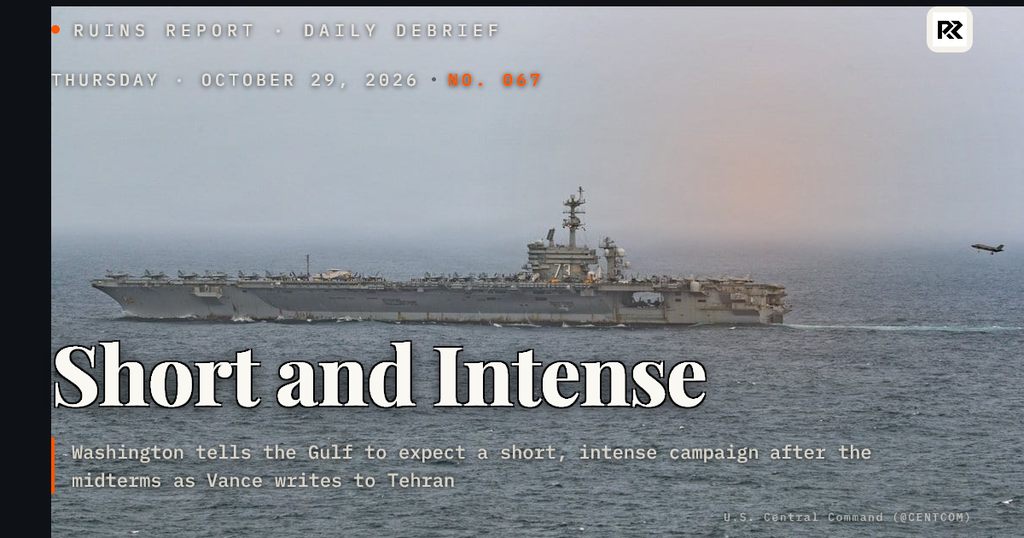
The Wall Street Journal reported on Wednesday 28 October that Washington has told the Gulf states to prepare for a "short, intense" campaign against Iran after the 3 November midterms, and that the American and Israeli militaries are preparing a wave of strikes meant to push Tehran back to the negotiating table.¹ Patriot batteries are moving from Texas to Israel,² and more are being pulled out of South Korea.³ The Wall Street Journal also reported the other half of the policy: JD Vance has written to Mohsen Rezaei, secretary of Iran's Supreme National Defense Council, on Trump's behalf, asking to restart talks.⁴ A threat of a short war and an offer to talk reached Tehran on the same day, three days after Saudi, Turkish and Pakistani chiefs spent four hours there on Monday and a day after an Israeli vote that left Netanyahu short of 61 seats. The analysts who took up the report did not much dispute that the strike is coming. Their argument was over the adjective.
Anthony Aguilar put the date first and the doubt nowhere. "I don't think it's a matter of if, I think it's a matter of when, the timing being coincidentally very close to November 4th after the US midterms,"⁵ and later put it more precisely: within "the next five to six days."⁶ Douglas Macgregor, asked whether another round is coming, answered in one breath: "I think it's obvious we're going to be involved in another exchange of missiles and explosions with our friends in Tehran."⁷ Patrick Cockburn, the most careful of the three, arrived at the same place by way of the evidence. "Israel isn't going to do this on its own, but all the noise out of Washington, all their maneuvers in the Gulf make it look more and more likely that there is going to be a third round of this war."⁸ What moves Trump, in his account, is not a plan but a person: "Somebody who's as mercurial as Trump under pressure from Netanyahu, the likelihood is that at some point he'll go for it, maybe quite soon."⁹
David Pyne, a former US Army officer and security strategist, read the letter as the truer signal. "It's not the Iranians that want to end the war, it's Trump."¹⁰ Trump never had a plan for this war and wants out of it, in Pyne's telling, because the arithmetic at home is against him: "The only reason that support is even at 32% for the war is because the casualties have been limited,"¹¹ and a president who keeps it going leaves office with approval in the twenties, as Herbert Hoover did.¹² Iran, meanwhile, "has anti-ship missile supremacy over the US in the Persian Gulf region."¹³ On this reading the threat and the letter are one message: Washington wants a settlement before the next round and is arming the round to get it, which is exactly what the Wall Street Journal said the strikes are for.
That is where the adjective comes in. A "short, intense" campaign assumes that Iran, after a burst of strikes, does what it has not done in nine months. Cockburn's objection was the plainest.

“The idea of a short burst after which the Iranians are going to capitulate is entirely against what we've seen in the last nine months since this war started.”
Iran, he said, is "the weaker side militarily, strategically it's stronger than it was," for its leverage over Hormuz and over the Gulf Arab states themselves,¹⁴ and oil, already high after the last round, goes higher with the next.¹⁵ Macgregor's objection is older than the war. "This is Persia, a civilizational state much like China or India or Russia."¹⁶ The United States and Israel can bomb such a state, he said; "what they cannot do is destroy Iran or Turkey or Russia or China or India. These are civilizational states."¹⁷ "Behind Tehran stands Beijing and along with Beijing stands Moscow."¹⁸ It is because a short air campaign cannot produce the result it promises that Macgregor keeps returning to the weapon that might. "I continue bringing up the potential use of a tactical nuclear weapon because there are voices advocating for this inside the Department of Defense and also the White House."¹⁹ His forecast for the round: "I think we're going to go in. I think we're going to bomb. I think we may well use a tactical nuclear weapon, or the Israelis will, or both."²⁰
Matt Hoh does not expect a short war because he does not think a short war is the plan. Plans A and B have failed, in his account, and "plan C is basically very similar to the 1991 to 2003 campaign by the Americans against Iraq,"²¹ a siege that took twelve years to produce an invasion. "I certainly believe this war goes on through Donald Trump's presidency."²² Aguilar, who had put the next round inside a week, agreed on the length: a year or more, "and far more than that."²³ The siege already has a price the Gulf is paying. "We just had the report the other day that 0% of fertilizer is getting out of the Persian Gulf."²⁴ John Mearsheimer, asked about Iran's threat to hit Gulf civilian infrastructure if its own is struck, answered the question the Wall Street Journal's sources had evidently asked themselves: "There's no question that if Iran is struck that it will retaliate in a significant way against the Gulf states and against Israel itself."²⁵ "Israel will be high up on the target list. So, Israel will be struck and badly hurt as a consequence."²⁶ A Gulf-wide war takes the world economy with it, "and if the international economy goes off a cliff, that has profound effects on Israel,"²⁷ which is why "it is not in Israel's interest to have a war that devastates all of the Gulf states."²⁸ The warning to the Gulf, in other words, concedes the retaliation it warns of. So does the force posture: the New York Times reported that American units are pulling back from the Gulf as far as Britain, with base closures and carriers moving out adding weeks to any operation.²⁹ Read beside the Wall Street Journal's adjective, the pullback suggests a campaign kept short because the force that would fight it is already moving beyond Iran's reach.
Why plan a war in days that no one who studies Iran expects to end in days? Cockburn's answer is the man in the clip. "Netanyahu started four wars and none of them have ended,"³⁰ and the pattern is not new: "Israel has always had difficulty turning its military strength into political success."³¹ Hoh's answer is the man who takes the calls: "Our explanation really has to come down to we are at the mercy of a mad president."³² Macgregor's is structural. "Israel strategically is America's unsinkable aircraft carrier,"³³ and the system that once justified the ships around it has gone: "We used to say that the petrodollar system depended upon our forward presence. Well, that petrodollar system is gone."³⁴ The Patriot batteries bound for Israel landed on an old wound for Aguilar: "Americans died because Israel lied to us about their own interceptors."³⁵ Cockburn thinks the cost will outlast the campaign. The war is "deeply unpopular in a way that practically no other American war at the beginning was unpopular,"³⁶ and he expects no future president of either party to fight beside Israel again, because "being allied to Israel brings you nothing but tears."³⁷ Hoh's horizon is longer still: "The American imperial order that has existed for the last 80 years is going away, and nations need to start acting now in order to fill out and flesh out this new coming order."³⁸ Of the five, only Aguilar supplied a date for the start. Nobody supplied one for the end.
Aden's airport hit twice, $82 billion more for Kiev, and a "stolen" vote in Jerusalem
Ansar Allah struck Aden International Airport twice with ballistic missiles on Wednesday 28 October, to stop Saudi resupply flights to the militias Riyadh backs in the south, Rachel Blevins and Laith Marouf reported.³⁹ Marouf's reading of Monday's traffic through Tehran, where Saudi, Turkish and Pakistani officials went to see Iran's leaders, is about who traveled to whom: "It wasn't Iran that was summoned to Riyadh, for instance. It was the other way around."⁴⁰
Zelensky says Ukraine needs $27 billion more for 2026 and $82 billion more for 2027, on top of the $52 billion a year already pledged, figures John Mearsheimer cited in conversation with Glenn Diesen.⁴¹ His account of what the money has bought is short: "We have incentivized the Russians to do as much damage as possible to Ukraine."⁴²
The day after the Israeli vote, Netanyahu posted that the election had been "stolen by Arab parties" through bribery, threats and forgeries, and demanded a Shin Bet and police investigation; Tucker Carlson read the post out on his show.⁴³ Jeffrey Sachs, his guest, gave his verdict on its author: "Netanyahu is one of the great disasters of modern history for Israel and for the whole world and for the United States."⁴⁴
Sources
- Wall Street Journal, as read on Tom Switzer · The US warned Gulf states of a possible short, intense renewal of the Iran war after the 3 November midterms; US and Israeli militaries show signs of preparing a wave of strikes to push Tehran to the negotiating table · watch ▶
- News reports, as read on Daniel Davis / Deep Dive · US moving Patriot missile defense systems from Texas to Israel ahead of a possible renewed strike on Iran after the midterms · watch ▶
- South Korean government, as read on Daniel Davis / Deep Dive · The US is removing more Patriot missiles and radars from Korea · watch ▶
- Wall Street Journal, as read on Mario Nawfal · Vice President Vance sent a letter to Iran's Mohsen Rezaei on Trump's behalf seeking to restart peace talks; the US is giving Israel another Patriot battery · watch ▶
- Anthony Aguilar, Danny Haiphong · "I don't think it's a matter of if, I think it's a matter of when, the timing being coincidentally very close to November 4th after the US midterms." · watch ▶ 3:05
- Anthony Aguilar, Danny Haiphong · "It's not a matter of if, it's a matter of when. And that when is coming within the next five to six days, I think." · watch ▶ 7:16
- Douglas Macgregor, Daniel Davis / Deep Dive · "I think it's obvious we're going to be involved in another exchange of missiles and explosions with our friends in Tehran." · watch ▶ 0:31
- Patrick Cockburn, Tom Switzer · "Israel isn't going to do this on its own, but all the noise out of Washington, all their maneuvers in the Gulf make it look more and more likely that there is going to be a third round of this war." · watch ▶ 0:01
- Patrick Cockburn, Tom Switzer · "Somebody who's as mercurial as Trump under pressure from Netanyahu, the likelihood is that at some point he'll go for it, maybe quite soon." · watch ▶ 11:54
- David Pyne, Mario Nawfal · "It's not the Iranians that want to end the war, it's Trump." · watch ▶ 34:54
- David Pyne, Mario Nawfal · "The only reason that support is even at 32% for the war is because the casualties have been limited." · watch ▶ 44:35
- David Pyne, Mario Nawfal · If Trump keeps the war going he leaves office with approval in the 20s, as Herbert Hoover did: "And that's what's going to happen to him if he keeps the war going." · watch ▶ 34:42
- David Pyne, Mario Nawfal · "Iran has anti-ship missile supremacy over the US in the Persian Gulf region." · watch ▶ 24:08
- Patrick Cockburn, Tom Switzer · "Iran is the weaker side militarily, strategically it's stronger than it was," through its leverage over Hormuz and the Gulf Arab states · watch ▶ 6:02
- Patrick Cockburn, Tom Switzer · The price of oil is already high after the last round; a new round "is going to push it higher." · watch ▶ 5:06
- Douglas Macgregor, Daniel Davis / Deep Dive · "This is Persia, a civilizational state much like China or India or Russia." · watch ▶ 10:51
- Douglas Macgregor, Daniel Davis / Deep Dive · "What they cannot do is destroy Iran or Turkey or Russia or China or India. These are civilizational states." · watch ▶ 15:26
- Douglas Macgregor, Daniel Davis / Deep Dive · "Behind Tehran stands Beijing and along with Beijing stands Moscow." · watch ▶ 7:23
- Douglas Macgregor, Daniel Davis / Deep Dive · "I continue bringing up the potential use of a tactical nuclear weapon because there are voices advocating for this inside the Department of Defense and also the White House." · watch ▶ 3:07
- Douglas Macgregor, Daniel Davis / Deep Dive · "I think we're going to go in. I think we're going to bomb. I think we may well use a tactical nuclear weapon, or the Israelis will, or both." · watch ▶ 57:10
- Matt Hoh, Danny Haiphong · Plans A and B failed; "I think plan C is basically very similar to the 1991 to 2003 campaign by the Americans against Iraq." · watch ▶ 0:55
- Matt Hoh, Danny Haiphong · "I certainly believe this war goes on through Donald Trump's presidency." · watch ▶ 30:23
- Anthony Aguilar, Danny Haiphong · The conflict can go on for a year or more: "I agree with that and far more than that." · watch ▶ 29:21
- Matt Hoh, Danny Haiphong · "We just had the report the other day that 0% of fertilizer is getting out of the Persian Gulf." · watch ▶ 56:36
- John Mearsheimer, John Mearsheimer · "There's no question that if Iran is struck that it will retaliate in a significant way against the Gulf states and against Israel itself." · watch ▶ 0:53
- John Mearsheimer, John Mearsheimer · "Israel will be high up on the target list. So, Israel will be struck and badly hurt as a consequence." · watch ▶ 7:49
- John Mearsheimer, John Mearsheimer · "If the international economy goes off a cliff, that has profound effects on Israel." · watch ▶ 7:01
- John Mearsheimer, John Mearsheimer · "It is not in Israel's interest to have a war that devastates all of the Gulf states." · watch ▶ 9:14
- New York Times, as read on Daniel Davis / Deep Dive · US forces pulling back from the Gulf to Britain, with base closures and carriers moving back adding weeks to operations · watch ▶
- Patrick Cockburn, Tom Switzer · "Netanyahu started four wars and none of them have ended." · watch ▶ 16:44
- Patrick Cockburn, Tom Switzer · "Israel has always had difficulty turning its military strength into political success." · watch ▶ 16:00
- Matt Hoh, Danny Haiphong · "Our explanation really has to come down to we are at the mercy of a mad president." · watch ▶ 22:32
- Douglas Macgregor, Daniel Davis / Deep Dive · "Israel strategically is America's unsinkable aircraft carrier." · watch ▶ 19:17
- Douglas Macgregor, Daniel Davis / Deep Dive · "We used to say that the petrodollar system depended upon our forward presence. Well, that petrodollar system is gone." · watch ▶ 25:37
- Anthony Aguilar, Danny Haiphong · "Americans died because Israel lied to us about their own interceptors." · watch ▶ 16:21
- Patrick Cockburn, Tom Switzer · The rupture is largely permanent because the war "is deeply unpopular in a way that practically no other American war at the beginning was unpopular." · watch ▶ 22:40
- Patrick Cockburn, Tom Switzer · "Being allied to Israel brings you nothing but tears." · watch ▶ 23:13
- Matt Hoh, Danny Haiphong · "The American imperial order that has existed for the last 80 years is going away and nations need to start acting now in order to fill out and flesh out this new coming order." · watch ▶ 32:12
- Rachel Blevins, Rachel Blevins · With Laith Marouf: Ansar Allah struck Aden International Airport twice with ballistic missiles on Wednesday 28 October to stop Saudi resupply flights to allied militias · watch ▶
- Laith Marouf, Rachel Blevins · "It wasn't Iran that was summoned to Riyadh, for instance. It was the other way around." · watch ▶ 20:23
- John Mearsheimer, Glenn Diesen · Zelensky says Ukraine needs $27 billion more for 2026 and $82 billion more for 2027 beyond the pledged $52 billion a year · watch ▶
- John Mearsheimer, Glenn Diesen · "We have incentivized the Russians to do as much damage as possible to Ukraine." · watch ▶ 43:31
- Tucker Carlson, Tucker Carlson · Reads Netanyahu's post that the election was "stolen by Arab parties" through bribery, threats and forgeries, with a demand for a Shin Bet and police investigation · watch ▶
- Jeffrey Sachs, Tucker Carlson · "Netanyahu is one of the great disasters of modern history for Israel and for the whole world and for the United States." · watch ▶ 38:25
By Ruins Report, a daily synthesis of what our tracked analysts said, not original reporting. Every numbered claim is sourced, dated, and timestamped above.
Newsletter
Get the Daily Debrief
One email each morning: what the analysts we track actually said, and every call timestamped to its source. Free.
Free. No spam. View on Substack →
Support the Report
Free to read, every day.
The Debrief is compiled each morning from what the analysts we track actually said, sourced and timestamped. No paywall, no ads, no investors. If it earns a place in your inbox, you can help keep it independent.
Support the report →