
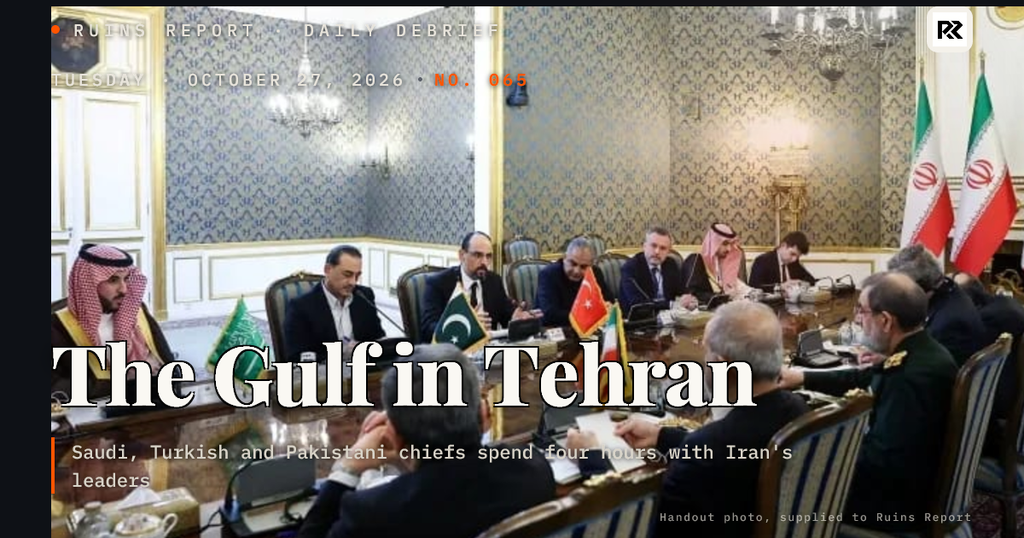
Khalid bin Salman, Saudi Arabia's defense minister, Turkey's intelligence chief and Pakistan's Field Marshal Asim Munir spent about four hours with Iran's leadership in Tehran on Monday 26 October and left without a joint statement. Yemen and the Israeli occupation were discussed; Qatari officials met the Iranians separately; the United Arab Emirates, Bahrain and Kuwait sent nobody.¹ The idea for the visit, according to Pepe Escobar's sources, came from Munir during his trip to Tehran a week earlier, the one that produced no deal.² On the same morning, Laith Marouf reported, Yemeni forces put three ballistic missiles into a gathering of Saudi military advisors and the militias they run.³ The footage of the arrivals had reached every show by evening, and what it showed was not in dispute. What the visitors had come for was.
The reading that came easiest was that the campaign to isolate Iran had failed, and that the proof had landed on Saudi and Pakistani aircraft. "If Iran's so isolated, why are the Saudis, the Turks, and the Pakistanis there meeting with them?" Larry Johnson asked.⁴ He traced the visit back to the Mecca accord, which in his telling blew up Western hopes the moment it was signed,⁵ and to the message Turkey and Pakistan have since delivered to Riyadh: "we ain't coming to bail you out."⁶ Danny Haiphong put it more simply. "All three of these states understand who the real regional power is right now and that is Iran,"⁷ a power that has already mapped a couple of hundred targets for the next round, some of them in Saudi Arabia.⁸ On that reading the visitors came to Tehran because the alternative was to wait at home for the missiles.
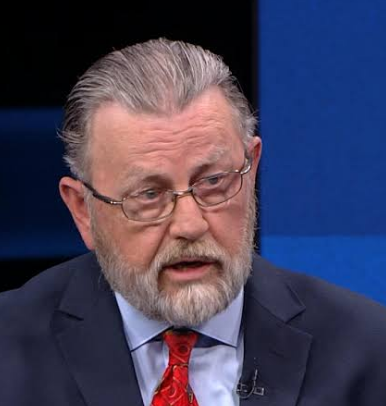
“If Iran's so isolated, why are the Saudis, the Turks, and the Pakistanis there meeting with them?”
Pepe Escobar took the same facts a step further. What the world watched on Monday, he said, was "the neo-Ottoman Turks, the Kingdom of Saudi Arabia and nuclear power Pakistan basically paying tribute to the Persians in Tehran."⁹ The tribute buys something specific. Iran's message to the monarchies, in his account, has not changed: "if we detect that any attack against us came from your territory or bases in your territory, you're going to pay a price."¹⁰ Yet Escobar did not call the visit a defection. "Saudi Arabia remains and will continue to remain a US vassal now under threat of being dismantled from within," he said.¹¹ A kingdom can pay tribute to one power while remaining the property of another; that is what tribute is for.
Laith Marouf drew the line all the way out. The flights from Qatar and Saudi Arabia that landed in Tehran, and the Pakistani delegation that followed its own government's closure of the border with Iran, were in his account delegations paying for protection and fronting for the United States, and Iran will take whatever they offer, make no deal with them, and wait for Washington to come to it.¹² He read the Saudi position off the deployments: "Bahrain is now policed by Pakistani forces because the Saudis had to withdraw to fight Yemen."¹³ "The US and its vassals are running out of options," he said; "the threats to Yemen on behalf of the Saudis came up with zero."¹⁴ On this reading the men in Tehran were not changing patrons. They were clients of a patron who cannot win, sent to find out the price of the power that can.
The disagreement is narrower than it sounds. Johnson and Haiphong see hedging, Escobar sees tribute, Marouf sees an errand, and all four read the table the same way: Iran at its head and the United States not in the room. The four hours in Tehran do not record a Gulf turning away from Washington so much as a Gulf that has learned Washington cannot protect it, and has begun paying, in visits and offers, the power that can.
Matthew Hoh supplied the reason the protection is no longer for sale. "I think President Trump has no idea what he wants to do," he said, and the trouble does not stop with Trump.¹⁵ Iran is, in his words, a "completely different country than Iraq was" in 2003, with missiles, drones, hardened underground sites and a hand on Hormuz,¹⁶ and even with "a thousand different landing craft" and open access through Pakistan, Iraq or Turkmenistan, he does not think the United States has "the people or the wherewithal to mount an invasion."¹⁷ The order the Gulf monarchies grew up inside, an American-dominated Middle East, has in his view ended: "That is gone and it's not coming back."¹⁸ A state that lacks the political, military, economic and ideological power to enforce its order will watch its clients hedge toward whatever alternative exists, and the Mecca accord is the alternative on offer.
Washington's own signals on Monday told those clients little. CNN, citing two US officials, reported that CENTCOM is ready to launch a new and larger strike on Iran within 96 hours of an order, with energy, nuclear and military sites on the target list;¹⁹ the New York Times reported talks on a phased deal, Iran reopening Hormuz against the United States lifting its naval blockade of Iranian ports, with mediators pushing a nuclear concession that Iran rejects;²⁰ and CNN reported that Netanyahu, refused by his own army chief, had pressed Washington for a strike before Tuesday's Israeli election and been turned down because of the American midterms.²¹ Johnson's view is that the strike talk is a pre-midterm game and that Washington does not want the combat;²² Escobar's is that the war comes regardless: "Everybody's expecting war after the midterms. They don't know how. They don't know exactly when," only that it is coming.²³ Between a strike that is always 96 hours away and a deal that is always one concession short, Iran does what Marouf said it would do, which is wait. The delegations in Tehran, whoever sent them, were the first to stop waiting and come.
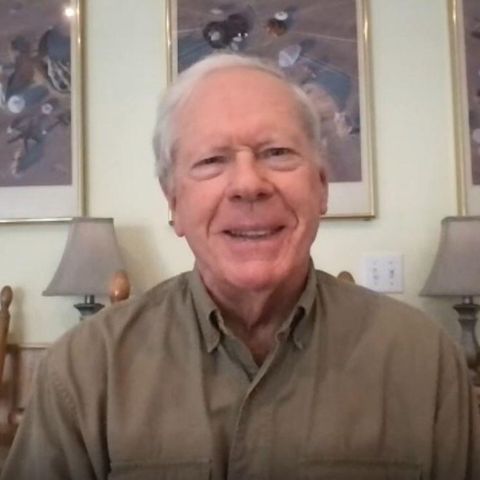
Ten million barrels off the market, and a House map that looks like 1920
Steve Jermy put a figure on the stalemate. Trump claims that oil flows through Hormuz are one to two million barrels a day above their pre-war level; Jermy's estimate is that actual flow is between 10 and 13 million barrels a day, which means "10 million barrels a day has been taken off the market," with Brent still above $100 against about $65 before the war.²⁴ Iran has not had to do anything more than hold the strait, and his verdict on the result was blunt: "the world economy is bleeding out and not much has been done about that."²⁵
Robert Barnes, citing White House internal polling, said the Republicans are behind in more than 240 House seats and could lose as many as 260, with Trump's approval in the low 30s. "It's starting to look like 1920," he said.²⁶ Elon Musk has put close to half a billion dollars into the final stretch in the hope that Trump exits the Ukraine war, and Peter Thiel has said publicly that the United States should never have entered the Iran war.²⁷
Sources
- Larry Johnson, Dialogue Works · Saudi, Turkish and Pakistani delegations in Tehran with no joint statement; Yemen and the Israeli occupation discussed; Qatari officials met Iran separately; UAE, Bahrain and Kuwait absent · watch ▶
- Pepe Escobar, Danny Haiphong · Khalid bin Salman, Turkey's intelligence chief and Asim Munir met Iranian leaders on Monday; per his sources the idea came from Munir during his visit last week · watch ▶
- Laith Marouf, Garland Nixon · Yemeni forces hit a gathering of Saudi military advisors and Yemen-based militias with three ballistic missiles on the morning of 26 October · watch ▶
- Larry Johnson, Dialogue Works · "If Iran's so isolated, why are the Saudis, the Turks, and the Pakistanis there meeting with them?" · watch ▶ 42:01
- Larry Johnson, Dialogue Works · "They blew up the western narrative or the western hopes when the Mecca agreement, the Mecca Accord, whatever you want to call it, was first signed." · watch ▶ 1:20
- Larry Johnson, Dialogue Works · "Turkey and Pakistan made it clear to Saudi Arabia, we ain't coming to bail you out." · watch ▶ 0:33
- Danny Haiphong, Rachel Blevins · "all three of these states understand who the real regional power is right now and that is Iran." · watch ▶ 4:50
- Danny Haiphong, Rachel Blevins · Iran has upwards of a couple of hundred targets already mapped out, some of them in Saudi Arabia · watch ▶ 5:42
- Pepe Escobar, Danny Haiphong · "the neo-Ottoman Turks, the Kingdom of Saudi Arabia and nuclear power Pakistan basically paying tribute to the Persians in Tehran." · watch ▶ 34:40
- Pepe Escobar, Danny Haiphong · Iran's message to the monarchies: "if we detect that any attack against us came from your territory or bases in your territory, you're going to pay a price." · watch ▶ 52:28
- Pepe Escobar, Danny Haiphong · "Saudi Arabia remains and will continue to remain a US vassal now under threat of being dismantled from within." · watch ▶ 40:44
- Laith Marouf, Garland Nixon · Flights from Qatar and Saudi Arabia landed in Tehran and Pakistan sent a delegation after closing its border with Iran; the delegations are paying for protection and fronting for the US, and Iran will take what they offer, make no deal with them, and wait for America · watch ▶
- Laith Marouf, Garland Nixon · "Bahrain is now policed by Pakistani forces because the Saudis had to withdraw to fight Yemen." · watch ▶ 37:13
- Laith Marouf, Garland Nixon · "the US and its vassals are running out of options; the threats to Yemen on behalf of the Saudis came up with zero." · watch ▶ 1:37
- Matthew Hoh, Daniel Davis / Deep Dive · "I think President Trump has no idea what he wants to do." · watch ▶ 2:44
- Matthew Hoh, Daniel Davis / Deep Dive · Iran is a "completely different country than Iraq was" in 2003, with missiles, drones, underground sites and Hormuz · watch ▶ 4:17
- Matthew Hoh, Daniel Davis / Deep Dive · Even with "a thousand different landing craft" and open access through Pakistan, Iraq or Turkmenistan, the US lacks "the people or the wherewithal to mount an invasion" · watch ▶ 43:20
- Matthew Hoh, Daniel Davis / Deep Dive · The American-dominated Middle East order: "That is gone and it's not coming back." · watch ▶ 7:46
- CNN, as read on Dialogue Works · Citing two US officials, CENTCOM is ready for a new, larger strike on Iran within 96 hours, with energy, nuclear and military sites on the target list · watch ▶
- New York Times, as read on Dialogue Works · US-Iran talks on a phased deal, Iran reopening Hormuz and the US lifting its naval blockade of Iranian ports; mediators pushing a nuclear concession Iran rejects · watch ▶
- CNN, as read on Rachel Blevins · Netanyahu pressed Washington for a strike before the 27 October Israeli election; the Trump administration refused because of its own midterms · watch ▶
- Larry Johnson, Dialogue Works · US strike talk is a pre-midterm game; Washington does not really want combat · watch ▶
- Pepe Escobar, Danny Haiphong · "Everybody's expecting war after the midterms. They don't know how. They don't know exactly when"; only that it is coming · watch ▶ 54:44
- Steve Jermy, Daniel Davis / Deep Dive · Actual Hormuz flow is 10 to 13 million barrels a day, so "10 million barrels a day has been taken off the market"; Brent above $100 against about $65 before the war, while Trump claims flows above pre-war levels · watch ▶ 3:29
- Steve Jermy, Daniel Davis / Deep Dive · "the world economy is bleeding out and not much has been done about that." · watch ▶ 19:30
- Robert Barnes, Judging Freedom · Citing White House internal polling, the GOP is behind in over 240 House seats and could lose 260, with Trump's approval in the low 30s: "It's starting to look like 1920." · watch ▶ 6:40
- Robert Barnes, Judging Freedom · Elon Musk has put close to half a billion into the final stretch hoping Trump exits the Ukraine war; Peter Thiel said publicly the US should never have entered the Iran war · watch ▶
By Ruins Report, a daily synthesis of what our tracked analysts said, not original reporting. Every numbered claim is sourced, dated, and timestamped above.
Newsletter
Get the Daily Debrief
One email each morning: what the analysts we track actually said, and every call timestamped to its source. Free.
Free. No spam. View on Substack →
Support the Report
Free to read, every day.
The Debrief is compiled each morning from what the analysts we track actually said, sourced and timestamped. No paywall, no ads, no investors. If it earns a place in your inbox, you can help keep it independent.
Support the report →