
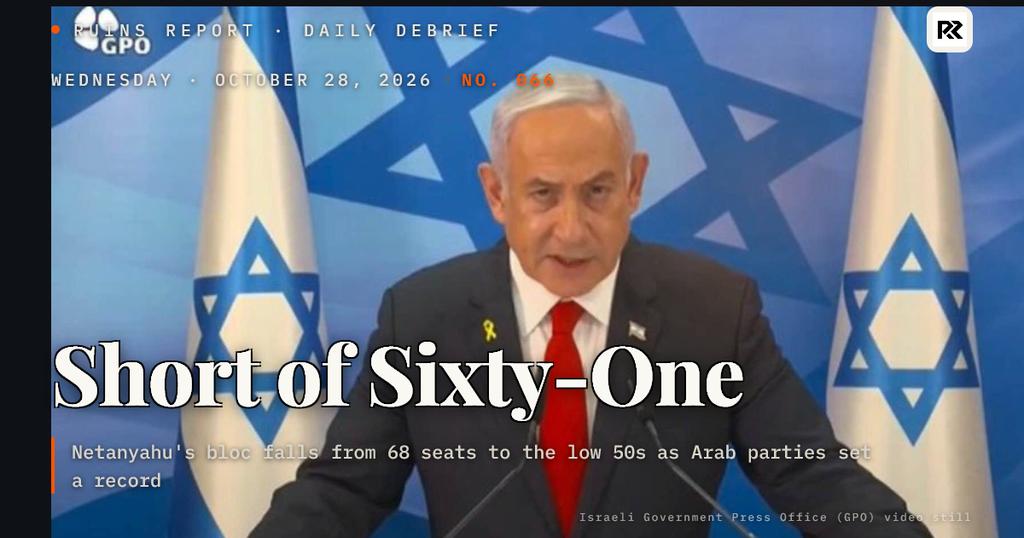
Israel voted on Tuesday 27 October, and by the time the exit polls had settled Benjamin Netanyahu's bloc stood in the low 50s in the 120-seat Knesset, down from the 68 seats it held and short of the 61 needed to govern.¹ The Arab parties took a record 18 seats, against a previous best of 15,² and Likud itself did better than expected, at the expense of Ben-Gvir, Smotrich and the ultra-Orthodox parties rather than of the opposition.³ Turnout was 77.7 percent, the highest since 2001, and Channel 12 and Channel 15 projected that Gadi Eisenkot, the former army chief, would receive the first mandate to form a government.⁴ Final results are about a week away. The question the analysts we track argued over on election night is one no count will settle: whether a bloc in the low 50s ends Netanyahu, or whether a parliament with no majority is the one result he knows how to use.
Larry Johnson took the result at face value. "If the current projections hold up, then Netanyahu will not be forming a government. And if Eisenkot does succeed in forming a government, then all of a sudden Netanyahu is likely to be back in front of a judge facing criminal charges," and could end up in prison.⁵ Asked whether a man in that position might do something desperate in his last days in office, he answered, "Yeah, I'd say yes. That's always possible."⁶ John Mearsheimer, asked the same question, counted two threats to Netanyahu beyond the loss of office: the corruption trial he has managed to prolong, where conviction now looks likely, and an inquiry he has spent three years preventing. "The successor government, assuming there is one, would probably create an independent commission to examine what happened on October 7th. And I believe if that happens, he will be held responsible in ways that will damage his reputation permanently."⁷
Shaiel Ben-Ephraim read the same numbers and reached the opposite conclusion. "Functionally we have a tie because of the racism in Israeli society."⁸ The parties that want Netanyahu gone have a large majority between them, he said, but not enough Jewish seats to govern without the Arab parties, "and you can't have the Arab parties in the coalition, especially not after October 7th."⁹ That leaves two blocs of roughly equal size and one man with the advantages of incumbency. "Netanyahu has the institutional levers of power in his hands and the experience that will allow him to manipulate and get this game going the way that he wants."¹⁰ The mechanics, as he laid them out, reward delay: Eisenkot gets a period to form a coalition and probably fails, Netanyahu gets a period and fails, and a new election follows no earlier than April, through all of which "Netanyahu will be the head of a caretaker government, which again can use security crises to manipulate and to deepen his hold on power."¹¹ "I think the odds are that he will do it successfully."¹²
Garland Nixon arrived at the same place by a shorter road. Weeks or months of argument over who won and who holds how many seats lie ahead, he said, "which means Netanyahu will still be in power."¹³ "I bet you they drag this thing out till spring," somewhere between six weeks and six months, "probably closer to six months."¹⁴ His verdict on the vote itself: "Nothing happened. They didn't get a new person so they could cast Netanyahu aside, blame everything on him. So it will be business as usual."¹⁵
“Netanyahu has the institutional levers of power in his hands and the experience that will allow him to manipulate and get this game going the way that he wants.”
Where the two readings part most sharply is Iran. Johnson's view is that the vote closed that file. "Restarting the war with Iran I don't think will be on the table anymore, because Netanyahu's attempt to make the case for it was based upon false intelligence,"¹⁶ a case that senior Mossad officers and the army chief who refused him a strike before the vote had already rejected. Eisenkot, a general the army respects, would inherit a force that Johnson described as overstretched, full of men who need rehabilitation for post-traumatic stress, and in no condition for another round.¹⁷ Mearsheimer gave the army the same credit: "The IDF, much to its credit, and it appears most of the security elite inside of Israel, said that this is unacceptable and pushed back really hard, and therefore there was no attack."¹⁸ Ben-Ephraim reads the refusal as a postponement, not a verdict. What Netanyahu had ordered, in his account, was an exact replica of the preparations for the last two attacks, staged so that Iran would see them and strike first; Eyal Zamir vetoed it.¹⁹ The election does not remove the motive. "Netanyahu has an incentive to escalate. Netanyahu has an incentive for Israel to be hurt and be hurt seriously,"²⁰ because a country under fire does not change its prime minister, and "there's going to be a war with Iran coming in a few days."²¹ Trump, in his reading, will not stand in the way: "Trump believes that an escalation is the only way forward," and Netanyahu will take that escalation and multiply it.²²
Esteban Carrillo had expected the strike before the Israeli vote and said so; it did not come, and he now thinks the reports that put it after the US midterms are the likelier ones, unless the diplomatic traffic through Tehran produces a settlement first.²³ On Gaza, the West Bank and Lebanon, nobody expected a new government to change anything but the signature. "I think there you'll have some tactical changes, there'll be some differences between the new leadership and what Netanyahu was doing, but at a more macro level there'll be no change at all. Israel remains committed to continuing the genocide, to expelling the Palestinians, to expanding its borders," Mearsheimer said.²⁴ Carrillo put it in fewer words: "It's changing the name of your butcher, right? Of the executioner, who's going to continue with the same policies."²⁵ Netanyahu, Eisenkot, Yair Golan and Naftali Bennett have all said publicly that equal rights for everyone under Israeli control cannot happen, he said, because they understand what it would mean: "The end of Israel will come at the hands of actual functioning representative democracy."²⁶
So the split is narrower than it looks. None of the five expects Eisenkot to end the war in Gaza or the expansion in the West Bank; the argument is over whether a prime minister in the low 50s can still start a war with Iran, and whether the officers who told him no in October will say it again to a caretaker. Johnson and Mearsheimer say the army has answered. Ben-Ephraim says it answered a candidate, and a caretaker has months to ask again; Nixon says only that the count drags on till spring with Netanyahu still in the chair. The date most of them put on it is next Tuesday, when the United States votes, and Johnson's one certainty concerned the man who endorsed Netanyahu: "He got one on Sunday courtesy of Lula's victory. He'll get another one here courtesy of Netanyahu's effective defeat."²⁷
A hole in Kiev's South Bridge, 4,100 Saudi flights grounded, and four points Kiev refused in advance
Around 20 ballistic missiles hit Kiev overnight into Tuesday, and one of them opened a hole in the rail deck of the South Bridge, the road-and-rail crossing over the Dnieper; Ukrainian authorities estimate at least a week before it can reopen.²⁸ Alexander Mercouris treats the strike as part of a campaign rather than a one-off: "It is now absolutely obvious that the Russians are now working to dismantle Ukraine's logistics, to break the Dnieper bridges, to render them inoperative."²⁹ A single missile does limited damage to a structure that strong, he said, but the damage is cumulative,³⁰ and he expects the next strikes to wait for the repair crews: "There will be more attacks on the south bridge over the next few weeks. Probably the Russians will wait to see how successful the Ukrainians are with their repairs."³¹
Of about 4,200 flights scheduled over Saudi Arabia on Monday, about 4,100 were canceled, a figure read to Chas Freeman on Judging Freedom.³² Asked what control Iran has over the Houthis, Freeman answered: "It has leverage. It doesn't have control."³³ The larger point, for him, is about Washington: "We have shown that we're not only unwilling, but unable to defend these countries despite their giving us bases,"³⁴ and the consequence is already in view. "We're seeing the Gulf, the Persian Gulf, beginning to declare its independence from the American tutelage it's been under."³⁵
Jeffrey Sachs brought a four-point plan to The Duran the day after Zelensky, by Sachs's account, rejected neutrality outright:³⁶ NATO stops enlarging, Ukraine returns to neutrality, Ukraine may join the European Union as a neutral member on the Irish or Austrian model, and an armistice line is drawn without legal recognition of the territory behind it.³⁷ His case rests on a date. "The war did not start in February 2022 as is often said. The war started in February 2014."³⁸
Sources
- Israeli exit polls, as read on Mario Nawfal · Netanyahu's coalition of 68 seats is down to the low 50s; Likud is the largest single party but short of a majority · watch ▶ 1:41
- Israeli exit polls, as read on Mario Nawfal · Arab parties at a record 18 seats; the previous record was 15 · watch ▶ 2:54
- Shaiel Ben-Ephraim, Mario Nawfal · Nothing surprising in the outcome except that Likud did better than expected, cannibalizing Ben-Gvir, Smotrich and the ultra-Orthodox parties without changing the bloc · watch ▶ 4:04
- Channel 12 and Channel 15, as read on Dialogue Works · Projections give Gadi Eisenkot the mandate to form the next government; final turnout 77.7 percent, the highest since 2001 · watch ▶ 5:32
- Larry Johnson, Dialogue Works · "If the current projections hold up, then Netanyahu will not be forming a government. And if Eisenkot does succeed in forming a government, then all of a sudden Netanyahu is likely to be back in front of a judge facing criminal charges and could well wind up in prison." · watch ▶ 4:46
- Larry Johnson, Dialogue Works · Would Netanyahu try something desperate in his last days in office? "Yeah, I'd say yes. That's always possible." · watch ▶ 5:19
- John Mearsheimer, Judging Freedom · "The successor government, assuming there is one, would probably create an independent commission to examine what happened on October 7th. And I believe if that happens, he will be held responsible in ways that will damage his reputation permanently." · watch ▶ 2:02
- Shaiel Ben-Ephraim, Mario Nawfal · "Functionally we have a tie because of the racism in Israeli society." · watch ▶ 3:09
- Shaiel Ben-Ephraim, Mario Nawfal · The anti-Netanyahu majority lacks the Jewish seats to govern alone, "and you can't have the Arab parties in the coalition, especially not after October 7th." · watch ▶ 3:29
- Shaiel Ben-Ephraim, Mario Nawfal · "Netanyahu has the institutional levers of power in his hands and the experience that will allow him to manipulate and get this game going the way that he wants." · watch ▶ 3:43
- Shaiel Ben-Ephraim, Mario Nawfal · If both Eisenkot and Netanyahu fail, a new election follows, and meanwhile "Netanyahu will be the head of a caretaker government, which again can use security crises to manipulate and to deepen his hold on power." · watch ▶ 5:36
- Shaiel Ben-Ephraim, Mario Nawfal · "I think the odds are that he will do it successfully." · watch ▶ 5:54
- Garland Nixon, Garland Nixon · Weeks or months of arguing over who won and who got how many seats, "which means Netanyahu will still be in power." · watch ▶ 13:13
- Garland Nixon, Garland Nixon · "I bet you they drag this thing out till spring," between six weeks and six months, "probably closer to six months." · watch ▶ 13:24
- Garland Nixon, Garland Nixon · "Nothing happened. They didn't get a new person so they could cast Netanyahu aside, blame everything on him. So it will be business as usual." · watch ▶ 22:38
- Larry Johnson, Dialogue Works · "Restarting the war with Iran I don't think will be on the table anymore, because Netanyahu's attempt to make the case for it was based upon false intelligence." · watch ▶ 11:46
- Larry Johnson, Dialogue Works · The Israeli army is in trouble, overstretched, with many soldiers needing rehabilitation for post-traumatic stress; Eisenkot, as a real general, will command more respect · watch ▶ 12:28
- John Mearsheimer, Judging Freedom · "The IDF, much to its credit, and it appears most of the security elite inside of Israel, said that this is unacceptable and pushed back really hard, and therefore there was no attack." · watch ▶ 5:02
- Shaiel Ben-Ephraim, Mario Nawfal · Netanyahu ordered the IDF to replicate the preparations of the last two attacks on Iran so that Iran would strike first; Chief of Staff Zamir vetoed it · watch ▶ 17:49
- Shaiel Ben-Ephraim, Mario Nawfal · "Netanyahu has an incentive to escalate. Netanyahu has an incentive for Israel to be hurt and be hurt seriously." · watch ▶ 25:01
- Shaiel Ben-Ephraim, Mario Nawfal · "There's going to be a war with Iran coming in a few days." · watch ▶ 5:00
- Shaiel Ben-Ephraim, Mario Nawfal · "Trump believes that an escalation is the only way forward"; Netanyahu will take that escalation and multiply it · watch ▶ 18:28
- Esteban Carrillo, Rachel Blevins · He had expected an attack on Iran before the Israeli election; now the reports of a strike after the US midterms seem "more likely," though the diplomatic movements could point to a settlement · watch ▶ 16:43
- John Mearsheimer, Judging Freedom · "I think there you'll have some tactical changes, there'll be some differences between the new leadership and what Netanyahu was doing, but at a more macro level there'll be no change at all. Israel remains committed to continuing the genocide, to expelling the Palestinians, to expanding its borders." · watch ▶ 3:29
- Esteban Carrillo, Rachel Blevins · "It's changing the name of your butcher, right? Of the executioner, who's going to continue with the same policies." · watch ▶ 8:08
- Esteban Carrillo, Rachel Blevins · "The end of Israel will come at the hands of actual functioning representative democracy." · watch ▶ 12:59
- Larry Johnson, Dialogue Works · On Trump: "He got one on Sunday courtesy of Lula's victory. He'll get another one here courtesy of Netanyahu's effective defeat." · watch ▶ 15:35
- Alexander Mercouris, Alexander Mercouris · Around 20 ballistic missiles hit Kiev overnight; the South Bridge road-and-rail crossing over the Dnieper was hit, with a hole in the rail line, and Ukrainian authorities estimate at least a week to repair it enough to reopen · watch ▶ 8:41
- Alexander Mercouris, Alexander Mercouris · "It is now absolutely obvious that the Russians are now working to dismantle Ukraine's logistics, to break the Dnieper bridges, to render them inoperative." · watch ▶ 15:10
- Alexander Mercouris, Alexander Mercouris · Individual strikes on so strong a structure do limited damage, "but the effect of the damage is cumulative." · watch ▶ 11:17
- Alexander Mercouris, Alexander Mercouris · "There will be more attacks on the south bridge over the next few weeks. Probably the Russians will wait to see how successful the Ukrainians are with their repairs." · watch ▶ 23:31
- Andrew Napolitano, Judging Freedom · Of 4,200 flights scheduled over Saudi Arabia the previous day, 4,100 were canceled, while a Saudi minister was in Tehran · watch ▶ 26:26
- Chas Freeman, Judging Freedom · On Iran and the Houthis: "It has leverage. It doesn't have control." · watch ▶ 26:48
- Chas Freeman, Judging Freedom · "We have shown that we're not only unwilling, but unable to defend these countries despite their giving us bases." · watch ▶ 25:03
- Chas Freeman, Judging Freedom · "We're seeing the Gulf, the Persian Gulf, beginning to declare its independence from the American tutelage it's been under." · watch ▶ 20:30
- Jeffrey Sachs, The Duran · Zelensky said the day before, "We reject neutrality." · watch ▶ 16:27
- Jeffrey Sachs, The Duran · "NATO must stop enlarging. Point number one. Point number two. Ukraine must return to neutrality."; then EU membership as a neutral state on the Irish or Austrian model, and an armistice line · watch ▶ 17:00
- Jeffrey Sachs, The Duran · "The war did not start in February 2022 as is often said. The war started in February 2014." · watch ▶ 4:13
By Ruins Report, a daily synthesis of what our tracked analysts said, not original reporting. Every numbered claim is sourced, dated, and timestamped above.
Newsletter
Get the Daily Debrief
One email each morning: what the analysts we track actually said, and every call timestamped to its source. Free.
Free. No spam. View on Substack →
Support the Report
Free to read, every day.
The Debrief is compiled each morning from what the analysts we track actually said, sourced and timestamped. No paywall, no ads, no investors. If it earns a place in your inbox, you can help keep it independent.
Support the report →