
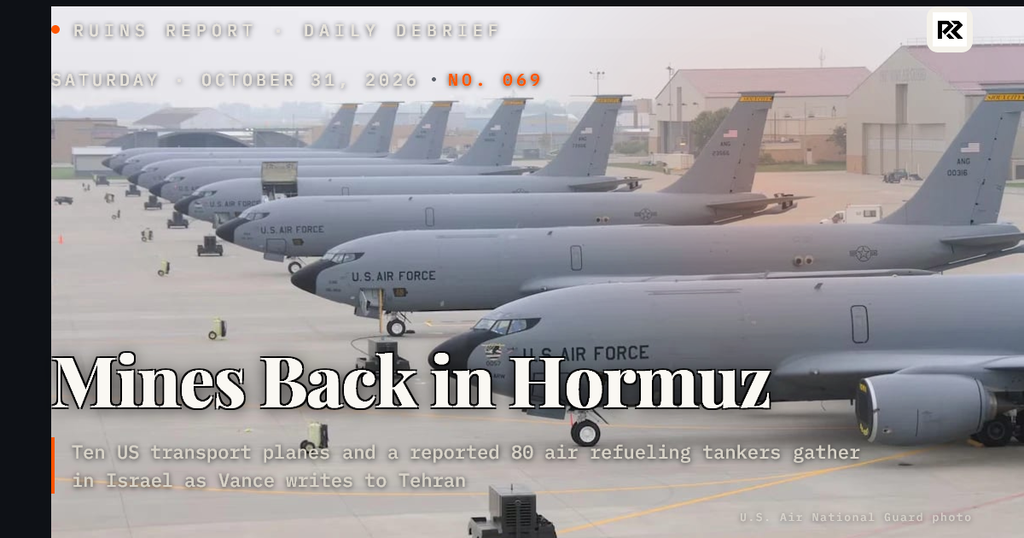
Israeli media reported on Friday 30 October that about ten US military transport aircraft had landed in southern Israel within 24 hours, flights that Daniel Davis traced to Fort Bliss, Texas, and read, without confirmation, as carrying interceptor missiles.¹ Nate of Canadian Prepper put the number of US refueling tankers now in Israel at about 80, many of them moved back from an air base in Qatar, without naming a source.² Trump, after meeting Pete Hegseth, Gen. Dan Caine and Adm. Brad Cooper at the White House on Thursday 29 October, said the Iran war would be "wrapped up soon, one way or the other."³ And the Financial Times reported that Iran is attaching limpet mines to tankers in the Strait of Hormuz, the first such attacks since 2019, with two supertankers reported on fire east and west of the strait, one day after CENTCOM had declared the strait open and its mines cleared.⁴
The "short, intense" campaign the Gulf was told to expect now has an airlift behind it. The question on Friday's shows was no longer whether the strike follows the midterms on Tuesday 3 November but how many days after, and what Iran does in reply. The mines suggest the second question is being answered before the first.
On timing, the analysts converged. Mohammad Marandi, speaking from Tehran, said that "the working assumption in Iran is that there will be war,"⁵ and gave his own estimate: "most probably immediately after the election, it could happen tonight, but immediately after the election, there will be a major assault and then Iran will retaliate," to be followed by a second American strike.⁶ Nate of Canadian Prepper reported, again without naming a source, that the Gulf states are being told the strikes begin on Wednesday 4 November,⁷ and read Tehran's position as fixed: "Iran is basically not giving an inch of ground."⁸ Larry Johnson said Trump is serious about an attack on Iran's nuclear sites, and that the distance Saudi Arabia, Pakistan and Turkey have put between themselves and Washington this week serves Iran's aim of pushing the United States out of the Gulf.⁹

“I think that the decision to attack Iran has been made and I expect it to happen at some point over the next few days.”
The diplomacy running alongside the airlift changed no one's estimate. The Washington Post reported that J.D. Vance had offered to meet Mohsen Rezaei, the secretary of Iran's Supreme National Security Council, and that Rezaei's reply set terms: lift the blockade, return the frozen assets, and talk under the memorandum of 18 June.¹⁰ Marandi's answer to Tom Barrack's claim that the outlines of a deal were agreed was one word, "No"; Iran will discuss its nuclear program only after the first phase of that memorandum is carried out.¹¹ Alexander Mercouris read the whole exchange as cover: "all of this is being done in order to put the Iranians in a false sense of complacency, thinking the negotiations are underway and something is going to come out of it when in fact the attack is being prepared."¹² Nor does he expect Tehran to buy its way out, since "any concessions they make to the Americans and to the Israelis will simply lead to more demands."¹³
On what Iran does when the strike comes, the analysts did not differ either. Marandi said "the Iranians have already chosen their targets": if Iran's infrastructure is attacked, infrastructure across the Persian Gulf and in Israel is hit in return.¹⁴
Scott Ritter called an American attack on Iranian energy a bet on economic collapse that Iran can answer against every energy facility in the Gulf, taking 23 to 25 percent of the world's energy production off the market and bringing on an immediate global crisis the US economy might not survive. "This is the deliberate destruction of the global economy by the president."¹⁵ Marandi put a date on it: "2 weeks from now, we will be living in a very different world. A world where the economies have collapsed and where the markets have collapsed and hopefully we won't get there."¹⁶ Nate of Canadian Prepper expects the fight to outlast the plan for it: "This upcoming offensive that they're going to do in Iran is going to be anything but short."¹⁷
The mines are the reason that reply is not hypothetical. Lawrence Wilkerson declined to call them an escalation: "Limpet mines are as old as war... I don't see it as a real escalation except that it adds to the variety of mines that they can use."¹⁸ Johnson measured what has changed in the water since the spring: "we controlled the Persian Gulf. And absolutely controlled the Strait of Hormuz. Now, we can't even go in there."¹⁹ By his count the Gulf is producing at best half the oil it did, whatever Trump says, and "there's nothing that can be done within the next year that's going to eliminate that shortage."²⁰ Bloomberg reported that Saudi Aramco had shut a 550,000-barrel-a-day crude distillation unit after Houthi attacks three days earlier.²¹ As for the island landings in the plan Sen. Murphy called insane, Johnson's objection was arithmetic: "Karg is the size of Iwo Jima... we don't have anywhere near any of those numbers of Marines."²² Wilkerson's was simpler. A ground operation "is going to be a disaster. Not for the Iranians. It's going to be a windfall for them. It's going to be a disaster for us."²³
The shared read, then, is that the airlift is not a deterrent, the letters are not an opening, and the strike they precede will be answered at the Gulf's refineries and in Israel's grid, as it is already being answered on the hulls of tankers.
Why go ahead with it? None of the analysts believed the stated purpose. Ritter: "we don't know where the 60% enriched uranium is. So we're just doing this for optics."²⁴ Marandi reported that Tehran's Friday prayer leader had called for a change in Iran's nuclear posture, with no pushback from the government, and that about 70 percent of Iranians now support building a weapon. "If Iran wants to develop a nuclear weapon, there's nothing that the American government can do about it."²⁵ Nate of Canadian Prepper drew the same line: a new attack pushes Iran toward a bomb rather than away from one.²⁶ Wilkerson went furthest. What Iran is doing, in his reading, is not surviving a war but ending an arrangement: "Iran just might do it. And that is put a check on the empire that is permanent."²⁷ That is the deeper cause the analysts reached by different roads. The strike is not a means to an outcome Washington can still reach. It is what a power does when it can still move the planes but no longer the result.
Washington hushes the Baltics, Europe's hybrid war file comes up empty, and French bonds pay for the Iran war
Reuters reported exclusively that Elbridge Colby, the Pentagon's policy chief, had told Lithuania, Latvia and Estonia to tone down their anti-Russia rhetoric; the Pentagon declined to comment.²⁸ Mercouris read it as a limit said out loud: "the United States really does not want to get into a battle, a war with the Russians in the Baltic."²⁹
Thomas Fazi, the journalist, took Europe's "hybrid war" file apart item by item: the Baltic cable damage traced to ships and judged likely accidental, the DHL crash to pilot error, a Dutch investigation of about 60 drone sightings that found planes, helicopters and stars, and Germany's attribution of the Leipzig incident with no evidence made public. His conclusion: "There's no evidence of a systematic Russian hybrid warfare being waged against Europe."³⁰
Alex Krainer tied the fall in French government bonds, and the spike in the cost of insuring French debt, to the protests and curfews in Paris, and then to Washington. Trump's pitch at Davos in January for an "American system," in his account, was sincere, and the Iran war destroyed it: "it seems to me that Trump wrecked the vehicle that he intended to drive into a different future."³¹
Sources
- Israeli media, as read on Deep Dive · About ten US military transport aircraft landed in southern Israel within 24 hours; Daniel Davis traced the flights to Fort Bliss, Texas, and inferred, without confirmation, that they carried interceptor missiles · watch ▶ 0:03
- Nate of Canadian Prepper, Canadian Prepper · About 80 US refueling tankers now in Israel, many moved back from an air base in Qatar; no source named · watch ▶ 11:17
- Donald Trump, as read on Deep Dive · After meeting Hegseth, Caine and Cooper at the White House, the Iran war will be "wrapped up soon, one way or the other" · watch ▶ 0:13
- Financial Times, as read on Dialogue Works · Iran is using limpet mines on tankers in the Strait of Hormuz, the first such reports since 2019; two supertankers reported on fire east and west of the strait; CENTCOM had said the day before that the strait was open and the mines removed · watch ▶ 0:27
- Mohammad Marandi, Deep Dive · "I personally think that the chances for the chance for war is very high and I think the belief the working assumption in Iran is that there will be war" · watch ▶ 0:48
- Mohammad Marandi, Deep Dive · "Most probably immediately after the election, it could happen tonight, but immediately after the election, there will be a major assault and then Iran will retaliate," then a second US strike · watch ▶ 58:19
- Nate of Canadian Prepper, Canadian Prepper · The Gulf states are being advised that US strikes on Iran start on 4 November; no source named · watch ▶ 0:24
- Nate of Canadian Prepper, Canadian Prepper · "Iran is basically not giving an inch of ground. So, it looks like, uh, very much there is going to be a major flare up in hostilities" · watch ▶ 14:50
- Larry Johnson, Judging Freedom · Trump is serious about a US attack on Iran's nuclear sites; the Gulf states, Pakistan and Turkey distancing themselves from Washington advances Iran's aim of ejecting the US from the Gulf · watch ▶
- Washington Post, as read on Dialogue Works · Vance offered to meet SNSC Secretary Mohsen Rezaei; Rezaei's reported reply demands lifting the blockade and returning frozen assets, with talks under the 18 June memorandum · watch ▶ 22:58
- Mohammad Marandi, Deep Dive · On Tom Barrack's claim that outlines were agreed: "No"; Iran discusses the nuclear program only after phase one of the memorandum is implemented · watch ▶ 17:36
- Alexander Mercouris, The Duran · "All of this is being done in order to put the Iranians in a false sense of complacency, thinking the negotiations are underway and something is going to come out of it when in fact the attack is being prepared" · watch ▶ 10:33
- Alexander Mercouris, Danny Haiphong · Iran will not make the concessions Vance and the Saudis want: "any concessions they make to the Americans and to the Israelis will simply lead to more demands" · watch ▶ 9:26
- Mohammad Marandi, Deep Dive · "The Iranians have already chosen their targets"; if Iran's infrastructure is attacked, Iran hits infrastructure across the Persian Gulf and in Israel · watch ▶ 1:57
- Scott Ritter, Judging Freedom · An attack on Iranian energy is a doomed bet on economic collapse; Iran retaliates against all Gulf energy, 23 to 25 percent of world production, bringing an immediate global crisis; "This is the deliberate destruction of the global economy by the president" · watch ▶ 12:53
- Mohammad Marandi, Deep Dive · "2 weeks from now, we will be living in a very different world. A world where the economies have collapsed and where the markets have collapsed and hopefully we won't get there" · watch ▶ 58:46
- Nate of Canadian Prepper, Canadian Prepper · "This upcoming offensive that they're going to do in Iran is going to be anything but short" · watch ▶ 24:11
- Lawrence Wilkerson, Dialogue Works · "Limpet mines are as old as war... I don't see it as a real escalation except that it adds to the variety of mines that they can use" · watch ▶ 2:24
- Larry Johnson, Dialogue Works · "We controlled the Persian Gulf. And absolutely controlled the Strait of Hormuz. Now, we can't even go in there" · watch ▶ 6:12
- Larry Johnson, Judging Freedom · Gulf oil output is at best 50 percent of what it was; "there's nothing that can be done within the next year that's going to eliminate that shortage" · watch ▶ 23:52
- Bloomberg, as read on Canadian Prepper · Saudi Aramco shut a main crude distillation unit of 550,000 barrels a day after Houthi attacks three days earlier · watch ▶ 18:45
- Larry Johnson, Dialogue Works · On seizing Kharg: "Karg is the size of Iwo Jima... we don't have anywhere near any of those numbers of Marines" · watch ▶ 13:00
- Lawrence Wilkerson, Dialogue Works · On a US ground operation: "It's going to be a disaster. Not for the Iranians. It's going to be a windfall for them. It's going to be a disaster for us" · watch ▶ 31:24
- Scott Ritter, Judging Freedom · "We don't know where the 60% enriched uranium is. So we're just doing this for optics" · watch ▶ 10:55
- Mohammad Marandi, Deep Dive · Tehran's Friday prayer leader called for a change in Iran's nuclear posture, with no government pushback; about 70 percent of Iranians support building a weapon; "If Iran wants to develop a nuclear weapon, there's nothing that the American government can do about it" · watch ▶ 30:13
- Nate of Canadian Prepper, Canadian Prepper · A new attack would push Iran to build a bomb; Iran gives no ground and a deal looks unlikely · watch ▶
- Lawrence Wilkerson, Dialogue Works · "Iran just might do it. And that is put a check on the empire that is permanent" · watch ▶ 67:42
- Reuters, as read on The Duran · Exclusive: Pentagon policy chief Elbridge Colby told Lithuania, Latvia and Estonia to tone down anti-Russia rhetoric; the Pentagon declined to comment · watch ▶ 6:34
- Alexander Mercouris, The Duran · "The United States really does not want to get into a battle, a war with the Russians in the Baltic" · watch ▶ 8:23
- Thomas Fazi, Neutrality Studies · Baltic cable damage by ships and likely accidental, the DHL crash pilot error, a Dutch review of about 60 drone sightings that found planes, helicopters and stars, Germany's Leipzig attribution without public evidence; "There's no evidence of a systematic Russian hybrid warfare being waged against Europe" · watch ▶ 29:44
- Alex Krainer, Glenn Diesen · French bonds falling and CDS on French debt spiking alongside the protests and curfews; Trump's January Davos pitch for the "American system" was sincere and the Iran war wrecked it: "it seems to me that Trump wrecked the vehicle that he intended to drive into a different future" · watch ▶ 24:53
By Ruins Report, a daily synthesis of what our tracked analysts said, not original reporting. Every numbered claim is sourced, dated, and timestamped above.
Newsletter
Get the Daily Debrief
One email each morning: what the analysts we track actually said, and every call timestamped to its source. Free.
Free. No spam. View on Substack →
Support the Report
Free to read, every day.
The Debrief is compiled each morning from what the analysts we track actually said, sourced and timestamped. No paywall, no ads, no investors. If it earns a place in your inbox, you can help keep it independent.
Support the report →