
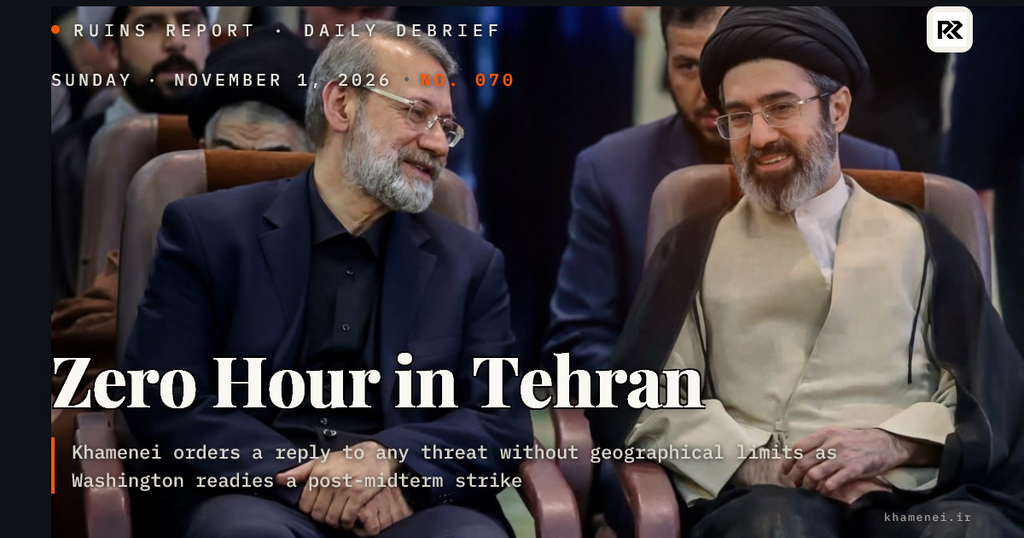
Mojtaba Khamenei met his senior commanders on Saturday 31 October, his first such meeting since the war began, and ordered, according to Iranian media, an immediate response to any threat "without geographical limitations," adding that Iran's armed forces and people, not Washington, will determine when any renewed war ends.¹ The target bank, the same reports said, now covers all enemy military and commercial assets.² The order followed a "zero hour" doctrine from the Khatam al-Anbiya central headquarters: strike first if preparations for a strike are seen, with infrastructure including undersea cables on the list; Trump telephoned Benjamin Netanyahu afterward.³ The preparations are not hard to see. Israel's Channel 14 reported more than 80 KC-135 refueling tankers on the ground in Israel,⁴ and MS NOW reported that Trump plans to resume strikes the day after the midterms, possibly as soon as Wednesday 4 November.⁵
Washington's plan, as reported, is for a short war that begins after Tuesday's vote, and the airlift into Israel reported on Friday is its visible preparation. Tehran has now published a plan of its own: a war with no front line, begun on warning rather than on impact, and ended on Iran's word. J.D. Vance's letter, carried to Tehran through Qatar, sits unanswered; Laith Marouf relayed the Iranian statement that the letter's contents will not be released and that there will be no public reply until after the American election.⁶ Two questions follow. Does Tehran's order change the arithmetic of the strike? And can the United States end a war it chooses to restart?
On whether the strike comes, nobody dissented; the differences were about the hour. Mohammad Marandi, speaking from Tehran, said "as things stand, we're going to war," and that it "may be before the midterms."⁷ Marouf read the same signs and thought it could come "in the next few hours, maybe over the weekend."⁸ Anthony Aguilar put it around 4 November: "I anticipate that Donald Trump is on the road to war, continuing this war, escalating again in a way that has not yet been seen,"⁹ with the corollary that "Iran is not going to sit by and just wait to take it."¹⁰ Mark Sleboda addressed the one event that might be expected to intervene. A Democratic win on Tuesday, he said, puts no short-term limit on the political will to attack Iran; it distracts Trump only after January.¹¹ "Democrats know that Israel wants this war to continue and wants the US to continue to take the lead in this war against Iran for them and they're not going to cross Israel openly."¹²


Khamenei's order speaks less to whether the strike happens than to the word "short." Daniel Davis gave the most precise estimate of what the United States can actually do: "a three to five day big splurge and then we're out," with Iran's missile cities untouched.¹³ He then asked the question he says nobody in Washington has, about what happens after a short, sharp strike: "if they do not sue for peace, if they do not surrender, what then?"¹⁴ Saturday's statement from Tehran is that question answered in advance. Marandi said Iran will not end this phase until it gets what it wants, and that "the Iranians are going to hammer the Americans and their regional proxies."¹⁵ On the island landings in the Pentagon's plan, he was blunter: "Okay, they capture an island. Iran will destroy everything on the other side of the Persian Gulf. The Strait of Hormuz will be irrelevant."¹⁶
The doctrine of striking first matters because of what it would strike into. Aguilar laid out the American preparations that the briefings about a short war leave out. "We have army corps currently operating on how to conduct tactical combat burial operations at scale," he said, exercises to "bury up to 2,400 US service members over a 24-hour period."¹⁷ The carriers have been kept out of the Persian Gulf itself "because we're afraid of the losses."¹⁸ Marouf read the same burial drills the same way: preparation for a war in which the dead cannot be flown out by helicopter.¹⁹ The Wall Street Journal put the standing cost of the Hormuz operation at 50,000 troops, 20 Navy ships, two carriers and about $2.3 billion a month.²⁰ Sleboda's verdict on the planning behind it was that "there is no US strategy... Everything is being done by the seat of his pants,"²¹ and yet the United States "cannot just walk away from this war leaving Iran in control of the strait of Hormuz that they did not have or at least did not exert before the war on Iran began."²² That is the position Khamenei's order presses on: a war too costly to continue and too costly to leave.
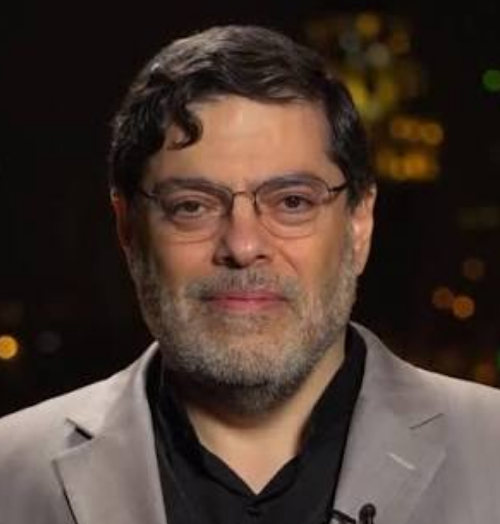
“This is not a war that Americans can win. There is no path to victory. All paths lead to defeat.”
So the order does not change the arithmetic of the strike, because the strike was never arithmetic; the five analysts agreed it is coming whatever Tehran says. What the order changes is the second question. A war Iran has pledged to open on warning, fight without geographical limit and end on its own terms cannot be closed with a three-day barrage, and none of them expected the barrage to be followed by a surrender.
Why, then, proceed? Davis's answer is that the United States is no longer choosing from a position that allows it to stop. "Because of our absurdity and our foolish actions, we have destroyed our economic power. We have destroyed our political and our diplomatic influence,"²³ and the bases that were supposed to project that power "have been nothing but points of strategic vulnerability."²⁴ Marandi described the other side of the same change: "Iran today is very different from Iran 3-4 months ago, and much different from 7-8 months ago. They're very confident."²⁵ The nuclear file, the stated object of the whole campaign, "is not up for discussion at all until US obligations are met. That's final."²⁶ Davis thinks the strike cannot reach that object either: "I think that it's already too late to stop Iran if they don't already have a nuclear weapon."²⁷ Fars reported that ten proposals to leave the Non-Proliferation Treaty have now been registered in Iran's parliament.²⁸ The strike, on this reading, is not a means to an outcome. It is what remains when the outcomes are gone, and Davis's summary of where it leads was unqualified: "There is no scenario where America doesn't get crushed on the back side of this."²⁹
Eleven ships sunk in a week in the Black Sea, while Sanaa closes on Taiz
Alexander Mercouris noted that Russia is now hitting Ukraine-bound cargo ships in the Black Sea, including in Romanian and Bulgarian waters, that the Russian Defense Ministry counts eleven sunk in the previous week, and that the Financial Times now rates the Black Sea above Hormuz as the most dangerous place for merchant shipping. Set against the attention paid to Hormuz, he finds "a relative silence about what is actually going on in the Black Sea."³⁰
Hussain Al-Bukhaiti, speaking from Sanaa, said Sanaa's forces have nearly taken Taiz city since the Saudi-Yemeni truce collapsed on 13 July and expects it to fall within one to two weeks.³¹ His warning to Riyadh went further than the front: "We could enter a new stage, a total destruction of Saudi oil infrastructure like carpet bombing of every Saudi Aramco company or facility."³²
Cenk Uygur, whose Rebellion PAC ran an ad on US money to Israel in Michigan's Democratic Senate primary for Abdul El-Sayed, said CNN's Dana Bash accused the ad of blaming Jews for high prices when it named Mike Rogers and Israeli officials. His measure of the race: "We spent $1,000. AIPAC has spent $39 million on this race. So $1,000 is beating nearly $40 million."³³ Mario Nawfal put El-Sayed's betting odds up from 72 to 80 percent over the week, and cited a CNN segment in which 54 percent of Michigan voters opposed more money for Israel.³⁴
Sources
- Iranian media, as read on Dialogue Works · Mojtaba Khamenei met senior commanders on 31 October for the first time since the attacks; ordered an immediate response to any threat "without geographical limitations" and said Iran's forces will determine when any renewed war ends · watch ▶
- Iranian media, as read on Deep Dive · Khamenei, unseen since the war began, said the armed forces and the nation will set the time and conditions of any renewed war's end; the target bank now covers all enemy military and commercial assets · watch ▶
- News reports, as read on Mario Nawfal · Trump called Netanyahu after Iran's Khatam al-Anbiya command released a zero-hour strategy to strike preemptively on seeing strike preparations, with undersea cables among the targets; parliament's Ebrahim Azizi promised a harsher response with zero limits and an open bank of targets outside the Persian Gulf · watch ▶
- Channel 14, as read on Danny Haiphong · More than 80 KC-135 refueling tankers on the ground in Israel, ready to support a strike on Iran · watch ▶
- MS NOW, as read on Danny Haiphong · Trump plans to resume strikes on Iran the day after the midterms, possibly as soon as 4 November, per Barak Ravid's sources · watch ▶
- Laith Marouf, Neutrality Studies · Iran received a letter on behalf of Vance via a Qatari messenger, will not release its contents, and "will not be responding to it publicly until after the elections in the United States" · watch ▶ 23:44
- Mohammad Marandi, Dialogue Works · "As things stand, we're going to war. As things stand, it could be not tonight. It may be before the midterms" · watch ▶ 35:38
- Laith Marouf, Neutrality Studies · "There's clear indications that maybe we will see war in the next few hours, maybe over the weekend," without waiting for the US elections · watch ▶ 24:55
- Anthony Aguilar, Mario Nawfal · "I anticipate that Donald Trump is on the road to war, continuing this war, escalating again in a way that has not yet been seen" · watch ▶ 7:14
- Anthony Aguilar, Mario Nawfal · Escalation is coming around 4 November, the day after the midterms, "and Iran is not going to sit by and just wait to take it" · watch ▶ 8:49
- Mark Sleboda, Danny Haiphong · A Democratic win next week puts no short-term limit on US political will to attack Iran; it distracts Trump only in the medium term, after January · watch ▶ 43:57
- Mark Sleboda, Danny Haiphong · "Democrats know that Israel wants this war to continue and wants the US to continue to take the lead in this war against Iran for them and they're not going to cross Israel openly" · watch ▶ 40:30
- Daniel Davis, Deep Dive · If Trump restarts the war, "the best we're going to do here is a three to five day big splurge and then we're out," with Iran's missile cities untouched · watch ▶ 55:44
- Daniel Davis, Deep Dive · "Nobody has asked what happens after a short sharp strike if they do not sue for peace, if they do not surrender, what then?" · watch ▶ 55:57
- Mohammad Marandi, Dialogue Works · Iran will not end this phase until it gets what it wants, "and the Iranians are going to hammer the Americans and their regional proxies" · watch ▶ 4:07
- Mohammad Marandi, Dialogue Works · "Okay, they capture an island. Iran will destroy everything on the other side of the Persian Gulf. The Strait of Hormuz will be irrelevant" · watch ▶ 43:03
- Anthony Aguilar, Mario Nawfal · "We have army corps currently operating on how to conduct tactical combat burial operations at scale... bury up to 2,400 US service members over a 24-hour period"; the 18th Airborne Corps exercise at Fort Bragg · watch ▶ 40:24
- Anthony Aguilar, Mario Nawfal · On the carriers: "The United States hasn't put those into the Persian Gulf because we're afraid of the losses" · watch ▶ 39:16
- Laith Marouf, Neutrality Studies · The mass-burial drills are preparation for a war "where the US military cannot extract this dead by helicopters and jets" · watch ▶ 31:34
- Wall Street Journal, as read on Danny Haiphong · The US Hormuz operation involves 50,000 troops, 20 Navy ships and two carriers at about $2.3 billion a month · watch ▶
- Mark Sleboda, Danny Haiphong · "There is no US strategy... Everything is being done by the seat of his pants" · watch ▶ 13:29
- Mark Sleboda, Danny Haiphong · "The US cannot just walk away from this war leaving Iran in control of the strait of Hormuz that they did not have or at least did not exert before the war on Iran began" · watch ▶ 29:12
- Daniel Davis, Deep Dive · "Because of our absurdity and our foolish actions, we have destroyed our economic power. We have destroyed our political and our diplomatic influence" · watch ▶ 53:09
- Daniel Davis, Deep Dive · US bases in the Middle East "have been nothing but points of strategic vulnerability" · watch ▶ 22:29
- Mohammad Marandi, Dialogue Works · "Iran today is very different from Iran 3-4 months ago, and much different from 7-8 months ago. They're very confident" · watch ▶ 22:00
- Mohammad Marandi, Dialogue Works · "The nuclear program is not up for discussion at all until US obligations are met. That's final" · watch ▶ 35:19
- Daniel Davis, Deep Dive · "I think that it's already too late to stop Iran if they don't already have a nuclear weapon" · watch ▶ 40:45
- Fars, as read on Deep Dive · MP Ebrahim Rezaei said ten proposals to withdraw from the NPT have been registered; lawmaker Nabavian called for leaving the treaty and Tehran's Friday prayer leader floated a change in nuclear posture · watch ▶
- Daniel Davis, Deep Dive · "There is no scenario where America doesn't get crushed on the back side of this" · watch ▶ 60:00
- Alexander Mercouris, Alexander Mercouris · Russia is hitting Ukraine-bound cargo ships in the Black Sea, including in Romanian and Bulgarian waters; the Russian Defense Ministry says eleven were sunk in the previous week; the Financial Times rates the Black Sea above Hormuz for danger to merchant shipping; "Compare the uproar about that with a relative silence about what is actually going on in the Black Sea" · watch ▶ 23:47
- Hussain Al-Bukhaiti, Dialogue Works · Taiz city will fall to Sanaa's forces "in the coming days or maybe one or two weeks," after the Saudi-Yemeni truce collapsed on 13 July · watch ▶ 8:03
- Hussain Al-Bukhaiti, Dialogue Works · "We could enter a new stage, a total destruction of Saudi oil infrastructure like carpet bombing of every Saudi Aramco company or facility" · watch ▶ 37:46
- Cenk Uygur, Mario Nawfal · His Rebellion PAC ad on US money to Israel ran for Abdul El-Sayed in Michigan; Dana Bash called it blaming Jews for high prices; "We spent $1,000. AIPAC has spent $39 million on this race. So $1,000 is beating nearly $40 million" · watch ▶ 14:20
- Mario Nawfal, Mario Nawfal · El-Sayed's betting odds rose from 72 to 80 percent over the week; a CNN segment found 54 percent of Michigan voters against more money for Israel · watch ▶
By Ruins Report, a daily synthesis of what our tracked analysts said, not original reporting. Every numbered claim is sourced, dated, and timestamped above.
Newsletter
Get the Daily Debrief
One email each morning: what the analysts we track actually said, and every call timestamped to its source. Free.
Free. No spam. View on Substack →
Support the Report
Free to read, every day.
The Debrief is compiled each morning from what the analysts we track actually said, sourced and timestamped. No paywall, no ads, no investors. If it earns a place in your inbox, you can help keep it independent.
Support the report →