
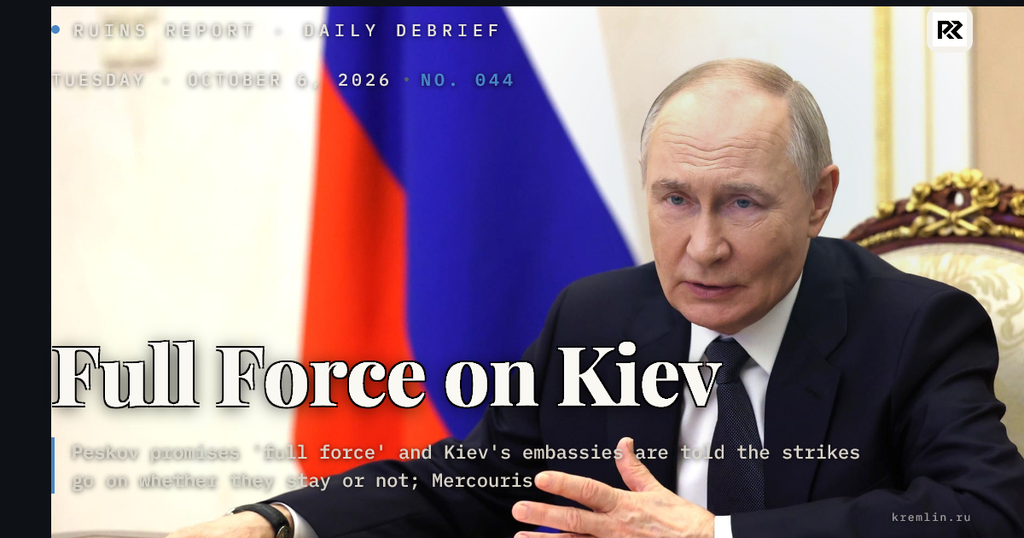
The foreign embassies in Kiev can stay or leave as they choose; Russian strikes on the city will continue either way. That was Dmitry Peskov's message to the diplomats, and it was one of three from Moscow. The Kremlin spokesman also said Russia will fight for every inch of the four oblasts it claims and will use "full force" to do it, and the Defence Ministry issued a statement blaming Volodymyr Zelensky personally for the course of the war, warning of escalation and telling Westerners not to travel to Kiev. Alexander Mercouris reported those two on The Duran on 5 October and called the ministry's statement rare.¹ The embassy message he relayed on his own channel the same day from a TASS report, in which Peskov cast the continuing strikes as retaliation for Ukrainian attacks on Russian economic facilities.² All three reached a capital where both of Kiev's road bridges over the Dnieper, closed by Russian strikes over the weekend were still shut.
Since February 2022 the Russian army has fought, in Mercouris's words, under "restrictions placed on the Russian military at the beginning of the SMO,"¹ and, in Stas Krapivnik's account, under a political decision the generals had to wait for the Kremlin to reverse. Have those limits now been withdrawn, and if so what does Moscow intend for Kiev itself? Mercouris, Krapivnik and Andrei Martyanov each gave an answer.
Mercouris's answer was direct. "Peskov said that Russia will use full force," he said on The Duran. "What it obviously means is that the restrictions placed on the Russian military at the beginning of the SMO are being lifted."¹ The bridges, in this reading, were the first thing the lifted restrictions touched; the government is next. "It is only a question of time before we also see attacks on the decision making centers as well," he said.³ On his own channel he relayed what US intelligence was reported to have told Kiev: that Russia had massed Iskander missiles and loaded its strategic bombers with cruise missiles for a massive strike expected within 48 hours, with surveillance drones already over central Ukraine and the capital.⁴ That is Washington's warning rather than his forecast; his own call was hedged: "We are probably going to see a major attack over the next few days or even hours."⁵ The embassies, he argued, no longer function as a restraint. "The Russians will not hold back from their attacks on Kiev simply because the embassies are there."²
Krapivnik, on Neutrality Studies, described the same decision from the Russian side, as a political order finally revoked: Putin, in his account, told the generals to "do what you need to do," and the military went after the bridges.⁶ The campaign against the crossings "is going to continue,"⁷ he said, and he placed it inside a larger Russian posture. By his estimate "about a third, maybe two-fifths of the Russian military is in Ukraine. The majority is still being prepared for war with Europe."⁸
Martyanov, on Daniel Davis's Deep Dive, was less interested in the political signal than in the arithmetic. Kiev's answer to the bridge strikes is pontoon crossings, and "pontoons are much easier targets than bridges. So good luck with that."⁹ Russia, he said, "will stop any kind of the movement through Kiev,"¹⁰ and is deliberately strangling the city while it dismantles Ukraine's military industry. Mercouris supplied the technical reason the strikes keep getting through. By a Ukrainian report he cited, the Geran-4 and Geran-5 jet drones that hit the bridges are now built around a Russian engine mass-produced in Tatarstan, and some fly autonomous terrain-following routes. Such systems, he said, "have definitely in my opinion crossed the boundary between drones and have become in effect small subsonic cruise missiles,"¹¹ against which Ukraine's gunners "have to rely mostly on luck."¹²
Here the three converge, and the convergence is the story. Russia's restraint since 2022 was a political choice, held in place from the Kremlin rather than imposed by the battlefield, and the Kremlin has now withdrawn it in public, in the three statements Mercouris reported on 5 October.
Where they part is on what the withdrawal is for. Krapivnik said it plainly: "Kiev's going to have to be taken."¹³ Martyanov drew the line at the river instead. "There will be no Ukraine up to the left bank of Dnieper,"¹⁴ he said, and the territory "up to Dnepropetrovsk, that's probably going to be under Russian control and it's going to be buffer zone,"¹⁵ which is a Russia that strangles the capital rather than storms it. Mercouris made no call on the city at all. His reading is that Russia will talk and concede nothing: Peskov, as he put it, "says, We are not going to stop. We want to achieve all our objectives,"¹⁶ and the trilateral meeting that Alex Christoforou, his co-host, said Zelensky had signalled for the end of October after speaking with Steve Witkoff and Jared Kushner¹⁷ serves Zelensky only if it yields a ceasefire, which Mercouris does not expect Russia to accept.¹⁶ That is a difference of destination, not of direction. None of the three thinks the limits come back.
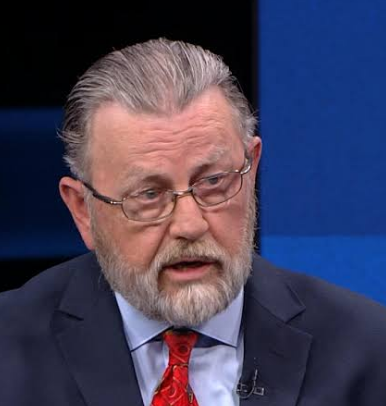


“Putin finally rolled the political decision back and told the generals, do what you need to do, and the military has gone after the bridges.”
Friedrich Merz's visit to Kiev on Sunday 4 October sits inside this picture rather than against it. By Mercouris's account the chancellor brought a further billion euros and promises of weapons, refused Zelensky's push for a faster EU accession, and so "came to Kiev apparently to all appearances empty-handed."²⁰ Christoforou had "no doubt that Russia green lit Merz's safe passage to Kiev because it does Merz a whole lot of damage,"²¹ and Mercouris agreed the trip hurts Merz at home, where he cited polls putting the AfD at 30 percent and the CDU at 18. "If Ukraine frays or breaks, then Merz himself politically is toast."²² The purpose of the visit, as Mercouris read it, was to keep Ukraine fighting and to keep Western diplomats from leaving, and he expects both efforts to fail. "Sooner or later, the Westerners are going to leave,"²³ he said, and in the meantime "the Russians are going to impose conditions on those visits."²⁴
Why now, after three and a half years? The answer these analysts give runs through Ukraine's own campaign and the state of the Western cupboard. Peskov framed the strikes as retaliation for attacks on Russian economic facilities, in Mercouris's account of the TASS report,² and in the same days, by Mercouris's account, Zelensky claimed to have destroyed 51 percent of Russia's refineries²⁰ while Martyanov reported 199 long-range drones and Flamingo missiles shot down on the approaches to Moscow in a single day.²⁵ In their reading the restraint that mattered was a calculation about the West's reaction, and neither Mercouris nor Martyanov thinks that reaction can now change the outcome. Ukraine's air defence, by Mercouris's account, is down to luck,¹² and Russia, by Martyanov's, "produces more tanks than whole NATO combined, and we're looking at orders of magnitude in missiles."²⁶ On that reading a limit kept to manage Western opinion is easier to drop once the West has little left to add. Whether the campaign ends at a buffer zone on the left bank or in the capital itself is the question Krapivnik and Martyanov leave open between them; that the limit is gone, none of the three doubts.
A helicopter off Yanbu, no option after the midterms and a one-in-twenty strait
Dave DeCamp, on Deep Dive, reported that the United States has resumed refuelling Saudi fighter jets for the first time in about eight years, as Riyadh's Operation Dawn of Yemen draws Houthi missiles onto Riyadh, Jeddah and the East-West pipeline, the Houthis close around Taiz, and a US Navy helicopter is reported down in the Red Sea near Yanbu, its cause not established. "The US has over 200 military advisers deployed there providing targeting data and intelligence and is now according to the latest reports refueling Saudi fighter jets," he said.²⁷ Robert Inlakesh, on Rachel Blevins's show, gave the Saudi-backed push along the Bab el-Mandeb coast short odds: "most likely they're going to be driven back."²⁸
John Mearsheimer, on his own channel, took up the third carrier and the roughly 10,000 additional troops reported heading for the Gulf, and Donald Trump's line that the Iran matter ends after the midterms. His verdict did not depend on the date. "We have no military option today and we're not going to have a military option after the midterm elections."²⁹
Sal Mercogliano, on What's Going on With Shipping?, read Bloomberg's account of a Philippine tanker captain who ran Hormuz with his lights and AIS off under US military watch, with at least six vessels reported hit since Sunday 4 October, and put a number on the gamble: "Shipping executives estimate about 1 in 20 chance of being hit while crossing Hormuz with the ships under the watch of the US military."³⁰
Sources
- Alexander Mercouris, The Duran · Peskov's "full force" and the Defence Ministry statement blaming Zelensky: "What it obviously means is that the restrictions placed on the Russian military at the beginning of the SMO are being lifted." · watch ▶ 8:46
- Alexander Mercouris, Alexander Mercouris · Peskov told the embassies in Kiev the decision to stay is theirs and strikes will continue regardless: "The Russians will not hold back from their attacks on Kiev simply because the embassies are there." · watch ▶ 20:44
- Alexander Mercouris, The Duran · "It is only a question of time before we also see attacks on the decision making centers as well." · watch ▶ 11:02
- Alexander Mercouris, Alexander Mercouris · US intelligence reportedly told Kiev that Iskanders are massed and strategic bombers loaded for a massive strike "likely to be used at some point over the next 48 hours." · watch ▶ 1:52
- Alexander Mercouris, Alexander Mercouris · "We are probably going to see a major attack over the next few days or even hours." · watch ▶ 51:04
- Stas Krapivnik, Neutrality Studies · "Putin finally rolled the political decision back and told the generals, do what you need to do, and the military has gone after the bridges." · watch ▶ 27:38
- Stas Krapivnik, Neutrality Studies · "They've gone after the bridges and this is going to continue." · watch ▶ 5:03
- Stas Krapivnik, Neutrality Studies · "About a third, maybe two-fifths of the Russian military is in Ukraine. The majority is still being prepared for war with Europe." · watch ▶ 12:44
- Andrei Martyanov, Daniel Davis / Deep Dive · "Pontoons are much easier targets than bridges. So good luck with that." · watch ▶ 1:38
- Andrei Martyanov, Daniel Davis / Deep Dive · "Russia will stop any kind of the movement through Kiev." · watch ▶ 5:13
- Alexander Mercouris, Alexander Mercouris · Geran-4 and Geran-5 jet drones with a Russian-built engine "have definitely in my opinion crossed the boundary between drones and have become in effect small subsonic cruise missiles." · watch ▶ 11:57
- Alexander Mercouris, Alexander Mercouris · "The Ukrainians in order to shoot them down have to rely mostly on luck." · watch ▶ 52:17
- Stas Krapivnik, Neutrality Studies · "Kiev's going to have to be taken." · watch ▶ 32:39
- Andrei Martyanov, Daniel Davis / Deep Dive · "There will be no Ukraine up to the left bank of Dnieper." · watch ▶ 20:28
- Andrei Martyanov, Daniel Davis / Deep Dive · "Up to Dnepropetrovsk, that's probably going to be under Russian control and it's going to be buffer zone." · watch ▶ 18:21
- Alexander Mercouris, The Duran · Russia will talk but concede nothing: "Peskov says, We are not going to stop. We want to achieve all our objectives." · watch ▶ 28:04
- Alex Christoforou, The Duran · Zelensky signalled a US-Russia-Ukraine trilateral meeting at the end of October after speaking with Witkoff and Kushner · watch ▶
- Larry Johnson, Neutrality Studies · Expects Russia to move on Sumy within the next month or so, then the capital: "I think Russia will take Kiev." · watch ▶ 15:24
- Iuliia Mendel, Daniel Davis / Deep Dive · "Russia can be bad on the battlefield, but Russia has never been bad in the war of attrition, because Russia is going to sacrifice as many people as many resources as needed to win this war." · watch ▶ 26:26
- Alexander Mercouris, Alexander Mercouris · Merz pledged a further billion euros and refused a faster EU accession, so "came to Kiev apparently to all appearances empty-handed"; Zelensky claimed to have destroyed 51% of Russian refineries · watch ▶
- Alex Christoforou, The Duran · "No doubt that Russia green lit Merz's safe passage to Kiev because it does Merz a whole lot of damage." · watch ▶ 14:40
- Alexander Mercouris, Alexander Mercouris · "If Ukraine frays or breaks, then Merz himself politically is toast." · watch ▶ 22:48
- Alexander Mercouris, The Duran · "Sooner or later, the Westerners are going to leave." · watch ▶ 23:03
- Alexander Mercouris, The Duran · "The Russians are going to impose conditions on those visits." · watch ▶ 21:33
- Andrei Martyanov, Daniel Davis / Deep Dive · Russia said to have shot down 199 long-range drones and Flamingo missiles on the approaches to Moscow in a day · watch ▶
- Andrei Martyanov, Daniel Davis / Deep Dive · "Russia produces more tanks than whole NATO combined, and we're looking at orders of magnitude in missiles." · watch ▶ 25:59
- Dave DeCamp, Daniel Davis / Deep Dive · "The US has over 200 military advisers deployed there providing targeting data and intelligence and is now according to the latest reports refueling Saudi fighter jets." · watch ▶ 6:55
- Robert Inlakesh, Rachel Blevins · On the Saudi-backed push along the Bab el-Mandeb coast: "most likely they're going to be driven back." · watch ▶ 6:15
- John Mearsheimer, John Mearsheimer · "We have no military option today and we're not going to have a military option after the midterm elections." · watch ▶ 0:17
- Sal Mercogliano, What's Going on With Shipping? · "Shipping executives estimate about 1 in 20 chance of being hit while crossing Hormuz with the ships under the watch of the US military." · watch ▶ 12:26
By Ruins Report, a daily synthesis of what our tracked analysts said, not original reporting. Every numbered claim is sourced, dated, and timestamped above.
Newsletter
Get the Daily Debrief
One email each morning: what the analysts we track actually said, and every call timestamped to its source. Free.
Free. No spam. View on Substack →
Support the Report
Free to read, every day.
The Debrief is compiled each morning from what the analysts we track actually said, sourced and timestamped. No paywall, no ads, no investors. If it earns a place in your inbox, you can help keep it independent.
Support the report →